

The DOI matches its Crossref record; 39 of the 39 references it cites were found in a registry or an index.
Benefits and challenges of EMR implementations in low resource settings: a state-of-the-art review
Open accessPublished version of a preprint
Abstract
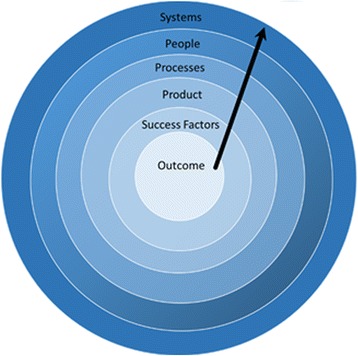
BACKGROUND: The intent of this review is to discover the types of inquiry and range of objectives and outcomes addressed in studies of the impacts of Electronic Medical Record (EMR) implementations in limited resource settings in sub-Saharan Africa. METHODS: A state-of-the-art review characterized relevant publications from bibliographic databases and grey literature repositories through systematic searching, concept-mapping, relevance and quality filter optimization, methods and outcomes categorization and key article analysis. RESULTS: From an initial population of 749 domain articles published before February 2015, 32 passed context and methods filters to merit full-text analysis. Relevant literature was classified by type (e.g., secondary, primary), design (e.g., case series, intervention), focus (e.g., processes, outcomes) and context (e.g., location, organization). A conceptual framework of EMR implementation determinants (systems, people, processes, products) was developed to represent current knowledge about the effects of EMRs in resource-constrained settings and to facilitate comparisons with studies in other contexts. DISCUSSION: This review provides an overall impression of the types and content of health informatics articles about EMR implementations in sub-Saharan Africa. Little is known about the unique effects of EMR efforts in slum settings. The available reports emphasize the complexity and impact of social considerations, outweighing product and system limitations. Summative guides and implementation toolkits were not found but could help EMR implementers. CONCLUSION: The future of EMR implementation in sub-Saharan Africa is promising. This review reveals various examples and gaps in understanding how EMR implementations unfold in resource-constrained settings; and opportunities for new inquiry about how to improve deployments in those contexts.
Overview
The claims and statistics of this paper haven’t been checked yet.
Run the check — free, no account needed. It reads the open-access text and checks the sources it cites.
Integrity signals
Registry
Cites
Statistics
Figures
Verification
Claims the paper makes
The claims and statistics of this paper haven’t been checked yet.
Run the check — free, no account needed. It reads the open-access text and checks the sources it cites.
Claims other papers make about this one
Each is checked against this paper’s own text: does it say what the citing paper says it does?
In the citing paper
“Many of the challenges faced by integrating electronic medical records in LMICs, for example, are likely to also impede AI applications, including limited funding, poor infrastructure for reliably delivering technologies, and discontinuous participation from users (12).”
From Artificial intelligence for global health (2019) · cites this paper as [12]
Self-check
Percentages, sums and reported differences re-computed from the paper’s own numbers.
The self-check needs the paper’s full text.
Citations
Cites
A typology of reviews: an analysis of 14 review types and associated methodologies
Grant, M. J., & Booth, A. (2009) · Health Information & Libraries Journal · doi:10.1111/j.1471-1842.2009.00848.x · Cited by 10,817
e-Health technologies show promise in developing countries
Blaya, J. A., Fraser, H. S. F., & Holt, B. (2010) · Health Affairs · doi:10.1377/hlthaff.2009.0894 · Cited by 581
Implementing electronic medical record systems in developing countries
Fraser, H., Biondich, P., Moodley, D., Choi, S. S., Mamlin, B. W., & Peter Szolovits, B. (2005) · Journal of Innovation in Health Informatics · doi:10.14236/jhi.v13i2.585 · Cited by 298
Williams, F., & Boren, S. A. (2008) · Journal of Innovation in Health Informatics · doi:10.14236/jhi.v16i2.685 · Cited by 204
(2006) · PubMed Central · Cited by 166
Rotich, J. (2003) · Journal of the American Medical Informatics Association · doi:10.1197/jamia.m1301 · Cited by 155
Use of Electronic Health Records in sub-Saharan Africa: Progress and challenges.
Akanbi, M. O., Ocheke, A. N., Agaba, P. A., Daniyam, C. A., Agaba, E. I., Okeke, E. N., & Ukoli, C. O. (2012) · PubMed · Cited by 134
Fritz, F., Tilahun, B., & Dugas, M. (2015) · Journal of the American Medical Informatics Association · doi:10.1093/jamia/ocu038 · Cited by 131 · cited 3×
“Since completing the literature review, two new contributions have appeared [35, 36].”
BackgroundTierney, W. M., Rotich, J., Hannan, T., Siika, A. M., Biondich, P., Mamlin, B. W., Nyandiko, W. M., Kimaiyo, S. N., Wools‐Kaloustian, K., Sidle, J. E., et al. (2007) · PubMed · Cited by 109
Kamadjeu, R. M., Tapang, E. M., & Moluh, R. N. (2005) · Journal of Innovation in Health Informatics · doi:10.14236/jhi.v13i3.595 · Cited by 92
Research works printed but not linked: 1
- Talisuna S. Electronic medical records and same-day patient tracing improves clinic efficiency and adherence to appointments in a community-based HIV/AIDS care program in Uganda [abstract]. 7th International Conference on HIV Treatment and Prevention Adherence, 2012. Accessed 7 Jan 2015.
Cited by
Sorted by citations
Artificial intelligence for global health
Hosny, A., & Aerts, H. J. W. L. (2019) · Science · doi:10.1126/science.aay5189 · Cited by 177
Yang, Z., Xu, X., Yao, B., Rogers, E., Zhang, S., Intille, S., Shara, N., Gao, G. G., & Wang, D. (2024) · Proceedings of the ACM on Interactive, Mobile, Wearable and Ubiquitous Technologies · doi:10.1145/3659625 · Cited by 120
Open-Source Electronic Health Record Systems for Low-Resource Settings: Systematic Review
Syzdykova, A., Malta, A., Zolfo, M., Diro, E., & Oliveira, J. L. (2017) · JMIR Medical Informatics · doi:10.2196/medinform.8131 · Cited by 95
Artificial Intelligence in Global Health —A Framework and Strategy for Adoption and Sustainability
Hadley, T. D., Pettit, R. W., Malik, T., Khoei, A. A., & Salihu, H. M. (2020) · International Journal of Maternal and Child Health and AIDS · doi:10.21106/ijma.296 · Cited by 75
The impact of routine data quality assessments on electronic medical record data quality in Kenya
Muthee, V., Bochner, A. F., Osterman, A., Liku, N., Akhwale, W., Kwach, J., Prachi, M., Wamicwe, J., Odhiambo, J., Onyango, F., et al. (2018) · PLOS ONE · doi:10.1371/journal.pone.0195362 · Cited by 64
Metadata
- Authors
- Jawhari, B., Ludwick, D., Keenan, L., Zakus, D., & Hayward, R.
- Affiliations
- University of Alberta (CA)
- Toronto Metropolitan University (CA)
- Corresponding author
- Jawhari, Badeia
- Venue
- BMC Medical Informatics and Decision Making
- Published
- 2016-09-06
- Volume
- 16
- Issue
- 1
- Pages
- 116-116
- ISSN
- 1472-6947 (ISSN-L)
- PMC
- PMC5011989
- OpenAlex
- W2510765898
- Cited by
- 106
- References
- 39
- Citations by year
- 2026: 5 · 2025: 15 · 2024: 19 · 2023: 11 · 2022: 13 · 2021: 13 · 2020: 6 · 2019: 10 · 2018: 8 · 2017: 6
- FWCI
- 1.61
- Type
- journal article
- Language
- en
- Open access
- gold
- doi.org
- Licence
- Locations
- BMC Medical Informatics and Decision Making (publishedVersion, cc-by)
- PubMed Central (publishedVersion, cc-by)
- PubMed (publishedVersion)
- Funders
- Mitacs
- Innovative Canadians for Change
- Topics
- Health Sciences › Health Professions › Health Information Management › Electronic Health Records Systems
- Health Sciences › Health Professions › Health Information Management › Medical Coding and Health Information
- Physical Sciences › Computer Science › Information Systems › ICT in Developing Communities
- Keywords
- electronic health records, EMR implementation, resource-limited settings, sub-Saharan Africa, health informatics, implementation factors, conceptual framework, implementation toolkit, resource-constrained healthcare
- MeSH terms
- Humans, Africa South of the Sahara, Electronic Health Records
About these checks
Registry, retraction, Cites and statistics results are computed, not judged, with one exception: a printed reference that no index lists is read once by a model before it counts as a citation error. Claims are extracted by a model and kept only when their quote appears verbatim in the text; each cited source is then checked, with a model’s help, for whether it says what the claim relies on. Those verdicts can be wrong — read the claim’s quote and the cited source before relying on one.
Statistics and arithmetic are recomputed, not judged.
Confidence bands are shown only for fields calibrated on our annotated test set. None is calibrated yet, so no band is shown.
What counts as a claim ›How we measure confidence ›How we check this ›
Are you an author, or do you see a problem with this page? Request a review
