

Combining EEG signal processing with supervised methods for Alzheimer’s patients classification
Open accessThe DOI matches its Crossref record; 75 of the 76 references it cites were found in a registry or an index.
Abstract
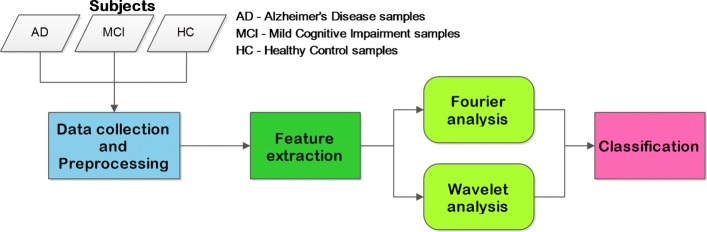
BACKGROUND: Alzheimer's Disease (AD) is a neurodegenaritive disorder characterized by a progressive dementia, for which actually no cure is known. An early detection of patients affected by AD can be obtained by analyzing their electroencephalography (EEG) signals, which show a reduction of the complexity, a perturbation of the synchrony, and a slowing down of the rhythms. METHODS: In this work, we apply a procedure that exploits feature extraction and classification techniques to EEG signals, whose aim is to distinguish patient affected by AD from the ones affected by Mild Cognitive Impairment (MCI) and healthy control (HC) samples. Specifically, we perform a time-frequency analysis by applying both the Fourier and Wavelet Transforms on 109 samples belonging to AD, MCI, and HC classes. The classification procedure is designed with the following steps: (i) preprocessing of EEG signals; (ii) feature extraction by means of the Discrete Fourier and Wavelet Transforms; and (iii) classification with tree-based supervised methods. RESULTS: By applying our procedure, we are able to extract reliable human-interpretable classification models that allow to automatically assign the patients into their belonging class. In particular, by exploiting a Wavelet feature extraction we achieve 83%, 92%, and 79% of accuracy when dealing with HC vs AD, HC vs MCI, and MCI vs AD classification problems, respectively. CONCLUSIONS: Finally, by comparing the classification performances with both feature extraction methods, we find out that Wavelets analysis outperforms Fourier. Hence, we suggest it in combination with supervised methods for automatic patients classification based on their EEG signals for aiding the medical diagnosis of dementia.
Overview
The claims and statistics of this paper haven’t been checked yet.
Free: it reads the open-access text and checks the first 5 claims that cite a source we can check. Create a free account to check every claim.
Integrity signals
Registry
Cites
Statistics
Figures
Verification
Claims the paper makes
The claims and statistics of this paper haven’t been checked yet.
Free: it reads the open-access text and checks the first 5 claims that cite a source we can check. Create a free account to check every claim.
Claims other papers make about this one
Each is checked against this paper’s own text: does it say what the citing paper says it does?
The source backs part of the claim, not all of it — or backs it for a different population, condition or comparison.
In the citing paper
“The use of frequency-domain metrics such as frequency band energy is a widely used method of feature extraction for AD signals classification [30,45]”
From Alzheimer's Disease and Frontotemporal Dementia: A Robust Classification Method of EEG Signals and a Comparison of Validation Methods (2021) · cites this paper as [30]
Experimental — accuracy not yet measuredThe cited source says what the claim attributes to it.
In the citing paper
“Both decision trees [30] and random forests [41] implementations are used in the classification of EEG signals for the diagnosis of AD and other dementia types.”
From Alzheimer's Disease and Frontotemporal Dementia: A Robust Classification Method of EEG Signals and a Comparison of Validation Methods (2021) · cites this paper as [30]
Self-check
Percentages, sums and reported differences re-computed from the paper’s own numbers.
The self-check needs the paper’s full text.
Citations
Cites
Neural networks for pattern recognition
(1994) · Choice Reviews Online · doi:10.5860/choice.31-5500 · Cited by 18,538 · cited 1×
“We also test other classification methods, such as function-based, rule-based, naive-based, and Bayesian-based (e.g., RIPPER [54], SVM [55], the MultiLayer Perceptron [56]), whose performances are not satisfying and hence are not reported.”
MethodThe WEKA data mining software: an update
Hall, M., Frank, E., Holmes, G., Pfahringer, B., Reutemann, P., & Witten, I. H. (2009) · ACM SIGKDD Explorations Newsletter · doi:10.1145/1656274.1656278 · Cited by 17,750
Daubechies, I. (1992) · doi:10.1137/1.9781611970104 · Cited by 15,979
An Introduction to Support Vector Machines and Other Kernel-based Learning Methods
Cristianini, N., & Shawe-Taylor, J. (2000) · doi:10.1017/cbo9780511801389 · Cited by 13,855 · cited 1×
“We also test other classification methods, such as function-based, rule-based, naive-based, and Bayesian-based (e.g., RIPPER [54], SVM [55], the MultiLayer Perceptron [56]), whose performances are not satisfying and hence are not reported.”
MethodNeural Networks for Pattern Recognition
Bishop, C. M. (1995) · doi:10.1093/oso/9780198538493.001.0001 · Cited by 12,287
(2008) · Data Mining and Market Intelligence for Optimal Marketing Returns · doi:10.4324/9780080878096-12 · Cited by 6,954
The ten-twenty electrode system of the international federation
Jasper, H. H. (1958) · Electroencephalography and Clinical Neurophysiology · Cited by 6,567
An Introduction to Data Mining
Stephens, C. R., & Sukumar, R. (2006) · The Handbook of Marketing Research · doi:10.4135/9781412973380.n22 · Cited by 4,562
Cohen, W. W. (1995) · Machine Learning Proceedings 1995 · doi:10.1016/b978-1-55860-377-6.50023-2 · Cited by 3,787 · cited 1×
“We also test other classification methods, such as function-based, rule-based, naive-based, and Bayesian-based (e.g., RIPPER [54], SVM [55], the MultiLayer Perceptron [56]), whose performances are not satisfying and hence are not reported.”
MethodKlem, G. H., Lüders, H. O., Jasper, H. H., & Elger, C. E. (1999) · PubMed · Cited by 2,361
Research works printed but not linked: 4
- DeKosky ST Marek K Looking backward to move forward: early detection of neurodegenerative disorders Science 2003 302 5646 830 4 10.1126/science.1090349 14593169 · DOI · Paper page
- Jackson CE Snyder PJ Electroencephalography and event-related potentials as biomarkers of mild cognitive impairment and mild alzheimer’s disease Alzheimer’s and Dementia 2008 4 1 137 43 10.1016/j.jalz.2007.10.008 18631990 · DOI · Paper page
- Hampel H Lista S Teipel SJ Garaci F Nisticò R Blennow K Zetterberg H Bertram L Duyckaerts C Bakardjian H Perspective on future role of biological markers in clinical therapy trials of alzheimer’s disease: a long-range point of view beyond 2020 Biochem Pharmacol 2014 88 4 426 49 10.1016/j.bcp.2013.11.009 24275164 · DOI
- Jeong J Eeg dynamics in patients with alzheimer’s disease Clin Neurophysiol 2004 115 7 1490 505 10.1016/j.clinph.2004.01.001 15203050 · DOI · Paper page
Cited by
Ieracitano, C., Mammone, N., Hussain, A., & Morabito, F. C. (2020) · Neural Networks · doi:10.1016/j.neunet.2019.12.006 · Cited by 329
Neural Decoding of EEG Signals with Machine Learning: A Systematic Review
Saeidi, M., Karwowski, W., Farahani, F. V., Fiok, K., Taiar, R., Hancock, P. A., & Al-Juaid, A. (2021) · Brain Sciences · doi:10.3390/brainsci11111525 · Cited by 258
“Among different conventional classification algorithms including supervised learning and unsupervised learning, supervised algorithms are the most well-known methods used in EEG data analysis [102].”
MethodResultArtificial Intelligence and Biosensors in Healthcare and Its Clinical Relevance: A Review
(2023) · doi:10.1109/access.2023.3285596 · Cited by 205
“Healthy subjects from EEG signals [95].”
Miltiadous, A., Tzimourta, K. D., Giannakeas, N., Tsipouras, M. G., Afrantou, T., Ioannidis, P., & Tzallas, A. T. (2021) · Diagnostics · doi:10.3390/diagnostics11081437 · Cited by 160
“used Fourier analysis and wavelet transform to extract EEG features which then were classified by a decision trees algorithm [30].”
MethodInfluentialAutomatic seizure detection using three-dimensional CNN based on multi-channel EEG
Wei, X., Zhou, L., Chen, Z., Zhang, L., & Zhou, Y. (2018) · BMC Medical Informatics and Decision Making · doi:10.1186/s12911-018-0693-8 · Cited by 159
“On the one hand, the time-frequency analysis [7], nonlinear dynamics [8], complexity, synchronization [9] and increments of accumulated energy [10] methods were used as feature extraction method.”
MethodAbibullaev, B., Keutayeva, A., & Zollanvari, A. (2023) · IEEE Access · doi:10.1109/access.2023.3329678 · Cited by 183
Oltu, B., Akşahin, M. F., & Kibaroğlu, S. (2020) · Biomedical Signal Processing and Control · doi:10.1016/j.bspc.2020.102223 · Cited by 130
EEG Signal Processing and Supervised Machine Learning to Early Diagnose Alzheimer’s Disease
Pirrone, D., Weitschek, E., Paolo, P. D., Salvo, S. D., & Cola, M. C. D. (2022) · Applied Sciences · doi:10.3390/app12115413 · Cited by 150
“The first four problems were addressed in our previous study [24], whereas the last one defines the three class classification problem [30].”
BackgroundMethodResultInfluentialSelf-citationAlSharabi, K., Salamah, Y. B., Abdurraqeeb, A. M., Aljalal, M., & Alturki, F. A. (2022) · IEEE Access · doi:10.1109/access.2022.3198988 · Cited by 140
“Fiscon [21] provided a diagnostic system that employed tree-based classifiers and used Fourier and wavelet analysis as feature extraction methods (J48).”
MethodInfluentialKim, M., Youn, Y. C., & Paik, J. (2023) · NeuroImage · doi:10.1016/j.neuroimage.2023.120054 · Cited by 142
“Conventional EEG-based automatic systems for early diagnosis of CI and dementia have made considerable efforts in feature engineerng ( Fiscon et al., 2018; McBride et al., 2014; Sharma et al., 2019 ). cBride et al. (2014) computed the relative spectral power, entropy, nd complexity features from 48…”
Impact of EEG Parameters Detecting Dementia Diseases: A Systematic Review
Sánchez, L.-M., Rodríguez‐Reséndiz, J., Ramírez, G. N. A., Gomar, M. L. G., & Robles-Ocampo, J. B. (2021) · IEEE Access · doi:10.1109/access.2021.3083519 · Cited by 84
“The mother wavelets used were the Daubechies and the Symlets [55].”
MethodQuantile graphs for EEG-based diagnosis of Alzheimer’s disease
Pineda, A. M., Ramos, F. M., Betting, L. E., & Campanharo, A. S. L. O. (2020) · PLoS ONE · doi:10.1371/journal.pone.0231169 · Cited by 75
Zheng, X., Wang, B., Liu, H., Wu, W., Sun, J., Fang, W., Jiang, R., Hu, Y., Jin, C., Wei, X., et al. (2023) · Frontiers in Aging Neuroscience · doi:10.3389/fnagi.2023.1288295 · Cited by 86
Ensemble Approach for Detection of Depression Using EEG Features
Avots, E., Jermakovs, K., Bachmann, M., Päeske, L., Ozcinar, C., & Anbarjafari, G. (2022) · Entropy · doi:10.3390/e24020211 · Cited by 81
EEG Signal Processing for Medical Diagnosis, Healthcare, and Monitoring: A Comprehensive Review
Amer, N. S., & Belhouari, S. B. (2023) · IEEE Access · doi:10.1109/access.2023.3341419 · Cited by 94
“Fiscon and Weitschek implemented a methodology that leverages techniques for extracting distinctive attributes and categorizing EEG [128].”
MethodCilia, N. D., D’Alessandro, T., Stefano, C. D., Fontanella, F., & Molinara, M. (2021) · IEEE Journal of Biomedical and Health Informatics · doi:10.1109/jbhi.2021.3101982 · Cited by 76
An Integrated MCI Detection Framework Based on Spectral-temporal Analysis
Yin, J., Cao, J., Siuly, S., & Wang, H. (2019) · Machine Intelligence Research · doi:10.1007/s11633-019-1197-4 · Cited by 66
A self-driven approach for multi-class discrimination in Alzheimer's disease based on wearable EEG
Perez‐Valero, E., López-Gordo, M. A., Morillas, C. A., Carrera-Muñoz, I., & Vílchez-Carrillo, R. M. (2022) · Computer Methods and Programs in Biomedicine · doi:10.1016/j.cmpb.2022.106841 · Cited by 64
An Approach toward Artificial Intelligence Alzheimer’s Disease Diagnosis Using Brain Signals
Sadegh‐Zadeh, S., Fakhri, E., Bahrami, M., Bagheri, E., Khamsehashari, R., Noroozıan, M., & Hajiyavand, A. M. (2023) · Diagnostics · doi:10.3390/diagnostics13030477 · Cited by 62
“In the meta-analysis study that investigated olfactory function to differentiate these three cases, it was shown that olfactory identification was more profoundly impaired in patients with AD than in those with MCI [13].”
BackgroundMethodInfluentialA systematic review and methodological analysis of EEG-based biomarkers of Alzheimer's disease
Modir, A., Shamekhi, S., & Ghaderyan, P. (2023) · Measurement · doi:10.1016/j.measurement.2023.113274 · Cited by 64
Smart-Data-Driven System for Alzheimer Disease Detection through Electroencephalographic Signals
Araújo, T., Teixeira, J. P., & Rodrigues, P. M. (2022) · Bioengineering · doi:10.3390/bioengineering9040141 · Cited by 52
“[36] Fourier and Wavelet Analysis via FFT and DWT Fourier and Wavelet Coefficients Not applied DT C vs.”
MethodAlSharabi, K., Salamah, Y. B., Aljalal, M., Abdurraqeeb, A. M., & Alturki, F. A. (2023) · Frontiers in Human Neuroscience · doi:10.3389/fnhum.2023.1190203 · Cited by 67
“Our methods outperformed Fiscon et al. (2018a,b) in terms of classification accuracy study. Their method attained amaximum classification accuracy of 80.6%. Simons et al. (2015) employed quadratic sample entropy for feature extraction and a linear discrimination analysis classifier to reach a maximum accuracy of 77.”
MethodInfluentialNeurological abnormality detection from electroencephalography data: a review
Alvi, A. M., Siuly, S., & Wang, H. (2021) · Artificial Intelligence Review · doi:10.1007/s10462-021-10062-8 · Cited by 57
Perez‐Valero, E., López-Gordo, M. A., Morillas, C. A., Pelayo, F. J., & Vaquero‐Blasco, M. A. (2021) · Journal of Alzheimer s Disease · doi:10.3233/jad-201455 · Cited by 50
Rezaee, K., & Zhu, M. (2024) · Biomedical Signal Processing and Control · doi:10.1016/j.bspc.2024.106895 · Cited by 50
Aljalal, M., Molinas, M., Aldosari, S. A., AlSharabi, K., Abdurraqeeb, A. M., & Alturki, F. A. (2023) · Biomedical Signal Processing and Control · doi:10.1016/j.bspc.2023.105462 · Cited by 46
Feature Selection Model based on EEG Signals for Assessing the Cognitive Workload in Drivers
Becerra-Sánchez, P., Reyes, A., & Ibáñez, J. A. G. (2020) · Sensors · doi:10.3390/s20205881 · Cited by 43
“Datasets analyzed in the model following the four principles to analyze the information’s behavior.”
BackgroundMethodThe development of an automated machine learning pipeline for the detection of Alzheimer’s Disease
Chedid, N. R., Tabbal, J., Kabbara, A., Allouch, S., & Hassan, M. (2022) · Scientific Reports · doi:10.1038/s41598-022-22979-3 · Cited by 50
Wirt, R. A., Crew, L. A., Ortiz, A. A., McNeela, A. M., Flores, E., Kinney, J. W., & Hyman, J. M. (2021) · Communications Biology · doi:10.1038/s42003-021-02558-4 · Cited by 44
Structural MRI Texture Analysis for Detecting Alzheimer’s Disease
Silva, J., Bispo, B. C., Rodrigues, P. M., & Initiative, A. D. N. (2023) · Journal of Medical and Biological Engineering · doi:10.1007/s40846-023-00787-y · Cited by 39
“In the MCI vs AD case, the proposed method outscored the methods developed in [40, 41], and [38] by 10, 9, and 5%, respectively, but is outperformed by the method elaborated in [39] by 6%.”
MethodKhosravi, M., Parsaei, H., Rezaee, K., & Helfroush, M. S. (2024) · Scientific Reports · doi:10.1038/s41598-024-77876-8 · Cited by 49
“For example, Fouad and Labib 34 reported high accuracy using wavelet techniques and ResNet-50 but did not thoroughly discuss potential drawbacks such as computational costs or sensitivity to data variations.”
BackgroundResultIterative Filtering Decomposition Based Early Dementia Diagnosis Using EEG With Cognitive Tests
Sharma, N., Kolekar, M. H., & Jha, K. (2020) · IEEE Transactions on Neural Systems and Rehabilitation Engineering · doi:10.1109/tnsre.2020.3007860 · Cited by 40
“The second stage encompasses the segmentation of continuous data into events; EO, EC, FTT and CPT. Traditionally, Fourier spectral analysis has used to analysing signal [12], [13].”
Lee, K., Choi, K., Park, S., Lee, S., & Im, C. (2022) · Alzheimer s Research & Therapy · doi:10.1186/s13195-022-01115-3 · Cited by 43
“[21] achieved a classification accuracy of 92% for the detection of MCI using a decision tree classifier with wavelet coefficients from the EEG data.”
MethodSpatial–Temporal EEG Fusion Based on Neural Network for Major Depressive Disorder Detection
Zhang, B., Wei, D., Yan, G., Li, X., Su, Y., & Cai, H. (2023) · Interdisciplinary Sciences Computational Life Sciences · doi:10.1007/s12539-023-00567-x · Cited by 45
“…(IMFs) are extracted as accurately as possible, and the best depression detection accuracy of 88.07% was obtained using SVM. Fiscon et al. [19] applied feature extraction and classification technology to EEG signals to distinguish mild cognitive impairment (MCI) and HC. Li et al. [20]…”
MethodInfluentialIeracitano, C., Mammone, N., Bramanti, A., Marino, S., Hussain, A., & Morabito, F. C. (2019) · International Joint Conference on Neural Networks (IJCNN) · doi:10.1109/ijcnn.2019.8852240 · Cited by 46
“[14] performed both spectral and time-frequency (TF) analysis on 109 EEG traces belonging to AD, MCI, and HC, for training a decision tree classifier.”
Self-citationEEG-Based Diagnosis of Alzheimer's Disease Using Kolmogorov Complexity
Puri, D., Nalbalwar, S. L., Nandgaonkar, A. B., & Wagh, A. E. (2021) · Advances in intelligent systems and computing · doi:10.1007/978-981-16-2008-9_15 · Cited by 35
Ricciardi, C., Ponsiglione, A. M., Scala, A., Borrelli, A., Misasi, M., Romano, G., Russo, G., Triassi, M., & Improta, G. (2022) · Bioengineering · doi:10.3390/bioengineering9040172 · Cited by 36
A Pilot Study on Visually Stimulated Cognitive Tasks for EEG-Based Dementia Recognition
Kongwudhikunakorn, S., Kiatthaveephong, S., Thanontip, K., Leelaarporn, P., Piriyajitakonkij, M., Charoenpattarawut, T., Autthasan, P., Chaisaen, R., Dujada, P., Sudhawiyangkul, T., et al. (2021) · IEEE Transactions on Instrumentation and Measurement · doi:10.1109/tim.2021.3120131 · Cited by 33
“previous works, this work studies dementia subjects instead of Alzheimer’s subjects [2], [7], [21] to produce more general models that can detect other types of dementia.”
BackgroundGugliandolo, A., Chiricosta, L., Silvestro, S., Bramanti, P., & Mazzon, E. (2019) · Brain Sciences · doi:10.3390/brainsci9080196 · Cited by 29
Self-citationAnomaly Detection on Electroencephalography with Self-supervised Learning
Xu, J., Zheng, Y., Mao, Y., Wang, R., & Zheng, W. (2020) · IEEE International Conference on Bioinformatics and Biomedicine (BIBM) · doi:10.1109/bibm49941.2020.9313163 · Cited by 39
“364 used to extract frequency features from EEG [5], and nonlinear dynamics of the EEG signals in the time domain has also been shown helpful in differentiating the epilepsy state from the healthy one [6].”
BackgroundDementia detection from brain activity during sleep
Ye, E. M., Sun, H., Krishnamurthy, P. V., Adra, N., Ganglberger, W., THOMAS, R. J., Lam, A. D., & Westover, M. B. (2022) · SLEEP · doi:10.1093/sleep/zsac286 · Cited by 36
Aljalal, M., Aldosari, S. A., Molinas, M., & Alturki, F. A. (2024) · Scientific Reports · doi:10.1038/s41598-024-63180-y · Cited by 44
“Besides, there is a noticeable gap in most of the previous studies 27,28,30,32–34, 36– 39 , as the methods proposed in these studies were evaluated using intra-subject Thus, there remains a necessity to introduce alternative and more effective approaches for selecting channels or features that have…”
MethodMicrostate feature fusion for distinguishing AD from MCI
Shi, Y., Ma, Q., Feng, C., Wang, M., Wang, H., Li, B., Fang, J., Ma, S., Guo, X., & Li, T. (2022) · Health Information Science and Systems · doi:10.1007/s13755-022-00186-8 · Cited by 28
“In recent decades, feature extraction methods for EEG have primarily included time domain analysis [7, 8], frequency domain analysis [3, 9, 10] and time-frequency domain analysis [11].”
MethodClassification of Emotional State Based on EEG Signal using AMGLVQ
Masruroh, A. H., Imah, E. M., & Rahmawati, E. (2019) · Procedia Computer Science · doi:10.1016/j.procs.2019.09.013 · Cited by 26
Cilia, N. D., D’Alessandro, T., Stefano, C. D., & Fontanella, F. (2022) · Machine Vision and Applications · doi:10.1007/s00138-022-01297-8 · Cited by 35
“Indeed, deep learning techniques in the assessment of the AD are usually employed starting fromMRI images as input signals [15–17] or from EEG signals [18,19].”
BackgroundSupporting the Detection of Early Alzheimer’s Disease with a Four-Channel EEG Analysis
Perez‐Valero, E., Morillas, C. A., López-Gordo, M. A., & Minguillón, J. (2023) · International Journal of Neural Systems · doi:10.1142/s0129065723500211 · Cited by 30
Exploring new horizons in neuroscience disease detection through innovative visual signal analysis
Amer, N. S., & Belhouari, S. B. (2024) · Scientific Reports · doi:10.1038/s41598-024-54416-y · Cited by 29
Fiscon, G., Weitschek, E., Cola, M. C. D., Felici, G., & Bertolazzi, P. (2018) · IEEE International Conference on Bioinformatics and Biomedicine (BIBM) · doi:10.1109/bibm.2018.8621473 · Cited by 30
“In [8], we presented an integrated classification procedure that combined EEG-signal preprocessing with supervised machine learning methods in order distinguish different dementia”
MethodSelf-citationGe, Q., Lin, Z., Gao, Y., & Zhang, J. (2020) · Healthcare · doi:10.3390/healthcare8040476 · Cited by 24
“Motivated by the encouraging outcomes obtained with the WT analysis and ML methods [23,29,30], the study aims to explore robust functional biomarkers based on time-frequency features of qEEG and develop a computer-aided discriminant system for classifying EEG signals of AD and normal elderly controls (NC) automaticall…”
MethodPerez‐Valero, E., Morillas, C. A., López-Gordo, M. A., Carrera-Muñoz, I., López-Alcalde, S., & Vílchez-Carrillo, R. M. (2022) · Frontiers in Neuroinformatics · doi:10.3389/fninf.2022.924547 · Cited by 29
“We used this setup to uniformly cover the scalp according to previous AD detection studies (Wang et al., 2015; Kulkarni and Bairagi, 2017; Fiscon et al., 2018).”
BackgroundMethodResultInfluentialTowards Explainable Image Analysis for Alzheimer's Disease and Mild Cognitive Impairment Diagnosis
Sidulova, M., Nehme, N., & Park, C. H. (2021) · IEEE Applied Imagery Pattern Recognition Workshop · doi:10.1109/aipr52630.2021.9762082 · Cited by 30
Wu, R., Li, A., Xue, C., Chai, J., Qiang, Y., Zhao, J., & Wang, L. (2023) · Brain Sciences · doi:10.3390/brainsci13081222 · Cited by 26
CNN for a Regression Machine Learning Algorithm for Predicting Cognitive Impairment Using qEEG
Simfukwe, C., Youn, Y. C., Kim, M., Paik, J., & Han, S. (2023) · Neuropsychiatric Disease and Treatment · doi:10.2147/ndt.s404528 · Cited by 21
Mansourian, M., Khademi, S., & Marateb, H. R. (2021) · Diagnostics · doi:10.3390/diagnostics11030393 · Cited by 22
Azami, H., Mirjalili, M., Rajji, T. K., Wu, C., Humeau‐Heurtier, A., Jung, T., Wei, C.-S., Trinh, T.-T., & Liu, Y. (2025) · IEEE Journal of Selected Areas in Sensors · doi:10.1109/jsas.2025.3552546 · Cited by 23
“…provides information on the nonstationarity of EEG signals by decomposing them into time–frequency components. use limited to the terms of the This technique is valuable for identifying transient changes in brain activity associated with specific cognitive tasks in MCI patients [103], [107], [108].”
John, T. N., Puthankattil, S. D., & Menon, N. R. (2019) · BMC Neuroscience · doi:10.1186/s12868-019-0519-3 · Cited by 20
Μιλτιάδους, Α., Tzimourta, K. D., Aspiotis, V., Afrantou, T., Tsipouras, M. G., Γιαννακέας, Ν., Glavas, E., & Tzallas, A. T. (2023) · Proceedings - IEEE Symposium on Computer-Based Medical Systems · doi:10.1109/cbms58004.2023.00335 · Cited by 25
Mild Cognitive Impairment detection based on EEG and HRV data
Boudaya, A., Chaabene, S., Bouaziz, B., Hökelmann, A., & Chaâri, L. (2024) · Digital Signal Processing · doi:10.1016/j.dsp.2024.104399 · Cited by 23
Nasrolahzadeh, M., Haddadnia, J., & Rahnamayan, S. (2020) · IEEE Access · doi:10.1109/access.2020.3001426 · Cited by 22
“The literature shows several studies reporting waveletbased processing as a robust tool to investigate non-stationary signals, which are useful for extracting speech properties [18]–[20].”
BackgroundGöker, H. (2023) · Traitement du signal · doi:10.18280/ts.400125 · Cited by 20
“When we examined the relevant literature, methods such as SSTL [10], PSI [11], complexity-based features [31], WT [32, 33] and bispectral features [34] were used in the signal preprocessing stage.”
Falaschetti, L., Biagetti, G., Alessandrini, M., Turchetti, C., Luzzi, S., & Crippa, P. (2024) · Sensors · doi:10.3390/s24206721 · Cited by 23
“Some authors propose datasets with three classes [48,49], to then combine them two by two and then perform a binary classification.”
BackgroundAjra, Z., Xu, B., Dray, G., Montmain, J., & Perrey, S. (2023) · Frontiers in Neurology · doi:10.3389/fneur.2023.1270405 · Cited by 24
“In (12), the authors used a time-frequency features by applying both Fourier and Wavelet transforms to classify patients with Alzheimer’s disease versus healthy controls.”
Mouleeshuwarapprabu, R., & Kasthuri, N. (2020) · Microprocessors and Microsystems · doi:10.1016/j.micpro.2020.103075 · Cited by 16
Enhanced visibility graph for EEG classification
Belhadi, A., Lind, P. G., Djenouri, Y., & Yazidi, A. (2025) · Frontiers in Neuroscience · doi:10.3389/fnins.2025.1541062 · Cited by 22
Puri, D., Nalbalwar, S. L., Nandgaonkar, A. B., Rajput, J. L., & Wagh, A. E. (2023) · International Journal on Advanced Science Engineering and Information Technology · doi:10.18517/ijaseit.13.2.18252 · Cited by 18
EEG-Based Neurodegenerative Disease Classification using LSTM Neural Networks
Alessandrini, M., Biagetti, G., Crippa, P., Falaschetti, L., Luzzi, S., & Turchetti, C. (2023) · IEEE Statistical Signal Processing Workshop (SSP) · doi:10.1109/ssp53291.2023.10208023 · Cited by 20
Fuzzy RNN Model-Based Classification of Alzheimer’s Disease and Dementia Using Brain EEG Signals
Sreedhar, J., Pattapu, U., Reddy, M. B., Dara, S., Agrawal, K. K., Kumar, P., Ali, J., & Alkhayyat, A. H. (2025) · IEEE Transactions on Consumer Electronics · doi:10.1109/tce.2025.3570375 · Cited by 22
Bayesian Topological Learning for Brain State Classification
Nasrin, F., Oballe, C., Boothe, D. L., & Maroulas, V. (2019) · International Conference on Machine Learning and Applications · doi:10.1109/icmla.2019.00205 · Cited by 14
“signals [39], [40].”
Zhang, J., Xia, J., Liu, X., & Olichney, J. (2023) · Brain Sciences · doi:10.3390/brainsci13050770 · Cited by 16
Yang, S., Sánchez‐Bornot, J. M., Bruña, R., Deravi, F., Wong‐Lin, K., & Prasad, G. (2021) · Brain Informatics · doi:10.1186/s40708-021-00145-1 · Cited by 16
“Computing the mean and SD for the final stage of feature extraction is based on a few well-established approaches reported in [5, 18], and serves for both dimension reduction and effective feature extraction.”
BackgroundMethodAlzheimer’s disease detection from optimal EEG channels and Tunable Q-Wavelet Transform
Puri, D., Nalbalwar, S. L., Nandgaonkar, A. B., & Wagh, A. E. (2022) · Indonesian Journal of Electrical Engineering and Computer Science · doi:10.11591/ijeecs.v25.i3.pp1420-1428 · Cited by 23
Krikid, F., Karfoul, A., Chaibi, S., Kachenoura, A., Nica, A., Kachouri, A., & Jeannès, R. L. B. (2021) · Biomedical Signal Processing and Control · doi:10.1016/j.bspc.2021.103418 · Cited by 13
EEG-Based Detection of Mild Cognitive Impairment Using DWT-Based Features and Optimization Methods
Aljalal, M., Aldosari, S. A., AlSharabi, K., & Alturki, F. A. (2024) · Diagnostics · doi:10.3390/diagnostics14151619 · Cited by 17
Hadiyoso, S., Zakaria, H., Ong, P. A., & Rajab, T. L. E. (2023) · Sensors · doi:10.3390/s23041900 · Cited by 15
“An EEG is a low-cost, non-invasive method that has the sensitivity to detect early dementia and even measure its severity [14].”
Göker, H. (2023) · Uludağ University Journal of The Faculty of Engineering · doi:10.17482/uumfd.1142345 · Cited by 16
Integrating Different Data Modalities for the Classification of Alzheimer’s Disease Stages
Maddalena, L., Granata, I., Giordano, M., Manzo, M., & Guarracino, M. R. (2023) · SN Computer Science · doi:10.1007/s42979-023-01688-2 · Cited by 12
“Other approaches rely on cross-sectional studies, aiming to classify the degree of the disease based on the results of a predetermined visit [10–13].”
BackgroundHata, M., Miyazaki, Y., Mori, K., Yoshiyama, K., Akamine, S., Kanemoto, H., Gotoh, S., Omori, H., Hirashima, A., Satake, Y., et al. (2024) · Frontiers in Psychiatry · doi:10.3389/fpsyt.2024.1392158 · Cited by 14
“A further EEG study applied time-frequency analysis with the Fourier and wavelet transforms and yielded an accuracy of 83% in the discrimination between patients with AD and HVs, providing superior performance in wavelet transforms used in this study (30).”
MethodŞENKAYA, Y., Kurnaz, Ç., & Özbilgin, F. (2025) · Diagnostics · doi:10.3390/diagnostics15172190 · Cited by 13
Classification of Dementia in EEG with a Two-Layered Feed Forward Artificial Neural Network
Anuradha, G., & Jamal, D. N. (2021) · Engineering Technology & Applied Science Research · doi:10.48084/etasr.4112 · Cited by 10
“Table III shows the accuracy, sensitivity, and specificity using the classifiers spectral SVM, decision tree with Fourier coefficients, and SVM with spectral peak [30, 35, 36].”
MethodVersaci, M., & Foresta, F. L. (2024) · Signals · doi:10.3390/signals5020018 · Cited by 12
“…(AI), the effectiveness of EEG in distinguishing AD from other neurological conditions has improved, offering promising prospects for clinical management [44–46], enabling more efficient and accurate classification and artifact removal, and overcoming the limitations of conventional methods [47].”
BackgroundAlvi, A. M., Siuly, S., Cola, M. C. D., & Wang, H. (2022) · Lecture notes in computer science · doi:10.1007/978-3-031-20627-6_5 · Cited by 9
Effect of neurological screening on early dementia detection in southern Italy
Cola, M. C. D., Triglia, G., Camera, M., Corallo, F., Cara, M. D., Bramanti, P., & Buono, V. L. (2020) · Journal of International Medical Research · doi:10.1177/0300060520949763 · Cited by 9
Self-citationHybridViT: An Approach for Alzheimer’s Disease Classification with ADNI Neuroimaging Data
Albarakat, H. M., Chaitanya, T. V. S. S., Annamalai, R., Bassfar, Z., & Aljaedi, A. (2025) · SN Computer Science · doi:10.1007/s42979-025-03862-0 · Cited by 12
“Recent surveys [22–24] emphasize longitudinal investigations and cross-sectional research methods [25–27] assessing AD severity, while studies [27–30] in the AD domain rely on conventional ML approaches and manually defined features extracted from the data.”
Lakshmipriya, B., & Jayalakshmy, S. (2023) · International Journal of Information Technology · doi:10.1007/s41870-023-01213-x · Cited by 13
“More works are available in literature for the classification of brain related diseases like brain tumour, Alzheimer’s and other neurodegenerative diseases [4, 5], epilepsy [6, 7] and so on.”
BackgroundTaghavirashidizadeh, A., Sharifi, F., Vahabi, S. A., Hejazi, A., SaghabTorbati, M., & Mohammed, A. S. (2022) · Computational Intelligence and Neuroscience · doi:10.1155/2022/9554768 · Cited by 14
“[45] 2018 EEG signal AD, MCI, HC Fast Fourier transform, discrete wavelet transform DT 4 Computational Intelligence and Neuroscience”
MethodTusheng, T., Li, H., Zhou, G., Gu, X., & Xue, J. (2022) · Frontiers in Aging Neuroscience · doi:10.3389/fnagi.2022.943436 · Cited by 8
Göker, H., & Tosun, M. (2023) · Neural Computing and Applications · doi:10.1007/s00521-023-08971-6 · Cited by 7
“Fiscon et al. [20] used feature extraction and classification approaches to classify mild cognitive impairment (MCI) and HC groups from EEG signals.”
BackgroundMethodInfluentialComputer-Based Techniques for Detecting the Neurological Disorders
Kidwai, M. S., & Siddiqui, M. M. (2021) · EAI/Springer Innovations in Communication and Computing · doi:10.1007/978-3-030-77746-3_13 · Cited by 8
Deep Neural Network Model for Automated Detection of Alzheimer’s Disease using EEG Signals
Deshmukh, A., Karki, M. V., Bhuvan, S. R., -, S. G., & Hitesh, J. P. (2022) · International Journal of Online and Biomedical Engineering (iJOE) · doi:10.3991/ijoe.v18i08.29867 · Cited by 8
A Review of Biosensors and Artificial Intelligence in Healthcare and their Clinical Significance
Tariq, M. (2024) · Psychology & Psychological Research International Journal · doi:10.23880/pprij-16000392 · Cited by 9
Altıntop, Ç. G. (2025) · Diagnostics · doi:10.3390/diagnostics15172132 · Cited by 9
Multimodal Classification of Cognitive States in Alzheimer's Disease
Hemant, M. S., Jagadabhi, S. R., Vidapu, B., & Srinivasa, K. G. (2023) · IEEE Region 10 Conference (TENCON) · doi:10.1109/tencon58879.2023.10322497 · Cited by 6
“For [14] the author classified the stages of AD by pairing two stages together at a time.”
BackgroundTrinh, T.-T., Liu, Y., Wu, C., Peng, W.-H., Hou, C.-L., Weng, C.-H., & Lee, C. (2023) · Annual International Conference of the IEEE Engineering in Medicine and Biology Society (EMBC) · doi:10.1109/embc40787.2023.10340854 · Cited by 6
“Our results seem to echo these previous studies [27,28,29].”
ResultLiao, K., Martin, L. E., Fakorede, S., Brooks, W. M., Burns, J. M., & Devos, H. (2024) · Clinical Neurophysiology · doi:10.1016/j.clinph.2024.11.013 · Cited by 7
“Specifically, Daubechies wavelet with four vanishing moments (Db4) was adopted due to its suitability for analyzing EEG signals in AD in several studies (AlSharabi et al., 2022; Fiscon et al., 2018; Ghorbanian et al., 2013; Petrosian et al., 2001; Polikar et al., 2007).”
Brain-inspired computing based on deep learning for human-computer interaction: A review
Yu, B., Zhang, S., Zhou, L., Wei, J., Sun, L., & Bu, L. (2025) · Neurocomputing · doi:10.1016/j.neucom.2025.130928 · Cited by 8
Yang, S., Sánchez‐Bornot, J. M., Bruña, R., Deravi, F., Hoque, S., Wong‐Lin, K., & Prasad, G. (2021) · Sensors · doi:10.3390/s21186210 · Cited by 6
ÇİZMECİ, H., Özcan, C., & Durgut, R. (2022) · Soft Computing · doi:10.1007/s00500-022-07413-0 · Cited by 7
“Therefore, EEG signals obtained from the human brain need to be analyzed and processed accurately and consistently (Fiscon et al. 2014, 2018).”
Lightweight Graph Neural Network for Dementia Assessment from EEG Recordings
Barbera, T., Zini, S., Bianco, S., & Napoletano, P. (2024) · IEEE International Forum on Research and Technology for Society and Industry (RTSI) · doi:10.1109/rtsi61910.2024.10761763 · Cited by 6
“Those works focused their attention on different types of features representation such as relative spectral density, signal entropy, complexity features [8], Fourier and wavelet decomposition [7], power spectral density, skewness, kurtosis, and entropy [9].”
Kang, J., Yang, X., Zhang, L., Li, X., Zheng, S., & Tian, X. (2025) · Brain and Development · doi:10.1016/j.braindev.2025.104423 · Cited by 5
Vo, T., Ibrahim, A. K., Zhuang, H., & Bang, C. (2025) · Biomedical Signal Processing and Control · doi:10.1016/j.bspc.2025.108667 · Cited by 11
Metadata
- Authors
- Fiscon, G., Weitschek, E., Cialini, A., Felici, G., Bertolazzi, P., De Salvo, S., Bramanti, A., Bramanti, P., & De Cola, M. C.
- Affiliations
- National Research Council (IT)
- Centro Neurolesi Bonino Pulejo (IT)
- Corresponding author
- Fiscon, Giulia
- ORCID
- Venue
- BMC Medical Informatics and Decision Making
- Published
- 2018-05-31
- Volume
- 18
- Issue
- 1
- Pages
- 35-35
- ISSN
- 1472-6947 (ISSN-L)
- PMC
- PMC5984382
- OpenAlex
- W2805246634
- Cited by
- 172
- References
- 76
- Citations by year
- 2026: 16 · 2025: 26 · 2024: 27 · 2023: 31 · 2022: 28 · 2021: 19 · 2020: 11 · 2019: 11 · 2018: 3
- FWCI
- 6.54
- Type
- journal article
- Language
- en
- Open access
- gold
- doi.org
- Licence
- cc-by
- creativecommons.org/licenses/by/4.0/ (tdm)
- Locations
- BMC Medical Informatics and Decision Making (publishedVersion, cc-by)
- Europe PMC (PubMed Central) (publishedVersion, other-oa)
- PubMed Central (publishedVersion, cc-by)
- PubMed (publishedVersion)
- IRIS Research product catalog (Sapienza University of Rome) (submittedVersion, cc-by)
- DOAJ (DOAJ: Directory of Open Access Journals) (submittedVersion)
- Funders
- Flagship Project "EPIGEN" (PB.P01)
- Nanomax Flagship Project (B81J12006270001)
- Topics
- Life Sciences › Neuroscience › Cognitive Neuroscience › EEG and Brain-Computer Interfaces
- Health Sciences › Medicine › Psychiatry and Mental health › Dementia and Cognitive Impairment Research
- Physical Sciences › Computer Science › Artificial Intelligence › Emotion and Mood Recognition
- Keywords
- Alzheimer's disease, mild cognitive impairment, EEG classification, wavelet transform, discrete Fourier transform, time-frequency analysis, tree-based classification, dementia diagnosis, feature extraction, early detection of dementia
- MeSH terms
- Aged, Aged, 80 and over, Alzheimer Disease, Classification, Electroencephalography, Female, Humans, Male, Middle Aged, Signal Processing, Computer-Assisted, Cognitive Dysfunction
About these checks
Registry, retraction, Cites and statistics results are computed, not judged, with one exception: a printed reference that no index lists is read once by a model before it counts as a citation error. Claims are extracted by a model and kept only when their quote appears verbatim in the text; each cited source is then checked, with a model’s help, for whether it says what the claim relies on. Those verdicts can be wrong — read the claim’s quote and the cited source before relying on one.
Statistics and arithmetic are recomputed, not judged.
Confidence bands are shown only for fields calibrated on our annotated test set. None is calibrated yet, so no band is shown.
What counts as a claim ›How we measure confidence ›How we check this ›
Are you an author, or do you see a problem with this page? Request a review
Data sources
Bibliographic data: Semantic Scholar, OpenAlex, Crossref.
Contains information from the Semantic Scholar Academic Graph Datasets, made available under the ODC Attribution License (ODC-BY 1.0).
Semantic Scholar’s data is described in: Kinney, R., et al. (2023). The Semantic Scholar Open Data Platform. arXiv:2301.10140.
