

A clinical trials corpus annotated with UMLS entities to enhance the access to evidence-based medicine.
Open accessThe DOI matches its Crossref record; 70 of the 72 references it cites were found in a registry or an index.
Abstract
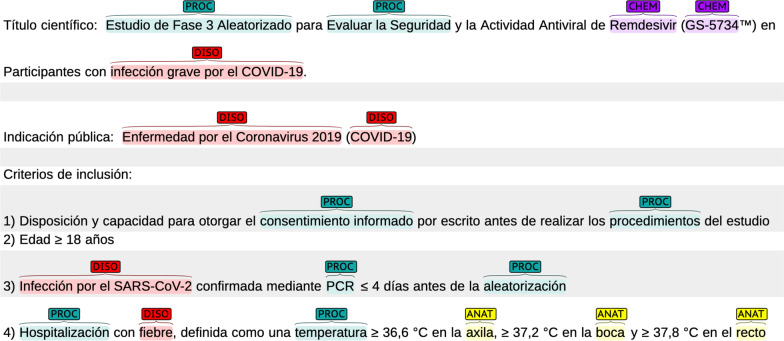
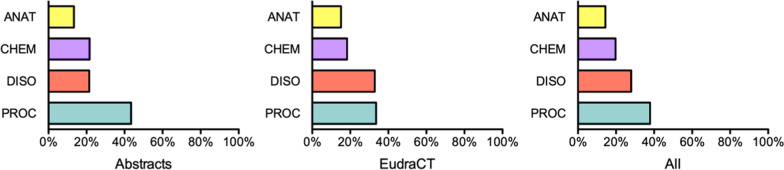
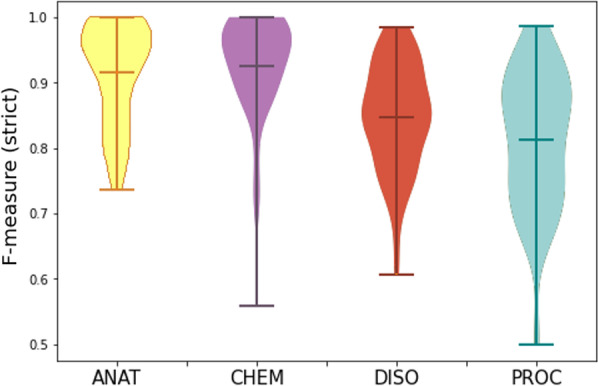
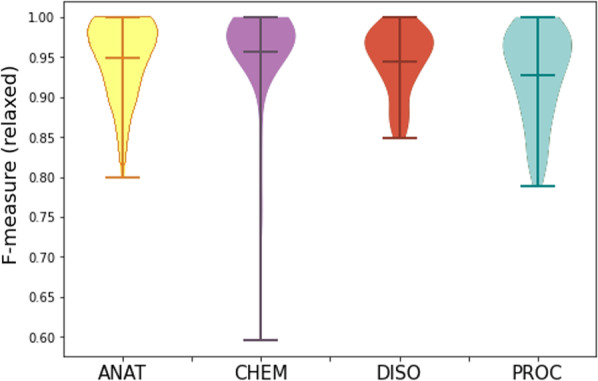
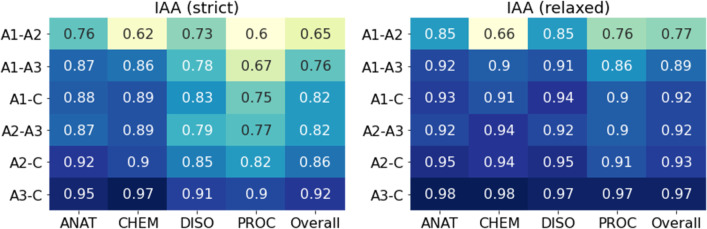
Background: The large volume of medical literature makes it difficult for healthcare professionals to keep abreast of the latest studies that support Evidence-Based Medicine. Natural language processing enhances the access to relevant information, and gold standard corpora are required to improve systems. To contribute with a new dataset for this domain, we collected the Clinical Trials for Evidence-Based Medicine in Spanish (CT-EBM-SP) corpus. Methods: We annotated 1200 texts about clinical trials with entities from the Unified Medical Language System semantic groups: anatomy (ANAT), pharmacological and chemical substances (CHEM), pathologies (DISO), and lab tests, diagnostic or therapeutic procedures (PROC). We doubly annotated 10% of the corpus and measured inter-annotator agreement (IAA) using F-measure. As use case, we run medical entity recognition experiments with neural network models. Results: This resource contains 500 abstracts of journal articles about clinical trials and 700 announcements of trial protocols (292 173 tokens). We annotated 46 699 entities (13.98% are nested entities). Regarding IAA agreement, we obtained an average F-measure of 85.65% (±4.79, strict match) and 93.94% (±3.31, relaxed match). In the use case experiments, we achieved recognition results ranging from 80.28% (±00.99) to 86.74% (±00.19) of average F-measure. Conclusions: Our results show that this resource is adequate for experiments with state-of-the-art approaches to biomedical named entity recognition. It is freely distributed at: http://www.lllf.uam.es/ESP/nlpmedterm_en.html . The methods are generalizable to other languages with similar available sources.
Overview
The claims and statistics of this paper haven’t been checked yet.
Free: it reads the open-access text and checks the first 5 claims that cite a source we can check. Create a free account to check every claim.
Integrity signals
Registry
Cites
Statistics
Figures

Verification
Claims the paper makes
The claims and statistics of this paper haven’t been checked yet.
Free: it reads the open-access text and checks the first 5 claims that cite a source we can check. Create a free account to check every claim.
Claims other papers make about this one
Each is checked against this paper’s own text: does it say what the citing paper says it does?
The cited source says what the claim attributes to it.
In the citing paper
“and a small number of publications went one step further to normalise to actual concepts and including data sources such as UMLS (Unified Medical Language System). 35 , 39 , 59 , 73 , 85”
From Data extraction methods for systematic review (semi)automation: a living systematic review (2021) · cites this paper as [35]
In the citing paper
“Other transformer-based architectures such as the bio-pretrained version of ELECTRA, are also still gaining attention, 32,33 as well as FLAIR-based models.”
From Data extraction methods for systematic review (semi)automation: Update of a living systematic review (2025) · cites this paper as [35]
In the citing paper
“35”
From Data extraction methods for systematic review (semi)automation: Update of a living systematic review (2025) · cites this paper as [35]
In the citing paper
“Yes, https://www.ncbi.nlm.nih.gov/pmc/articles/ PMC8135980/bin/ ocab077_supplementary_data.pdf extraction, domain COVID-19 Yes, https://github.com/kilicogluh/CONSORT-TM”
From Data extraction methods for systematic review (semi)automation: Update of a living systematic review (2025) · cites this paper as [35]
In the citing paper
“from 20k reviews, entity labels initially assigned via model trained on EBM-NLP 500 abstracts and 700 records”
From Data extraction methods for systematic review (semi)automation: Update of a living systematic review (2025) · cites this paper as [35]
3 more claims about this paper
Create a free account to see every claim other papers make about this one.
Self-check
Percentages, sums and reported differences re-computed from the paper’s own numbers.
The self-check needs the paper’s full text.
Citations
Cites
Vaswani, A., Shazeer, N., Parmar, N., Uszkoreit, J., Jones, L., Gomez, A. N., Kaiser, L., & Polosukhin, I. (2017) · arXiv · doi:10.48550/arxiv.1706.03762 · Cited by 120,404 · cited 1×
“It is trained with self-attention layers of the Transformer encoder [67] and a masked language model (MLM), which replaces randomly 15% of input tokens with a mask token.”
MethodThe Measurement of Observer Agreement for Categorical Data
Landis, J. R., & Koch, G. G. (1977) · Biometrics · doi:10.2307/2529310 · Cited by 81,148
BERT: Pre-training of Deep Bidirectional Transformers for Language Understanding
Devlin, J., Chang, M.-W., Lee, K., & Toutanova, K. (2019) · Proceedings of the 2019 Conference of the North American Chapter of the Association for Computational Linguistics: Human Language Technologies, Volume 1 (Long and Short Papers) · doi:10.18653/v1/n19-1423 · Cited by 54,325 · cited 17×
“We used the BERT base model trained on 12 layers, with a hidden size of 768 and 12 attention heads.”
BackgroundMethodInfluentialGlove: Global Vectors for Word Representation
Pennington, J., Socher, R., & Manning, C. (2014) · Proceedings of the 2014 Conference on Empirical Methods in Natural Language Processing (EMNLP) · doi:10.3115/v1/d14-1162 · Cited by 34,071 · cited 1×
“We tested three frameworks based on a language-modeling objective, given that this yields better results for NER than the classic embedding approaches [60, 61].”
MethodOn Information and Sufficiency
Kullback, S., & Leibler, R. A. (1951) · The Annals of Mathematical Statistics · doi:10.1214/aoms/1177729694 · Cited by 20,193
Deep Contextualized Word Representations
Peters, M., Neumann, M., Iyyer, M., Gardner, M., Clark, C., Lee, K., & Zettlemoyer, L. (2018) · Proceedings of the 2018 Conference of the North American Chapter of the Association for Computational Linguistics: Human Language Technologies, Volume 1 (Long Papers) · doi:10.18653/v1/n18-1202 · Cited by 11,983
Enriching Word Vectors with Subword Information
Bojanowski, P., Grave, E., Joulin, A., & Mikolov, T. (2017) · Transactions of the Association for Computational Linguistics · doi:10.1162/tacl_a_00051 · Cited by 9,645 · cited 2×
“For SequenceLabeler and Flair, we used fastText wordembeddings [65].”
MethodTransformers: State-of-the-Art Natural Language Processing
Wolf, T., Debut, L., Sanh, V., Chaumond, J., Delangue, C., Moi, A., Cistac, P., Rault, T., Louf, R., Funtowicz, M., et al. (2020) · Proceedings of the 2020 Conference on Empirical Methods in Natural Language Processing: System Demonstrations · doi:10.18653/v1/2020.emnlp-demos.6 · Cited by 8,741
BioBERT: a pre-trained biomedical language representation model for biomedical text mining
Lee, J., Yoon, W., Kim, S., Kim, D., Kim, S., So, C. H., & Kang, J. (2020) · Bioinformatics · doi:10.1093/bioinformatics/btz682 · Cited by 7,218 · cited 1×
“In particular, using data from the domain to train a Spanish medical BERT or medical Flair embeddings, similar to the BioBERT [75] or HunFlair models [76], respectively.”
MethodNeural Architectures for Named Entity Recognition
Lample, G., Ballesteros, M., Subramanian, S., Kawakami, K., & Dyer, C. (2016) · Proceedings of the 2016 Conference of the North American Chapter of the Association for Computational Linguistics: Human Language Technologies · doi:10.18653/v1/n16-1030 · Cited by 4,401 · cited 1×
“It is a Bidirectional LongShort Term Memory (Bi-LSTM) model with a final layer implementing Conditional Random Fields (CRF); this is similar to the framework proposed in [63, 64].”
Method
Research works printed but not linked: 8
- Intxaurrondo A, de la Torre JC, Rodríguez Betanco H, Marimón M, Lopez-Martín JA, Gonzalez-Agirre A, et al. Resources, guidelines and annotations for the recognition, definition resolution and concept normalization of Spanish clinical abbreviations: the BARR2 corpus. In: Proceedings of SEPLN. 2018; p. 1–9.
- FAPESP - BIREME. Scientific Library Online (SciELO). https://www.scielo.org/es/. Accessed 5 Sep 2020.
- National Library of Medicine. PubMed. https://pubmed.ncbi.nlm.nih.gov/. Accessed 5 Sep 2020.
- Ogren P, Savova G, Chute C. constructing evaluation corpora for automated clinical named entity recognition. In: Proceedings of the 6th LREC Marrakech, Morocco, 28–30 May. 2008;p. 3143–50.
- Brown TB, Mann B, Ryder N, Subbiah M, Kaplan J, Dhariwal P, et al. language models are few-shot learners. Preprint at arXiv. 2020; arXiv:abs/2005.14165
- Mikolov T, Sutskever I, Chen K, Corrado GS, Dean J. Distributed representations of words and phrases and their compositionality. In: Proceedings of advances in neural information processing systems. 2013; p. 3111–9.
- Cañete J, Chaperon G, Fuentes R, Pérez J. Spanish pre-trained BERT model and evaluation data. PML4DC at ICLR 2020 Addis Ababa, Ethiopia, 26 Apr. 2020; p. 1–10.
- Abacha AB, Zweigenbaum P. Medical entity recognition: a comparaison of semantic and statistical methods. In: Proceedings of BioNLP 2011 workshop. 2011;p. 56–64.
Cited by
Data extraction methods for systematic review (semi)automation: a living systematic review
Schmidt, L., Olorisade, B. K., McGuinness, L. A., Thomas, J., & Higgins, J. P. T. (2021) · F1000Research · doi:10.12688/f1000research.51117.1 · Cited by 106
Santos, Á. O. D., da Silva, E. S., Couto, L. M., Reis, G. V. L., & Belo, V. S. (2023) · Journal of Biomedical Informatics · doi:10.1016/j.jbi.2023.104389 · Cited by 64
Natural Language Processing in medicine and ophthalmology: A review for the 21st-century clinician
Rojas-Carabali, W. A., Agrawal, R., Gutiérrez-Sinisterra, L., Baxter, S. L., Cifuentes‐González, C., Wei, Y. C., Abisheganaden, J. A., Kannapiran, P., Wong, S., Lee, B. T. K., et al. (2024) · Asia-Pacific Journal of Ophthalmology · doi:10.1016/j.apjo.2024.100084 · Cited by 82
Data extraction methods for systematic review (semi)automation: Update of a living systematic review
Schmidt, L., Finnerty Mutlu, A. N., Elmore, R., Olorisade, B. K., Thomas, J., & Higgins, J. P. T. (2023) · F1000Research · doi:10.12688/f1000research.51117.2 · Cited by 44
The OpenDeID corpus for patient de-identification
Jonnagaddala, J., Chen, A., Batongbacal, S., & Nekkantti, C. (2021) · Scientific Reports · doi:10.1038/s41598-021-99554-9 · Cited by 45
Pabón, O. S., Montenegro, O., Torrente, M., Rodríguez‐González, A., Provencio, M., & Ernestina, M. (2022) · PeerJ Computer Science · doi:10.7717/peerj-cs.913 · Cited by 39
“Although, both Kappa statistic (Cohen, 1960) and F-measure (Hripcsak & Rothschild, 2005) have been used to calculate de IAA between annotators, it has been argued that using the F-measure is more suitable than Kappa in contexts where annotated entities might have different token spans (Campillos-Llanos et al., 2021; B…”
MethodRaza, S., Schwartz, B., & Rosella, L. C. (2022) · BMC Bioinformatics · doi:10.1186/s12859-022-04751-6 · Cited by 39
“A gold-standard dataset is prepared and annotated by experts in the field [49].”
BackgroundRaza, S., & Schwartz, B. (2023) · Scientific Reports · doi:10.1038/s41598-023-35482-0 · Cited by 39
Data extraction methods for systematic review (semi)automation: Update of a living systematic review
Schmidt, L., Finnerty Mutlu, A. N., Elmore, R., Olorisade, B. K., Thomas, J., & Higgins, J. P. T. (2025) · F1000Research · doi:10.12688/f1000research.51117.3 · Cited by 27
GPT for medical entity recognition in Spanish
García-Barragán, Á., Calatayud, A., Pabón, O. S., Provencio, M., Menasalvas, E., & Robles, V. (2024) · Multimedia Tools and Applications · doi:10.1007/s11042-024-19209-5 · Cited by 45
“We used the F-measure to calculate the IAA between annotation pairs, as suggested in several NER annotation studies [41–43].”
Transformers for extracting breast cancer information from Spanish clinical narratives
Pabón, O. S., Montenegro, O., García-Barragán, Á., Torrente, M., Provencio, M., Menasalvas, E., & Robles, V. (2023) · Artificial Intelligence in Medicine · doi:10.1016/j.artmed.2023.102625 · Cited by 36
Automatic Extraction of Nested Entities in Clinical Referrals in Spanish
Pablo Báez, B., Bravo-Márquez, F., Dunstan, J., Rojas, M. S., & Villena, F. (2022) · ACM Transactions on Computing for Healthcare · doi:10.1145/3498324 · Cited by 32
Shaitarova, A., Zaghir, J., Lavelli, A., Krauthammer, M. O., & Rinaldi, F. (2023) · Yearbook of Medical Informatics · doi:10.1055/s-0043-1768726 · Cited by 29
NEREL-BIO: a dataset of biomedical abstracts annotated with nested named entities
Loukachevitch, N., Manandhar, S., Baral, E., Рожков, І. М., Braslavski, P., Ivanov, V. V., Batura, T. V., & Tutubalina, E. V. (2023) · Bioinformatics · doi:10.1093/bioinformatics/btad161 · Cited by 36
“This indicates good quality of agreement and reliability of annotations as noted by other researchers (Shabankhani et al. 2020; Campillos-Llanos et al. 2021).”
ResultBadalotti, D., Agrawal, A., Pensato, U., Angelotti, G., & Marcheselli, S. (2024) · International Journal of Medical Informatics · doi:10.1016/j.ijmedinf.2024.105626 · Cited by 27
BigBIO: A Framework for Data-Centric Biomedical Natural Language Processing
Fries, J. A., Weber, L., Seelam, N., Altay, G., Datta, D., Garda, S., Kang, M., Su, R., Kusa, W., Cahyawijaya, S., et al. (2022) · arXiv · doi:10.48550/arxiv.2206.15076 · Cited by 17
Raza, S., Schwartz, B., Lakamana, S., Ge, Y., & Sarker, A. (2023) · BMC Digital Health · doi:10.1186/s44247-023-00029-w · Cited by 23
“These works primarily utilize data from scientific literature [26] or clinical research studies [21] to extract crucial insights pertaining to the subject matter.”
BackgroundNamed Entity Recognition in Unstructured Medical Text Documents
Pearson, C., Seliya, N., & Dave, R. (2021) · International Conference on Electrical, Computer and Energy Technologies (ICECET) · doi:10.1109/icecet52533.2021.9698694 · Cited by 22
Chen, L., Qi, Y., Wu, A., Deng, L., & Jiang, T. (2023) · IEEE Journal of Biomedical and Health Informatics · doi:10.1109/jbhi.2023.3315143 · Cited by 17
“As a high-quality medical terminology system, the UMLS provides essential support for most medical entity linking tasks in English [3], [4], [5], [6], [7].”
BackgroundMedLexSp – a medical lexicon for Spanish medical natural language processing
Campillos-Llanos, L. (2023) · Journal of Biomedical Semantics · doi:10.1186/s13326-022-00281-5 · Cited by 13
“This resource is distributed in the community and full details are described in another article [23].”
BackgroundNLI4CT: Multi-Evidence Natural Language Inference for Clinical Trial Reports
Jullien, M., Valentino, M., Frost, H., O’Regan, P., Landers, D., & Freitas, A. (2023) · Conference on Empirical Methods in Natural Language Processing (EMNLP) · doi:10.18653/v1/2023.emnlp-main.1041 · Cited by 54
Hybrid natural language processing tool for semantic annotation of medical texts in Spanish
Campillos-Llanos, L., Valverde-Mateos, A., & Capllonch-Carrión, A. (2025) · BMC Bioinformatics · doi:10.1186/s12859-024-05949-6 · Cited by 11
Self-citationA comparative analysis of Spanish Clinical encoder-based models on NER and classification tasks
Subies, G. G., Jiménez, Á. B., & Fernández, P. M. (2024) · Journal of the American Medical Informatics Association · doi:10.1093/jamia/ocae054 · Cited by 16
Aracena, C., Villena, F., Rojas, M. S., & Dunstan, J. (2022) · International Workshop on Health Text Mining and Information Analysis (LOUHI) · doi:10.18653/v1/2022.louhi-1.22 · Cited by 11
“• CT-EBM-SP8 (Campillos-Llanos et al., 2021): annotated corpus with UMLS entities in 1,200 texts about clinical trials studies and clinical trials announcements.”
BackgroundAutomatic Detection of Distant Metastasis Mentions in Radiology Reports in Spanish
Ahumada, R., Dunstan, J., Rojas, M. S., Peñafiel, S., Paredes, I., & Pablo Báez, B. (2024) · JCO Clinical Cancer Informatics · doi:10.1200/cci.23.00130 · Cited by 7
Jonker, R. A. A., de Almeida, T. D., Antunes, R., Almeida, J. R., & Matos, S. (2024) · Database · doi:10.1093/database/baae068 · Cited by 17
“In this work, we utilize a Spanish RoBERTa model (https://huggingface.co/lcampillos/ roberta-es-clinical-trials-ner) as our transformer base, which we established to be optimal in previous works [81, 82].”
MethodOchoa, J. G. D., Mustafa, F. E., Weil, F., Wang, Y., Dima, C., Kama, K., & Knott, M. (2024) · BMC Medical Informatics and Decision Making · doi:10.1186/s12911-024-02825-4 · Cited by 13
Marode, T. P., Bhangdiya, V. K., Nemane, S. G., Tulaskar, D. P., Sarad, V. M., Sankar, K., Chopade, S., Avthankar, A., Bhaiyya, M. L., & Kulkarni, M. B. (2026) · Bioengineering · doi:10.3390/bioengineering13010075 · Cited by 11
Weakly-Supervised Multilingual Medical NER for Symptom Extraction for Low-Resource Languages
Sallauka, R., Ariöz, U., Rojc, M., & Mlakar, I. (2025) · Applied Sciences · doi:10.3390/app15105585 · Cited by 8
Transfer Learning Approaches for Indonesian Biomedical Entity Recognition
Purwitasari, D., Abdillah, A. F., Juanita, S., & Purnomo, M. H. (2021) · International Conference on Information & Communication Technology and System (ICTS) · doi:10.1109/icts52701.2021.9608496 · Cited by 6
Explanatory argumentation in natural language for correct and incorrect medical diagnoses
Molinet, B., Marro, S., Cabrio, E., & Villata, S. (2024) · Journal of Biomedical Semantics · doi:10.1186/s13326-024-00306-1 · Cited by 4
“To annotate the clinical cases from the MEDQA-USMLE dataset, we rely on the labels from the Unified Medical Language System (UMLS) [10] Semantic Types, making it consistent with standard textual annotations in the medical domain [77–79].”
MethodNamed Entity Recognition in Italian Lung Cancer Clinical Reports using Transformers
Paolo, D., Bria, A., Greco, C., Russano, M., Ramella, S., Soda, P., & Sicilia, R. (2023) · IEEE International Conference on Bioinformatics and Biomedicine (BIBM) · doi:10.1109/bibm58861.2023.10385778 · Cited by 4
“To calculate the IAA in named entity annotation contexts, several studies [20]–[22] have pointed out that using the F1-score [23] is more suitable than using the Kappa statistic [24], because annotated entities might have different number of tokens in textual documents.”
MethodClinical Trial Information Extraction with BERTPreprint
Liu, X., Hersch, G. L., Khalil, I. G., & Devarakonda, M. V. (2022) · Research Square · doi:10.21203/rs.3.rs-2379810/v1 · Cited by 4
PheNormGPT: a framework for extraction and normalization of key medical findings
Soysal, E., & Roberts, K. E. (2024) · Database · doi:10.1093/database/baae103 · Cited by 4
Advances in orofacial pain research: a bibliometric analysis
Qin, S., Liu, J., Fan, J., Qin, Z., & Jia, J. (2025) · Frontiers in Neurology · doi:10.3389/fneur.2025.1609437 · Cited by 3
The USMLE® Step 2 Clinical Skills Patient Note Corpus
Yaneva, V., Mee, J., Ha, L., Harik, P., Jodoin, M. G., & Mechaber, A. J. (2022) · Conference of the North American Chapter of the Association for Computational Linguistics: Human Language Technologies (NAACL-HLT) · doi:10.18653/v1/2022.naacl-main.208 · Cited by 4
“As noted in two overview articles by Savkov et al. (2016) and Campillos-Llanos et al. (2021), such large corpora include CLEF (565k notes), which is “currently restricted" , awaiting “a governance framework in which it can be made more widely available" (Roberts et al., 2007); and a corpus related…”
BackgroundAdvances in monolingual and crosslingual automatic disability annotation in Spanish
Goenaga, I., Andrés, E., Gojenola, K., & Atutxa, A. (2023) · BMC Bioinformatics · doi:10.1186/s12859-023-05372-3 · Cited by 6
Extract antibody and antigen names from biomedical literature
Dinh, T. T., Vo-Chanh, T. P., Nguyen, C., Huynh, V. Q., Vo, N. T., & Nguyen, H. D. (2022) · BMC Bioinformatics · doi:10.1186/s12859-022-04993-4 · Cited by 5
“F1 scores were calculated as: The overall F-measure is 91.46% for strict method and 94.31% for relax method (Table 1), which is in the ‘almost perfect agreement’ range of F = 81–100%, according to the Landis and Koch scale [28, 29].”
MethodInfluentialA Deep Learning Approach to Extract Lung Cancer Information from Spanish Clinical TextsPreprint
Pabón, O. S., Montenegro, O., García, A., Rodríguez‐González, A., Sánchez, J. C., Robles, V., Provencio, M., & Menasalvas, E. (2022) · SSRN Electronic Journal · doi:10.2139/ssrn.4049602 · Cited by 3
Llanos, L. C., Valverde-Mateos, A., Capllonch-Carrión, A., González-Quevedo, D., López-Urbán, M. R., Hernando-Tundidor, M. S., Puig, S. Z., & Heras, J. J. (2026) · Scientific Data · doi:10.1038/s41597-026-06608-6 · Cited by 3
“A more detailed description of the texts was explained in former work 62 .”
Self-citationLiu, Y., Zhang, G., Luan, R., & Yu, X. (2026) · Sensors · doi:10.3390/s26051553 · Cited by 3
Development of pre-trained language models for clinical NLP in Spanish
Aracena, C., & Dunstan, J. (2023) · Conference of the European Chapter of the Association for Computational Linguistics: Student Research Workshop (EACL SRW) · doi:10.18653/v1/2023.eacl-srw.5 · Cited by 4
“CT-EBM-SP3 (Campillos-Llanos et al., 2021): annotated corpus with UMLS entities in 1,200 texts about clinical trials studies and announcements.”
BackgroundNatural Language Explanatory Arguments for Correct and Incorrect Diagnoses of Clinical Cases
Marro, S., Molinet, B., Cabrio, E., & Villata, S. (2023) · International Conference on Agents and Artificial Intelligence (ICAART) · doi:10.5220/0011927000003393 · Cited by 7
“…cases from the MEDQA-USMLE dataset, we rely on the labels from the Unified Medical Language System (UMLS) (Bo-denreider, 2004) Semantic Types, making it consistent with standard textual annotations in the medical domain (Campillos-Llanos et al., 2021; Albright et al., 2013; Mohan and Li, 2019).”
Pablo Báez, B., Llanos, L. C., Torres, F. N., & Dunstan, J. (2024) · Language Resources and Evaluation · doi:10.1007/s10579-024-09755-7 · Cited by 1
“In contrast, the performance of using MedLexSp to normalize entities in a corpus of clinical trials texts (CT-EBM-SP) reached an average of 70.68% (Campillos-Llanos et al., 2021)—note that the rest of the non-normalized entities are currently being revised manually.”
InfluentialAbdillah, A. F., Purwitasari, D., Juanita, S., & Purnomo, M. H. (2023) · Jurnal Teknologi Informasi dan Ilmu Komputer · doi:10.25126/jtiik.20231016337 · Cited by 1
Cross- & multi-lingual medication detection: a transformer-based analysis
Raithel, L., Frei, J., Thomas, P. E., Roller, R., Zweigenbaum, P., Möller, S., & Krämer, F. (2025) · BMC Medical Informatics and Decision Making · doi:10.1186/s12911-025-03179-1 · Cited by 3
“The latter are defined as “pharmacological and chemical substances” [46].”
Identification Semantic Text of Indonesian Medical Terms from Question-Answer Data
Purwitasari, D., Juanita, S., Purnama, I. K. E., Raihan, M., & Purnomo, M. H. (2022) · International Conference on Information Technology, Information Systems and Electrical Engineering (ICITISEE) · doi:10.1109/icitisee57756.2022.10057601 · Cited by 1
“Bio-NER in this study using Unified Medical Language System semantic groups: anatomy (ANAT), pharmacological and chemical substances (CHEM), pathology (DISO), and laboratory test procedures of diagnostic or therapeutic (PROC) [13].”
MethodInfluentialGrabar, N., & Grouin, C. (2022) · Yearbook of Medical Informatics · doi:10.1055/s-0042-1742547 · Cited by 2
Llanos, L. C., Valverde-Mateos, A., Capllonch-Carrión, A., & Sandoval, A. M. (2021) · BMC Medical Informatics and Decision Making · doi:10.1186/s12911-021-01475-0 · Cited by 1
Self-citationA transcription and information extraction system to facilitate EHR documentation in SpanishPreprint
Fernández, M., Villena, F., Rojas, M. S., Torres, F. N., Silva, J. F., & Dunstan, J. (2023) · Research Square · doi:10.21203/rs.3.rs-3175804/v1 · Cited by 1
Pabón, O. S. (2022) · UPM Digital Archive (Technical University of Madrid) · doi:10.20868/upm.thesis.72262
Rojas, M. S., Carrino, C. P., González-Agirre, A., Dunstan, J., & Villegas, M. (2022) · International Workshop on Health Text Mining and Information Analysis (LOUHI) · doi:10.18653/v1/2022.louhi-1.2
“On the other hand, the best setting in Clinical Trials is the Joint Labeling approach with the clinical version of RoBERTa.”
BackgroundInfluentialMenta, A., & García-Serrano, A. M. (2024) · Computer Science and Information Systems · doi:10.2298/csis230912017m · Cited by 4
Escartín, J., Úbeda, P. L., Martín‐Noguerol, T., & Luna, A. (2025) · Magnetic Resonance Imaging · doi:10.1016/j.mri.2025.110538
Raza, S., Schwartz, B., & Rosella, L. C. (2022) · Figshare · doi:10.6084/m9.figshare.19976930
Ramar, V. A., Kolli, Y. K., Kushala, K., Induru, V., Radhakrishnan, P., & Kumar, S. K. P. (2025) · Asian Conference on Intelligent Technologies (ACOIT) · doi:10.1109/acoit66109.2025.11436948
“The resource is multilingual, state-of-the-art technique-supported, and has proven to be useful for application in biological named entity identification tests [8].”
Jaschke, D., Bergmann, C.-F., Blumenstock, M. C., Brobeil, A., Dietrich, S., Dittrich, T., Herweg, M., Knaup, P., Lehmann, C. U., Liebers, N., et al. (2026) · Computers in Biology and Medicine · doi:10.1016/j.compbiomed.2026.111648
Schneider, E. T. R., Gumiel, Y. B., Martı́nez, P., Moro, C. M. C., & Paraíso, E. C. (2026) · Journal of the Brazilian Computer Society · doi:10.5753/jbcs.2026.5790
The Digital Turn in the Humanities
Alaba, F. A., & Ajibola, I. G. (2026) · Information systems engineering and management · doi:10.1007/978-3-032-20335-9_2
MDeID: A dataset for multilingual medical de-identification
Surana, R., Quispe, R., Johnson, A. E. W., & Lin, T. (2026) · Journal of Biomedical Informatics · doi:10.1016/j.jbi.2026.105106
Metadata
- Authors
- Campillos-Llanos, L., Valverde-Mateos, A., Capllonch-Carrión, A., & Moreno-Sandoval, A.
- ORCID
- Venue
- BMC Medical Informatics and Decision Making
- Published
- 2021-02-22
- Volume
- 21
- Issue
- 1
- Pages
- 69-69
- ISSN
- 1472-6947 (ISSN-L)
- PMC
- PMC7898014
- OpenAlex
- W3130583616
- Semantic Scholar
- a0fcced57c26ff5dad30e7a404a84ea26844764e
- Cited by
- 65
- References
- 72
- Citations by year
- 2026: 7 · 2025: 7 · 2024: 11 · 2023: 16 · 2022: 20 · 2021: 4
- FWCI
- 4.00
- Type
- journal article
- Language
- en
- Update notices
- correction (2021-04-07)
- Open access
- gold
- doi.org
- Licence
- cc-by
- creativecommons.org/licenses/by/4.0 (tdm)
- creativecommons.org/licenses/by/4.0 (vor)
- Locations
- BMC Medical Informatics and Decision Making (publishedVersion, cc-by)
- PubMed Central (publishedVersion, cc-by)
- PubMed (publishedVersion)
- DIGITAL.CSIC (Spanish National Research Council (CSIC)) (submittedVersion, cc-by)
- DIGITAL.CSIC (Spanish National Research Council (CSIC)) (submittedVersion, public-domain)
- DOAJ (DOAJ: Directory of Open Access Journals) (submittedVersion, cc-by-sa)
- Hispana (submittedVersion)
- Biblos-e Archivo (Universidad Autónoma de Madrid) (submittedVersion, public-domain)
- Funders
- H2020 Marie Skłodowska-Curie Actions (713366)
- Topics
- Health Sciences › Medicine › Health Informatics › Biomedical Text Mining and Ontologies
- Physical Sciences › Computer Science › Artificial Intelligence › Topic Modeling
- Physical Sciences › Computer Science › Artificial Intelligence › Machine Learning in Healthcare
- Keywords
- clinical trials, evidence-based medicine, biomedical named entity recognition, Spanish medical texts, inter-annotator agreement, nested entities, clinical trial abstracts, gold standard corpus
- MeSH terms
- Humans, Language, Natural Language Processing, Semantics, Unified Medical Language System, Evidence-Based Medicine
About these checks
Registry, retraction, Cites and statistics results are computed, not judged, with one exception: a printed reference that no index lists is read once by a model before it counts as a citation error. Claims are extracted by a model and kept only when their quote appears verbatim in the text; each cited source is then checked, with a model’s help, for whether it says what the claim relies on. Those verdicts can be wrong — read the claim’s quote and the cited source before relying on one.
Statistics and arithmetic are recomputed, not judged.
Confidence bands are shown only for fields calibrated on our annotated test set. None is calibrated yet, so no band is shown.
What counts as a claim ›How we measure confidence ›How we check this ›
Are you an author, or do you see a problem with this page? Request a review
Data sources
Bibliographic data: Semantic Scholar, OpenAlex, Crossref.
Contains information from the Semantic Scholar Academic Graph Datasets, made available under the ODC Attribution License (ODC-BY 1.0).
Semantic Scholar’s data is described in: Kinney, R., et al. (2023). The Semantic Scholar Open Data Platform. arXiv:2301.10140.
