

The DOI matches its Crossref record; 57 of the 57 references it cites were found in a registry or an index.
Nurses’ lifestyle behaviours, health priorities and barriers to living a healthy lifestyle: a qualitative descriptive study
Open accessAbstract
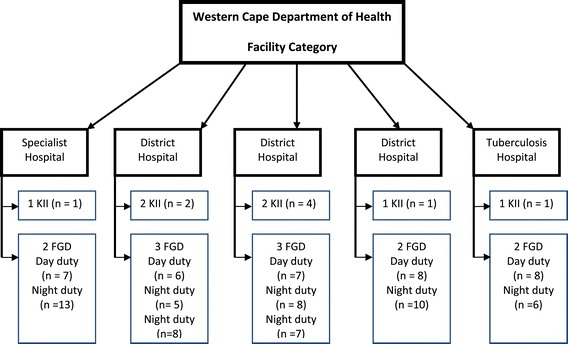
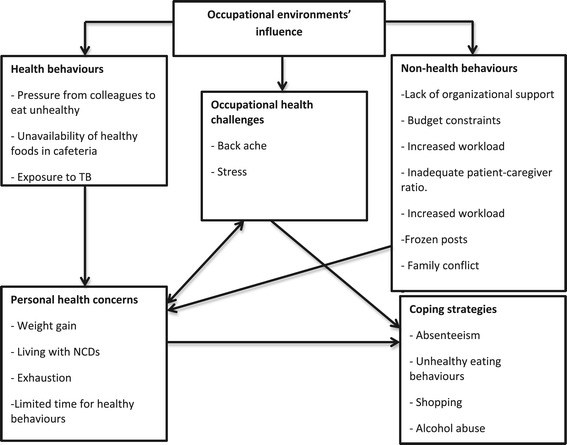
BACKGROUND: Nurses have an increased risk for non-communicable diseases (NCDs), along with a high prevalence of obesity, poor eating habits and insufficient physical activity. The aim of this study was to determine the health concerns, health priorities and barriers to living a healthy lifestyle among nurses and hospital management staff from public hospitals in the Western Cape Metropole, South Africa. METHODS: Participants were purposively sampled (n = 103), and included management personnel (n = 9), night shift (n = 57) and day-shift nurses (n = 36). Twelve focus groups (FGDs) were conducted with nursing staff to obtain insight into nurses' health concerns, lifestyle behaviours and worksite health promotion programmes (WHPPs). Seven key informant interviews (KII) were conducted with management personnel, to gain their perspective on health promotion in the worksite. Thematic analysis was used to analyse the data with the assistance of Atlas.ti Qualitative Data Analysis Software. RESULTS: Night shift nurses frequently identified weight gain and living with NCDs such as hypertension as their main health concerns. Being overweight was perceived to have a negative impact on work performance. All nurses identified backache and exposure to tuberculosis (TB) as occupation-related health concerns, and both management and nurses frequently reported a stressful working environment. Nurses frequently mentioned lack of time to prepare healthy meals due to long working hours and being overtired from work. The hospital environment was perceived to have a negative influence on the nurses' lifestyle behaviours, including food service that offered predominantly unhealthy foods. The most commonly delivered WHPPs included independent counselling services, an online employee wellness programme offered by the Department of Health and wellness days in which clinical measures, such as blood glucose were measured. Nurses identified a preference for WHPPs that provided access to fitness facilities or support groups. CONCLUSIONS: Public hospitals are a stressful work environment and shift work places an additional strain on nurses. The risk of NCDs and exposure to infectious disease remains a concern in this working population. Our findings highlight the need for WHPPs that support nurses in managing stress and transforming the work environment to facilitate healthy lifestyles.
Overview
The claims and statistics of this paper haven’t been checked yet.
Run the check — free, no account needed. It reads the open-access text and checks the sources it cites.
Integrity signals
Registry
Cites
Statistics
Figures
Verification
Claims the paper makes
The claims and statistics of this paper haven’t been checked yet.
Run the check — free, no account needed. It reads the open-access text and checks the sources it cites.
Claims other papers make about this one
Each is checked against this paper’s own text: does it say what the citing paper says it does?
In the citing paper
“This results in competition between the need for sleep and other demands, such as exercise, healthy eating, and personal care. These latter activities are then often done quickly or to a lesser standard (e.g., fast food), or foregone altogether, making it difficult for shift workers to maintain a healthy lifestyle [107].”
From Shift Work: Disrupted Circadian Rhythms and Sleep—Implications for Health and Well-being (2017) · cites this paper as [107]
Self-check
Percentages, sums and reported differences re-computed from the paper’s own numbers.
The self-check needs the paper’s full text.
Citations
Cites
Using thematic analysis in psychology
Braun, V., & Clarke, V. (2006) · Qualitative Research in Psychology · doi:10.1191/1478088706qp063oa · Cited by 194,414
Australian Journal of Advanced Nursing
(2020) · Australian journal of advanced nursing · doi:10.37464/2020 · Cited by 1,596
Workplace Wellness Programs Can Generate Savings
D, K. B. A., Cutler, D., & Song, Z. (2010) · Health Affairs · doi:10.1377/hlthaff.2009.0626 · Cited by 1,227
Global status report on noncommunicable diseases
Chan, M. (2010) · Cited by 1,065
Meta-analysis of workplace physical activity interventions
Conn, V. S., Hafdahl, A. R., Cooper, P. S., Brown, L. M., & Lusk, S. L. (2009) · American Journal of Preventive Medicine · doi:10.1016/j.amepre.2009.06.008 · Cited by 741
Tuberculosis among Health-Care Workers in Low- and Middle-Income Countries: A Systematic Review
Joshi, R. P., Reingold, A. L., Menzies, D., & Pai, M. (2006) · PLoS Medicine · doi:10.1371/journal.pmed.0030494 · Cited by 595
Primary Care Research: A Multimethod Typology and Qualitative Roadmap
Miller, W. L., & Crabtree, B. F. (1992) · Cited by 474
Rotating shift work and the metabolic syndrome: a prospective study
De Bacquer, D., Van Risseghem, M., Clays, E., Kittel, F., De Backer, G., & Braeckman, L. (2009) · International Journal of Epidemiology · doi:10.1093/ije/dyn360 · Cited by 394 · cited 1×
“The high prevalence of healthrelated conditions and risk factors such as obesity, overweight, physical inactivity, and poor eating habits has been reported amongst shift and rotational night shift workers [24-28].”
BackgroundThe prevalence and health impact of shiftwork.
Gordon, N. P., Cleary, P. D., Parker, C. E., & Czeisler, C. A. (1986) · American Journal of Public Health · doi:10.2105/ajph.76.10.1225 · Cited by 244
O’Donnell, M. R., Jarand, J. M., Loveday, M., Padayatchi, N., Zelnick, J., Werner, L., Naidoo, K., Master, I., Osburn, G., Kvasnovsky, C., et al. (2010) · Annals of Internal Medicine · doi:10.7326/0003-4819-153-8-201010190-00008 · Cited by 192
Research works printed but not linked: 3
- Quintiliani L, Sattelmair J, Sorensen G: The Workplace As A Setting For Interventions To Improve Diet And Promote Physical Activity. 2007
- Abdalkader R, Hayajneh F: Effect of Night Shift on Nurses Working in Intensive Care Units at Jordan University Hospital. Eur J Sci Res. 2008, 23: 70-86.
- Patton MQ: Qualitative Research. 2002, Sage Publications, Thousand Oaks, California, Third edition
Cited by
Sorted by citations
Shift Work: Disrupted Circadian Rhythms and Sleep—Implications for Health and Well-being
James, S. M., Honn, K. A., Gaddameedhi, S., & Van Dongen, H. P. A. (2017) · Current Sleep Medicine Reports · doi:10.1007/s40675-017-0071-6 · Cited by 517
Nurses and Health‐Promoting Behaviors: Knowledge May Not Translate Into Self‐Care
Ross, A. C., Bevans, M. F., Brooks, A. T., Gibbons, S. W., & Wallen, G. R. (2017) · AORN Journal · doi:10.1016/j.aorn.2016.12.018 · Cited by 255
Effectiveness of lifestyle health promotion interventions for nurses: a systematic review
Stanulewicz, N., Knox, E., Narayanasamy, M., Shivji, N., Khunti, K., & Blake, H. (2019) · International Journal of Environmental Research and Public Health · doi:10.3390/ijerph17010017 · Cited by 206
The factors influencing the eating behaviour of shiftworkers: what, when, where and why
Gupta, C. C., Coates, A. M., Dorrian, J., & Banks, S. (2018) · Industrial Health · doi:10.2486/indhealth.2018-0147 · Cited by 167
Barriers and facilitators to healthy eating for nurses in the workplace: an integrative review
Nicholls, R., Perry, L., Duffield, C., Gallagher, R., & Pierce, H. (2017) · Journal of Advanced Nursing · doi:10.1111/jan.13185 · Cited by 149
Metadata
- Authors
- Phiri, L. P., Draper, C. E., Lambert, E. V., & Kolbe-Alexander, T. L.
- Affiliations
- University of Cape Town (ZA)
- Corresponding author
- Kolbe-Alexander, Tracy L
- Venue
- BMC Nursing
- Published
- 2014-11-28
- Volume
- 13
- Issue
- 1
- Pages
- 38-38
- ISSN
- 1472-6955 (ISSN-L)
- PMC
- PMC4264254
- OpenAlex
- W1997698673
- Cited by
- 178
- References
- 57
- Citations by year
- 2026: 10 · 2025: 8 · 2024: 15 · 2023: 25 · 2022: 22 · 2021: 18 · 2020: 20 · 2019: 17 · 2018: 16 · 2017: 15 · 2016: 7 · 2015: 4
- FWCI
- 15.69
- Type
- journal article
- Language
- en
- Open access
- gold
- doi.org
- Locations
- BMC Nursing (publishedVersion, cc-by)
- Europe PMC (PubMed Central) (publishedVersion, cc-by)
- PubMed Central (publishedVersion, cc-by)
- PubMed (publishedVersion)
- University of Southern Queensland ePrints (University of Southern Queensland) (acceptedVersion)
- Open University of Cape Town (University of Cape Town) (submittedVersion, cc-by)
- Topics
- Health Sciences › Medicine › Public Health, Environmental and Occupational Health › Workplace Health and Well-being
- Health Sciences › Medicine › Public Health, Environmental and Occupational Health › Health and Lifestyle Studies
- Health Sciences › Health Professions › General Health Professions › Health and Wellbeing Research
- Keywords
- healthy lifestyle, non-communicable diseases, shift work, night shift nurses, occupational health, workplace health promotion, obesity, hypertension, occupational stress, tuberculosis exposure, back pain, food service, working hours, public hospitals, hospital management
About these checks
Registry, retraction, Cites and statistics results are computed, not judged, with one exception: a printed reference that no index lists is read once by a model before it counts as a citation error. Claims are extracted by a model and kept only when their quote appears verbatim in the text; each cited source is then checked, with a model’s help, for whether it says what the claim relies on. Those verdicts can be wrong — read the claim’s quote and the cited source before relying on one.
Statistics and arithmetic are recomputed, not judged.
Confidence bands are shown only for fields calibrated on our annotated test set. None is calibrated yet, so no band is shown.
What counts as a claim ›How we measure confidence ›How we check this ›
Are you an author, or do you see a problem with this page? Request a review
