

A mediation approach to understanding socio-economic inequalities in maternal health-seeking behaviours in Egypt
Open accessThe DOI matches its Crossref record; 45 of the 47 references it cites were found in a registry or an index.
Abstract
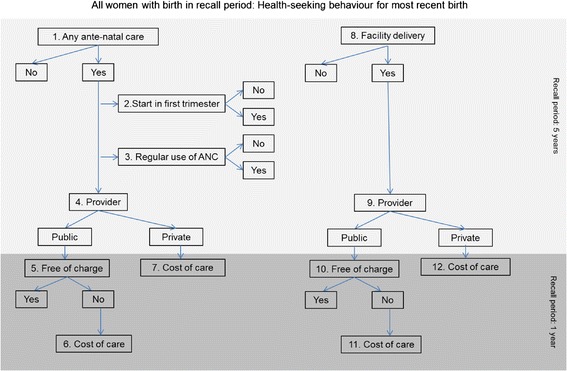
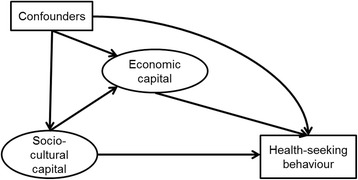
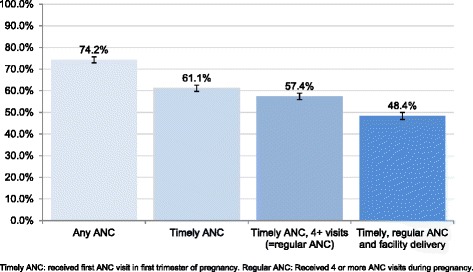
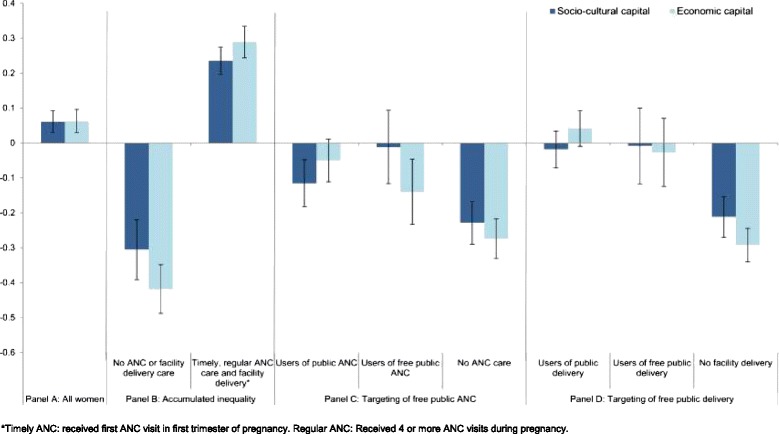
BACKGROUND: The levels and origins of socio-economic inequalities in health-seeking behaviours in Egypt are poorly understood. This paper assesses the levels of health-seeking behaviours related to maternal care (antenatal care [ANC] and facility delivery) and their accumulation during pregnancy and childbirth. Secondly, it explores the mechanisms underlying the association between socio-economic position (SEP) and maternal health-seeking behaviours. Thirdly, it examines the effectiveness of targeting of free public ANC and delivery care. METHODS: Data from the 2008 Demographic and Health Survey were used to capture two latent constructs of SEP: individual socio-cultural capital and household-level economic capital. These variables were entered into an adjusted mediation model, predicting twelve dimensions of maternal health-seeking; including any ANC, private ANC, first ANC visit in first trimester, regular ANC (four or more visits during pregnancy), facility delivery, and private delivery. ANC and delivery care costs were examined separately by provider type (public or private). RESULTS: While 74.2% of women with a birth in the 5-year recall period obtained any ANC and 72.4% delivered in a facility, only 48.8% obtained the complete maternal care package (timely and regular facility-based ANC as well as facility delivery) for their most recent live birth. Both socio-cultural capital and economic capital were independently positively associated with receiving any ANC and delivering in a facility. The strongest direct effect of socio-cultural capital was seen in models predicting private provider use of both ANC and delivery. Despite substantial proportions of women using public providers reporting receipt of free care (ANC: 38%, delivery: 24%), this free-of-charge public care was not effectively targeted to women with lowest economic resources. CONCLUSIONS: Socio-cultural capital is the primary mechanism leading to inequalities in maternal health-seeking in Egypt. Future studies should therefore examine the objective and perceived quality of care from different types of providers. Improvements in the targeting of free public care could help reduce the existing SEP-based inequalities in maternal care coverage in the short term.
Overview
The claims and statistics of this paper haven’t been checked yet.
Free: it reads the open-access text and checks the first 5 claims that cite a source we can check. Create a free account to check every claim.
Integrity signals
Registry
Cites
Statistics
Figures
Verification
Claims the paper makes
The claims and statistics of this paper haven’t been checked yet.
Free: it reads the open-access text and checks the first 5 claims that cite a source we can check. Create a free account to check every claim.
Claims other papers make about this one
Each is checked against this paper’s own text: does it say what the citing paper says it does?
The check wasn’t confident either way, so it gives no verdict — never disputed.
In the citing paper
“key determinants of partnership synergy include connections to other organizations (Allen et al., 2012; Flewelling & Hanley, 2016; Valentijn et al., 2015), ability to convene diverse stakeholders (Kramer et al., 2005; Marchand et al., 2005; Stevens et al., 2007), leaders’ skills and expertise (Allen et al., 2012; Feinberg, Greenberg, & Osgood, 2004; Marchand et al., 2005; Powell & Peterson, 2014;”
From Insights from the national maternal and Child Health Workforce Development Center on Title V Teams’ collaborative readiness and goal accomplishment (2022) · cites this paper as Valentijn et al., 2015
Experimental — accuracy not yet measured
Self-check
Percentages, sums and reported differences re-computed from the paper’s own numbers.
The self-check needs the paper’s full text.
Citations
Cites
Filmer, D., & Pritchett, L. H. (2001) · Demography · doi:10.1353/dem.2001.0003 · Cited by 5,238 · cited 1×
“The DHS wealth index provides a more stable measurement of household-level resources than consumption expenditure [26], although the underlying constructs may not coincide [27].”
BackgroundFilmer, D., & Pritchett, L. H. (2001) · Demography · doi:10.2307/3088292 · Cited by 2,972
Indicators of socioeconomic position (part 1): Figure 1
Galobardes, B., Shaw, M., Lawlor, D. A., Lynch, J. W., & Davey Smith, G. (2006) · Journal of Epidemiology and Community Health · doi:10.1136/jech.2004.023531 · Cited by 2,867
Socioeconomic Disparities In Health: Pathways And Policies
Adler, N. E., & Newman, K. (2002) · Health Affairs · doi:10.1377/hlthaff.21.2.60 · Cited by 2,104 · cited 1×
“Education and literacy capture knowledge, ability to access new information, cognitive skills, previous exposure to authority, ability to interact with modern institutions such as healthcare providers, and have been linked to effective negotiation within familial power structures [20-23].”
BackgroundStrategies for reducing maternal mortality: getting on with what works
Campbell, O. M., & Graham, W. J. (2006) · The Lancet · doi:10.1016/s0140-6736(06)69381-1 · Cited by 1,785 · cited 1×
“delivery care prevent maternal and perinatal deaths [6], but their coverage relies on numerous complex factors such as availability, quality and cost of care, as well as their utilisation by women.”
BackgroundSelf-citationGeneralized Latent Variable Modeling: Multilevel, Longitudinal, and Structural Equation Models
Skrondal, A., & Rabe‐Hesketh, S. (2004) · Thammasat University Digital Collections · Cited by 1,505
Generalized Latent Variable Modeling
Skrondal, A., & Rabe-Hesketh, S. (2004) · Chapman & Hall/CRC eBooks · doi:10.1201/9780203489437 · Cited by 1,484
Still too far to walk: Literature review of the determinants of delivery service use
Gabrysch, S., & Campbell, O. M. (2009) · BMC Pregnancy and Childbirth · doi:10.1186/1471-2393-9-34 · Cited by 1,255 · cited 2×
“Socio-economic resources are well-established determinants of maternal care utilisation in low and middleincome countries [14,15].”
BackgroundSelf-citationDemographic and health surveys: a profile
Corsi, D. J., Neuman, M., Finlay, J. E., & Subramanian, S. (2012) · International Journal of Epidemiology · doi:10.1093/ije/dys184 · Cited by 1,178 · cited 1×
“However, the validity of women’s recall of the various dimensions of maternal health-seeking has not been assessed in Egypt, and may be differentially biased according to the time that had elapsed since the events took place [41,42].”
BackgroundThe World Health Report 2005 - make every mother and child count
Lerberghe, W. V., Manuel, A., Matthews, Z., & Wolfheim, C. (2005) · ePrints Soton (University of Southampton) · Cited by 1,015
Research works printed but not linked: 4
- Ashford L Hidden Suffering: Disabilities from pregnancy and childbirth in less developed countries 2002 Washington DC Population Reference Bureau
- El-Zanaty F Way A Egypt Demographic and Health Survey 2008 2009 Cairo, Egypt and Calverton, MD Ministry of Health, El-Zanaty and Associates, and Macro International
- World Health Organization Egypt Country Cooperation Strategy 2009 Cairo, Egypt WHO EMRO
- Gowayed H Benova L This is all Koosa: Health-seeking for children in a Cairo slum: Balancing need, money and mistrust 2009 Oxford, UK Conference presentation at Health, Illness and Disease
Cited by
Items 201–243 of 243
Sciberras, M., & Dingli, A. (2023) · Lecture notes in networks and systems · doi:10.1007/978-3-031-19900-4_5 · Cited by 3
Nicolini, D., Bharatan, I., Gkeredakis, E., Manning, R. M., & Swan, J. A. (2023) · Organizational behaviour in health care · doi:10.1007/978-3-031-24212-0_12 · Cited by 4
Kibria, G. M. A., Shawon, M. S. R., Nurunnabi, M., & Hasan, M. Z. (2026) · Discover Public Health · doi:10.1186/s12982-026-01588-9 · Cited by 3
“Moreover, studies from other countries had similar findings [28, 29].”
Afetor, M., Harris, E., Der, J. B., & Narh, C. T. (2023) · BMJ Open · doi:10.1136/bmjopen-2022-066457 · Cited by 3
Agu, M. C., Chima, U. E., Eze, O. P., Maduekwe, S. N., Okafor, V. U., Chibuoke, O. M., Nwankwo, C. B., Okoye, C. O., Ngige, A. P., Chigbo, D. C., et al. (2025) · Discover Public Health · doi:10.1186/s12982-025-00595-6 · Cited by 2
Robin, G., Brown, E. M., Davis, C., Bird, L., Wilson, L., Halperin, R. M., Brundage, M., Croke, J. M., Harper, C., Giuliani, M., et al. (2021) · Journal of Cancer Education · doi:10.1007/s13187-021-02049-4 · Cited by 2
Innovative services in home health nursing: a scoping review protocol
Eshghi, F., Pourgholam, N., Kianian, T., Kashani, M., & Azami, M. (2024) · BMJ Open · doi:10.1136/bmjopen-2023-077174 · Cited by 2
Consanguineous Marriages and Domestic Violence against Women: Evidence from Pakistan
Zafar, S., Shah, G. H., & Amir‐ud‐Din, R. (2024) · Journal of Asian and African Studies · doi:10.1177/00219096241270683 · Cited by 2
“Some other factors associated with DV include women’s financial independence (Renzetti, 2009), control of women’s finances (Outlaw, 2009), and husband’s education (Benova et al., 2015).”
Abel, L. N., & Tandoh, M. A. (2025) · Health Science Reports · doi:10.1002/hsr2.70594 · Cited by 2
Youn, K.-I. (2015) · The Korean Journal of Health Service Management · doi:10.12811/kshsm.2015.9.4.131 · Cited by 2
Context of boat drowning in Ghana: a mixed qualitative research study
Kushitor, M. K., Bour, H., Nyame, P., & Yabila, S. (2022) · Injury Prevention · doi:10.1136/ip-2022-044567 · Cited by 2
Prichard, R. A., Kershaw, L., Goodall, S., Davidson, P. M., Newton, P. J., Saing, S., & Hayward, C. (2019) · Heart Lung and Circulation · doi:10.1016/j.hlc.2019.08.008 · Cited by 1
Tolmay, S., Koea, J., Stewart, I., & Rahiri, J. (2021) · Surgery · doi:10.1016/j.surg.2021.08.040 · Cited by 1
Laver, K., Lynch, E. A., Rupa, J., McNamara, C., Crotty, M., & Harvey, G. (2022) · BMJ Open Quality · doi:10.1136/bmjoq-2021-001774 · Cited by 1
Assessing Pandemic Impacts to Collaborative Management in Parks and Protected Areas
McCreary, A., Seekamp, E., & Edwards, M. B. (2025) · Environmental Management · doi:10.1007/s00267-025-02207-0 · Cited by 1
He, L., Xie, X., Liu, H., & Li, B. (2017) · Lecture notes in computer science · doi:10.1007/978-3-319-67964-8_7 · Cited by 1
Jamaluddin, A., & Abawajy, J. (2021) · Lecture notes in networks and systems · doi:10.1007/978-3-030-80216-5_21 · Cited by 2
Leading Health Workforce Change: Insights from Experience
Chadwick, M. (2018) · Tuwhera (Auckland University of Technology) · Cited by 1
Gopalan, S. S. (2019) · LSHTM Research Online (London School of Hygiene and Tropical Medicine) · doi:10.17037/pubs.04655682 · Cited by 1
Wells, R., Coffey, A. M., Mullenix, A., Simon, J., & Lich, K. H. (2022) · Maternal and Child Health Journal · doi:10.1007/s10995-022-03437-y
De webagenda: speelruimte om toegankelijkheid van de praktijk te verhogen
der Heijde, C. M. V., Konijn, A. M., Vonk, P., & Meijman, F. J. (2016) · Huisarts en Wetenschap · doi:10.1007/s12445-016-0217-7
Virtual Entrepreneurship and e-Residency Adoption
Uljala, L., & Scupola, A. (2018) · Lecture notes in information systems and organisation · doi:10.1007/978-3-319-62636-9_5 · Cited by 1
Fagherazzi, G., Chambraud, C., Dow, C., Mancini, F. R., Affret, A., Balkau, B., Magliano, D. J., Boutron‐Ruault, M., & Bonnet, F. (2018) · Chronic Illness · doi:10.1177/1742395318801934
Feasibility of psychosocial intervention for children exposed to ethnic violence in Kenya
Getanda, E. M. (2018) · Figshare
Manifestations Of Inequity In Egypt’s Two-Tiered Healthcare System
Shokr, H. (2018) · TSpace (University of Toronto) · Cited by 1
Meigh, N. J., Keogh, J., Rathbone, E. N., & Hing, W. A. (2021) · medRxiv · doi:10.1101/2021.08.27.21262528
Appointment Scheduling in Healthcare Systems: A Scientometric Review
Hançerlioğulları, K. Ö. (2022) · Lecture notes in management and industrial engineering · doi:10.1007/978-3-031-08782-0_25
Rapid Response Systems and the Culture of Safety
Hillman, K., Churruca, K., Ehrenfeld, L., & Braithwaite, J. (2024) · Springer eBooks · doi:10.1007/978-3-031-67951-3_3
Health Seeking Behaviour in Primary Care
Wong, C. P. Y., & Yuen, F. C. M. (2025) · Quality of life in Asia · doi:10.1007/978-981-96-0817-1_26
The effects of workplace bullying on organisational commitment among nurses
Vijayakumar, G., & Rajagopal, S. (2025) · British Journal of Healthcare Management · doi:10.12968/bjhc.2024.0032
Visser, M. R., Voeten, D. M., Gisbertz, S. S., Ruurda, J. P. H., Henegouwen, M. I. V. B., van Hillegersberg, R., Dutch Upper Gastrointestinal Cancer Audit (DUCA) Group, van Etten, B., Heisterkamp, J., Lagarde, S. M., et al. (2025) · Surgical Endoscopy · doi:10.1007/s00464-025-12103-7
Asamoah, K. T., Dei‐Asamoa, R., Ampofo, E. B., Awindaogo, F. R., Agyekum, F., Doku, A., Ohene, S., & Amable, E. (2025) · medRxiv · doi:10.1101/2025.10.12.25337844
Conceptualising Blockchain Adoption Framework for Information Management
Akinradewo, O. I., Aigbavboa, C. O., & Oke, A. E. (2025) · Springer eBooks · doi:10.1007/978-981-95-2664-2_8
Mobile Health Technology, Empowerment, and Self-Respect: A Feminist Analysis
Proost, M. D. (2025) · International Journal of Feminist Approaches to Bioethics · doi:10.3138/ijfab-2024-0019
Singh, R. R., Mishra, S., & Mohanty, S. K. (2022) · Figshare · doi:10.6084/m9.figshare.19793357
Wang, J., Qi, X., Shan, L., Wang, K., Tan, X., Kang, Z., Ning, N., Liang, L., Gao, L., Jiao, M., et al. (2022) · Figshare · doi:10.6084/m9.figshare.20408454
Radovich, E., Banke-Thomas, A. O., Campbell, O. M. R., Ezeanochie, M., Gwacham-Anisiobi, U., Ande, A. B. A., & Benova, L. (2021) · Figshare · doi:10.6084/m9.figshare.16575771
Self-citationRadovich, E., Banke-Thomas, A. O., Campbell, O. M. R., Ezeanochie, M., Gwacham-Anisiobi, U., Ande, A. B. A., & Benova, L. (2021) · Figshare · doi:10.6084/m9.figshare.16575774
Self-citationWilson, J. W., Heinsch, M., Betts, D. N., Booth, D., & KAY‐LAMBKIN, F. J. (2021) · Figshare · doi:10.6084/m9.figshare.15179095
McGilton, K. S., Vellani, S., Krassikova, A., Robertson, S., Irwin, C., Cumal, A., Bethell, J., Burr, E., Keatings, M., McKay, S. M., et al. (2021) · Figshare · doi:10.6084/m9.figshare.14337666
Aboagye, E. A., Adei, D., & Agyemang‐Duah, W. (2026) · BMJ Public Health · doi:10.1136/bmjph-2026-005302
Otaifi, A. H. A. A., Alharbi, F. M. N., Alharbi, B. S. G., Alharbi, M. H. H., Alharbi, F. H. S., Alharbi, A. H. H., Alanazi, R. S. K., Almutairi, E. M. A., & Alharbi, A. J. A. (2025) · Journal of Neonatal Surgery
Hammond, J., Adjei-Gyamfi, S., Daniels, D. B., Sarpong, G. K., Aiga, H., & Aoki, T. (2026) · PLoS ONE · doi:10.1371/journal.pone.0359892
Metadata
- Authors
- Benova, L., Campbell, O. M., & Ploubidis, G. B.
- Affiliations
- London School of Hygiene & Tropical Medicine (GB)
- Venue
- BMC Health Services Research
- Published
- 2015-01-21
- Volume
- 15
- Issue
- 1
- Pages
- 1-1
- ISSN
- 1472-6963 (ISSN-L)
- PMC
- PMC4307186
- OpenAlex
- W2035346038
- Cited by
- 239
- References
- 47
- Citations by year
- 2026: 3 · 2025: 18 · 2024: 16 · 2023: 20 · 2022: 35 · 2021: 41 · 2020: 13 · 2019: 16 · 2018: 26 · 2017: 31 · 2016: 13 · 2015: 7
- FWCI
- 25.63
- Type
- journal article
- Language
- en
- Open access
- gold
- doi.org
- Locations
- BMC Health Services Research (publishedVersion, cc-by)
- Europe PMC (PubMed Central) (publishedVersion, cc-by)
- PubMed Central (publishedVersion, cc-by)
- PubMed (publishedVersion)
- LSHTM Research Online (London School of Hygiene and Tropical Medicine) (acceptedVersion)
- UCL Discovery (University College London) (submittedVersion)
- Funders
- Medical Research Council
- Economic and Social Research Council (ES/G040923/1, ES/M001660/1, 1013735, ES/I903224/1)
- Topics
- Health Sciences › Medicine › Pediatrics, Perinatology and Child Health › Global Maternal and Child Health
- Social Sciences › Health › Public Health and Social Inequalities
- Health Sciences › Medicine › Public Health, Environmental and Occupational Health › Healthcare Systems and Reforms
- Keywords
- socioeconomic disparities, maternal health-seeking behavior, prenatal care, institutional delivery, socio-cultural capital, economic capital, mediation analysis, Egypt
- MeSH terms
- Adolescent, Adult, Attitude to Health, Egypt, Female, Health Surveys, Humans, Income, Maternal Health Services, Middle Aged, Patient Acceptance of Health Care, Pregnancy, Socioeconomic Factors, Health Behavior, Pregnant People, Pregnant Women, Healthcare Disparities, Young Adult
About these checks
Registry, retraction, Cites and statistics results are computed, not judged, with one exception: a printed reference that no index lists is read once by a model before it counts as a citation error. Claims are extracted by a model and kept only when their quote appears verbatim in the text; each cited source is then checked, with a model’s help, for whether it says what the claim relies on. Those verdicts can be wrong — read the claim’s quote and the cited source before relying on one.
Statistics and arithmetic are recomputed, not judged.
Confidence bands are shown only for fields calibrated on our annotated test set. None is calibrated yet, so no band is shown.
What counts as a claim ›How we measure confidence ›How we check this ›
Are you an author, or do you see a problem with this page? Request a review
Data sources
Bibliographic data: Semantic Scholar, OpenAlex, Crossref.
Contains information from the Semantic Scholar Academic Graph Datasets, made available under the ODC Attribution License (ODC-BY 1.0).
Semantic Scholar’s data is described in: Kinney, R., et al. (2023). The Semantic Scholar Open Data Platform. arXiv:2301.10140.
