

Effects of continuity of care on hospital admission in patients with type 2 diabetes: analysis of nationwide insurance data
Open accessThe DOI matches its Crossref record; 29 of the 32 references it cites were found in a registry or an index.
Abstract
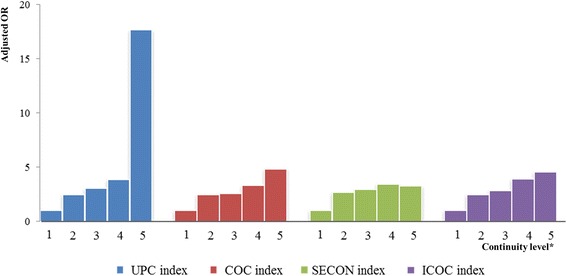
BACKGROUND: A system for managing chronic disease including diabetes mellitus based on primary care clinics has been used in Korea since April 2012. This system can reduce copayments for patients that are managed by a single primary-care provider and lead to improve continuity of care. The aim of this study is to determine whether there is an association between continuity of care for outpatients and hospital admission and identify the continuity index that best explains hospital admissions for patients with type 2 diabetes. METHODS: We performed a cross-sectional study using 2009 National Health Insurance Sample (NHIS) from the Health Insurance Review & Assessment Services (HIRA) of Korea. The dependent variable was hospital admission due to type 2 diabetes mellitus. Continuity of care was measured using the Usual Provider Care index (UPC), Continuity of Care index (COC), Sequential Continuity of Care index (SECON), and Integrated Continuity of Care index (ICOC). RESULTS: Patients with low COC scores (<0.75) were more likely to be hospitalized [odds ratio, 2.44; 95% CI, 2.17-2.75] compared with the reference group (COC ≥0.75), after adjusting for all covariates. we calculated the area under the receiver operating characteristic (AUROC) curve for each index to find which index had the greatest explanatory ability for hospital admission. The AUROC of the COC was the greatest (0.598), but the AUROC curves for the UPC (0.597), SECON (0.593), and ICOC (0.597) were similar. CONCLUSIONS: High continuity of care may reduce the likelihood for hospital admission. The COC had marginally more explanatory power.
Overview
The claims and statistics of this paper haven’t been checked yet.
Free: it reads the open-access text and checks the first 5 claims that cite a source we can check. Create a free account to check every claim.
Integrity signals
Registry
Cites
Statistics
Figures
Verification
Claims the paper makes
The claims and statistics of this paper haven’t been checked yet.
Free: it reads the open-access text and checks the first 5 claims that cite a source we can check. Create a free account to check every claim.
Claims other papers make about this one
Each is checked against this paper’s own text: does it say what the citing paper says it does?
In the citing paper
“This is similar to a previous research [26 -28], which found that continuity of care program can reduce the rate of readmission in patients with type 2 diabetes, improve self-care knowledge, and reduce length of hospital stays in high-risk pregnancy.”
From Effects of a Continuity of Preterm Infant Care Program on Parenting outcomes and Service Utilization Rates (2022) · cites this paper as [26]
Self-check
Percentages, sums and reported differences re-computed from the paper’s own numbers.
The self-check needs the paper’s full text.
Citations
Cites
Stratton, I. M. (2000) · BMJ · doi:10.1136/bmj.321.7258.405 · Cited by 9,059 · cited 1×
“Although diabetic complications or disabilities can be effectively reduced by periodic monitoring, dietary modification, medication, and early intervention for complications [9,10], the hospitalization rate”
Preventable Hospitalizations and Access to Health Care
Bindman, A. B. (1995) · JAMA: The Journal of the American Medical Association · doi:10.1001/jama.1995.03530040033037 · Cited by 903
Primary care: America's health in a new era
(1997) · Choice Reviews Online · doi:10.5860/choice.34-6304 · Cited by 816
Does continuity of care improve patient outcomes?
Cabana, M. D., & Jee, S. H. (2004) · PubMed · Cited by 599
A Quantitative Measure of Continuity of Care
Bice, T. W., & Boxerman, S. B. (1977) · Medical Care · doi:10.1097/00005650-197704000-00010 · Cited by 529 · cited 1×
“The COC emphasizes the distribution of visits to each healthcare provider that the patient visited [33].”
Potentially avoidable hospitalizations: inequalities in rates between US socioeconomic groups.
Pappas, G., Hadden, W. C., Kozak, L. J., & Fisher, G. F. (1997) · American Journal of Public Health · doi:10.2105/ajph.87.5.811 · Cited by 396 · cited 1×
“Previous studies have shown that fragmented visit patterns [21-24], a shortage of primary care [25], and difficulty in accessing ambulatory care are related to preventable hospitalization [26,27].”
Continuity of outpatient medical care in elderly men. A randomized trial
Wasson, J. H. (1984) · JAMA · doi:10.1001/jama.252.17.2413 · Cited by 352 · cited 1×
“In order to efficiently manage chronic diseases with limited resources, policymakers are becoming interested in the benefits of continuity of care, which can reduce the risks of diabetic complications [12], improve preventive care [13,14], increase patient satisfaction [15] and compliance [16,17], and decrease emergen…”
Continuity of Care and the Risk of Preventable Hospitalization in Older Adults
Nyweide, D. J., Anthony, D. L., Bynum, J. P. W., Strawderman, R. L., Weeks, W. B., Casalino, L. P., & Fisher, E. S. (2013) · JAMA Internal Medicine · doi:10.1001/jamainternmed.2013.10059 · Cited by 346 · cited 1×
“Previous studies have shown that fragmented visit patterns [21-24], a shortage of primary care [25], and difficulty in accessing ambulatory care are related to preventable hospitalization [26,27].”
Weiss, L. J., & Blustein, J. (1996) · American Journal of Public Health · doi:10.2105/ajph.86.12.1742 · Cited by 305
Factors Related to Potentially Preventable Hospitalizations Among the Elderly
Culler, S. D., Parchman, M. L., & Przybylski, M. (1998) · Medical Care · doi:10.1097/00005650-199806000-00004 · Cited by 239 · cited 1×
“Previous studies have shown that fragmented visit patterns [21-24], a shortage of primary care [25], and difficulty in accessing ambulatory care are related to preventable hospitalization [26,27].”
Continuity of care in a university-based practice
Breslau, N., & Reeb, K. G. (1975) · Academic Medicine · doi:10.1097/00001888-197510000-00006 · Cited by 239 · cited 1×
“The UPC highlights the density of care from the usual provider and measures the frequency of a patient’s visits to a physician, dividing the visits to the same physician by the total number of visits during the defined time period [32].”
Patient–Physician Connectedness and Quality of Primary Care
Atlas, S. J., Grant, R. W., Ferris, T. G., Chang, Y., & Barry, M. J. (2009) · Annals of Internal Medicine · doi:10.7326/0003-4819-150-5-200903030-00008 · Cited by 198 · cited 1×
“In order to efficiently manage chronic diseases with limited resources, policymakers are becoming interested in the benefits of continuity of care, which can reduce the risks of diabetic complications [12], improve preventive care [13,14], increase patient satisfaction [15] and compliance [16,17], and decrease emergen…”
Towards a Theory of Continuity of Care
Gray, D. P., Evans, P., Sweeney, K., Lings, P., Seamark, D., Seamark, C., Dixon, M., & Bradley, N. (2003) · Journal of the Royal Society of Medicine · doi:10.1177/014107680309600402 · Cited by 189 · cited 1×
“conducted a study of the theory of continuity of care, however, and suggested that continuity of care could provide benefits to patients by reinforcing the accumulation of patient knowledge, improving interpersonal communication, and increasing the likelihood that patients adhere to their doctors’ advice [37].”
Mainous, A. G., & Gill, J. M. (1998) · American Journal of Public Health · doi:10.2105/ajph.88.10.1539 · Cited by 185 · cited 1×
“In order to efficiently manage chronic diseases with limited resources, policymakers are becoming interested in the benefits of continuity of care, which can reduce the risks of diabetic complications [12], improve preventive care [13,14], increase patient satisfaction [15] and compliance [16,17], and decrease emergen…”
Continuity of Care, Self-Management Behaviors, and Glucose Control in Patients With Type 2 Diabetes
Parchman, M. L., Pugh, J. A., Noël, P. H., & Larme, A. C. (2002) · Medical Care · doi:10.1097/00005650-200202000-00008 · Cited by 185 · cited 1×
“In order to efficiently manage chronic diseases with limited resources, policymakers are becoming interested in the benefits of continuity of care, which can reduce the risks of diabetic complications [12], improve preventive care [13,14], increase patient satisfaction [15] and compliance [16,17], and decrease emergen…”
Chen, C.-C., Tseng, C.-H., & Cheng, S.-H. (2013) · Medical Care · doi:10.1097/mlr.0b013e31827da5b9 · Cited by 181 · cited 1×
“In order to efficiently manage chronic diseases with limited resources, policymakers are becoming interested in the benefits of continuity of care, which can reduce the risks of diabetic complications [12], improve preventive care [13,14], increase patient satisfaction [15] and compliance [16,17], and decrease emergen…”
Does continuity of care with a family physician reduce hospitalizations among older adults?
Menec, V. H., Sirski, M., Attawar, D., & Katz, A. (2006) · Journal of Health Services Research & Policy · doi:10.1258/135581906778476562 · Cited by 180 · cited 1×
“75 or more [36].”
Parchman, M. L. (1999) · Archives of Family Medicine · doi:10.1001/archfami.8.6.487 · Cited by 172 · cited 1×
“Previous studies have shown that fragmented visit patterns [21-24], a shortage of primary care [25], and difficulty in accessing ambulatory care are related to preventable hospitalization [26,27].”
Measuring Provider Continuity in Ambulatory Care: An Assessment of Alternative Approaches
Steinwachs, D. M. (1979) · Medical Care · doi:10.1097/00005650-197906000-00001 · Cited by 160 · cited 1×
“This index sequentially measures the various physicians visited [34].”
Preventable hospitalization and access to primary health care in an area of Southern Italy
Rizza, P., Bianco, A., Pavía, M., & Angelillo, I. F. (2007) · BMC Health Services Research · doi:10.1186/1472-6963-7-134 · Cited by 152 · cited 1×
“Previous studies have shown that fragmented visit patterns [21-24], a shortage of primary care [25], and difficulty in accessing ambulatory care are related to preventable hospitalization [26,27].”
Knight, J. C., Dowden, J. J., Worrall, G. J., Gadag, V. G., & Murphy, M. M. (2009) · Population Health Management · doi:10.1089/pop.2008.0020 · Cited by 80
Measuring the attainment of primary care
Starfield, B. H. (1979) · Academic Medicine · doi:10.1097/00001888-197905000-00001 · Cited by 77 · cited 1×
“Although continuity of care is one of the desirable attributes that define primary care [29,30], empirical studies of associations between continuity of care and health outcomes in Korea are rare.”
The burden of disease in Korea
Oh, I., Yoon, S., & Kim, E. J. (2011) · Journal of Korean Medical Association · doi:10.5124/jkma.2011.54.6.646 · Cited by 69 · cited 1×
“proportion of medical costs due to diabetes among total health care expenditures is increasing [3], and the disease burden is expected to be much greater in the future due to increases in life expectancy [4,5], a westernized lifestyle, and an aging society [6].”
Einarsdóttir, K., Preen, D. B., Emery, J. D., Kelman, C., & Holman, C. D. J. (2010) · Journal of General Internal Medicine · doi:10.1007/s11606-010-1361-6 · Cited by 64 · cited 1×
“Previous studies have shown that fragmented visit patterns [21-24], a shortage of primary care [25], and difficulty in accessing ambulatory care are related to preventable hospitalization [26,27].”
Continuity of ambulatory care and health outcomes in adult patients with type 2 diabetes in Korea
Hong, J., & Kang, H.-C. (2012) · Health Policy · doi:10.1016/j.healthpol.2012.09.009 · Cited by 61 · cited 1×
“In order to efficiently manage chronic diseases with limited resources, policymakers are becoming interested in the benefits of continuity of care, which can reduce the risks of diabetic complications [12], improve preventive care [13,14], increase patient satisfaction [15] and compliance [16,17], and decrease emergen…”
Tanaka, S., Yoshimura, Y., Kamada, C., Tanaka, S., Horikawa, C., Okumura, R., Ito, H., Ohashi, Y., Akanuma, Y., Yamada, N., et al. (2013) · Diabetes Care · doi:10.2337/dc13-0654 · Cited by 57
Chan, C., You, H.-J., Huang, H.-T., & Ting, H.-W. (2012) · BMC Health Services Research · doi:10.1186/1472-6963-12-405 · Cited by 56 · cited 1×
“The ICOC integrates the other three indices to give a different perspective when measuring continuity of care [35].”
Hong, J.-S., & Kang, H.-C. (2014) · Medical Care · doi:10.1097/mlr.0000000000000110 · Cited by 46
Malcolm, J. C., Maranger, J., Taljaard, M., Shah, B., Tailor, C., Liddy, C., Keely, E., & Ooi, T. C. (2013) · BMC Health Services Research · doi:10.1186/1472-6963-13-303 · Cited by 20 · cited 1×
“In order to efficiently manage chronic diseases with limited resources, policymakers are becoming interested in the benefits of continuity of care, which can reduce the risks of diabetic complications [12], improve preventive care [13,14], increase patient satisfaction [15] and compliance [16,17], and decrease emergen…”
Comparison of direct costs of type 2 diabetes care: Different care models with different outcomes
Giorda, C. B., Picariello, R., Nada, E., Tartaglino, B., Marafetti, L., Costa, G., Petrelli, A., & Gnavi, R. (2014) · Nutrition Metabolism and Cardiovascular Diseases · doi:10.1016/j.numecd.2014.01.009 · Cited by 13 · cited 1×
“A third study suggested that a diabetes care model that integrates primary and specialty care, together with practices that adhere to guideline recommendations, was associated with a reduction in all-cause mortality and all types of hospitalizations (not only diabetes related), as compared with less structured models,…”
Lee, K. W. (2011) · Journal of Korean Diabetes · doi:10.4093/jkd.2011.12.1.2 · Cited by 3 · cited 1×
“proportion of medical costs due to diabetes among total health care expenditures is increasing [3], and the disease burden is expected to be much greater in the future due to increases in life expectancy [4,5], a westernized lifestyle, and an aging society [6].”
Research works printed but not linked: 6
- Jung YH, Ko SJ, Kim EJ. A study on the effective chronic disease management: Policy directions for chronic diseases management. Seoul: Korea Institute for Health and Social Affairs Press; 2013.
- Korea Centers for Disease Control and Prevention: Korea National Health and Nutrition Examination Survey. 1998,2001,2005,2007-2010.
- Office KNS Statistics of all cause mortality in 2012 2013
- American Diabetes Association American Diabetes Association Guideline, 2013 2013
- Ministry of Helath & Welfare, Health Insurance Review & Assessment Service Production and Development of OECD Health Care Quality Indicator in 2011 2011
- Kim JY Basis of using health insurance data, strategic, and assignment from the computation of health statistic The 4th statistically innovation forum; Facts and figures on utilization of insurance statistics and pension statistics 2005 Seoul National Medicine Health Insurance
Cited by
Chan, K.-S., Wan, E. Y. F., Chin, W., Cheng, W. H.-G., Ho, M. K., Yu, E. Y. T., & Lam, C. L. (2021) · BMC Family Practice · doi:10.1186/s12875-021-01493-x · Cited by 186
Nicolet, A., Al‐Gobari, M., Perraudin, C., Wagner, J., Peytremann‐Bridevaux, I., & Marti, J. (2022) · BMC Health Services Research · doi:10.1186/s12913-022-07953-z · Cited by 58
Interpersonal continuity of care and type two diabetes
Lustman, A., Comaneshter, D. S., & Vinker, S. (2015) · Primary care diabetes · doi:10.1016/j.pcd.2015.10.001 · Cited by 53
Vanasse, A., Courteau, M., & Éthier, J. (2018) · Public Health · doi:10.1016/j.puhe.2018.01.007 · Cited by 48
Ye, T., Sun, X., Tang, W., Miao, Y., Zhang, Y., & Zhang, L. (2016) · BMC Health Services Research · doi:10.1186/s12913-016-1673-2 · Cited by 44
Metadata
- Authors
- Cho, K. H., Lee, S. G., Jun, B., Jung, B.-Y., Kim, J.-H., & Park, E.-C.
- Affiliations
- Yonsei University (KR)
- Corresponding author
- Park, Eun-Cheol
- Venue
- BMC Health Services Research
- Published
- 2015-03-17
- Volume
- 15
- Issue
- 1
- Pages
- 107-107
- ISSN
- 1472-6963 (ISSN-L)
- PMC
- PMC4393878
- OpenAlex
- W2037622852
- Semantic Scholar
- b686cd337a451e2c96937a149e52ee08c6f8f7e1
- Cited by
- 51
- References
- 32
- Citations by year
- 2026: 4 · 2025: 1 · 2024: 4 · 2023: 4 · 2022: 8 · 2021: 9 · 2020: 3 · 2019: 8 · 2018: 5 · 2016: 4 · 2015: 1
- FWCI
- 6.08
- Type
- journal article
- Language
- en
- Open access
- gold
- doi.org
- Locations
- BMC Health Services Research (publishedVersion, cc-by)
- Europe PMC (PubMed Central) (publishedVersion, cc-by)
- PubMed Central (publishedVersion, cc-by)
- PubMed (publishedVersion)
- YUHSpace (Yonsei University Medical Library) (submittedVersion, cc-by-nc-nd)
- Topics
- Health Sciences › Medicine › Family Practice › Primary Care and Health Outcomes
- Health Sciences › Medicine › Endocrinology, Diabetes and Metabolism › Diabetes Management and Education
- Health Sciences › Medicine › Epidemiology › Chronic Disease Management Strategies
- Keywords
- continuity of care, type 2 diabetes, hospitalization, continuity of care index, chronic disease management, primary care
- MeSH terms
- Adult, Aged, Aged, 80 and over, Chronic Disease, Continuity of Patient Care, Cross-Sectional Studies, Diabetes Mellitus, Type 2, Female, Hospitalization, Humans, Male, Middle Aged, National Health Programs, Patient Admission, Primary Health Care, Odds Ratio, Young Adult, Republic of Korea
About these checks
Registry, retraction, Cites and statistics results are computed, not judged, with one exception: a printed reference that no index lists is read once by a model before it counts as a citation error. Claims are extracted by a model and kept only when their quote appears verbatim in the text; each cited source is then checked, with a model’s help, for whether it says what the claim relies on. Those verdicts can be wrong — read the claim’s quote and the cited source before relying on one.
Statistics and arithmetic are recomputed, not judged.
Confidence bands are shown only for fields calibrated on our annotated test set. None is calibrated yet, so no band is shown.
What counts as a claim ›How we measure confidence ›How we check this ›
Are you an author, or do you see a problem with this page? Request a review
Data sources
Bibliographic data: Semantic Scholar, OpenAlex, Crossref.
Contains information from the Semantic Scholar Academic Graph Datasets, made available under the ODC Attribution License (ODC-BY 1.0).
Semantic Scholar’s data is described in: Kinney, R., et al. (2023). The Semantic Scholar Open Data Platform. arXiv:2301.10140.
