

The DOI matches its Crossref record; 1 of the 1 references it cites were found in a registry or an index.
Employees’ perceptions of patient safety culture in Norwegian nursing homes and home care services
Open accessAbstract
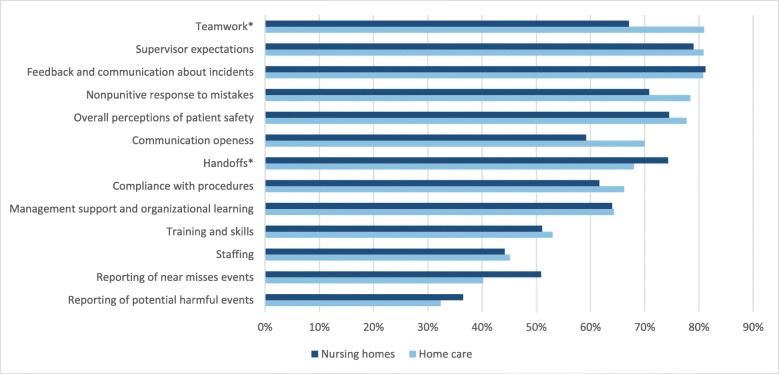
BACKGROUND: Most health care services are provided in the primary health care sector, and an increasing number of elderly is in need of these services. Nonetheless, the research on patient safety culture in home care services and nursing homes remains scarce. This study describes staff perceptions of patient safety culture in Norwegian home care services and nursing homes, and assesses how various patient safety culture dimensions contribute to explaining overall perceptions of patient safety. METHODS: Cross-sectional surveys were conducted among healthcare professionals in Norwegian home care services (N = 139) and nursing homes (N = 165) in 2018, response rates being 67.5% and 65%, respectively. A Norwegian version of the international recognized Nursing Home Survey on Patient Safety Culture was used. Descriptive statistics and t-tests were used to explore staff perceptions of patient safety culture. We used multiple regression analyses to explore the degree to which patient safety culture dimensions could explain overall perceptions of patient safety. RESULTS: The number of patient safety dimensions having an average score of more than 60% positive responses was seven out of 10 in nursing homes, and nine out of 10 in home care. Staffing had the lowest scores in both health care services. Home care services scored significantly higher than nursing homes on teamwork (eta squared = .053), while nursing homes scored somewhat higher on handover (eta squared = .027). In home care, total explained variance of overall perceptions of patient safety was 45%, with teamwork, staffing, and handoffs as significant predictors. The explained variance in nursing homes was 42.7%, with staffing and communication openness as significant predictors. CONCLUSIONS: There are differences in perceptions of patient safety culture between nursing homes and home care services. Staffing is important for patient safety perceptions in both health care services. In home care, teamwork seems to be a significant contributing factor to patient safety, and building sound teams with mutual trust and collaboration should therefore be an essential part of managers' work with patient safety. In nursing homes, the main focus when building a good patient safety culture should be on open communication, ensuring that staff's ideas and suggestions are valued.
Overview
The claims and statistics of this paper haven’t been checked yet.
Run the check — free, no account needed. It reads the open-access text and checks the sources it cites.
Integrity signals
Registry
Cites
Statistics
Figures
Verification
Claims the paper makes
The claims and statistics of this paper haven’t been checked yet.
Run the check — free, no account needed. It reads the open-access text and checks the sources it cites.
Self-check
Percentages, sums and reported differences re-computed from the paper’s own numbers.
The self-check needs the paper’s full text.
Citations
Cites
Psychological Safety and Learning Behavior in Work Teams
Edmondson, A. (1999) · Administrative Science Quarterly · doi:10.2307/2666999 · Cited by 12,026
Research works printed but not linked: 36
- Kohn LT, Corrigan JM, Donaldson MS. To err is human: building a safer health system. Washington (DC): National Academies Press; 2000.
- Ministry of Health and Care Services. Meld. St. 11 (2014–2015). Kvalitet og pasientsikkerhet [Norwegian]. Oslo: Ministry of Health and Care Services; 2014.
- Lawati MHA, Dennis S, Short SD, Abdulhadi NN. Patient safety and safety culture in primary health care: a systematic review. BMC Fam Pract. 2018. https://doi.org/10.1186/s12875-018-0793-7 . · DOI
- Braithwaite J, Herkes J, Ludlow K, Testa L, Lamprell G. Association between organisational and workplace cultures, and patient outcomes: systematic review. BMJ Open. 2017. https://doi.org/10.1136/bmjopen-2017-017708 . · DOI
- Wang X, Liu K, You L, Xiang J, Hud H, Zhang L, et al. The relationship between patient safety culture and adverse events: a questionnaire survey. Int J Nurs Stud. 2014;51(8):1114–22. · DOI
- Najjar S, Nafouri N, Vanhaecht K, Euwema M. The relationship between patient safety culture and adverse events: a study in Palestinian hospitals. Saf Health. 2015. https://doi.org/10.1186/s40886-015-0008-z . · DOI
- Abrahamson K, Hass Z, Morgan K, Fulton B, Ramanujam R. The relationship between nurse-reported safety culture and the patient experience. J Nurs Admin. 2016;46(12):662–8. · DOI
- Gartshore E, Waring J, Timmons S. Patient safety culture in care homes for older people: a scoping review. BMC Health Serv Res. 2017. https://doi.org/10.1186/s12913-017-2713-2 . · DOI · Paper page
- Cappelen K, Aase K, Storm M, Hetland J, Harris A. Psychometric properties of the nursing home survey on patient safety culture in Norwegian nursing homes. BMC Health Serv Res. 2016. https://doi.org/10.1186/s12913-016-1706-x . · DOI
- Cappelen K, Harris A, Aase K. Variability in staff perceptions of patient safety culture in Norwegian nursing homes—a longitudinal cross-sectional study. Saf Health. 2018. https://doi.org/10.1186/s40886-018-0076-y . · DOI
- Bondevik GT, Hofoss D, Husebø BS, Deilkås ECT. Patient safety culture in Norwegian nursing homes. BMC Health Serv Res. 2017. https://doi.org/10.1186/s12913-017-2387-9 . · DOI · Paper page
- Olsen RM, Bjerkan J. Patient safety culture in Norwegian home health nursing: a cross-sectional study of healthcare provider’s perceptions of the teamwork and safety climates. Saf Health. 2017. https://doi.org/10.1186/s40886-017-0066-5 . · DOI
- Wiig S, Ree E, Johannessen T, Strømme T, Storm M, Aase I, et al. Improving quality and safety in nursing homes and home care: the study protocol of a mixed-methods research design to implement a leadership intervention. BMJ Open. 2018. https://doi.org/10.1136/bmjopen-2017-020933 . · DOI
- Sorra J, Franklin M, Streagle S. Nursing home survey on patient safety culture. Rockville: Agency for Healthcare Research and Quality; 2008.
- Haugen AS, Storm M. Sikkerhetskultur i sykehus (Patient safety culture in hospitals). In: Aase K, editor. Pasientsikkerhet - Teori og praksis. Oslo: Universitetsforlaget; 2015. p. 77–86.
- Shieh G. Suppression situations in multiple linear regression. Educ Psychol Meas. 2006;66(3):435–47. · DOI
- Bodur S, Filiz E. A survey on patient safety culture in primary healthcare services in Turkey. Int J Qual Health Care. 2009;21(5):348–55. · DOI
- Cho E, Lee NJ b, Kim EY, Kim S, Lee K, Park KO, et al. Nurse staffing level and overtime associated with patient safety, quality of care, and care left undone in hospitals: a cross-sectional study. Int J Nurs Stud. 2016;60:263–71. · DOI
- Alenius LS, Tishelman C, Runesdotter S. Lindqvist. Staffing and resource adequacy strongly related to RNs’ assessment of patient safety: a national study of RNs working in acute-care hospitals in Sweden. BMJ Qual Saf. 2014;23(3):242–9. · DOI
- Aiken LH, Sloane DM, Bruyneel L, Van den Heede K, Griffiths P, Busse R, et al. Nurse staffing and education and hospital mortality in nine European countries. A retrospective observational study. Lancet. 2014;383:1824–30. · DOI
- McHugh M, Rochman M, Sloane D, Berg R, Mancini M, Nadkarni V, et al. Better nurse staffing and nurse work environments associated with increased survival of in-hospital cardiac arrest patients. Med Care. 2016. https://doi.org/10.1097/MLR.0000000000000456 . · DOI
- Kane RL, Shamliyan TA, Mueller C, Duval S, Wilt TJ. The association of registered nurse staffing levels and patient outcomes: systematic review and meta-analysis. Med Care. 2007;45(12):1195–204. · DOI
- Lawton R, Parker D. Barriers to incident reporting in a healthcare system. BMJ Qual Saf. 2002;11(1):15–8. · DOI
- Edmondson AC. The fearless organization. Creating psychological safety in the workplace for learning, innovation, and growth. Hoboken: John Wiley & Sons; 2019.
- Leroy H, Dierynck B, Anseel F, Simons T, Halbesleben JRB, McCaughey D, et al. Behavioral integrity for safety, priority of safety, psychological safety, and patient safety: a team-level study. J Appl Psychol. 2012;97(6):1273–81. · DOI
- Appelbaum NP, Dow A, Mazmanian PE, Jundt DK, Appelbaum EN. The effects of power, leadership and psychological safety on resident event reporting. Med Educ. 2016;50(3):343–50. · DOI · Paper page
- Wami SD, Demssie AF, Wassie MM, Ahmed AN. Patient safety culture and associated factors: a quantitative and qualitative study of healthcare workers’ view in Jimma zone hospitals, Southwest Ethiopia. BMC Health Serv Res. 2016. https://doi.org/10.1186/s12913-016-1757-z . · DOI
- Olsen E. Workers' perceptions of safety culture at a hospital. Tidsskr Nor Laegeforen. 2007;127(20):2656–60.
- Ballangrud R, Hedelin B, Hall-Lord ML. Nurses’ perceptions of patient safety climate in intensive care units: a cross-sectional study. Intensive Crit Care Nurs. 2012;28(6):344–54. · DOI
- Wagner LM, Capezuti E, Rice JC. Nurses' perceptions of safety culture in long-term care settings. J Nurs Scholarsh. 2009;41(2):184–92. · DOI
- Handler SM, Castle NG, Studenski SA, Perera S, Fridsma DB, Nace DA, et al. Patient safety culture assessment in the nursing home. BMJ Qual Saf. 2006;15(6):400–4. · DOI
- Ammouri TAK, Muliira JK, Geethakrishnan R, Al Kindi SN. Patient safety culture among nurses. Int Nurs Rev. 2015;62(1):102–10. · DOI
- Aase K, Shibevaag L. Researching patient safety and quality in healthcare. A nordic perspective. Boca Raton: Taylor & Francis Group; 2017.
- Quick O. Regulating patient safety. The end of professional dominance? Cambridge: Cambridge University Press; 2017. · DOI
- Wagner A, Rieger MA, Manser T, Sturm H, Hardt J, Martus P, et al. Healthcare professionals’ perspectives on working conditions, leadership, and safety climate: a cross-sectional study. BMC Health Serv Res. 2019. https://doi.org/10.1186/s12913-018-3862-7 . · DOI
- Deilkås E, Hofoss D. Patient safety culture lives in departments and wards: multilevel partitioning of variance in patient safety culture. BMC Health Serv Res. 2010. https://doi.org/10.1186/1472-6963-10-85 . · DOI
Metadata
- Authors
- Ree, E., & Wiig, S.
- Affiliations
- University of Stavanger (NO)
- Corresponding author
- Ree, Eline
- ORCID
- Venue
- BMC Health Services Research
- Published
- 2019-08-29
- Volume
- 19
- Issue
- 1
- Pages
- 607-607
- ISSN
- 1472-6963 (ISSN-L)
- PMC
- PMC6716833
- OpenAlex
- W2970654686
- Cited by
- 72
- References
- 1
- Citations by year
- 2026: 2 · 2025: 7 · 2024: 6 · 2023: 16 · 2022: 19 · 2021: 12 · 2020: 10
- FWCI
- 14.57
- Type
- journal article
- Language
- en
- Open access
- gold
- doi.org
- Locations
- BMC Health Services Research (publishedVersion, cc-by)
- Europe PMC (PubMed Central) (publishedVersion, cc-by)
- PubMed Central (publishedVersion, cc-by)
- PubMed (publishedVersion)
- DOAJ (DOAJ: Directory of Open Access Journals) (submittedVersion)
- NORA - Norwegian Open Research Archives (submittedVersion, cc-by)
- Funders
- Norges Forskningsråd (256681/H10)
- Topics
- Health Sciences › Medicine › Public Health, Environmental and Occupational Health › Patient Safety and Medication Errors
- Health Sciences › Nursing › Leadership and Management › Hospital Admissions and Outcomes
- Health Sciences › Medicine › Public Health, Environmental and Occupational Health › Healthcare Quality and Management
- Keywords
- patient safety culture, nursing homes, home care, employee perceptions, teamwork, staffing, handover, open communication, elderly care, primary care
- MeSH terms
- Adult, Aged, Attitude of Health Personnel, Communication, Cross-Sectional Studies, Female, Health Personnel, Health Services, Home Care Services, Homes for the Aged, Humans, Male, Middle Aged, Norway, Nursing Homes, Patient Care Team, Primary Health Care, Surveys and Questionnaires, Safety Management, Young Adult, Patient Safety
About these checks
Registry, retraction, Cites and statistics results are computed, not judged, with one exception: a printed reference that no index lists is read once by a model before it counts as a citation error. Claims are extracted by a model and kept only when their quote appears verbatim in the text; each cited source is then checked, with a model’s help, for whether it says what the claim relies on. Those verdicts can be wrong — read the claim’s quote and the cited source before relying on one.
Statistics and arithmetic are recomputed, not judged.
Confidence bands are shown only for fields calibrated on our annotated test set. None is calibrated yet, so no band is shown.
What counts as a claim ›How we measure confidence ›How we check this ›
Are you an author, or do you see a problem with this page? Request a review
