

When patients decide the admission – a four year pre-post study of changes in admissions and inpatient days following patient controlled admission contracts
Open accessThe DOI matches its Crossref record; 13 of the 14 references it cites were found in a registry or an index.
Abstract
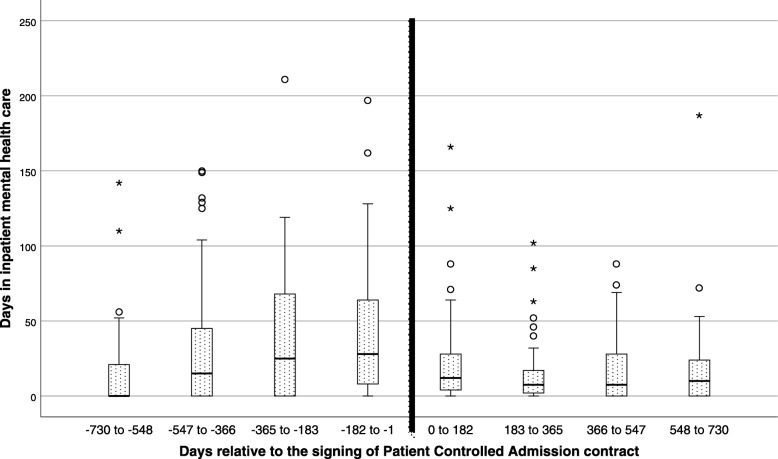
Background: Mental health professionals usually decide patients’ access to inpatient care to ensure the rational and fair distribution of care based on need and prognosis. The purpose of the current study is to investigate the effects of increasing patients’ influence on admission by enabling patients to initiate brief inpatient stays of up to five days at a community mental health center. Patients can initiate admission according to their own discretion, outside the existing referral and gatekeeping system. Methods: Patient-controlled admission (PCA) contracts were offered to eligible patients for inpatient stays in four community mental health centers in one health trust in Norway. Data on included patients’ inpatient stays at any of the hospitals’ mental health or addiction wards were collected by hospital electronic journal data extraction specialists for the two years before PCA contracts were introduced and the first two years after PCA contracts were introduced for the included patients. Results: The included patients ( n = 57) had 406 PCAs in the two years following signing PCA contracts. When comparing the periods before and after the introduction of the contracts, the total number of admissions increased from 203 to 498 ( p < .001), while the number of inpatient days decreased from 7172 to 3178 ( p < .001). No significant change in involuntary care was observed. A comparison of box plots of inpatient day use in the eight half-year periods of the study indicates a gradual increase in median inpatient days up to the signing of a PCA contract for the sample, and an abrupt reduction to a stable median level of inpatient days after signing a contract. Conclusions: The included patients’ use of inpatient days changed profoundly after signing PCA contracts, similar to what previous studies of PCAs have indicated. In spite of the marked reductions in inpatient days, the pre-post design makes it impossible to rule out that the reductions were caused by regression toward the mean. No study of PCAs has reported negative effects, indicating that giving patients control over very short admissions is a feasible and potentially positive scheme in mental health care wards.
Overview
The claims and statistics of this paper haven’t been checked yet.
Free: it reads the open-access text and checks the first 5 claims that cite a source we can check. Create a free account to check every claim.
Integrity signals
Registry
Cites
Statistics
Figures
Verification
Claims the paper makes
The claims and statistics of this paper haven’t been checked yet.
Free: it reads the open-access text and checks the first 5 claims that cite a source we can check. Create a free account to check every claim.
Claims other papers make about this one
Each is checked against this paper’s own text: does it say what the citing paper says it does?
The source backs part of the claim, not all of it — or backs it for a different population, condition or comparison.
In the citing paper
“Previous studies on both adult and adolescent patients have demonstrated a reduced need for inpatient care with brief admissions [7,27,28,29].”
From Implementation of Brief Admission by Self-Referral in Child and Adolescent Psychiatry in Sweden: Insights from Implementers and Staff (2023) · cites this paper as [27]
Experimental — accuracy not yet measured
Self-check
Percentages, sums and reported differences re-computed from the paper’s own numbers.
The self-check needs the paper’s full text.
Citations
Cites
Cohen, J. (1992) · Psychological Bulletin · doi:10.1037//0033-2909.112.1.155 · Cited by 8,771
Health of the Nation Outcome Scales (HoNOS): Research and development
Wing, J. K., Beevor, A. S., Curtis, R. H., Park, S. G. B., Hadden, J., & Burns, A. (1998) · British Journal of Psychiatry · doi:10.1192/bjp.172.1.11 · Cited by 1,203
Alcohol Use and Abuse in Schizophrenia: A Prospective Community Study
DRAKE, R. E., OSHER, F. C., & WALLACH, M. A. (1989) · The Journal of Nervous and Mental Disease · doi:10.1097/00005053-198907000-00004 · Cited by 470
Helleman, M., Goossens, P. J. J., Kaasenbrood, A., & van Achterberg, T. (2014) · Perspectives in Psychiatric Care · doi:10.1111/ppc.12023 · Cited by 59
Patient-controlled hospital admission in psychiatry: A systematic review
Strand, M., & von Hausswolff-Juhlin, Y. (2015) · Nordic Journal of Psychiatry · doi:10.3109/08039488.2015.1025835 · Cited by 50
Thomsen, C. T., Benros, M. E., Maltesen, T., Hastrup, L. H., Andersen, P. K., Giacco, D., & Nordentoft, M. (2018) · Acta Psychiatrica Scandinavica · doi:10.1111/acps.12868 · Cited by 32
Sigrunarson, V., Moljord, I. E. O., Steinsbekk, A., Eriksen, L., & Morken, G. (2017) · Nordic Journal of Psychiatry · doi:10.1080/08039488.2016.1240231 · Cited by 31
A Patient-Based Voucher System for Brief Hospitalisation
Little, J., & Stephens, D. (1999) · Australian & New Zealand Journal of Psychiatry · doi:10.1046/j.1440-1614.1999.00558.x · Cited by 25
[Patient-guided crisis admissions for severe psychotic conditions].
Heskestad, S., & Tytlandsvik, M. (2008) · PubMed · Cited by 23
Use of patient-controlled psychiatric hospital admissions: patients’ perspective
Ellegaard, T., Bliksted, V., Lomborg, K., & Mehlsen, M. (2017) · Nordic Journal of Psychiatry · doi:10.1080/08039488.2017.1302505 · Cited by 22
Research works printed but not linked: 3
- Heskestad S Tytlandsvik M Brukerstyrte kriseinnleggelser ved alvorlig psykisk lidelse. [Patient-guided crisis admissions for severe mental disorder] Tidsskr Nor Laegeforen 2008 128 1 32 35 18183054
- Johansen LMW Personalets erfaringer med brukerstyrt plass på DPS [Staff experiences with Patient Controlled Admissins at Community Mental Health Centres]. Master thesis 2014 Norway University of Stavanger
- World Health Organization The ICD-10 classification of mental and behavioural disorders: clinical descriptions and diagnostic guidelines 1992 Geneva World Health Organization
Cited by
Johansson, B. A., Holmström, E., Eberhard, S., Lindgren, A., & Rask, O. (2023) · The Lancet Psychiatry · doi:10.1016/s2215-0366(23)00157-8 · Cited by 18
Eckerström, J., Carlborg, A., Flyckt, L., & Jayaram‐Lindström, N. (2022) · Issues in Mental Health Nursing · doi:10.1080/01612840.2021.2018530 · Cited by 18
Eckerström, J., Rosendahl, I. K., Lindkvist, R., Amin, R., Carlborg, A., Flyckt, L., & Jayaram‐Lindström, N. (2024) · International Journal of Mental Health Nursing · doi:10.1111/inm.13371 · Cited by 16
Skott, M., Durbeej, N., Smitmanis-Lyle, M., Hellner, C., Allenius, E., Salomonsson, S., Lundgren, T., Jayaram-Lindström, N., & Rozental, A. (2021) · BMC Health Services Research · doi:10.1186/s12913-021-06617-8 · Cited by 12
“A recent study with a four-year follow-up suggests that results are maintained over time [18], but could however not rule out regression to the mean as a possible explanation for the results, implying that more research needs to be conducted on a long-term basis.”
ResultInfluentialLindgren, T., Westdahl, J., Stjernswärd, S., Saliba‐Gustafsson, E. A., Flyckt, L., Jayaram‐Lindström, N., & Eckerström, J. (2023) · Issues in Mental Health Nursing · doi:10.1080/01612840.2023.2270059 · Cited by 12
Metadata
- Authors
- Nyttingnes, O., & Ruud, T.
- Affiliations
- Akershus University Hospital (NO)
- University of Oslo (NO)
- Corresponding author
- Nyttingnes, Olav
- Venue
- BMC Health Services Research
- Published
- 2020-03-18
- Volume
- 20
- Issue
- 1
- Pages
- 229-229
- ISSN
- 1472-6963 (ISSN-L)
- PMC
- PMC7079511
- OpenAlex
- W3012397728
- Cited by
- 14
- References
- 14
- Citations by year
- 2026: 1 · 2025: 3 · 2024: 1 · 2023: 3 · 2022: 2 · 2021: 4
- FWCI
- 0.90
- Type
- journal article
- Language
- en
- Open access
- gold
- doi.org
- Licence
- cc-by
- creativecommons.org/licenses/by/4.0/ (tdm)
- creativecommons.org/licenses/by/4.0/ (vor)
- Locations
- BMC Health Services Research (publishedVersion, cc-by)
- PubMed Central (publishedVersion, cc-by)
- PubMed (publishedVersion)
- DOAJ (DOAJ: Directory of Open Access Journals) (submittedVersion, cc-by-sa)
- NORA - Norwegian Open Research Archives (submittedVersion, cc-by)
- Topics
- Social Sciences › Psychology › Clinical Psychology › Psychiatric care and mental health services
- Social Sciences › Psychology › Clinical Psychology › Healthcare Decision-Making and Restraints
- Health Sciences › Health Professions › General Health Professions › Mental Health and Patient Involvement
- Keywords
- community mental health centers, inpatient days, mental health services, patient empowerment, gatekeeping, involuntary care, short-stay admissions, regression to the mean
- MeSH terms
- Adult, Aged, Mental Disorders, Community Mental Health Centers, Decision Making, Female, Hospitalization, Humans, Interviews as Topic, Male, Middle Aged, Norway, Patient Admission, Referral and Consultation, Databases, Factual, Contracts, Qualitative Research, Young Adult
About these checks
Registry, retraction, Cites and statistics results are computed, not judged, with one exception: a printed reference that no index lists is read once by a model before it counts as a citation error. Claims are extracted by a model and kept only when their quote appears verbatim in the text; each cited source is then checked, with a model’s help, for whether it says what the claim relies on. Those verdicts can be wrong — read the claim’s quote and the cited source before relying on one.
Statistics and arithmetic are recomputed, not judged.
Confidence bands are shown only for fields calibrated on our annotated test set. None is calibrated yet, so no band is shown.
What counts as a claim ›How we measure confidence ›How we check this ›
Are you an author, or do you see a problem with this page? Request a review
How to cite
Cite CoChat for the checks on this page, and the paper for its own findings.
- This page
- CoChat. (2026). Citation check: When patients decide the admission – a four year pre-post study of changes in admissions and inpatient days following patient controlled admission contracts. https://app.cochat.ai/papers/10.1186/s12913-020-05101-z
- The paper
- Nyttingnes, O., & Ruud, T. (2020). When patients decide the admission – a four year pre-post study of changes in admissions and inpatient days following patient controlled admission contracts. BMC Health Services Research. https://doi.org/10.1186/s12913-020-05101-z
Data sources
Bibliographic data: Semantic Scholar, OpenAlex, Crossref.
Contains information from the Semantic Scholar Academic Graph Datasets, made available under the ODC Attribution License (ODC-BY 1.0).
Semantic Scholar’s data is described in: Kinney, R., et al. (2023). The Semantic Scholar Open Data Platform. arXiv:2301.10140.
