

The DOI matches its Crossref record; the references it cites are not checked yet.
Examining innovation in hospital units: a complex adaptive systems approach
Open accessPublished version of a preprint
Abstract
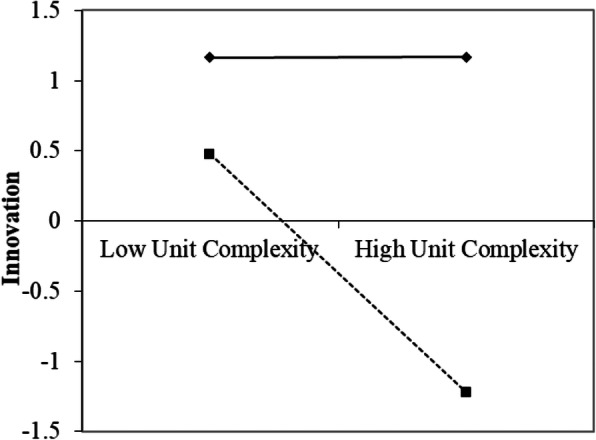
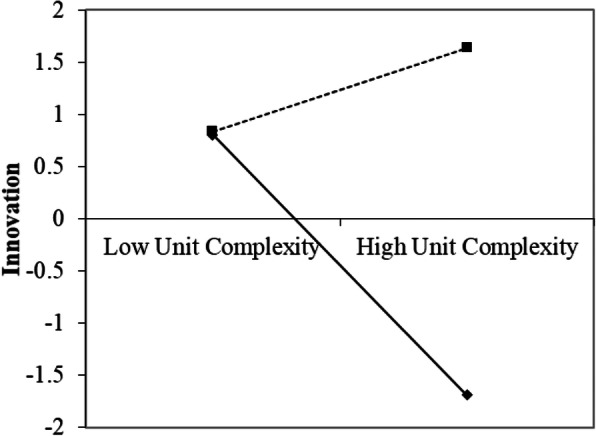
Background: We are in an innovation age for healthcare delivery. Some note that the complexity of healthcare delivery may make innovation in this setting more difficult and may require more adaptive solutions. The aim of this study is to examine the relationship between unit complexity and innovation, using a complex adaptive systems approach in a hospital setting. Methods: We conducted a quantitative study of 31 hospital units within one hospital and use complex adaptive systems (CAS) theory to examine how two CAS factors, autonomy and performance orientation, moderate the relationship between unit complexity and innovation. Results: We find that unit complexity is associated with higher innovation performance when autonomy is low rather than high. We also find that unit complexity is associated with higher innovation performance when performance orientation is high rather than low. Our findings make three distinct contributions: we quantify the influence of complexity on innovation success in the health care sector, we examine the impact of autonomy on innovation in health care, and we are the first to examine performance orientation on innovation in health care. Conclusions: This study tackles the long debate about the influence of complexity on healthcare delivery, particularly innovation. Instead of being subject to the influence of complexity with no means of making progress or gaining control, hospitals looking to implement innovation programs should provide guidance to teams and departments regarding the type of innovation sought and provide support in terms of time and management commitment. Hospitals should also find ways to promote and make successful pilot implementations of such innovations visible in the organization. A close connection between the targeted innovation and the overall success and performance of the hospital unit is ideal.
Overview
The claims and statistics of this paper haven’t been checked yet.
Run the check — free, no account needed. It reads the open-access text and checks the sources it cites.
Integrity signals
Registry
Cites
Statistics
Figures
Verification
Claims the paper makes
The claims and statistics of this paper haven’t been checked yet.
Run the check — free, no account needed. It reads the open-access text and checks the sources it cites.
Claims other papers make about this one
Each is checked against this paper’s own text: does it say what the citing paper says it does?
The cited source says what the claim attributes to it.
In the citing paper
“Healthcare is described as a complex adaptive system, discouraging simplistic linear cause-and-effect reasoning [8,9].”
From The NASSS (Non-Adoption, Abandonment, Scale-Up, Spread and Sustainability) framework use over time: A scoping review (2025) · cites this paper as [8]
Self-check
Percentages, sums and reported differences re-computed from the paper’s own numbers.
The self-check needs the paper’s full text.
Citations
The citation lists haven’t been fetched yet
References 61 · Cited by 57
Research works printed but not linked: 5
- Toussaint T, DaSilva K, Toussaint JS. How Atrius health is making the shift from volume to value: Harvard Business Review; 2016.
- Rouse W. Health care as a complex adaptive system: implications for design and management. Bridg Acad Eng. 2008;38(1):17.
- Aleu FG, Van Aken EM, Cross J, Glover W. “Determinants of goal achievement for Continuous improvement projects in hospitals,” in 67th Annual Conference and Expo of the Institute of Industrial Engineers 2017; 2017.
- Farris JA, Van Aken EM, Doolen TL, Worley JM. A study of mediating relationships on kaizen event teams. In: Proceedings of the 2007 industrial engineering and research conference; 2007.
- Puranam P, Singh H, Zollo M. Organizing for innovation: managing the coordination-autonomy dilemma in technology acquisitions. Acad Manag J. 2006;49(2):263–80. · DOI
Metadata
- Authors
- Glover, W. J., Nissinboim, N., & Naveh, E.
- Affiliations
- Babson College (US)
- Technion – Israel Institute of Technology (IL)
- Corresponding author
- Glover, Wiljeana Jackson
- Venue
- BMC Health Services Research
- Published
- 2020-06-18
- Volume
- 20
- Issue
- 1
- Pages
- 554-554
- ISSN
- 1472-6963 (ISSN-L)
- PMC
- PMC7302354
- OpenAlex
- W3036214367
- Cited by
- 57
- References
- 61
- Citations by year
- 2026: 9 · 2025: 11 · 2024: 14 · 2023: 5 · 2022: 13 · 2021: 3 · 2020: 1
- FWCI
- 4.67
- Type
- journal article
- Language
- en
- Open access
- gold
- doi.org
- Locations
- BMC Health Services Research (publishedVersion, cc-by)
- Research Square (acceptedVersion, cc-by)
- PubMed Central (publishedVersion, cc-by)
- PubMed (publishedVersion)
- DOAJ (DOAJ: Directory of Open Access Journals) (submittedVersion, cc-by-sa)
- Funders
- Massachusetts Institute of Technology (n/a)
- Topics
- Health Sciences › Medicine › Public Health, Environmental and Occupational Health › Healthcare Quality and Management
- Health Sciences › Health Professions › General Health Professions › Health Services Management and Policy
- Social Sciences › Business, Management and Accounting › Strategy and Management › Organizational Leadership and Management Strategies
- Keywords
- healthcare innovation, hospital departments, complex adaptive systems, organizational autonomy, performance orientation, innovation performance, pilot implementation
- MeSH terms
- Delivery of Health Care, Hospital Units, Hospitals, Humans, Organizational Innovation, Systems Analysis, Systems Theory
About these checks
Registry, retraction, Cites and statistics results are computed, not judged, with one exception: a printed reference that no index lists is read once by a model before it counts as a citation error. Claims are extracted by a model and kept only when their quote appears verbatim in the text; each cited source is then checked, with a model’s help, for whether it says what the claim relies on. Those verdicts can be wrong — read the claim’s quote and the cited source before relying on one.
Statistics and arithmetic are recomputed, not judged.
Confidence bands are shown only for fields calibrated on our annotated test set. None is calibrated yet, so no band is shown.
What counts as a claim ›How we measure confidence ›How we check this ›
Are you an author, or do you see a problem with this page? Request a review
How to cite
Cite CoChat for the checks on this page, and the paper for its own findings.
- This page
- CoChat. (2026). Citation check: Examining innovation in hospital units: a complex adaptive systems approach. https://app.cochat.ai/papers/10.1186/s12913-020-05403-2
- The paper
- Glover, W. J., Nissinboim, N., & Naveh, E. (2020). Examining innovation in hospital units: a complex adaptive systems approach. BMC Health Services Research. https://doi.org/10.1186/s12913-020-05403-2
