

The DOI matches its Crossref record; 20 of the 21 references it cites were found in a registry or an index.
Evidence that collaborative action between local health departments and nonprofit hospitals helps foster healthy behaviors in communities: a multilevel study
Open accessAbstract
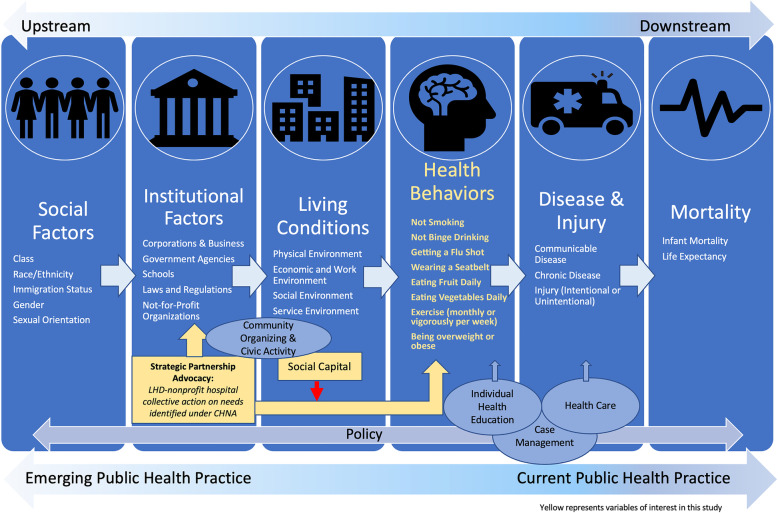
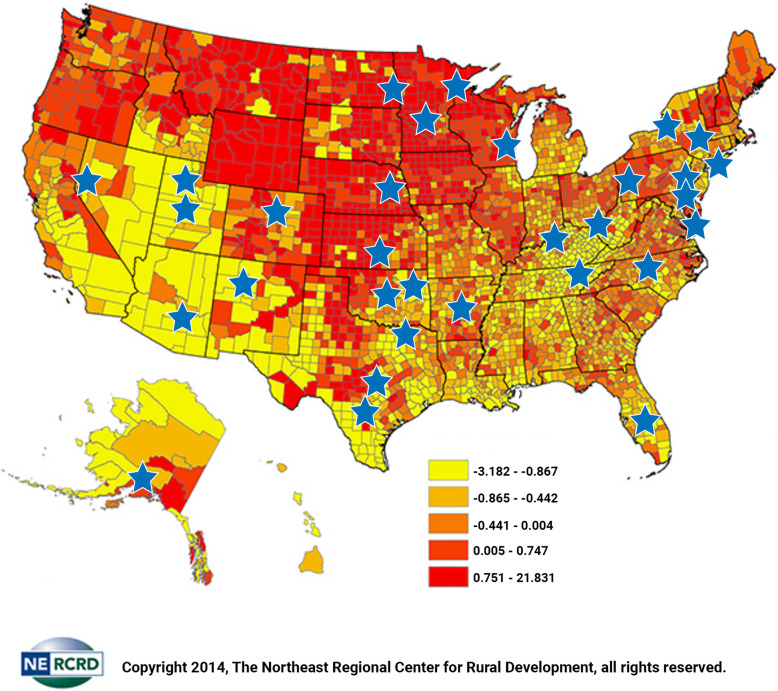
Background: The Patient Protection and Affordable Care Act of 2010 (ACA) encouraged nonprofit hospitals to collaborate with local public health experts in the conduct of community health needs assessments (CHNAs) for the larger goal of improving community health. Yet, little is known about whether collaborations between local health departments and hospitals may be beneficial to community health. In this study, we investigated whether individuals residing in communities with stronger collaboration between nonprofit hospitals and local public health departments (LHDs) reported healthier behaviors. We further explored whether social capital acts as a moderating factor of these relationships. Methods: We used multilevel cross-sectional models, controlling for both individual and community-level factors to explore LHD-hospital collaboration (measured in the National Association of County and City Health Officials (NACCHO) Forces of Change Survey), in relation to individual-level health behaviors in 56,826 adults living in 32 metropolitan and micropolitan statistical areas, captured through the 2015 Behavioral Risk Factor Surveillance System (BRFSS) SMART dataset. Nine health behaviors were examined including vigorous exercise, eating fruits and vegetables, smoking and binge drinking. Social capital, measured using an index developed by the Northeast Regional Center for Rural Development, was also explored as an effect modifier of these relationships. Results: Stronger collaboration between nonprofit hospitals and LHDs was associated with not smoking (odds ratio, OR 1.32, 95% CI 1.11 to 1.58), eating vegetables daily (OR 1.29; 95% CI 1.06 to 1.57), and vigorous exercise (OR 1.17; 95% CI 1.05 to 1.30). The presence of higher social capital also strengthened the relationships between LHD-hospital collaborations and wearing a seatbelt (p for interaction = 0.01) and general exercise (p for interaction = 0.03). Conclusions: Stronger collaboration between nonprofit hospitals and LHDs was positively associated with healthier individual-level behaviors. Social capital may also play a moderating role in improving individual and population health.
Overview
The claims and statistics of this paper haven’t been checked yet.
Run the check — free, no account needed. It reads the open-access text and checks the sources it cites.
Integrity signals
Registry
Cites
Statistics
Figures
Verification
Claims the paper makes
The claims and statistics of this paper haven’t been checked yet.
Run the check — free, no account needed. It reads the open-access text and checks the sources it cites.
Claims other papers make about this one
Each is checked against this paper’s own text: does it say what the citing paper says it does?
In the citing paper
“The health information of a patient may be distributed among an unspecified number of healthcare facilities. A hospital's medical information are not interchangeable and accessible to another health institution.”
From Interoperability of heterogeneous health information systems: a systematic literature review (2023) · cites this paper as [7]
In the citing paper
“In a given situation, the health professional does not have access to the whole of the patient's medical information unless the patient is conscious and can provide the information that the health professional requires to make an informed and individualized decision on the best course of action at the time [7].”
From Interoperability of heterogeneous health information systems: a systematic literature review (2023) · cites this paper as [7]
Self-check
Percentages, sums and reported differences re-computed from the paper’s own numbers.
The self-check needs the paper’s full text.
Citations
Cites
Bowling alone: the collapse and revival of American community
(2000) · Choice Reviews Online · doi:10.5860/choice.38-2454 · Cited by 28,723
Bowling Alone: The Collapse and Revival of American Community
Keddy, J. L. (2001) · Spiritus · doi:10.1353/scs.2001.0014 · Cited by 3,798
The production of social capital in US counties
Rupasingha, A., Goetz, S. J., & Freshwater, D. (2006) · The Journal of Socio-Economics · doi:10.1016/j.socec.2005.11.001 · Cited by 885
Austin, J. E., & Seitanidi, M. M. (2012) · Nonprofit and Voluntary Sector Quarterly · doi:10.1177/0899764012450777 · Cited by 790
Inequalities in Life Expectancy Among US Counties, 1980 to 2014
Dwyer‐Lindgren, L., Bertozzi-Villa, A., Stubbs, R. W., Morozoff, C., Mackenbach, J. P., van Lenthe, F. J., Mokdad, A. H., & Murray, C. J. L. (2017) · JAMA Internal Medicine · doi:10.1001/jamainternmed.2017.0918 · Cited by 418
U.S. Health in International Perspective: Shorter Lives, Poorer Health
(2016) · Military Medicine · doi:10.7205/milmed-d-16-00227 · Cited by 373
Mays, G. P., Mamaril, C. B., & Timsina, L. (2016) · Health Affairs · doi:10.1377/hlthaff.2016.0848 · Cited by 118
Multilevel Models for Categorical Data using SAS ® PROC GLIMMIX: The Basics
Ene, M., Leighton, E. A., Blue, G. L., & Bell, B. A. (2014) · Cited by 110
Nonprofit Hospitals’ Approach to Community Health Needs Assessment
Pennel, C. L., McLeroy, K. R., Burdine, J. N., & Matarrita‐Cascante, D. (2015) · American Journal of Public Health · doi:10.2105/ajph.2014.302286 · Cited by 106
The Progress of US Hospitals in Addressing Community Health Needs
Cramer, G. R., Singh, S. R., Flaherty, S. F., & Young, G. J. (2016) · American Journal of Public Health · doi:10.2105/ajph.2016.303570 · Cited by 58
Self-citation
Research works printed but not linked: 10
- University of Wisconsin Population Health Institute. County Health Rankings Key Findings 2018. 2018. Available at: https://www.countyhealthrankings.org/resources/2018-county-health-rankings-key-findings-report. Accessed on May 18, 2020.
- Trust for America’s Health. The Impact of Chronic Underfunding of America’s Public Health System: Trends, Risks, and Recommendations, 2019. 2019. Available at: https://www.tfah.org/report-details/2019-funding-report/. Accessed on: May 18, 2020.
- United States Government. An Act Entitled The Patient Protection and Affordable Care Act. In: Department of Health and Human Services, ed. Obama Care Act. Washington, D.C.: U.S. G.P.O.; 2010.
- Bay Area Regional Health Inequities Initiative (BARHII). A Public Health Framework for Reducing Health Inequities. 2015; http://barhii.org/framework/. Accessed August 3, 2018.
- Mattessich P, Monsey B. Community building: what makes it work. St. Paul: Amherst H. Wilder Foundation; 1997.
- Providence Alaska Medical Center. Anchorage Community Health Needs Assessment. 2015. Available at: https://www.psjhealth.org/-/media/files/providence-st-joseph-health/community-benefit/ak/2015chnaandchipprovidencealaskamedicalcenter.pdf?la=en. Published: 2015.
- National Association of County and City Health Officials (NACCHO). About. 2019; https://www.naccho.org/about. Accessed June 10, 2019.
- National Association of County and City Health Officials. Forces of Change Survey. 2015. http://nacchoprofilestudy.org/forces-of-change/2015-forces-of-change/.
- Hilltop Institute. Community benefit state law profiles. Baltimore: University of Maryland; 2013. https://hilltopinstitute.org/our-work/hospital-community-benefit/hcbp-state-comparison/.
- Chaudhary KR, Schreiber-Gregory DN. Multiple Imputation for Arbitrary Missing Data: SAS® and R. Available at: https://www.mwsug.org/proceedings/2015/TT/MWSUG-2015-TT-04.pdf. Published: 2015.
Cited by
Sorted by citations
COVID-19 and resilience of healthcare systems in ten countries
Arsenault, C., Gage, A., Kim, M. K., Kapoor, N. R., Akweongo, P., Amponsah, F., Aryal, A., Asai, D., Awoonor-Williams, J. K., Ayele, W., et al. (2022) · Nature Medicine · doi:10.1038/s41591-022-01750-1 · Cited by 554
Interoperability of heterogeneous health information systems: a systematic literature review
Torab-Miandoab, A., Samad-Soltani, T., Jodati, A., & Rezaei-Hachesu, P. (2023) · BMC Medical Informatics and Decision Making · doi:10.1186/s12911-023-02115-5 · Cited by 393
Patel, H., Perry, S., Badu, E., Mwangi, F., Onifade, O., Mazurskyy, A., Walters, J., Tavener, M., Noble, D., Chidarikire, S., et al. (2025) · BMC Medical Education · doi:10.1186/s12909-025-06969-3 · Cited by 131
Natali, C., Marconi, L., Dias Duran, L. D., & Cabitza, F. (2025) · Artificial Intelligence Review · doi:10.1007/s10462-025-11352-1 · Cited by 143
Capacities for resilience in healthcare; a qualitative study across different healthcare contexts
Lyng, H. B., Macrae, C., Guise, V., Haraldseid-Driftland, C., Fagerdal, B., Schibevaag, L., & Wiig, S. (2022) · BMC Health Services Research · doi:10.1186/s12913-022-07887-6 · Cited by 111
Metadata
- Authors
- Cramer, G. R., Young, G. J., Singh, S., McGuire, J., & Kim, D.
- Affiliations
- Northeastern University (US)
- University of Michigan (US)
- Corresponding author
- Kim, Daniel
- Venue
- BMC Health Services Research
- Published
- 2021-01-02
- Volume
- 21
- Issue
- 1
- Pages
- 1-1
- ISSN
- 1472-6963 (ISSN-L)
- PMC
- PMC7777410
- OpenAlex
- W3119111511
- Cited by
- 179
- References
- 21
- Citations by year
- 2026: 5 · 2025: 52 · 2024: 38 · 2023: 28 · 2022: 44 · 2021: 12
- FWCI
- 34.54
- Type
- journal article
- Language
- en
- Open access
- gold
- doi.org
- Locations
- BMC Health Services Research (publishedVersion, cc-by)
- Europe PMC (PubMed Central) (publishedVersion, other-oa)
- PubMed Central (publishedVersion, cc-by)
- PubMed (publishedVersion)
- Deep Blue (University of Michigan) (submittedVersion)
- DOAJ (DOAJ: Directory of Open Access Journals) (submittedVersion, cc-by-sa)
- University of Michigan Library
- Topics
- Health Sciences › Medicine › Public Health, Environmental and Occupational Health › Community Health and Development
- Health Sciences › Medicine › Public Health, Environmental and Occupational Health › Public Health Policies and Education
- Social Sciences › Economics, Econometrics and Finance › Economics and Econometrics › Healthcare Policy and Management
- Keywords
- local health departments, nonprofit hospitals, community health needs assessment, social capital, health behavior, smoking, fruit and vegetable intake, physical activity, seat belt use, binge drinking, Affordable Care Act, community health
- MeSH terms
- Adult, Cross-Sectional Studies, Hospitals, Humans, Organizations, Nonprofit, Public Health, United States, Health Behavior, Patient Protection and Affordable Care Act
About these checks
Registry, retraction, Cites and statistics results are computed, not judged, with one exception: a printed reference that no index lists is read once by a model before it counts as a citation error. Claims are extracted by a model and kept only when their quote appears verbatim in the text; each cited source is then checked, with a model’s help, for whether it says what the claim relies on. Those verdicts can be wrong — read the claim’s quote and the cited source before relying on one.
Statistics and arithmetic are recomputed, not judged.
Confidence bands are shown only for fields calibrated on our annotated test set. None is calibrated yet, so no band is shown.
What counts as a claim ›How we measure confidence ›How we check this ›
Are you an author, or do you see a problem with this page? Request a review
