

The practice of integrated healthcare and the experiences of people in Ghana’s Ashanti region
Open accessThe DOI matches its Crossref record; 42 of the 42 references it cites were found in a registry or an index.
Abstract
Background: The Ghanaian government has implemented interventions that integrate traditional medicine (TM) into its national health system in response to the high prevalence of TM use. However, empirical evidence of the experiences of service users and the practice of integrated health in Ghana is scanty. Therefore, this study explored the experiences of people with TM integration into the formal health system in Ashanti region using an adapted TM integration framework. Methods: A sequential explanatory mixed methods study design comprising survey administration and in-depth interviews for data collection was utilised to address the research objective. Framework analysis was used in analysing the qualitative data and for triangulation of results. Results: Participants were aware of licensing and training of TM practitioners in a science-based university in Ghana. However, knowledge of the existence of TM units in selected hospitals in the region was minimal. Integration knowledge was largely influenced by sex, marital status, household size and residential status, where males and urban dwellers were more familiar with the process than females and rural dwellers. Low patronage of integrated health services in the region was attributable to weak cross referrals. However, service users who had engaged with the integrated system recounted a satisfactory outcome. Conclusion: Service users’ unfamiliarity with the presence of integrated facilities in Ghana could be an impediment to the practice of integrated healthcare. Sensitisation of the public about the practice of an integrated system could refine the Ghanaian integrated system. Regular evaluation of patient satisfaction and outcome measures might also serve as an effective strategy for improving health services delivery since evaluation is becoming an important component of health service design and implementation. There is the need for future studies to focus on exploring the perceptions and experiences of health practitioners and hospital administrators regarding the practice of integrated health in Ghana.
Overview
The claims and statistics of this paper haven’t been checked yet.
Free: it reads the open-access text and checks the first 5 claims that cite a source we can check. Create a free account to check every claim.
Integrity signals
Registry
Cites
Statistics
Figures
Verification
Claims the paper makes
The claims and statistics of this paper haven’t been checked yet.
Free: it reads the open-access text and checks the first 5 claims that cite a source we can check. Create a free account to check every claim.
Claims other papers make about this one
Each is checked against this paper’s own text: does it say what the citing paper says it does?
The check wasn’t confident either way, so it gives no verdict — never disputed.
In the citing paper
“However, care for individuals with co‐occurring disorders remains weakly coordinated, with limited integration between mental health and substance use services, inconsistent follow‐up and delayed intervention during relapse episodes [24].”
From Treatment Experiences of Individuals With Co-Occurring Mental Health and Substance Use Disorders and Perspectives of Mental Health Workers in Ashanti Region, Ghana (2026) · cites this paper as [24]
Experimental — accuracy not yet measured
Self-check
Percentages, sums and reported differences re-computed from the paper’s own numbers.
The self-check needs the paper’s full text.
Citations
Cites
Tong, A., Sainsbury, P., & Craig, J. (2007) · International Journal for Quality in Health Care · doi:10.1093/intqhc/mzm042 · Cited by 42,509
How Many Interviews Are Enough?: An Experiment with Data Saturation and Variability
Guest, G., Bunce, A., & Johnson, L. (2006) · Field Methods · doi:10.1177/1525822x05279903 · Cited by 20,808 · cited 1×
“Data saturation was achieved when explicit concepts/opinions kept iterating [51] after the 16th interview.”
BackgroundToward a Conceptual Framework for Mixed-Method Evaluation Designs
Greene, J. C., Caracelli, V. J., & Graham, W. F. (1989) · Educational Evaluation and Policy Analysis · doi:10.3102/01623737011003255 · Cited by 5,687 · cited 1×
“The mixed methods approach was adopted to strengthen the validity of the study findings by neutralising biases associated with both quantitative and qualitative approaches [44, 47].”
MethodWhy Patients Use Alternative Medicine: Results of a National Study
Astin, J. A. (1998) · JAMA · doi:10.1001/jama.279.19.1548 · Cited by 2,865 · cited 1×
“Integrative medicine has a patient-centred approach to healing and a comprehensive emphasis on healthcare rather than an ailment-centred approach [5, 6].”
BackgroundTraditional, complementary and alternative medicine use in Sub-Saharan Africa: a systematic review
James, P. B., Wardle, J., Steel, A., & Adams, J. (2018) · BMJ Global Health · doi:10.1136/bmjgh-2018-000895 · Cited by 494 · cited 1×
“Other interventions introduced include the inauguration of a TM department in a science-based university in Ghana (Kwame Nkrumah University of Science and Technology) in the year 2001 to train TM practitioners [4, 10, 19, 20].”
BackgroundHerbal medicine use among urban residents in Lagos, Nigeria
Oreagba, I. A., Oshikoya, K. A., & Amachree, M. (2011) · BMC Complementary and Alternative Medicine · doi:10.1186/1472-6882-11-117 · Cited by 239
A Conceptual Framework for Quality of Care
Mosadeghrad, A. M. (2012) · Materia Socio Medica · doi:10.5455/msm.2012.24.251-261 · Cited by 221
Campbell-Hall, V., Petersen, I., Bhana, A., Mjadu, S., Hosegood, V., Flisher, A. J., & MHaPP Research Programme Consortium (2010) · Transcultural Psychiatry · doi:10.1177/1363461510383459 · Cited by 205 · cited 1×
“Several African studies have been conducted to examine peoples’ engagement with integrated health system [4, 10, 36].”
BackgroundPark, Y. L., & Canaway, R. (2018) · Health Systems & Reform · doi:10.1080/23288604.2018.1539058 · Cited by 170 · cited 13×
“Health practitioners’ appreciation of the role TM plays in health delivery could positively influence the practice of integrated health [38].”
BackgroundInfluentialBoadu, A. A., & Asase, A. (2017) · Evidence-Based Complementary and Alternative Medicine · doi:10.1155/2017/3043061 · Cited by 165 · cited 1×
“In Ghana, TM is used to cure and manage ailments such as fevers, cuts, foot rots, stroke, cancer, and diabetes [10, 21, 23].”
BackgroundHollenberg, D. (2006) · Social Science & Medicine · doi:10.1016/j.socscimed.2005.06.030 · Cited by 164 · cited 2×
“Some developed (Australia, Canada, United Kingdom) and developing (Ghana, Mali, Nigeria) countries practice an inclusive health system [12, 13].”
BackgroundUse of Traditional Herbal Medicine by AIDS Patients in Kabarole District, Western Uganda
Langlois-Klassen, D., Kipp, W., Jhangri, G. S., & Rubaale, T. (2007) · The American Journal of Tropical Medicine and Hygiene · doi:10.4269/ajtmh.2007.77.757 · Cited by 155 · cited 1×
“There are reports of negative health reactions following the use of TM alone or alongside orthodox therapies [33, 34].”
BackgroundYarney, J., Donkor, A., Opoku, S. Y., Yarney, L., Agyeman-Duah, I., Abakah, A. C., & Asampong, E. (2013) · BMC Complementary and Alternative Medicine · doi:10.1186/1472-6882-13-16 · Cited by 122 · cited 5×
“In 2013, it was reported that approximately 70% of Ghanaians rely on TM for healthcare [21].”
BackgroundResultInfluentialNordeng, H., Bayne, K., Havnen, G. C., & Paulsen, B. S. (2010) · Complementary Therapies in Clinical Practice · doi:10.1016/j.ctcp.2010.09.002 · Cited by 115 · cited 1×
“For example, research has shown an association between the use of raspberry leaves and increased risk of caesarean delivery [35].”
Result‘We are nothing without herbs’: a story of herbal remedies use during pregnancy in rural Ghana
Peprah, P., Agyemang‐Duah, W., Arthur-Holmes, F., Budu, H. I., Abalo, E. M., Okwei, R., & Nyonyo, J. (2019) · BMC Complementary and Alternative Medicine · doi:10.1186/s12906-019-2476-x · Cited by 105
Fracture treatment by bonesetters in central Ghana: patients explain their choices and experiences
Aries, M. J. H., Joosten, H., Wegdam, H. H. J., & van der Geest, S. (2007) · Tropical Medicine & International Health · doi:10.1111/j.1365-3156.2007.01822.x · Cited by 90 · cited 1×
“The government of Ghana initiated the incorporation of TM into mainstream health system through the formulation of a TM policy in 2005, the creation of a TM Practice Council and establishment of TM units in some selected hospitals across the country [10, 18].”
BackgroundChinese Herbal Medicine Induced Acute Renal Failure
Abt, A. B. (1995) · Archives of Internal Medicine · doi:10.1001/archinte.155.2.211 · Cited by 86
Agyei‐Baffour, P., Kudolo, A., Quansah, D. Y., & Boateng, D. (2017) · BMC Complementary and Alternative Medicine · doi:10.1186/s12906-017-2025-4 · Cited by 79 · cited 10×
“The government of Ghana initiated the incorporation of TM into mainstream health system through the formulation of a TM policy in 2005, the creation of a TM Practice Council and establishment of TM units in some selected hospitals across the country [10, 18].”
BackgroundResultInfluentialAn exploratory ethnobotanical study of the practice of herbal medicine by the Akan peoples of Ghana.
Abel, C., & Busia, K. A. (2005) · PubMed · Cited by 72
Self-reported use of anti-malarial drugs and health facility management of malaria in Ghana
Buabeng, K. O., Duwiejua, M., Dodoo, A. N. O., Matowe, L. K., & Enlund, H. (2007) · Malaria Journal · doi:10.1186/1475-2875-6-85 · Cited by 71
Bugyei, K., Boye, G., & Addy, M. (2011) · Ghana Medical Journal · doi:10.4314/gmj.v44i1.68849 · Cited by 65 · cited 1×
“For example, nibima a medicinal plant also known as Cryptolepis sanguinolenta is a commonly used and scientifically proven treatment for malaria [27].”
BackgroundBoateng, M. A., Danso‐Appiah, A., Turkson, B. K., & Tersbøl, B. P. (2016) · BMC Complementary and Alternative Medicine · doi:10.1186/s12906-016-1163-4 · Cited by 63 · cited 7×
“Similar results have been recounted in the works of Agyei-Baffour, Kudolo [10] and Boateng, Danso-Appiah [11] where service users preferred and were pleased with the practice of integrated health in the Ashanti region.”
BackgroundResultInfluentialScharp, K. M., & Thomas, L. J. (2019) · Review of Communication · doi:10.1080/15358593.2019.1595702 · Cited by 62 · cited 3×
“According to Scharp and Thomas [54], critical researchers should evaluate their own experiences, which might contribute to the interpretations of the experiences of other people.”
BackgroundInfluentialAppiah, B., Amponsah, I. K., Poudyal, A., & Mensah, M. L. K. (2018) · BMC Complementary and Alternative Medicine · doi:10.1186/s12906-018-2334-2 · Cited by 58 · cited 5×
“Directly related to the creation of TM units, is the fact that recommendations were made by the TM Directorate to public hospitals in Ghana to prescribe TM products to service users [16].”
BackgroundMethodInfluentialBen‐Arye, E., Karkabi, S., Shapira, C., Schiff, E., Lavie, O., & Keshet, Y. (2009) · Gender Medicine · doi:10.1016/j.genm.2009.07.002 · Cited by 56 · cited 1×
“This finding seems to support the pluralist model which postulates that gender and ethnicity/sub-groups should be core elements in defining and designing any future strategies regarding TM integration into national health systems to ensure greater involvement (crossreferral) and satisfaction for all stakeholders withi…”
ResultKretchy, I. A., Okere, H. A., Osafo, J., Afrane, B. A., Sarkodie, J. A., & Debrah, P. (2016) · Journal of Chinese Integrative Medicine · doi:10.1016/s2095-4964(16)60273-x · Cited by 53 · cited 1×
“Inclusive health system as practiced in Africa is not efficient due to a number of factors such as weak collaboration between orthodox and TM health practitioners and lack of support from government in terms of training opportunities [4, 17].”
BackgroundSex, Gender and Health: Developments in Research
Lagro-Janssen, T. (2007) · European Journal of Women's Studies · doi:10.1177/1350506807072314 · Cited by 47 · cited 1×
“This finding seems to support the pluralist model which postulates that gender and ethnicity/sub-groups should be core elements in defining and designing any future strategies regarding TM integration into national health systems to ensure greater involvement (crossreferral) and satisfaction for all stakeholders withi…”
ResultA traditional healers’ training model in rural Nepal: strengthening their roles in community health
Poudyal, A. K., Jimba, M., Murakami, I., Silwal, R. C., Wakai, S., & Kuratsuji, T. (2003) · Tropical Medicine & International Health · doi:10.1046/j.1365-3156.2003.01094.x · Cited by 43 · cited 2×
“This could mean that to some TM practitioners, integration is a strategy to control TM practice by favouring those with a tertiary degree over those who practice within communities just as portrayed in a survey conducted in rural Nepal [61].”
BackgroundLin, V. K., Canaway, R., & Carter, B. (2014) · Health Expectations · doi:10.1111/hex.12239 · Cited by 41 · cited 9×
“Author details 1 College of Public Health, Medical and Veterinary Sciences, James Cook Uni‑ versity, Townsville, QLD 4811, Australia.”
BackgroundInfluentialA Comparative Assessment of Herbal and Orthodox Medicines in Nigeria
Osemene, K., Elujoba, A. A., & Ilori, M. (2011) · Research Journal of Medical Sciences · doi:10.3923/rjmsci.2011.280.285 · Cited by 41
Gyasi, R. M., Poku, A. A., Boateng, S., Amoah, P. A., Mumin, A. A., Obodai, J., & Agyemang‐Duah, W. (2017) · Journal of Chinese Integrative Medicine · doi:10.1016/s2095-4964(17)60312-1 · Cited by 39 · cited 10×
“Other interventions introduced include the inauguration of a TM department in a science-based university in Ghana (Kwame Nkrumah University of Science and Technology) in the year 2001 to train TM practitioners [4, 10, 19, 20].”
BackgroundInfluentialEnhancing Healthcare System in Ghana through Integration of Traditional Medicine
Asante, E. C., & Avornyo, R. (2013) · Journal of Sociological Research · doi:10.5296/jsr.v4i2.4224 · Cited by 35 · cited 1×
“A previous study in Ghana showed that orthodox health providers were only prepared to collaborate with TM practitioners on the condition that the Ministry of Health offers a well drafted document/blueprint describing roles and standard operating procedures, which apply to all stakeholders in the system [11, 60].”
BackgroundCliff-Eribo, K. O., Sammons, H. M., Star, K., Edwards, I. R., Osakwe, A. I., & Choonara, I. (2015) · Paediatrics and International Child Health · doi:10.1179/2046905515y.0000000059 · Cited by 27
Bellhouse, D. R. (2005) · Wiley eBooks · doi:10.1002/0470011815.b2a16077 · Cited by 25 · cited 1×
“Systematic random sampling technique (a quantitative sampling technique where the initial unit is randomly selected in an ordered population and subsequent selection is based on a fixed sampling interval from the random start point) [49] was applied in recruiting houses for the study.”
MethodIn vivo efficacy of top five surveyed Ghanaian herbal anti-malarial products
Wilmot, D., Ameyaw, E. O., Amoako-Sakyi, D., Boampong, J. N., & Quashie, N. B. (2017) · Malaria Journal · doi:10.1186/s12936-017-1757-4 · Cited by 25
Allam, S., Moharam, M., & Alarfaj, G. (2014) · Journal of Evidence-Based Complementary & Alternative Medicine · doi:10.1177/2156587214531486 · Cited by 24 · cited 6×
“A validated tool, adapted from Allam, Moharam [6] and Adjei [50] was used for quantitative data collection.”
BackgroundMethodInfluentialEffectiveness of Integrated Health Systems in Africa: A Systematic Review
Ampomah, I. G., Malau‐Aduli, B. S., Malau‐Aduli, A. E. O., & Emeto, T. I. (2020) · Medicina · doi:10.3390/medicina56060271 · Cited by 23 · cited 1×
“The integration of TM into the Ghanaian health system was triggered by the high prevalence of TM use among the populace [22].”
BackgroundSelf-citationUse of Herbal Medicine in the Management of Malaria in the urban-periphery, Ghana
Mensah, C. M., & Gyasi, R. M. (2012) · Journal of Biology Agriculture and Healthcare · Cited by 21
Affum, A. O., Shiloh, D. O., & Adomako, D. (2013) · Food and Chemical Toxicology · doi:10.1016/j.fct.2013.01.049 · Cited by 19
Evaluation of Human Exposure to Lead and Cadmium from Some Local Nigerian Medicinal Preparations
Nnorom, I. C., Osibanjo, O., & ., C. E. (2006) · Journal of Applied Sciences · doi:10.3923/jas.2006.2907.2911 · Cited by 16
Herbal Medicine in the Informal Sector of Ghana
Essegbey, G. O., & Awuni, S. (2016) · Cambridge University Press eBooks · doi:10.1017/cbo9781316662076.010 · Cited by 16 · cited 1×
“Other interventions introduced include the inauguration of a TM department in a science-based university in Ghana (Kwame Nkrumah University of Science and Technology) in the year 2001 to train TM practitioners [4, 10, 19, 20].”
BackgroundCliff-Eribo, K. O., Sammons, H. M., Star, K., Edwards, I. R., Osakwe, A. I., & Choonara, I. (2016) · Paediatrics and International Child Health · doi:10.1080/20469047.2015.1122384 · Cited by 7
Research works printed but not linked: 18
- Sambo LG Integration of traditional medicine into health systems in the African region—The journey so far Afr Health Monit. 2003 4 1 8 11
- World Health Organization WHO Global Report onTraditional and Complementary Medicine 2019 2019 Geneva World Health Organization
- World Health Organization WHO traditional medicine strategy 2002-2005 2002 Geneva World Health Organization
- Vasconi E Owoahene-Acheampong S Recognition and integration of traditional medicine in Ghana: a perspective Res Rev 2010 26 2 1 17
- World Health Organization Traditional and modern medicine: harmonizing the two approaches: a report of the consultation meeting on traditional and modern medicine: Harmonising the two approaches, 22-26 November 1999, Beijing, China 2000 Manila WHO Regional Office for the Western Pacific
- World Health Organization Traditional medicine in the WHO south east region: review of Progress 2014-2019 2020 New Delhi World Health Organization, Regional Office for Soth East Asia
- Addo VN Herbal medicines: socio-demographic characteristics and pattern of use by patients in a tertiary obstetrics and gynaecology unit J Sci Technol 2007 27 3 149 155
- Ghana Statistical Service 2010 population and housing census regional analytical reports: Ashanti_Region. Report. Ghana Statistical Service 2013
- Ghana Statistical Service Population and housing census; analytical report, Offinso North District 2013 Ghana Ghana Statistical Service 1 75
- Gyasi RM Tagoe-Darko E Mensah CM Use of traditional mediicne by HIV/AIDS patients in Kumasi metropolis, Ghana: a cross-sectional survey Am Int J Complement Res 2013 3 4 117 129
- Creswell JW Plano Clark VL The nature of mixed methods research. Designing and conducting mixed method research 2011 2 London Sage Publications 1 18
- Creswell PCVL Designing and conducting mixed methods research third edition ed 2018 Thousand Oaks SAGE Publications
- Creswell JW Five qualitative approaches to inquiry. Qualitative inquiry and research design: Choosing among five approaches 2007 53 80
- Lwanga SK Lemeshow S Organization WH Sample size determination in health studies: a practical manual Geneva 1991 Switzerland WHO Library Catalogue 1 77
- Adjei B Utilisation of traditional herbal medicine and its role in health care delivery in Ghana: the case of Wassa Amenfi west district 2013 Kwame Nkrumah University of Science and Technology
- O’Connor C Joffe H Intercoder reliability in qualitative research: debates and practical guidelines Int J Qual Methods. 2020 20 19 1 19
- Food and Drugs Authority Guidelines for Adverse Reaction Reporting 2016 Accra Ghana Food and Drugs Authority
- Suzan G Coulibaly SK Sustainable development goal #3, “health and well-being”, and the need for more integrative thinking Vet Mex 2018 5 2 1 19
Cited by
Ampomah, I. G., Malau‐Aduli, B. S., Seidu, A., Malau‐Aduli, A. E. O., & Emeto, T. I. (2022) · International Health · doi:10.1093/inthealth/ihac059 · Cited by 65
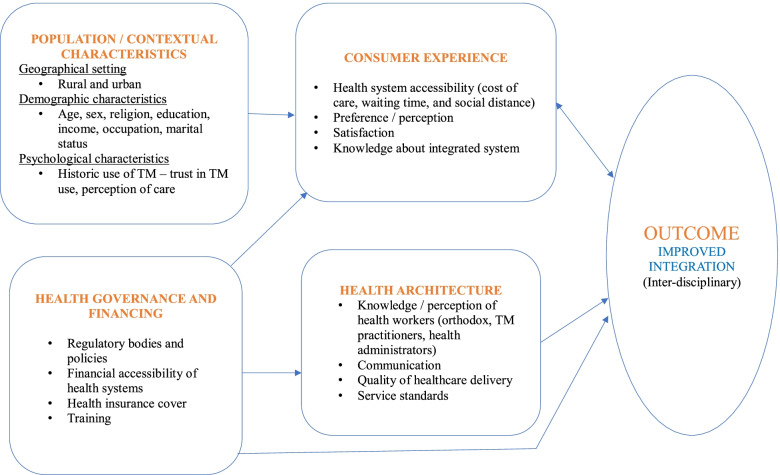
“…characteristics and consumer experiences components of the framework have been employed to evaluate the experiences of health service users, 19 while the health architecture/health governance and financing components were used to investigate the experiences of orthodox health practitioners…”
InfluentialSelf-citationProviding mental healthcare through faith-based entities in Africa: a systematic review
Nanji, N., & Olivier, J. (2024) · Christian Journal for Global Health · doi:10.15566/cjgh.v11i1.795 · Cited by 28
Wang, M., Liu, Z., Sun, Y., Zhang, Y., Ghaffar, A., & Ren, M. (2025) · Bulletin of the World Health Organization · doi:10.2471/blt.25.293465 · Cited by 22
“32 This sense of familiarity and compassion was seen as a reason to include traditional and complementary medicine in broader health-care systems.”
Jiménez‐Fernández, R., Vázquez, R. R., Marín‐Morales, D., Herraiz-Soria, E., Losa‐Iglesias, M. E., Vallejo, R., & Corral‐Liria, I. (2023) · Healthcare · doi:10.3390/healthcare11060808 · Cited by 15
“Recently, in addition to the WHO strategy, there have also been studies on how traditional medicine can be integrated into the biomedical system with excellent results, notably reducing mortality without any adverse effects on countries such as Ghana [30] or South Africa [31,32].”
BackgroundAmpomah, I. G., Ampomah, G. A., & Emeto, T. I. (2024) · Archives of Public Health · doi:10.1186/s13690-024-01472-5 · Cited by 8
Self-citation
Metadata
- Authors
- Ampomah, I. G., Malau-Aduli, B. S., Seidu, A.-A., Malau-Aduli, A. E. O., & Emeto, T. I.
- Affiliations
- University of Cape Coast (GH)
- James Cook University (AU)
- Corresponding author
- Emeto, Theophilus I.
- Venue
- BMC Health Services Research
- Published
- 2022-01-05
- Volume
- 22
- Issue
- 1
- Pages
- 32-32
- ISSN
- 1472-6963 (ISSN-L)
- PMC
- PMC8734307
- OpenAlex
- W4205493905
- Cited by
- 13
- References
- 42
- Citations by year
- 2026: 3 · 2025: 3 · 2024: 2 · 2023: 4 · 2022: 1
- FWCI
- 2.61
- Type
- journal article
- Language
- en
- Open access
- gold
- doi.org
- Licence
- cc-by-nc-sa
- creativecommons.org/licenses/by/4.0 (tdm)
- creativecommons.org/licenses/by/4.0 (vor)
- Locations
- BMC Health Services Research (publishedVersion, cc-by-nc-sa)
- PubMed Central (publishedVersion, cc-by)
- PubMed (publishedVersion)
- ResearchOnline - JCU (James Cook University) (submittedVersion)
- DOAJ (DOAJ: Directory of Open Access Journals) (submittedVersion, cc-by-sa)
- Funders
- James Cook University
- Topics
- Health Sciences › Medicine › Complementary and alternative medicine › Complementary and Alternative Medicine Studies
- Social Sciences › Sociology and Political Science › African Studies and Ethnography
- Health Sciences › Medicine › Public Health, Environmental and Occupational Health › Healthcare Systems and Reforms
- Keywords
- integrated care, traditional medicine, integration of traditional and modern medicine, service user experiences, cross-referral, service utilization, patient satisfaction, Ashanti Region, Ghana
- MeSH terms
- Female, Ghana, Health Facilities, Hospital Administrators, Humans, Male, Medicine, Traditional, Delivery of Health Care, Integrated
About these checks
Registry, retraction, Cites and statistics results are computed, not judged, with one exception: a printed reference that no index lists is read once by a model before it counts as a citation error. Claims are extracted by a model and kept only when their quote appears verbatim in the text; each cited source is then checked, with a model’s help, for whether it says what the claim relies on. Those verdicts can be wrong — read the claim’s quote and the cited source before relying on one.
Statistics and arithmetic are recomputed, not judged.
Confidence bands are shown only for fields calibrated on our annotated test set. None is calibrated yet, so no band is shown.
What counts as a claim ›How we measure confidence ›How we check this ›
Are you an author, or do you see a problem with this page? Request a review
Data sources
Bibliographic data: Semantic Scholar, OpenAlex, Crossref.
Contains information from the Semantic Scholar Academic Graph Datasets, made available under the ODC Attribution License (ODC-BY 1.0).
Semantic Scholar’s data is described in: Kinney, R., et al. (2023). The Semantic Scholar Open Data Platform. arXiv:2301.10140.
