

Renal function during long-term lithium treatment: a cross-sectional and longitudinal study
Open accessThe DOI matches its Crossref record; 30 of the 30 references it cites were found in a registry or an index.
Abstract
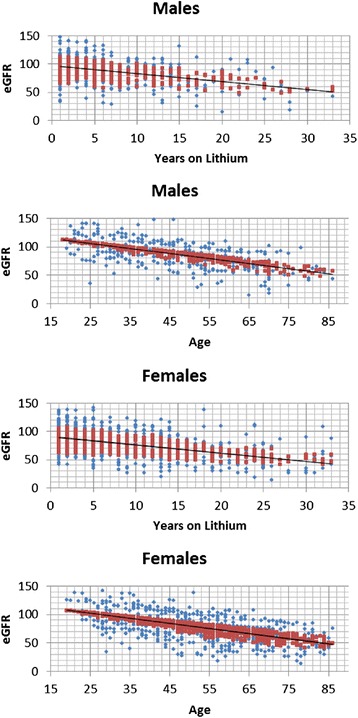
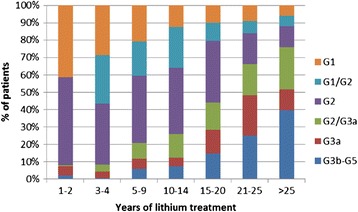
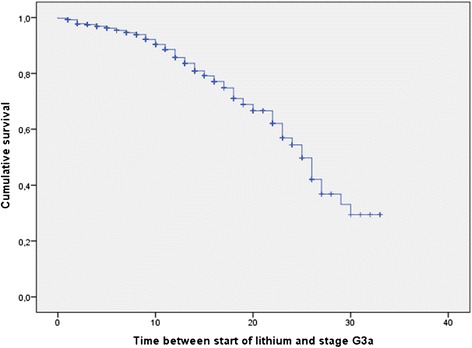
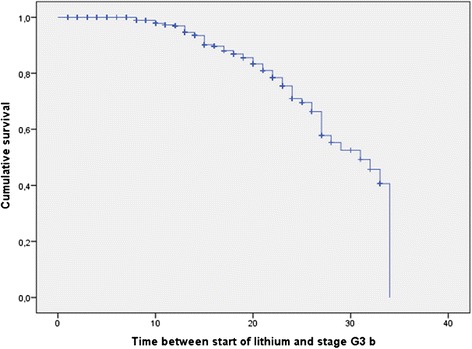
BACKGROUND: The effects of lithium treatment on renal function have been previously shown, albeit with discrepancies regarding their relevance. In this study, we examined glomerular filtration rate in patients treated with lithium for up to 33 years. METHODS: All lithium patients registered from 1980 to 2012 at a Lithium Clinic were screened. Estimated glomerular filtration rate (eGFR) was calculated from serum creatinine concentration using the Modification of Diet in Renal Disease Study Group equation. A cross-sectional evaluation of the last available eGFR of 953 patients was carried out using multivariate regression analysis for gender, current age, and duration of lithium treatment. Survival analysis was subsequently applied to calculate the time on lithium needed to enter the eGFR ranges 45 to 59 mL/min/1.73 m² (G3a) or 30 to 44 mL/min/1.73 m² (G3b). Finally, 4-year follow-up of eGFR was examined in subgroups of patients who, after reduction to an eGFR lower than 45 mL/min/1.73 m² either i) continued lithium at the same therapeutic range or ii) discontinued lithium or continued at concentrations below the therapeutic range (0.5 mmol/L). RESULTS: In the cross-sectional evaluation, eGFR was found to be lower in women (by 3.47 mL/min/1.73 m²), in older patients (0.73 mL/min/1.73 m² per year of age), and in patients with longer lithium treatment (0.73 mL/min/1.73 m² per year). Half of the patients treated for longer than 20 years had an eGFR lower than 60 mL/min/1.73 m². The median time on lithium taken to enter G3a or G3b was 25 years (95% CI, 23.2-26.9) and 31 years (95% CI, 26.6-35.4), respectively. Progression of renal failure throughout the 4-year follow-up after a reduction to an eGFR lower than 45 mL/min/1.73 m² did not differ between the subgroup who continued lithium as before and the subgroup who either discontinued lithium or continued at concentrations below the therapeutic range. CONCLUSIONS: Duration of lithium treatment is to be added to advancing age as a risk factor for reduced glomerular filtration rate. However, renal dysfunction tends to appear after decades of treatment and to progress slowly and irrespective of lithium continuation.
Overview
The claims and statistics of this paper haven’t been checked yet.
Free: it reads the open-access text and checks the first 5 claims that cite a source we can check. Create a free account to check every claim.
Integrity signals
Registry
Cites
Statistics
Figures
Verification
Claims the paper makes
The claims and statistics of this paper haven’t been checked yet.
Free: it reads the open-access text and checks the first 5 claims that cite a source we can check. Create a free account to check every claim.
Claims other papers make about this one
Each is checked against this paper’s own text: does it say what the citing paper says it does?
The source backs part of the claim, not all of it — or backs it for a different population, condition or comparison.
In the citing paper
“Instances of lithium toxicity will also greatly increase risk of renal dysfunction.821”
From Canadian Network for Mood and Anxiety Treatments ( CANMAT ) and International Society for Bipolar Disorders ( ISBD ) 2018 guidelines for the management of patients with bipolar disorder (2018) · cites this paper as [821]
Experimental — accuracy not yet measured
Self-check
Percentages, sums and reported differences re-computed from the paper’s own numbers.
The self-check needs the paper’s full text.
Citations
Cites
Levey, A. S., Bosch, J. P., Lewis, J. B., Greene, T., Rogers, N., Roth, D., & for the Modification of Diet in Renal Disease Study Group* (1999) · Annals of Internal Medicine · doi:10.7326/0003-4819-130-6-199903160-00002 · Cited by 15,079
Yatham, L., & Malhi, G. (2011) · Oxford University Press eBooks · doi:10.1093/med/9780199562305.001.0001 · Cited by 3,506
(2013) · Kidney International Supplements · doi:10.1038/kisup.2012.73 · Cited by 3,206
Lithium toxicity profile: a systematic review and meta-analysis
McKnight, R. F., Adida, M., Budge, K., Stockton, S., Goodwin, G. M., & Geddes, J. R. (2012) · The Lancet · doi:10.1016/s0140-6736(11)61516-x · Cited by 877 · cited 2×
“However, some concerns have frequently been raised about its safety [4].”
BackgroundGeddes, J. R., Burgess, S., Hawton, K., Jamison, K., & Goodwin, G. M. (2004) · American Journal of Psychiatry · doi:10.1176/appi.ajp.161.2.217 · Cited by 661 · cited 1×
“Background Lithium is the most effective long-term therapy for bipolar disorder [1,2] and is also effective in unipolar depression [3].”
BackgroundCipriani, A., Pretty, H., Hawton, K., & Geddes, J. R. (2005) · American Journal of Psychiatry · doi:10.1176/appi.ajp.162.10.1805 · Cited by 617 · cited 1×
“Indeed, the benefits obtained from lithium must be regarded not only in terms of stabilization of recurrent mood disorders, but also in normalization of their otherwise increased mortality, mainly due to suicide [24-26].”
BackgroundLithium toxicity profi le: a systematic review and meta-analysis
McKnight, R. F., Budge, K., Ba, S., Goodwin, G. M., Geddes, J. R., & Adida, M. (2012) · Cited by 544
Earley, A., Miskulin, D., Lamb, E. J., Levey, A. S., & Uhlig, K. (2012) · Annals of Internal Medicine · doi:10.7326/0003-4819-156-11-201203200-00391 · Cited by 487 · cited 4×
“An advance in epidemiological surveys of large populations was represented by the demonstrated reliability of eGFR calculated from routine laboratory determinations of serum creatinine [7,8].”
MethodInfluentialChronic renal lesions following long-term treatment with lithium
Hestbech, J., Hansen, H. E., Amdisen, A., & Olsen, S. (1977) · Kidney International · doi:10.1038/ki.1977.102 · Cited by 403 · cited 1×
“Nevertheless, adverse renal effects of lithium have long been known, varying from very frequent reversible polyuria [12] to irreversible kidney damage [13,14].”
BackgroundPrevalence, Pathogenesis, and Treatment of Renal Dysfunction Associated With Chronic Lithium Therapy
Boton, R., Gaviria, M., & Batlle, D. C. (1987) · American Journal of Kidney Diseases · doi:10.1016/s0272-6386(87)80098-7 · Cited by 353 · cited 2×
“survey, but, in any case, rates can be considered impressive as compared to the 15% prevalence calculated by the review of earlier studies of unselected patients on chronic lithium [16].”
BackgroundResult
Research works printed but not linked: 1
- Kidney Disease: Improving Global Outcomes (KDIGO) CKD Work Group. KDIGO 2012 clinical practice guideline for the evaluation and management of chronic kidney disease. Kidney Int Suppl. 2013;3:1–150.
Cited by
Yatham, L. N., Kennedy, S. H., Parikh, S. V., Schaffer, A., Bond, D. J., Frey, B. N., Sharma, V., Goldstein, B. I., Rej, S., Beaulieu, S., et al. (2018) · Bipolar Disorders · doi:10.1111/bdi.12609 · Cited by 1,852
Lithium side effects and toxicity: prevalence and management strategies
Gitlin, M. (2016) · International Journal of Bipolar Disorders · doi:10.1186/s40345-016-0068-y · Cited by 531
“Risk factors for lithium-induced nephropathy are length of treatment, age, and prior episodes of lithium toxicity (Aiff et al. 2015; Bocchetta et al. 2015; Clos et al. 2015).”
BackgroundIncidence of Cancer in Patients with Chronic Heart Failure: A Long-Term Follow-Up Study
Banke, A., Schou, M., Videbæk, L., Møller, J. E., Torp-Pedersen, C., Gustafsson, F., Dahl, J. S., Køber, L., Hildebrandt, P. R., & Gislason, G. H. (2016) · European Journal of Heart Failure · doi:10.1002/ejhf.472 · Cited by 235
Tondo, L., Abramowicz, M., Alda, M., Bauer, M., Bocchetta, A., Bolzani, L., Calkin, C. V., Chillotti, C., Hidalgo-Mazzei, D., Manchia, M., et al. (2017) · International Journal of Bipolar Disorders · doi:10.1186/s40345-017-0096-2 · Cited by 125
Self-citationOtt, M., Stegmayr, B. G., Renberg, E. S., & Werneke, U. (2016) · Journal of Psychopharmacology · doi:10.1177/0269881116652577 · Cited by 122
“Long-term lithium use is associated with an increased risk of loss of renal function (Bocchetta et al., 2015; Close et al., 2014).”
BackgroundÖhlund, L., Ott, M., Oja, S., Bergqvist, M., Lundqvist, R., Sandlund, M., Renberg, E. S., & Werneke, U. (2018) · BMC Psychiatry · doi:10.1186/s12888-018-1622-1 · Cited by 132
“This kind of problem tends to appear only after decades of treatment [15, 16].”
BackgroundThe New News about Lithium: An Underutilized Treatment in the United States
Post, R. M. (2017) · Neuropsychopharmacology · doi:10.1038/npp.2017.238 · Cited by 117
“However, recent reviews suggest that increased creatinine and low GFR may be related to episodes of toxicity (Clos et al, 2015), are seen just as often in patients maintained on anticonvulsants, and are not unique to lithium (Kessing et al, 2015).”
BackgroundInfluentialCastro, V. M., Roberson, A. M., McCoy, T. H., Wiste, A., Cagan, A., Smoller, J. W., Rosenbaum, J. F., Ostacher, M., & Perlis, R. H. (2016) · Neuropsychopharmacology · doi:10.1038/npp.2015.254 · Cited by 90
“To date, there is very little known about predictors of lithium-associated renal failure, other than age and/or longer treatment duration (Bocchetta et al, 2015; Presne et al, 2003).”
BackgroundSchoot, T. S., Molmans, T. H. J., Grootens, K. P., & Kerckhoffs, A. P. M. (2019) · European Neuropsychopharmacology · doi:10.1016/j.euroneuro.2019.11.006 · Cited by 85
Drug-Induced Kidney Injury in the Elderly
Khan, S. F., Loi, V., & Rosner, M. H. (2017) · Drugs & Aging · doi:10.1007/s40266-017-0484-4 · Cited by 78
Bocchetta, A., Cabras, F., Pinna, M., Poddighe, A., Sardu, C., Ardau, R., Chillotti, C., & Zompo, M. D. (2017) · International Journal of Bipolar Disorders · doi:10.1186/s40345-017-0089-1 · Cited by 61
“There are data suggesting that, once CKD is established, eGFR further declines irrespective of lithium withdrawal (Bendz et al. 2010; Bocchetta et al. 2015).”
BackgroundSelf-citationSebastiani, L., & Busconi, M. (2017) · Plant Cell Reports · doi:10.1007/s00299-017-2145-9 · Cited by 59
Monteith, S., Glenn, T., Geddes, J., Whybrow, P. C., & Bauer, M. (2016) · International Journal of Bipolar Disorders · doi:10.1186/s40345-016-0051-7 · Cited by 50
Osete, J. R., Akkouh, I. A., Ievglevskyi, O., Vandenberghe, M., de Assis, D. R., Ueland, T., Kondratskaya, E., Holen, B., Szabó, A., Hughes, T., et al. (2023) · Molecular Psychiatry · doi:10.1038/s41380-023-01944-0 · Cited by 61
“Thus, the disease-related molecular effects captured in the hCS likely stem from predisposing biological factors.”
BackgroundPahwa, M., Joseph, B., Núñez, N. A., Jenkins, G. D., Colby, C. L., KASHANI, K. B., Veldić, M., Moore, K. M., Betcher, H. K., Özerdem, A., et al. (2021) · Bipolar Disorders · doi:10.1111/bdi.13052 · Cited by 51
Dynamics of biomarkers in relation to aging and mortality
Arbeev, K. G., Ukraintseva, S. V., & Yashin, A. I. (2016) · Mechanisms of Ageing and Development · doi:10.1016/j.mad.2016.04.010 · Cited by 48
Lithium: Current state of the art and future directions
Gitlin, M., & Bauer, M. (2024) · International Journal of Bipolar Disorders · doi:10.1186/s40345-024-00362-7 · Cited by 38
Psychotropic Drugs and Adverse Kidney Effects: A Systematic Review of the Past Decade of Research
Damba, J. J., Bodenstein, K., Lavín, P., Drury, J., Sekhon, H., Renoux, C., Trinh, E., Rej, S., & Greenway, K. T. (2022) · CNS Drugs · doi:10.1007/s40263-022-00952-y · Cited by 43
“As discussed below, interpretation of the treatment duration required for the development of CKD is complicated by the finding that discontinuation of lithium appears to not affect CKD progression, at least beyond a certain point [37, 60, 65].”
BackgroundMethodInfluentialContinuation of lithium after a diagnosis of chronic kidney disease
Kessing, L. V., Feldt‐Rasmussen, B., Andersen, P. K., Gerds, T. A., & Licht, R. W. (2017) · Acta Psychiatrica Scandinavica · doi:10.1111/acps.12820 · Cited by 38
“…to progression to irreversible end-stage kidney disease, among patients using lithium, the median time taken to decline within moderate CKD from range G3a (45–59 ml/min/1.73 m2) to G3b (30–44 ml/min/ 1.73 m2) was 8 years (95% CI, 6.6–9.4) according to the study by Bocchetta et al. 2015 (23).”
InfluentialCarli, M., Weiss, F., Grenno, G., Ponzini, S., Kolachalam, S., Vaglini, F., Viaggi, C., Pardini, C., Tidona, S., Longoni, B., et al. (2023) · Current Neuropharmacology · doi:10.2174/1570159x21666230224102318 · Cited by 43
“Considering that Lithium usually is administrated for many years or throughout the whole patient’s life, its harmful adverse effect on thyroid and kidney function has to be constantly monitored and it can be reduced through Lithium plasma monitoring [51, 52].”
BackgroundEnderle, J., Klink, U., di Giuseppe, R., Koch, M., Seidel, U., Weber, K. S., Birringer, M., Ratjen, I., Rimbach, G. H., & Lieb, W. (2020) · Nutrients · doi:10.3390/nu12082489 · Cited by 32
Sampogna, G., Janiri, D., Albert, U., Caraci, F., Martinotti, G., Serafini, G., Tortorella, A. A. V., Zuddas, A., Sani, G., & Fiorillo, A. (2022) · Expert Review of Neurotherapeutics · doi:10.1080/14737175.2022.2161895 · Cited by 29
“et al [141] highlighted that duration of lithium treatment should be considered as an additional risk factor for renal adverse effect, in particular in elderly patients with a reduced glomerular filtration rate.”
BackgroundKey questions on the long term renal effects of lithium: a review of pertinent data
Gitlin, M. J., & Bauer, M. (2023) · International Journal of Bipolar Disorders · doi:10.1186/s40345-023-00316-5 · Cited by 32
“…of renal function after lithium discontinuation has been reported to stabilize or improve in some studies (Pahwa et al. 2021; Kessing et al. 2017; Bocchetta et al., 2015) while others found a subgroup of patients whose renal function continued to deteriorate after lithium discontinuation (Aiff…”
ResultEndocrinopathies and renal outcomes in lithium therapy: impact of lithium toxicity
Dineen, R., Bogdanet, D., Thompson, D., Thompson, C. J., Behan, L., Mckay, A., Boran, G., Wall, C. A. M., Gibney, J., O’Keane, V., et al. (2017) · QJM · doi:10.1093/qjmed/hcx171 · Cited by 23
Ott, M., Forssén, B., & Werneke, U. (2019) · Therapeutic Advances in Psychopharmacology · doi:10.1177/2045125319836563 · Cited by 22
Wilunda, B., Ng, N., & Williams, J. S. (2015) · BMC Public Health · doi:10.1186/s12889-015-2556-x · Cited by 25
Dastych, M., Synek, O., & Gottwaldová, J. (2019) · Journal of Clinical Psychopharmacology · doi:10.1097/jcp.0000000000001030 · Cited by 16
Parsaik, A. K., Chaudhary, A., Sharma, S., Delgoffe, B. E., Gabor, R., & Singh, B. (2024) · Bipolar Disorders · doi:10.1111/bdi.13501 · Cited by 18
“27 These findings are similar to our study, where there was of CKD. 9 Our study also identified hypertension, age, and BD as risk factors for CKD. Prior studies have consistently reported diabetes mellitus as a risk factor for CKD, both independently and in patients with BD on LTLT. 10 Although…”
Tsermpini, E. E., Zhang, Y., Niola, P., Chillotti, C., Ardau, R., Bocchetta, A., Patrinos, G. P., Zompo, M. D., Severino, G., Lee, M. T. M., et al. (2016) · Neuroscience Letters · doi:10.1016/j.neulet.2016.12.001 · Cited by 15
“EGFR was lower in females and in non-smokers (Table 2), consistently with our previous findings [14][13].”
BackgroundMethodResultInfluentialSelf-citationWiuff, A. C., Rohde, C., Jensen, B. D., Nierenberg, A. A., Østergaard, S. D., & Köhler‐Forsberg, O. (2023) · Bipolar Disorders · doi:10.1111/bdi.13356 · Cited by 20
“4,7,14,21,22,34 As it has been suggested that the process from decline in eGFR over CKD to the development of end-stage kidney disease usually requires ≥10 years of lithium exposure, 7,14,15,34– 36 the follow-up in the present study may have been too short to study this important aspect.”
BackgroundCarli, M., Risaliti, E., Francomano, M., Kolachalam, S., Longoni, B., Bocci, G., Maggio, R., & Scarselli, M. (2022) · Pharmaceuticals · doi:10.3390/ph15010105 · Cited by 15
“For many of them, a correlation with lithium Cp has been described [24,25].”
BackgroundPredicting Serum Levels of Lithium-Treated Patients: A Supervised Machine Learning Approach
Hsu, C., Tsai, S., Wang, L., Liang, C., Carvalho, A. F., Solmi, M., Vieta, E., Lin, P., Hu, C.-A., & Kao, H. (2021) · Biomedicines · doi:10.3390/biomedicines9111558 · Cited by 14
“There is evidence that older people have lower lithium clearance, which may explain the results of this study [50,51].”
ResultBocchetta, A., Ambrosiani, L., Baggiani, G., Pisanu, C., Chillotti, C., Ardau, R., Velluzzi, F., Piras, D., Loviselli, A., & Pani, A. (2018) · International Journal of Bipolar Disorders · doi:10.1186/s40345-017-0114-4 · Cited by 13
“It must be noted that we found only 14 cases of type-I diabetes, whereas cases of type-II diabetes were typically found in older patients and their effect was perhaps included in the age-related decline of eGFR that we already found in the entire cohort of patients treated with lithium (Bocchetta et al. 2015).”
BackgroundSelf-citationAiff, H., Attman, P., Ramsauer, B., Schön, S., & Svedlund, J. (2018) · Journal of Affective Disorders · doi:10.1016/j.jad.2018.09.044 · Cited by 12
Cho, Y., Lee, D., Baek, J. H., & Hong, K. S. (2022) · International Journal of Bipolar Disorders · doi:10.1186/s40345-022-00249-5 · Cited by 12
“Several studies have reported decline of renal function after lithium use, while others have reported negative associations between the two (McKnight et al. 2012; Bocchetta et al. 2015; Clos et al. 2015).”
ResultTaskaeva, I. S., Kasatova, А. I., Surodin, D., Bgatova, N. P., & Taskaev, S. Y. (2023) · Life · doi:10.3390/life13020518 · Cited by 16
Prevention of lithium-associated renal failure: recent evidence
Davis, J. M., Rosenbaum, A., Shahinian, V. B., & Brosius, F. C. (2015) · The Lancet Psychiatry · doi:10.1016/s2215-0366(15)00498-8 · Cited by 14
Khan, M. A., Walley, J. D., Khan, N., Khan, M. A., Ali, S., King, R., Khan, S. E., Sheikh, F. I., Manzoor, F., & Khan, H. J. (2018) · BJGP Open · doi:10.3399/bjgpopen18x101613 · Cited by 11
Tussing-Humphreys, L. M., Thomson, J. L., Goodman, M. H., & Olender, S. E. (2016) · Maternal Health Neonatology and Perinatology · doi:10.1186/s40748-016-0036-7 · Cited by 13
Señga, M. M. A., Sarapuddin, G., & Saniel, E. (2020) · Case Reports in Psychiatry · doi:10.1155/2020/5369297 · Cited by 11
“Long-term lithium use is associated with an increased risk of loss of renal function which further increases serum lithium levels [3, 7].”
BackgroundKidney function decline improves after lithium discontinuation
Fransson, F., Werneke, U., Öhlund, L., Jonsson, P. A., & Ott, M. (2025) · Journal of Internal Medicine · doi:10.1111/joim.20054 · Cited by 11
“This report is an update on a previous study [15].”
Starting lithium in patients with compromised renal function – is it wise?
Golic, M., Aiff, H., Attman, P., Ramsauer, B., Schön, S., Steingrímsson, S., & Svedlund, J. (2020) · Journal of Psychopharmacology · doi:10.1177/0269881120936541 · Cited by 11
“It seems that in most cases the progression to severe kidney failure takes decades to develop (Bocchetta et al., 2015) and the hazard ratio for developing ESRD remains small (Bendz et al., 2010; Close et al., 2014) In a previous study on lithium-treated patients, Aiff et al. (2015) found that not…”
BackgroundTobita, S., Sogawa, R., Murakawa‐Hirachi, T., Kimura, S., Tasaki, M., Sakamoto, Y., Monji, A., & Irie, H. (2020) · International Clinical Psychopharmacology · doi:10.1097/yic.0000000000000320 · Cited by 9
Hypertensive bipolar: chronic lithium toxicity in patients taking ACE inhibitor
Masiran, R., & Aziz, M. F. B. A. (2017) · BMJ Case Reports · doi:10.1136/bcr-2017-220631 · Cited by 9
A renoprotective role of chitosan against lithium-induced renal toxicity in rats
Aboulthana, W. M., & Ibrahim, N. E. (2018) · Bulletin of the National Research Centre/Bulletin of the National Research Center · doi:10.1186/s42269-018-0029-y · Cited by 10
Ambrosiani, L., Pisanu, C., Deidda, A., Chillotti, C., Stochino, M. E., & Bocchetta, A. (2018) · International Journal of Bipolar Disorders · doi:10.1186/s40345-018-0125-9 · Cited by 11
Self-citationMedical Complications of Psychiatric Treatment
Lahijani, S. C., & Harris, K. A. (2017) · Critical Care Clinics · doi:10.1016/j.ccc.2017.03.008 · Cited by 8
“Duration of lithium therapy has been identified as an independent risk factor.(66) Other risk factors include age, female sex, smoking, hypertension, medical comorbidity, psychotic disorder, and lithium serum level.”
BackgroundCompliance with the safety guidelines for long-term lithium treatment in Sweden
Golic, M., Aiff, H., Attman, P., Ramsauer, B., Schön, S., & Svedlund, J. (2018) · Journal of Psychopharmacology · doi:10.1177/0269881118780014 · Cited by 8
The low risk for early renal damage during lithium treatment has not changed over time
Golic, M., Aiff, H., Attman, P., Ramsauer, B., Schön, S., Steingrímsson, S., & Svedlund, J. (2022) · Journal of Psychopharmacology · doi:10.1177/02698811221123054 · Cited by 9
“In a longitudinal study on 953 patients (Bocchetta et al., 2015), the development towards CKD3a and 3b was continuous over 30 years and the median time on lithium needed to reach this level of renal impairment Cohort 1 (N = 623), 1980–1989 Cohort 2 (N = 874), 1990–1999 Cohort 3 (N = 672),…”
BackgroundKuiper, W. J., Grootens, K. P., & Kerckhoffs, A. P. M. (2023) · Bipolar Disorders · doi:10.1111/bdi.13390 · Cited by 6
Amerio, A., Arduino, G., Fesce, F., Costanza, A., Aguglia, A., Amore, M., & Serafini, G. (2024) · Expert Review of Neurotherapeutics · doi:10.1080/14737175.2024.2386429 · Cited by 7
“The long-term use of lithium has also been shown to be generally safe and well tolerated by patients [86,87].”
Baggiani, G., Ambrosiani, L., Trincas, P., Burrai, C., & Bocchetta, A. (2018) · Clinical Practice and Epidemiology in Mental Health · doi:10.2174/1745017901814010236 · Cited by 5
Self-citationLong-term lithium and estimated glomerular filtration rate
Bocchetta, A., Sardu, C., Piras, D., & Pani, A. (2016) · The Lancet Psychiatry · doi:10.1016/s2215-0366(15)00547-7 · Cited by 4
Self-citationGibt es bei der Lithiumlangzeitbehandlung ein erhöhtes Risiko für Nierentumoren?
Conell, J., Lewitzka, U., Ritter, P. S., Severus, E., Pilhatsch, M., Pfennig, A., Berghöfer, A., & Bauer, M. (2015) · Der Nervenarzt · doi:10.1007/s00115-015-4413-7 · Cited by 3
Syndrome de neurotoxicité irréversible de lithium-effectuated ou SILENT : à propos d’un cas
Hallab, B., Hallab, S., Battas, O., & Agoub, M. (2017) · Therapies · doi:10.1016/j.therap.2016.10.007 · Cited by 3
Li, G., Wang, L., & Qian, Q. (2022) · Wiley eBooks · doi:10.1002/9781119105954.ch60 · Cited by 3
Bernard, A. (2022) · Elsevier eBooks · doi:10.1016/b978-0-12-822946-0.00018-0 · Cited by 2
Update – Lithium in der Phasenprophylaxe Bipolarer Störungen
Petzold, J., Bauer, M., & Severus, E. (2018) · Fortschritte der Neurologie · Psychiatrie · doi:10.1055/a-0633-2511 · Cited by 2
Renal Concerns Relative to the Use of Lithium in Geriatric Bipolar Disorder Patients
Szpunar, J., Maeshima, H., & Grossberg, G. T. (2017) · Annals of Clinical Psychiatry · doi:10.1177/104012371702900410 · Cited by 2
“8,23,29,30 29-31 However, duration of lithium treatment and lithium levels have an undetermined relationship with CKD and ESRD in mixed-age and geriatric populations.”
Bocchetta, A., Ambrosiani, L., Sanna, F., Chillotti, C., Ardau, R., Pala, D., Cabiddu, G., Piras, D., & Pani, A. (2022) · Journal of Nephrology · doi:10.1007/s40620-022-01490-y · Cited by 2
Self-citationCarswell, C., Nisbet, R., Khan, J., Patel, Z., Husain, A., Bramham, K., Chilcot, J., Jacobs, R., Osborn, D., & Siddiqi, N. (2026) · The British Journal of Psychiatry · doi:10.1192/bjp.2026.10659 · Cited by 1
Diagnosis and Management of Acute and Chronic Lithium-Associated Nephrotoxicity
Krishnan, N., & Perazella, M. A. (2026) · Journal of the American Society of Nephrology · doi:10.1681/asn.0000001172 · Cited by 2
Lithiumtherapie bei eingeschränkter Nierenfunktion: Zwischen Skylla und Charybdis
Dehning, J., Grunze, H., Born, C., & Hausmann, A. (2017) · Fortschritte der Neurologie · Psychiatrie · doi:10.1055/s-0043-106739 · Cited by 1
Maroney, M. E., Liu, M. T., Smith, T. W., & Thomas, K. L. H. (2016) · Side effects of drugs annual · doi:10.1016/bs.seda.2016.07.014 · Cited by 2
Lewitzka, U., & Haußmann, R. (2022) · InFo Neurologie + Psychiatrie · doi:10.1007/s15005-021-2201-4 · Cited by 2
Lithium and kidney disease: Understand the risks
Ali, Z. (2021) · Current Psychiatry · doi:10.12788/cp.0130 · Cited by 1
Pharmacological Interventions in Older Adults
Patel, J. J., Smith, D. W., Heafner, J., Christopher, N. G., & Grossberg, G. T. (2019) · Springer eBooks · doi:10.1007/978-3-030-10814-4_9
Ardila, L. J. P., Santamaria, M. J. C., Prada, M. A. V., Romero, L. D. J., Bulla, I. K. R., Contreras, A. C. H., David, A. C. B., Medina, R. A. A., & Quintero, V. Q. (2024) · Ciencia Latina Revista Científica Multidisciplinar · doi:10.37811/cl_rcm.v8i1.9853
Almeida, J., Spelber, D., & Smith, T. L. (2024) · American Psychiatric Association Publishing eBooks · doi:10.1176/appi.books.9781615375523.as37 · Cited by 2
Nephrotoxicity of Lithium and Drugs of Abuse
Neugarten, J., Neugarten, S., & Golestaneh, L. (2024) · Elsevier eBooks · doi:10.1016/b978-0-323-95488-4.00075-9
Evaluation of Kidney Function in Bipolar Patients: A Cross-Sectional Study
Fernandes, S. M., Silva, T. C., Dallalana, C., Pinto, A. R., Daltro, C., & Scippa, Â. M. (2024) · Journal of Pharmaceutical Research · doi:10.18579/jopcr/v23.1.84
Gupta, S., Alabi, A., Goswami, S., Sinha, B. N. P., & Chakraborty, K. (2024) · Bengal Journal of Psychiatry · doi:10.25259/bjpsy_4_2024
Lithium and Mental Health: The Small Element with a Big Impact
Cruvinel, I. D., Zanuzzi, T. R. L., & de Oliveira, F. M. (2025) · OALib · doi:10.4236/oalib.1113282
Jagsch, C., Wirnsberger, G. H., & Simhandl, C. (2025) · Neuropsychiatrie · doi:10.1007/s40211-025-00532-8
Cho, Y., Lee, D., Baek, J. H., & Hong, K. S. (2022) · Figshare · doi:10.6084/m9.figshare.19129123
Psychiatric treatment in patients undergoing hemodialysis
Sopu, A. (2026) · Romanian Journal of Psychiatry & Psychotherapy · doi:10.37897/rjpp.2026.1.5
ADITHYA, R., R, T., D, M., & B, D. (2026) · Asian Journal of Pharmaceutical and Clinical Research · doi:10.22159/ajpcr.2026v19i9.61585
Effects of Lithium Treatment on Renal Function in Bipolar Disorder: A Retrospective Cohort Study
İnanlı, İ., Ayhan, M. G., Yıldız, L., Mert, M., & Yıldız, N. (2026) · Psychiatry Research · doi:10.1016/j.psychres.2026.117470
Nojima, K. (2026) · Journal of Clinical Psychopharmacology · doi:10.1097/jcp.0000000000002191
Metadata
- Authors
- Bocchetta, A., Ardau, R., Fanni, T., Sardu, C., Piras, D., Pani, A., & Del Zompo, M.
- Affiliations
- University of Cagliari (IT)
- Azienda Ospedaliero-Universitaria Cagliari (IT)
- Azienda Ospedaliera G. Brotzu (IT)
- Corresponding author
- Bocchetta, Alberto
- Venue
- BMC Medicine
- Published
- 2015-01-21
- Volume
- 13
- Issue
- 1
- Pages
- 12-12
- ISSN
- 1741-7015 (ISSN-L)
- PMC
- PMC4300557
- OpenAlex
- W1985028928
- Cited by
- 77
- References
- 30
- Citations by year
- 2026: 5 · 2025: 2 · 2024: 8 · 2023: 6 · 2022: 10 · 2021: 3 · 2020: 4 · 2019: 4 · 2018: 10 · 2017: 12 · 2016: 9 · 2015: 4
- FWCI
- 9.46
- Type
- journal article
- Language
- en
- Open access
- gold
- doi.org
- Locations
- BMC Medicine (publishedVersion, cc-by)
- PubMed Central (publishedVersion, cc-by)
- PubMed (publishedVersion)
- UNICA IRIS Institutional Research Information System (University of Cagliari) (submittedVersion, other-oa)
- Topics
- Health Sciences › Medicine › Psychiatry and Mental health › Bipolar Disorder and Treatment
- Health Sciences › Medicine › Psychiatry and Mental health › Schizophrenia research and treatment
- Health Sciences › Medicine › Nephrology › Chronic Kidney Disease and Diabetes
- Keywords
- lithium, glomerular filtration rate, renal function, long-term lithium therapy, chronic kidney disease, renal failure, age as risk factor, bipolar disorder, estimated glomerular filtration rate, serum creatinine, lithium nephrotoxicity
- MeSH terms
- Adolescent, Adult, Age Factors, Aged, Creatinine, Cross-Sectional Studies, Female, Glomerular Filtration Rate, Humans, Lithium, Longitudinal Studies, Male, Middle Aged, Risk Factors, Antipsychotic Agents, Disease Progression, Renal Insufficiency, Chronic, Renal Insufficiency, Kaplan-Meier Estimate, Young Adult
About these checks
Registry, retraction, Cites and statistics results are computed, not judged, with one exception: a printed reference that no index lists is read once by a model before it counts as a citation error. Claims are extracted by a model and kept only when their quote appears verbatim in the text; each cited source is then checked, with a model’s help, for whether it says what the claim relies on. Those verdicts can be wrong — read the claim’s quote and the cited source before relying on one.
Statistics and arithmetic are recomputed, not judged.
Confidence bands are shown only for fields calibrated on our annotated test set. None is calibrated yet, so no band is shown.
What counts as a claim ›How we measure confidence ›How we check this ›
Are you an author, or do you see a problem with this page? Request a review
Data sources
Bibliographic data: Semantic Scholar, OpenAlex, Crossref.
Contains information from the Semantic Scholar Academic Graph Datasets, made available under the ODC Attribution License (ODC-BY 1.0).
Semantic Scholar’s data is described in: Kinney, R., et al. (2023). The Semantic Scholar Open Data Platform. arXiv:2301.10140.
