

Changes in evidence for studies assessing interventions for COVID-19 reported in preprints: meta-research study
Open accessThe DOI matches its Crossref record; 20 of the 20 references it cites were found in a registry or an index.
Abstract
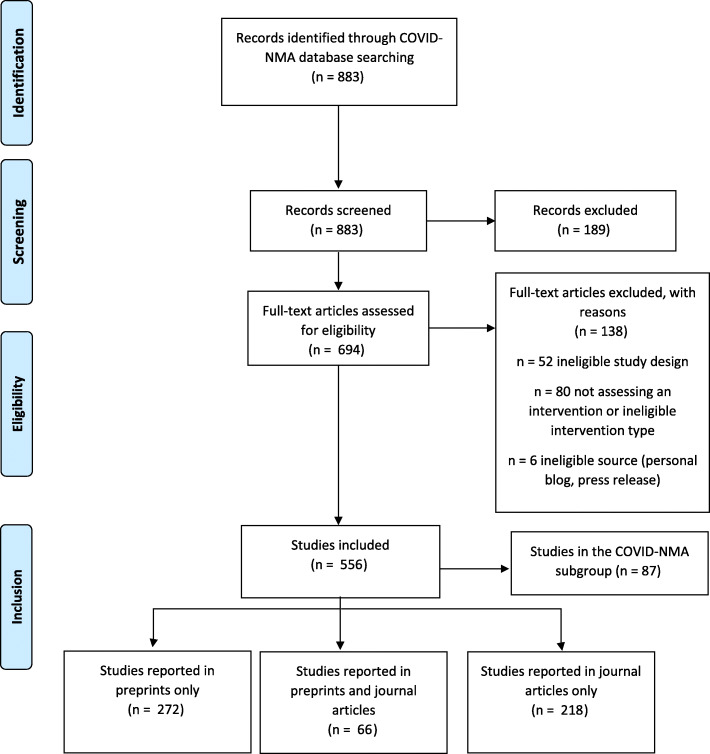
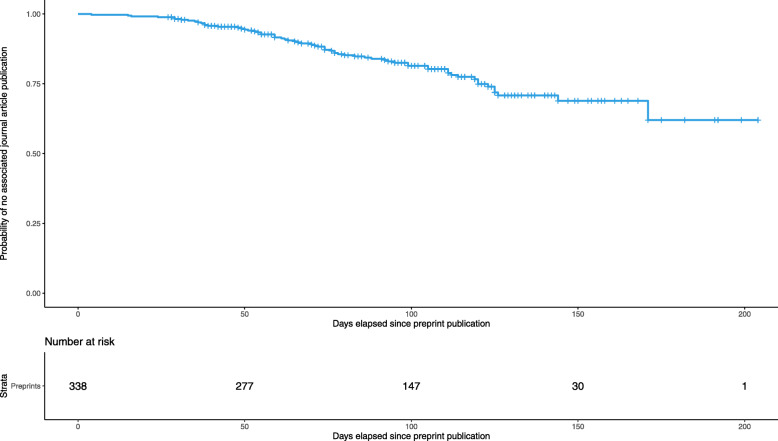
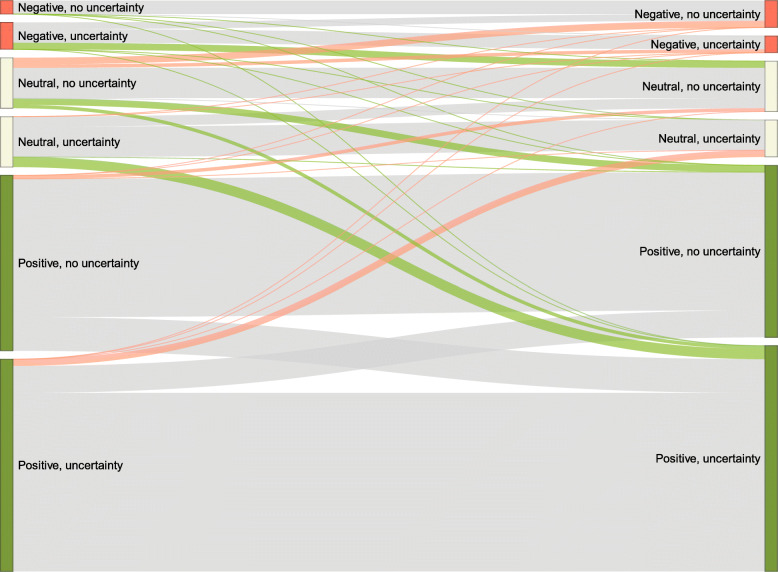
Background: The increasing use of preprints to disseminate evidence on the effect of interventions for the coronavirus disease 2019 (COVID-19) can lead to multiple evidence sources for a single study, which may differ in the reported evidence. We aim to describe the proportion of evidence on the effect of interventions for COVID-19 from preprints and journal articles and map changes in evidence between and within different sources reporting on the same study. Methods: Meta-research study. We screened the Cochrane living systematic review and network meta-analysis (COVID-NMA) database to identify all preprints and journal articles on all studies assessing interventions for COVID-19 published up to 15 August 2020. We compared all evidence sources (i.e., preprint and associated journal article) and the first and latest versions of preprints for each study to identify changes in two evidence components: study results (e.g., numeric change in hazard ratio, odds ratio, event rate, or change in p value > or < 0.05 in any outcome) and abstract conclusions (classified as positive, negative or neutral regarding the intervention effect, and as reporting uncertainty in the findings or not). Changes in study results were further classified as important changes if they (1) represented a change in any effect estimate by ≥ 10% and/or (2) led to a change in the p value crossing the threshold of 0.05. Results: We identified 556 studies. In total, 338 (61%) had been reported in a preprint: 66 (20%) of these had an associated journal article (median time to publication 76 days [interquartile range (IQR) 55–106]) and 91 (27%) had > 1 preprint version. A total of 139 studies (25% of the overall sample) were reported in multiple evidence sources or versions of the same source: for 63 (45%), there was a change in at least one evidence component between or within sources (42 [30%] had a change in study results, and in 29 [21%] the change was classified as important; 33 [24%] had a change in the abstract conclusion). For studies with both a preprint and an article, a median of 29% (IQR 14–50) of total citations were attributed to the preprint instead of the article. Conclusions: Results on the effect of interventions for COVID-19 are often reported in multiple evidence sources or source versions for a single study. Evidence is not stable between and within evidence sources. Real-time linkage of all sources per study could help to keep systematic reviews up-to-date.
Overview
The claims and statistics of this paper haven’t been checked yet.
Free: it reads the open-access text and checks the first 5 claims that cite a source we can check. Create a free account to check every claim.
Integrity signals
Registry
Cites
Statistics
Figures
Verification
Claims the paper makes
The claims and statistics of this paper haven’t been checked yet.
Free: it reads the open-access text and checks the first 5 claims that cite a source we can check. Create a free account to check every claim.
Claims other papers make about this one
Each is checked against this paper’s own text: does it say what the citing paper says it does?
The cited source says what the claim attributes to it.
In the citing paper
“These studies did not compare the effects of including preprints on meta-analytic estimates and the certainty of the body of evidence”
From Consistency of covid-19 trial preprints with published reports and impact for decision making: retrospective review (2022) · cites this paper as [43]
In the citing paper
“Furthermore, living reviews of evolving topics may be less reliable than traditional SRs.”
From A narrative review of recent tools and innovations toward automating living systematic reviews and evidence syntheses (2023) · cites this paper as [7]
In the citing paper
“Our estimate of the time to publication of preprint reports might have been over-estimated if some preprint authors did not attempt to subsequently publish in peer reviewed journals—although evidence shows that most authors of covid-19 preprints intend to publish their findings.”
From Consistency of covid-19 trial preprints with published reports and impact for decision making: retrospective review (2022) · cites this paper as [43]
Self-check
Percentages, sums and reported differences re-computed from the paper’s own numbers.
The self-check needs the paper’s full text.
Citations
Cites
ROBINS-I: a tool for assessing risk of bias in non-randomised studies of interventions
Sterne, J. A., Hernán, M. A., Reeves, B. C., Savović, J., Berkman, N. D., Viswanathan, M., Henry, D., Altman, D. G., Ansari, M. T., Boutron, I., et al. (2016) · BMJ · doi:10.1136/bmj.i4919 · Cited by 20,329 · cited 1×
“In addition to the study results and conclusion, we searched for changes in the following methodologic components that could affect the appraisal of risk of bias [8, 9]: blinding of participants, clinicians, or outcome assessors; amount and handling of missing data; randomization process and allocation concealment (in…”
Self-citationSystematic Reviews: Synthesis of Best Evidence for Clinical Decisions
Cook, D. J., Mulrow, C. D., & Haynes, R. B. (1997) · Annals of Internal Medicine · doi:10.7326/0003-4819-126-5-199703010-00006 · Cited by 2,184
Assessing risk of bias in a randomized trial
Higgins, J. P., Savović, J., Page, M. J., Elbers, R. G., & Sterne, J. A. (2019) · Cochrane Handbook for Systematic Reviews of Interventions · doi:10.1002/9781119536604.ch8 · Cited by 1,765 · cited 1×
“In addition to the study results and conclusion, we searched for changes in the following methodologic components that could affect the appraisal of risk of bias [8, 9]: blinding of participants, clinicians, or outcome assessors; amount and handling of missing data; randomization process and allocation concealment (in…”
Visser, M., van Eck, N. J., & Waltman, L. (2021) · Quantitative Science Studies · doi:10.1162/qss_a_00112 · Cited by 865 · cited 1×
“Had we used a different source, we may have obtained different figures, owing to the different data sources used by each database [15].”
MethodFraser, N., Brierley, L., Dey, G., Polka, J. K., Pálfy, M., Nanni, F., & Coates, J. A. (2021) · PLOS Biology · doi:10.1371/journal.pbio.3000959 · Cited by 555
Li, Y., Xie, Z., Lin, W., Cai, W., Wen, C., Guan, Y., Mo, X., Wang, J., Wang, Y., Peng, P., et al. (2020) · Med · doi:10.1016/j.medj.2020.04.001 · Cited by 385
Pandemic publishing: Medical journals strongly speed up their publication process for COVID-19
Horbach, S. P. J. M. (2020) · Quantitative Science Studies · doi:10.1162/qss_a_00076 · Cited by 268
Dimensions: Bringing down barriers between scientometricians and data
Herzog, C., Hook, D., & Konkiel, S. (2020) · Quantitative Science Studies · doi:10.1162/qss_a_00020 · Cited by 219
Altmetric: enriching scholarly content with article‐level discussion and metrics
ADIE, E., & ROE, W. (2013) · Learned Publishing · doi:10.1087/20130103 · Cited by 218
How swamped preprint servers are blocking bad coronavirus research
Kwon, D. (2020) · Nature · doi:10.1038/d41586-020-01394-6 · Cited by 174
Research works printed but not linked: 2
- medRxiv.org - the preprint server for Health Sciences. https://www.medrxiv.org/. Accessed 12 July 2020.
- Cabanac G. COVID-19 Preprint Tracker. https://www.irit.fr/~Guillaume.Cabanac/covid19-preprint-tracker. Accessed 4 Dec 2020.
Cited by
Efficacy and safety of COVID-19 vaccines
Graña, C., Ghosn, L., Evrenoglou, T., Jarde, A., Minozzi, S., Bergman, H., Buckley, B. S., Probyn, K., Villanueva, G., Henschke, N., et al. (2022) · Cochrane Database of Systematic Reviews · doi:10.1002/14651858.cd015477 · Cited by 310
Self-citationInterleukin-6 blocking agents for treating COVID-19: a living systematic review
Ghosn, L., Chaimani, A., Evrenoglou, T., Davidson, M., Graña, C., Schmucker, C., Bollig, C., Henschke, N., Sguassero, Y., Nejstgaard, C. H., et al. (2021) · Cochrane Database of Systematic Reviews · doi:10.1002/14651858.cd013881 · Cited by 181
Self-citationThe present and future of peer review: Ideas, interventions, and evidence
Aczel, B., Barwich, A.-S., Diekman, A. B., Fishbach, A., Goldstone, R. L., Gomez, P., Gundersen, O. E., von Hippel, P. T., Holcombe, A. O., Lewandowsky, S., et al. (2025) · Proceedings of the National Academy of Sciences · doi:10.1073/pnas.2401232121 · Cited by 87
“These changes may reflect the impact of both preprint peer review and journal peer review (if preprints are posted before journal peer review), and they suggest that review makes little difference .”
Searching for studies: A guide to information retrieval for Campbell systematic reviews
MacDonald, H., Comer, C., Foster, M., Labelle, P. R., Marsalis, S., Nyhan, K., Premji, Z., Rogers, M., Splenda, R., Stansfield, C., et al. (2024) · Campbell Systematic Reviews · doi:10.1002/cl2.1433 · Cited by 98
“Letters, comments, errata and preprints may all contain relevant information about a study (Iansavichene et al., 2008; Oikonomidi et al., 2020; Zeraatkar et al., 2022).”
BackgroundTracking changes between preprint posting and journal publication during a pandemic
Brierley, L., Nanni, F., Polka, J., Dey, G., Pálfy, M., Fraser, N., & Coates, J. A. (2022) · PLoS Biology · doi:10.1371/journal.pbio.3001285 · Cited by 108
Pathophysiology of infection with SARS‐CoV ‐2— What is known and what remains a mystery
Sridhar, S., & Nicholls, J. M. (2021) · Respirology · doi:10.1111/resp.14091 · Cited by 70
Interleukin-1 blocking agents for treating COVID-19
Davidson, M., Menon, S., Chaimani, A., Evrenoglou, T., Ghosn, L., Graña, C., Henschke, N., Cogo, E., Villanueva, G., Ferrand, G., et al. (2022) · Cochrane Database of Systematic Reviews · doi:10.1002/14651858.cd015308 · Cited by 59
Self-citationInterleukin-6 blocking agents for treating COVID-19: a living systematic review
Ghosn, L., Assi, R., Evrenoglou, T., Buckley, B. S., Henschke, N., Probyn, K., Riveros, C., Davidson, M., Graña, C., Bonnet, H., et al. (2023) · Cochrane Database of Systematic Reviews · doi:10.1002/14651858.cd013881.pub2 · Cited by 55
Self-citationThe academic impact of Open Science: a scoping review
Klebel, T., Traag, V., Grypari, I., Stoy, L., & Ross‐Hellauer, T. (2025) · Royal Society Open Science · doi:10.1098/rsos.241248 · Cited by 53
“[74] report a median lag of just two months for bioRxiv preprints on COVID-19 interventions.”
Bero, L., Lawrence, R., Leslie, L., Chiu, K., McDonald, S., Page, M. J., Grundy, Q., Parker, L., Boughton, S., Kirkham, J. J., et al. (2021) · BMJ Open · doi:10.1136/bmjopen-2021-051821 · Cited by 50
Day-to-day discovery of preprint–publication links
Cabanac, G., Oikonomidi, T., & Boutron, I. (2021) · Scientometrics · doi:10.1007/s11192-021-03900-7 · Cited by 43
“Such changes in conclusions between a preprint and its published counterpart were underlined in recent studies (Fraser et al. 2020a; Oikonomidi et al. 2020).”
BackgroundResultSelf-citationRobustness of evidence reported in preprints during peer review
Nelson, L., Ye, H., Schwenn, A., Lee, S., Arabi, S., & Hutchins, B. I. (2022) · The Lancet Global Health · doi:10.1016/s2214-109x(22)00368-0 · Cited by 54
“However, as noted above, little is known about how the extent to which data in biomedical preprints systematically differ from their peer-reviewed counterfactuals, despite the importance of this emerging question (17-24).”
BackgroundResultComparison of Clinical Study Results Reported in medRxiv Preprints vs Peer-reviewed Journal Articles
Janda, G., Khetpal, V., Shi, X., Ross, J. S., & Wallach, J. D. (2022) · JAMA Network Open · doi:10.1001/jamanetworkopen.2022.45847 · Cited by 49
Zeraatkar, D., Pitre, T., Leung, G., Cusano, E., Agarwal, A., Khalid, F., Escamilla, Z., Cooper, M. A., Ghadimi, M., Wang, Y., et al. (2022) · BMJ Medicine · doi:10.1136/bmjmed-2022-000309 · Cited by 44
Loubere, L., Kasparian, S., & Ashkar, F. (2018) · Les cahiers du journalisme · doi:10.31188/cajsm · Cited by 42
Using preprints in evidence synthesis: Commentary on experience during the COVID-19 pandemic
Clyne, B., Walsh, K. A., Murchú, É. Ó., Sharp, M. K., Comber, L., O’Brien, K. K., Smith, S. M., Harrington, P., O’Neill, M., Teljeur, C., et al. (2021) · Journal of Clinical Epidemiology · doi:10.1016/j.jclinepi.2021.05.010 · Cited by 34
Schmidt, L., Sinyor, M., Webb, R. T., Marshall, C., Knipe, D., Eyles, E. C., John, A., Gunnell, D., & Higgins, J. P. T. (2023) · Zeitschrift für Evidenz, Fortbildung und Qualität im Gesundheitswesen · doi:10.1016/j.zefq.2023.06.007 · Cited by 31
Transparency and reporting characteristics of COVID-19 randomized controlled trials
Kapp, P., Esmail, L., Ghosn, L., Ravaud, P., & Boutron, I. (2022) · BMC Medicine · doi:10.1186/s12916-022-02567-y · Cited by 25
Self-citationSalholz‐Hillel, M., Grabitz, P., Pugh-Jones, M., Strech, D., & DeVito, N. (2021) · BMJ Open · doi:10.1136/bmjopen-2021-053096 · Cited by 21
Turki, H., Taieb, M. A. H., Aouicha, M. B., Fraumann, G., Hauschke, C., & Heller, L. (2021) · Frontiers in Research Metrics and Analytics · doi:10.3389/frma.2021.694307 · Cited by 21
“The matter with considering preprints in information retrieval is that these publications have not undergone peer review (Glasziou et al., 2020) and their outputs can be dynamically changed over months (Oikonomidi et al., 2020).”
BackgroundRosenberger, K. J., Xu, C., & Lin, L. (2021) · Journal of Evaluation in Clinical Practice · doi:10.1111/jep.13578 · Cited by 18
“While the gravity of the COVID-19 pandemic warrants expedited efforts, there are concerns about the quality of peer reviews and resulting publications as the spread of misinformation could have harmful consequences.(4-11) Individual studies have limited ability to summarize the current state of research; thus, many ef…”
BackgroundGehanno, J.-F., Grosjean, J., Darmoni, S. J., & Rollin, L. (2022) · PLoS ONE · doi:10.1371/journal.pone.0264661 · Cited by 18
Predicting substantive biomedical citations without full text
Hoppe, T. A., Arabi, S., & Hutchins, B. I. (2023) · Proceedings of the National Academy of Sciences · doi:10.1073/pnas.2213697120 · Cited by 17
“Analysis of the primary data constituting the evidence base suggests that estimate values in published papers are nearly identical to those in preprint versions (55, 56).”
Nishioka, C., Färber, M., & Saier, T. (2022) · ACM/IEEE Joint Conference on Digital Libraries · doi:10.1145/3529372.3530953 · Cited by 17
A living meta-ecological study of the consequences of the COVID-19 pandemic on mental health
Leucht, S., Cipriani, A., Furukawa, T. A., Peter, N. L., Tonia, T., Papakonstantinou, T., Holloway, A., & Salanti, G. (2021) · European Archives of Psychiatry and Clinical Neuroscience · doi:10.1007/s00406-021-01242-2 · Cited by 15
Reproducibility of COVID-19 pre-prints
Collins, A., & Alexander, R. (2022) · Scientometrics · doi:10.1007/s11192-022-04418-2 · Cited by 13
“Many concerns have arisen from the rate at which COVID-19 research has been posted and consumed through pre-print repositories, particularly in the early stages of the pandemic (Raynaud et al. 2020). Rushed scientific research has the potential to skip (or at least place less importance on) open science practices, so…”
BackgroundSiemens, W., Nothacker, J., Stadelmaier, J., Meerpohl, J. J., & Schmucker, C. M. (2022) · Journal of Clinical Epidemiology · doi:10.1016/j.jclinepi.2022.09.011 · Cited by 13
“Although there is no doubt that preprint publications have become more relevant in the pandemic [16], it has to be taken into account that preprints are not peerreviewed and that there may be substantial differences between preprints and peer-reviewed publicationsdtaking into account that reviewer comments may impact…”
Bellos, I. (2021) · Journal of Clinical Epidemiology · doi:10.1016/j.jclinepi.2021.03.020 · Cited by 13
“The situation is further complicated by the existence of multiple versions of a single study in open archives and as journal articles, often presenting contradictory outcomes [3] .”
Decontamination of the scientific literaturePreprint
Cabanac, G. (2022) · arXiv (Cornell University) · doi:10.48550/arxiv.2210.15912 · Cited by 13
“(Oikonomidi et al., 2020) and so are erroneous publications.”
BackgroundSelf-citationTreatment of severe covid-19 with interleukin 6 receptor inhibition
Rajasundaram, S., Burgess, S., & Gill, D. (2022) · BMJ Medicine · doi:10.1136/bmjmed-2022-000144 · Cited by 12
Itani, D., Lababidi, G. H., Itani, R., Ghoul, T. E., Hamade, L., Hijazi, A. R. A., Khabsa, J., & Akl, E. A. (2022) · Journal of Clinical Epidemiology · doi:10.1016/j.jclinepi.2022.06.008 · Cited by 10
Sommer, I., Sunder-Plassmann, V., Ratajczak, P., Emprechtinger, R., Dobrescu, A. I., Griebler, U., & Gartlehner, G. (2023) · Scientific Reports · doi:10.1038/s41598-023-44291-4 · Cited by 10
Davidson, M., Evrenoglou, T., Graña, C., Chaimani, A., & Boutron, I. (2024) · BMC Medical Research Methodology · doi:10.1186/s12874-023-02136-8 · Cited by 9
“A meta-research study of 139 studies reported in preprint and subsequent journal article or in different versions of the preprint found a change in the abstract’s conclusion in 24% of studies [7].”
BackgroundSelf-citationTong, J., Luo, C., Sun, Y., Duan, R., Saine, M. E., Lin, L., Peng, Y., Lu, Y., Batra, A., Pan, A., et al. (2023) · Journal of the American Medical Informatics Association · doi:10.1093/jamia/ocad248 · Cited by 8
Revision and academic impact: A case study of bioRxiv preprint papers
Peng, W., Yue, M., Sun, M., & Ma, T. (2023) · Journal of Informetrics · doi:10.1016/j.joi.2023.101484 · Cited by 6
Tsunoda, H., Sun, Y., Nishizawa, M., Liu, X., Amano, K., & Kominami, R. (2023) · Lecture notes in computer science · doi:10.1007/978-981-99-8088-8_7 · Cited by 5
Trial registries for transparency and accountability in clinical research
De Vito, N. (2022) · Oxford University Research Archive (ORA) (University of Oxford) · doi:10.5287/ora-w4yonogrg · Cited by 5
Yin, H. R., Ahn, W., Forster, P. M., & Rust, R. (2026) · bioRxiv (Cold Spring Harbor Laboratory) · doi:10.64898/2026.06.30.735556 · Cited by 5
“Work that operates at scale instead often measures textual similarity rather than the content of the scientific claims 12,13 , which cannot fully reveal whether a claim was strengthened, weakened, or even overturned.”
Stoll, M., Lindner, S., Marquardt, B., Salholz‐Hillel, M., DeVito, N., Klemperer, D., & Lieb, K. (2023) · BMC Medical Research Methodology · doi:10.1186/s12874-023-01991-9 · Cited by 4
Clinical features and predictors of mortality among hospitalized patients with COVID-19 in Niger
Katoto, P. D., Aboubacar, I., Oumarou, B., Adehossi, E. O., Anya, B.-P. M., Mounkaila, A., Moustapha, A., Ishagh, E. K., Diawara, G. A., Biey, J., et al. (2021) · Conflict and Health · doi:10.1186/s13031-021-00426-w · Cited by 4
Cappelletti, P., Bizzaro, N., & Dorizzi, R. M. (2021) · La Rivista Italiana della Medicina di Laboratorio - Italian Journal of Laboratory Medicine · doi:10.23736/s1825-859x.21.00113-4 · Cited by 3
Turoman, N., Heyard, R., Schwab, S., Furrer, E., Vergauwe, E., & Held, L. (2023) · F1000Research · doi:10.12688/f1000research.129814.1 · Cited by 3
Siemens, W., Bantle, G., Mahler, S., Nothacker, J., Stadelmaier, J., Bitzer, E. M., Schmucker, C. M., & Meerpohl, J. J. (2023) · Journal of Clinical Epidemiology · doi:10.1016/j.jclinepi.2023.111236 · Cited by 2
McGill, S. (2024) · Journal of the Canadian Health Libraries Association / Journal de l Association de bilbiothèques de la santé du Canada · doi:10.29173/jchla29741 · Cited by 2
Postprints-to-preprints linkage to enhance access to scientific literature
Moustafa, K. (2021) · Accountability in Research · doi:10.1080/08989621.2021.2019024 · Cited by 2
“…that, for example, substantial changes in the results or conclusions are noticeable between preprints and peer-reviewed articles related to COVID studies where authors do not always update their preprint versions with the latest knowledge published in journal articles (Oikonomidi et al. 2020).”
BackgroundMikulić, I., Puharić, D., & Malički, M. (2025) · International Nursing Review · doi:10.1111/inr.70088 · Cited by 1
Zoghbi, M. S., Ali, A., Hamade, L., Tedy, S., Zein, O. E., Khabsa, J., & Akl, E. A. (2026) · Research Integrity and Peer Review · doi:10.1186/s41073-026-00189-z · Cited by 1
“While no changes were identified by Oikonomi-diet al. [24], Davidson et [21].”
InfluentialKapp, P., Esmail, L. C., Ghosn, L., Ravaud, P., & Boutron, I. (2022) · Figshare · doi:10.6084/m9.figshare.21207016
Self-citationTuroman, N., Heyard, R., Schwab, S., Furrer, E., Vergauwe, E., & Held, L. (2024) · F1000Research · doi:10.12688/f1000research.129814.3
“25 Figure 1.”
Davidson, M., Evrenoglou, T., Graña, C., Chaimani, A., & Boutron, I. (2024) · Figshare · doi:10.6084/m9.figshare.24987783
Self-citationStoll, M., Lindner, S., Marquardt, B., Salholz‐Hillel, M., DeVito, N. J., Klemperer, D., & Lieb, K. (2024) · Figshare · doi:10.6084/m9.figshare.26607439
Stoll, M., Lindner, S., Marquardt, B., Salholz‐Hillel, M., DeVito, N. J., Klemperer, D., & Lieb, K. (2024) · Figshare · doi:10.6084/m9.figshare.26607442
Kapp, P., Esmail, L. C., Ghosn, L., Ravaud, P., & Boutron, I. (2022) · Figshare · doi:10.6084/m9.figshare.21207013
Self-citationStoll, M., Lindner, S., Marquardt, B., Salholz‐Hillel, M., DeVito, N. J., Klemperer, D., & Lieb, K. (2024) · Figshare · doi:10.6084/m9.figshare.26607436
Brierley, L., Nanni, F., Polka, J. K., Dey, G., Pálfy, M., Fraser, N., & Coates, J. A. (2022) · doi:10.1371/journal.pbio.3001285.r002
Metadata
- Authors
- the COVID-19 NMA Consortium, Oikonomidi, T., Boutron, I., Pierre, O., Cabanac, G., & Ravaud, P.
- Affiliations
- Inserm (FR)
- Centre National de la Recherche Scientifique (FR)
- Corresponding author
- Oikonomidi, Theodora
- Venue
- BMC Medicine
- Published
- 2020-12
- Volume
- 18
- Issue
- 1
- Pages
- 402-402
- ISSN
- 1741-7015 (ISSN-L)
- PMC
- PMC7745199
- OpenAlex
- W3111262560
- Cited by
- 54
- References
- 13
- Citations by year
- 2026: 1 · 2025: 3 · 2024: 9 · 2023: 11 · 2022: 16 · 2021: 13
- FWCI
- 10.15
- Type
- journal article
- Language
- en
- Open access
- gold
- doi.org
- Licence
- cc-by
- creativecommons.org/licenses/by/4.0/ (tdm)
- creativecommons.org/licenses/by/4.0/ (vor, 16 d)
- Locations
- BMC Medicine (publishedVersion, cc-by)
- PubMed Central (publishedVersion, cc-by)
- PubMed (publishedVersion)
- HAL (submittedVersion, cc-by)
- DOAJ (DOAJ: Directory of Open Access Journals) (submittedVersion, cc-by-sa)
- Informationszentrum Lebenswissenschaften (ZB MED) (submittedVersion, cc-by)
- Funders
- Agence Nationale de la Recherche (ANR-20-COVI-0084, ANR-11-LABX-0066)
- École des Hautes Études en Santé Publique
- Topics
- Social Sciences › Library and Information Sciences › Academic Publishing and Open Access
- Social Sciences › Decision Sciences › Statistics, Probability and Uncertainty › Meta-analysis and systematic reviews
- Social Sciences › Library and Information Sciences › scientometrics and bibliometrics research
- Keywords
- COVID-19 pandemic, preprints, sources of evidence, meta-research, network meta-analysis, citation attribution, time to publication, research integrity, reproducibility of findings
- MeSH terms
- Network Meta-Analysis as Topic, Preprints as Topic, Systematic Reviews as Topic, COVID-19, SARS-CoV-2, Humans, Databases, Factual
About these checks
Registry, retraction, Cites and statistics results are computed, not judged, with one exception: a printed reference that no index lists is read once by a model before it counts as a citation error. Claims are extracted by a model and kept only when their quote appears verbatim in the text; each cited source is then checked, with a model’s help, for whether it says what the claim relies on. Those verdicts can be wrong — read the claim’s quote and the cited source before relying on one.
Statistics and arithmetic are recomputed, not judged.
Confidence bands are shown only for fields calibrated on our annotated test set. None is calibrated yet, so no band is shown.
What counts as a claim ›How we measure confidence ›How we check this ›
Are you an author, or do you see a problem with this page? Request a review
Data sources
Bibliographic data: Semantic Scholar, OpenAlex, Crossref.
Contains information from the Semantic Scholar Academic Graph Datasets, made available under the ODC Attribution License (ODC-BY 1.0).
Semantic Scholar’s data is described in: Kinney, R., et al. (2023). The Semantic Scholar Open Data Platform. arXiv:2301.10140.
