

Effect of continuous positive airway pressure on long-term cardiovascular outcomes in patients with coronary artery disease and obstructive sleep apnea: a systematic review and meta-analysis
Open accessThe DOI matches its Crossref record; 26 of the 27 references it cites were found in a registry or an index.
Abstract
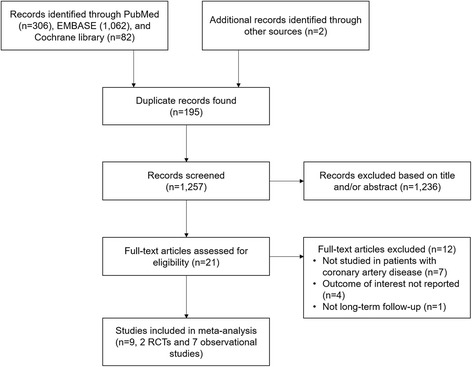
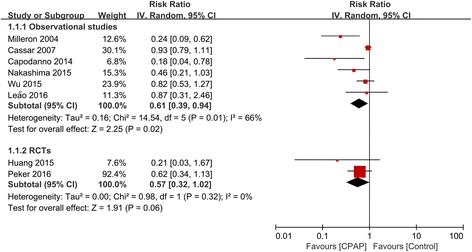
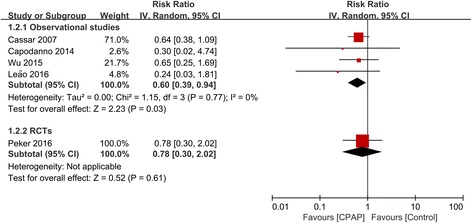
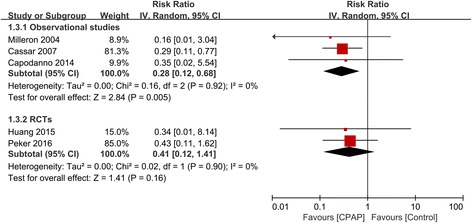
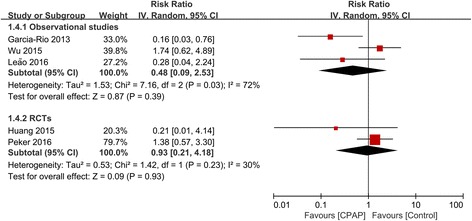
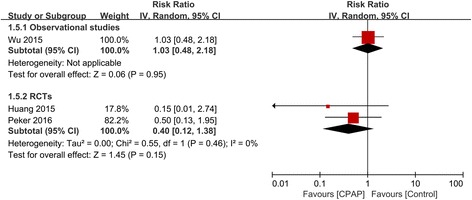
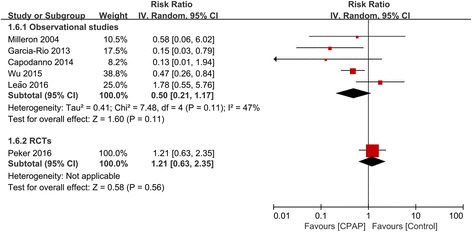
Obstructive sleep apnea (OSA) is highly prevalent in patients with coronary artery disease (CAD) and is associated with recurrent cardiovascular risk. However, whether treatment with continuous positive airway pressure (CPAP) reduces this risk remains unclear. We performed a systematic review and meta-analysis to assess the effect of CPAP on long-term cardiovascular outcomes in patients with concomitant CAD and OSA. We searched the PubMed, EMBASE, and Cochrane library from their inceptions to October 7, 2017. We included observational studies and randomized controlled trials (RCTs) that described the association of CPAP treatment with cardiovascular events in patients with CAD and OSA. The primary outcome of interest was major adverse cardiovascular event (MACE), including all-cause or cardiovascular death, myocardial infarction, stroke, repeat revascularization, or hospitalization for heart failure. Outcomes data were pooled using random effects models and heterogeneity assessed with the I 2 statistic. We identified 9 studies (2 RCTs and 7 observational studies) with 1430 participants. The median follow-up duration was from 36 to 86.5 months. Treatment with CPAP was associated with a significantly lower risk of MACE in 6 observational studies (RR 0.61, 95% CI: 0.39–0.94, P = 0.02), but this was not reproduced in 2 RCTs (RR 0.57, 95% CI: 0.32–1.02, P = 0.06). Similarly, CPAP significantly reduced the risk of all-cause death (4 observational studies) and cardiovascular death (3 observational studies), which were also not confirmed in RCTs. The use of CPAP in patients with CAD and OSA might prevent subsequent cardiovascular events, which was only demonstrated in observational studies, but not in RCTs. The value of CPAP therapy as second prevention for CAD needs further investigation.
Overview
The claims and statistics of this paper haven’t been checked yet.
Free: it reads the open-access text and checks the first 5 claims that cite a source we can check. Create a free account to check every claim.
Integrity signals
Registry
Cites
Statistics
Figures
Verification
Claims the paper makes
The claims and statistics of this paper haven’t been checked yet.
Free: it reads the open-access text and checks the first 5 claims that cite a source we can check. Create a free account to check every claim.
Claims other papers make about this one
Each is checked against this paper’s own text: does it say what the citing paper says it does?
The source backs part of the claim, not all of it — or backs it for a different population, condition or comparison.
In the citing paper
“OSA is highly prevalent in the general population and in individuals with CV disease.”
From International Consensus Statement on Obstructive Sleep Apnea (2023) · cites this paper as [635]
Experimental — accuracy not yet measuredThe source backs part of the claim, not all of it — or backs it for a different population, condition or comparison.
In the citing paper
“OSA is characterized by repeated episodes of UA collapse during sleep, resulting in intermittent hypoxemia and arousals.632–635”
From International Consensus Statement on Obstructive Sleep Apnea (2023) · cites this paper as [635]
Experimental — accuracy not yet measuredThe cited source says what the claim attributes to it.
In the citing paper
“Compared to the general population, OSA is highly prevalent (38%–65%) in patients with CAD.635”
From International Consensus Statement on Obstructive Sleep Apnea (2023) · cites this paper as [635]
The check wasn’t confident either way, so it gives no verdict — never disputed.
In the citing paper
“The inevitable meta-analyses suggest that OSA confers an increased risk of incident clinically overt CAD in men, with an apparent weaker relationship between OSA and CAD in women.633,635,639”
From International Consensus Statement on Obstructive Sleep Apnea (2023) · cites this paper as [635]
Experimental — accuracy not yet measured
Self-check
Percentages, sums and reported differences re-computed from the paper’s own numbers.
The self-check needs the paper’s full text.
Citations
Cites
Preferred Reporting Items for Systematic Reviews and Meta-Analyses: the PRISMA statement
Moher, D., Liberati, A., Tetzlaff, J., Altman, D. G., & for the PRISMA Group (2009) · BMJ · doi:10.1136/bmj.b2535 · Cited by 83,823
Preferred reporting items for systematic reviews and meta-analyses: the PRISMA Statement.
(2009) · PubMed Central · Cited by 44,859
(2014) · Medical Entomology and Zoology · Cited by 17,633
CPAP for Prevention of Cardiovascular Events in Obstructive Sleep Apnea
McEvoy, R. D., Antic, N. A., Heeley, E., Luo, Y., Ou, Q., Zhang, X., Mediano, O., Chen, R., Drager, L. F., Liu, Z., et al. (2016) · New England Journal of Medicine · doi:10.1056/nejmoa1606599 · Cited by 2,101 · cited 1×
“However, in the trials evaluating MACE, no significant beneficial effects of CPAP were shown in patients with OSA [15, 21, 22].”
BackgroundJavaheri, S., Barbe, F., Campos-Rodriguez, F., Dempsey, J. A., Khayat, R., Javaheri, S., Malhotra, A., Martinez-Garcia, M. A., Mehra, R., Pack, A. I., et al. (2017) · Journal of the American College of Cardiology · doi:10.1016/j.jacc.2016.11.069 · Cited by 1,434
Barbé, F., Durán-Cantolla, J., Sánchez-de-la-Torre, M., Martínez-Alonso, M., Carmona, C., Barceló, A., Chiner, E., Masa, J. F., Gonzalez, M., Marín, J. M., et al. (2012) · JAMA · doi:10.1001/jama.2012.4366 · Cited by 792 · cited 1×
“However, in the trials evaluating MACE, no significant beneficial effects of CPAP were shown in patients with OSA [15, 21, 22].”
BackgroundPeker, Y., Glantz, H., Eulenburg, C., Wegscheider, K., Herlitz, J., & Thunström, E. (2016) · American Journal of Respiratory and Critical Care Medicine · doi:10.1164/rccm.201601-0088oc · Cited by 756 · cited 9×
“cohort [8, 12], and 2 studies were RCTs [14, 15].”
BackgroundMethodInfluentialMartínez-García, M.-A., Capote, F., Campos-Rodríguez, F., Lloberes, P., Díaz de Atauri, M. J., Somoza, M., Masa, J. F., González, M., Sacristán, L., Barbé, F., et al. (2013) · JAMA · doi:10.1001/jama.2013.281250 · Cited by 685 · cited 1×
“pressure [14, 19] and insulin resistance [20].”
Barbé, F., Durán-Cantolla, J., Sánchez de la Torre, M., Martínez-Alonso, M., Carmona, C., Barceló, A., Chiner, E., Masa, J. F., Gonzalez, M., Marín, J. M., et al. (2013) · Survey of Anesthesiology · doi:10.1097/01.sa.0000431218.95299.07 · Cited by 386
Yu, J., Zhou, Z., McEvoy, R. D., Anderson, C. S., Rodgers, A., Perkovic, V., & Neal, B. (2017) · JAMA · doi:10.1001/jama.2017.7967 · Cited by 371
Cited by
International Consensus Statement on Obstructive Sleep Apnea
Chang, J. L., Goldberg, A. N., Alt, J. A., Mohammed, A., Ashbrook, L., Auckley, D., Ayappa, I., Bakhtiar, H., Barrera, J. E., Bartley, B. L., et al. (2023) · International Forum of Allergy & Rhinology · doi:10.1002/alr.23079 · Cited by 350
Dodds, S., Williams, L. J., Roguski, A., Vennelle, M., Douglas, N. J., Kotoulas, S., & Riha, R. L. (2020) · ERJ Open Research · doi:10.1183/23120541.00057-2020 · Cited by 124
Fan, J., Wang, X., Ma, X., Somers, V. K., Nie, S., & Wei, Y. (2019) · Journal of the American Heart Association · doi:10.1161/jaha.118.010826 · Cited by 72
Self-citationObstructive sleep apnoea in acute coronary syndrome
Randerath, W. J., Bonsignore, M. R., & Herkenrath, S. D. (2019) · European Respiratory Review · doi:10.1183/16000617.0114-2018 · Cited by 53
Hale, E., Gottlieb, E., Usseglio, J., & Shechter, A. (2023) · Sleep Medicine · doi:10.1016/j.sleep.2023.02.019 · Cited by 51
Chen, Y.-C., Hsu, P.-Y., Su, M.-C., Chin, C.-H., Liou, C.-W., Wang, T.-Y., Lin, Y.-Y., Lee, C. P., Lin, M.-C., & Hsiao, C.-C. (2020) · International Journal of Molecular Sciences · doi:10.3390/ijms21030999 · Cited by 32
Nastałek, P., Polok, K., Celejewska‐Wójcik, N., Kania, A., Sładek, K., Małczak, P., & Major, P. (2021) · Scientific Reports · doi:10.1038/s41598-021-84570-6 · Cited by 87
Voulgaris, A., Archontogeorgis, K., Steiropoulos, P., & Παπάνας, Ν. (2020) · Current Vascular Pharmacology · doi:10.2174/1570161118666200318103553 · Cited by 49
Sleep Disturbances in Patients with Autoimmune Encephalitis
Blattner, M. S., & Day, G. S. (2020) · Current Neurology and Neuroscience Reports · doi:10.1007/s11910-020-01048-0 · Cited by 30
Yang, D., Li, L., Dong, J., Yang, W., & Liu, Z. (2023) · Journal of Clinical Sleep Medicine · doi:10.5664/jcsm.10740 · Cited by 37
Sleep Apnea and Sudden Cardiac Death
Blackwell, J., Walker, M., Stafford, P. L., Estrada, S., Adabağ, S., & Kwon, Y. (2019) · Circulation Reports · doi:10.1253/circrep.cr-19-0085 · Cited by 35
Xu, Y., Wang, J., Zhou, Z., Yang, Y., & Tang, L. (2023) · Archives of Medical Research · doi:10.1016/j.arcmed.2023.102926 · Cited by 28
Role of sleep disorders in patients with cardiovascular disease: A systematic review
Zhang, L., Li, G., Bao, Y., & Liu, M. (2024) · International Journal of Cardiology Cardiovascular Risk and Prevention · doi:10.1016/j.ijcrp.2024.200257 · Cited by 42
“The Cochrane Risk of Bias (CoB) tool was used to assess the risk of bias/quality of randomized controlled trials (RCT) [22], the Newcastle-Ottawa (cohort) scale (NOS) was used for cohort studies [23], Combie was used for cross-sectional studies [24], and methodological index for non-randomized…”
MethodKasai, T., Kohno, T., Shimizu, W., Ando, S., Joho, S., Osada, N., Kato, M., Kario, K., Shiina, K., Tamura, A., et al. (2024) · Circulation Journal · doi:10.1253/circj.cj-23-0489 · Cited by 28
Teo, Y. H., Han, R., Leong, S., Teo, Y. N., Syn, N. L. X., Wee, C. F., Tan, B. K. J., Wong, R. C.-C., Chai, P., Kojodjojo, P., et al. (2021) · Sleep Medicine · doi:10.1016/j.sleep.2021.12.003 · Cited by 29
Pannone, L., Falasconi, G., Cianfanelli, L., Baldetti, L., Moroni, F., Spoladore, R., & Vergara, P. (2021) · Journal of Clinical Medicine · doi:10.3390/jcm10091823 · Cited by 26
Grewal, N., Gordon, D., Bajaj, S., Gyimah, C., Hassan, M., Fatima, U., & Mehrotra, P. P. (2023) · Current Problems in Cardiology · doi:10.1016/j.cpcardiol.2023.102139 · Cited by 26
Chen, Y., Chen, Y., Wen, F., He, Z., Niu, W., Ren, C., Li, N., Wang, Q., Ren, Y., & Liang, C. (2021) · Clinical Cardiology · doi:10.1002/clc.23669 · Cited by 23
“Though prior meta-analysis existed, and the final result was roughly consistent with it.(15) But our meta-analysis has several substantial strengths.”
ResultPerspective: Systematic review and meta-analysis in obstructive sleep apnea – What is lacking?
Lisik, D., Pires, G. N., & Zou, D. (2023) · Sleep Medicine · doi:10.1016/j.sleep.2023.09.006 · Cited by 21
Bernasconi, C., Ott, S. R., Fanfulla, F., Miano, S., Horvath, T., Seiler, A., Cereda, C. W., Brill, A., Young, P., Nobili, L., et al. (2020) · Sleep Medicine X · doi:10.1016/j.sleepx.2020.100027 · Cited by 18
“While some benefit appeared to be present in observational studies [16], according to a recent randomized study [17] and a meta-analysis [5] a significant benefit appears to be missing or only marginally significant for recurrent strokes in those patients who were adherent [17].”
ResultJayaprakash, T. P., Ogbue, O., Malhotra, P., Akku, R., & Khan, S. (2020) · Cureus · doi:10.7759/cureus.9796 · Cited by 22
Obstructive sleep apnoea and cardiovascular disease: a literature review
Assallum, H., Song, T.-Y., Aronow, W. S., & Chandy, D. (2019) · Archives of Medical Science · doi:10.5114/aoms.2019.88558 · Cited by 18
Tan, J. W. C., Leow, L. C., Wong, S., Khoo, S. M., Kasai, T., Kojodjojo, P., Duong‐Quy, S., Lee, C. P., Chirakalwasan, N., Li, H., et al. (2022) · European Cardiology Review · doi:10.15420/ecr.2021.59 · Cited by 17
Hao, W., Wang, X., Fan, J., Zeng, Y., Ai, H., Nie, S., & Wei, Y. (2021) · Annals of Medicine · doi:10.1080/07853890.2021.1875137 · Cited by 17
“prevent subsequent cardiovascular events [11].”
Self-citationXu, Y., Ye, Z., Wang, B., Tang, L., Sun, J., Chen, X., Yang, Y., & Wang, J. (2022) · Oxidative Medicine and Cellular Longevity · doi:10.1155/2022/5497134 · Cited by 17
Update on obstructive sleep apnea for neuro-ophthalmology
Fraser, C. L. (2018) · Current Opinion in Neurology · doi:10.1097/wco.0000000000000630 · Cited by 16
Yi, H., Shang, S., Zhang, Y., Zhang, C., Xu, L., Wang, J., He, X., Dong, X., & Han, F. (2022) · Methods · doi:10.1016/j.ymeth.2022.04.006 · Cited by 13
Self-citationMay, A. M., Wang, L., Strohl, K. P., Walia, H. K., Hazen, S. L., & Mehra, R. (2019) · Annals of the American Thoracic Society · doi:10.1513/annalsats.201908-593oc · Cited by 13
Role of Sleep and Sleep Disorders in Cardiometabolic Risk: a Review and Update
Qasrawi, S. O., & BaHammam, A. S. (2024) · Current Sleep Medicine Reports · doi:10.1007/s40675-024-00276-x · Cited by 15
“While observational research supports CPAP’s positive effects [108–110], many recent RCTs have shown limited benefits, especially in non-sleepy patients with severe conditions.”
Mandoli, G. E., Borrelli, C., Cameli, M., Mondillo, S., Ghiadoni, L., Taddei, C., Passino, C., Emdin, M., & Giannoni, A. (2021) · Heart Failure Reviews · doi:10.1007/s10741-021-10197-4 · Cited by 16
Obstructive sleep apnea syndrome: literature review
Александровна, С. Н., & Сергеевна, Г. А. (2023) · Cardiosomatics · doi:10.17816/cs321374 · Cited by 15
“Показаниями к CPAP-терапии являются отсутствие эффектов от другого лечения, наличие тяжёлых сопутствующих заболеваний ССЗ, ИАГ=30 .”
InfluentialHuang, Z., Zhao, Q., Zhao, Z., THOMAS, R. J., Duan, A., Li, X., Zhang, S., Gao, L., An, C., Wang, Y., et al. (2024) · Sleep Medicine · doi:10.1016/j.sleep.2024.12.019 · Cited by 12
He, C., Cao, L., Zhu, C., Dai, X.-C., Yu, Y.-Y., Zhu, Y., Zhai, C., Qian, G., & Hu, H. (2020) · Frontiers in Cardiovascular Medicine · doi:10.3389/fcvm.2020.573819 · Cited by 11
Sleep Disturbances in Autoimmune Encephalitis
Blattner, M. S. (2022) · Springer eBooks · doi:10.1007/978-3-031-34625-5_38 · Cited by 9
Current Management of CPAP After Otologic and Neurotologic Surgery
Cass, N. D., & Babu, S. C. (2020) · Otology & Neurotology · doi:10.1097/mao.0000000000002732 · Cited by 9
Barillas-Lara, M. I., Medina‐Inojosa, J. R., Kolla, B. P., Smith, J. R., Bonikowske, A. R., Allison, T. G., Olson, T. P., López-Jiménez, F. A., Somers, V. K., Caples, S. M., et al. (2021) · Mayo Clinic Proceedings · doi:10.1016/j.mayocp.2020.03.040 · Cited by 8
Gassama, A., Mukherjee, D., Ahmed, U., Coelho, S., Daniels, M., & Mukherjee, R. (2022) · Healthcare · doi:10.3390/healthcare10030465 · Cited by 7
“disease, particularly for severe OSA patients [6,12,26].”
Alruwaily, A., Alruwaili, H., Garvey, J., & le Roux, C. W. (2022) · Hearts · doi:10.3390/hearts3020008 · Cited by 9
“There is currently no level 1 evidence to suggest that CPAP can prevent future cardiovascular events in patients, including obstructive sleep apnea and coronary artery disease [48].”
BackgroundKerget, B., Araz, Ö., Erdem, H. B., & Akgün, M. (2019) · Lung · doi:10.1007/s00408-019-00256-x · Cited by 6
Padilla, D. E. L., Tinedo, J. R. T., Lajas, A. C., García, L. R., Castillejo, E. O., López-Martín, S., Díaz-Cambriles, T., Virseda, S. G., Melgar, B. A., Pizarro, A. C., et al. (2021) · Journal of Clinical Sleep Medicine · doi:10.5664/jcsm.9656 · Cited by 8
The Correlation Between Sleep and Coronary Heart Disease: A Review
Shi, Q., Gao, Y., Shi, Z., & Li, M. (2025) · Reviews in Cardiovascular Medicine · doi:10.31083/rcm37252 · Cited by 6
“However, this finding has only been confirmed in observational studies and has not been validated in randomized controlled trials [73].”
Li, H., Pan, Y., Lou, Y., Zhang, Y., Yin, L., Sanderson, J. E., & Fang, F. (2022) · Reviews in Cardiovascular Medicine · doi:10.31083/j.rcm2306195 · Cited by 7
“Wang et al .’s [38] meta-analysis including 7 observational studies and 2 RCTs studies, which suggested that the benefits of CPAP on prevent subsequent cardiovascular outcomes in patients with cardiovascular disease and OSA, was not verified in RCTs.”
BackgroundSelf-citationTkáčová, R. (2018) · Medical Hypotheses · doi:10.1016/j.mehy.2018.08.012 · Cited by 5
The Link Between Social Determinants of Health, Sleep, and Cardiovascular Disease
Siengsukon, C. F. (2019) · Cardiopulmonary Physical Therapy Journal · doi:10.1097/cpt.0000000000000130 · Cited by 6
Relationships between obstructive sleep apnea syndrome and cardiovascular risk factors
Evlampieva, L. G., Yaroslavskaya, E. I., & Харац, В. Е. (2021) · Сибирский журнал клинической и экспериментальной медицины · doi:10.29001/2073-8552-2021-36-1-58-65 · Cited by 4
“, доказана возможность предотвращения с помощью СИПАП-терапии сердечно-сосудистых событий у больных ишемической болезнью сердца (ИБС) [43].”
Sleep apnea, "the Ugly Duckling of the Cinderellas" in cardiovascular prevention and rehabilitation
Rivas-Echeverría, C., Thirlwell, C., Molina, L., Rivas, F., Sánchez, R., GONZÁLEZ, S. B., & RIVAS, C. A. (2021) · Panminerva Medica · doi:10.23736/s0031-0808.21.04273-7 · Cited by 5
Nairz, F., Meisinger, C., Kirchberger, I., Heier, M., Thilo, C., Kuch, B., Peters, A., & Amann, U. (2018) · BMC Cardiovascular Disorders · doi:10.1186/s12872-018-0969-z · Cited by 6
Obstructive sleep apnea and heart rhythm disorders: current state of the problem
Yaroslavskaya, E. I., Aksenova, K. V., Харац, В. Е., & Sergeichik, O. I. (2020) · Complex Issues of Cardiovascular Diseases · doi:10.17802/2306-1278-2020-9-3-40-48 · Cited by 3
“Недавний метаанализ показал, что CPAP-терапия может предотвращать сердечно-сосудистые события у больных ИБС, однако касалось это только проспективных наблюдений [39].”
Kang, M. J., Kang, Y. J., & Park, C. (2023) · Journal of rhinology · doi:10.18787/jr.2023.00004 · Cited by 2
Resano-Barrio, P., Gràcia‐Lavedan, E., Solano-Pérez, E., García-Mediano, B., Cubillos‐Zapata, C., Díaz‐García, E., Romero-Peralta, S., Castillo-García, M., Barbé, F., Rio, F. G., et al. (2025) · Sleep Medicine · doi:10.1016/j.sleep.2025.106804 · Cited by 2
Sampsonas, F., Karamouzos, V., Doulberis, M., Karkoulias, K., Lykouras, D., Steiropoulos, P., & Tzouvelekis, A. (2025) · Sleep Medicine Reviews · doi:10.1016/j.smrv.2025.102207 · Cited by 3
Zhu, W., Xiang, L., Cao, L., Tian, Y., Li, W., & He, L. (2024) · Journal of Clinical Sleep Medicine · doi:10.5664/jcsm.11162 · Cited by 3
Lee, J. H., Kang, E., Bae, W. Y., Kim, J. K., Choi, J. H., Kim, C. H., Kim, S. J., Jo, K. S., Kim, M. S., & Koh, T. K. (2019) · Korean Journal of Radiology · doi:10.3348/kjr.2018.0550 · Cited by 2
“Although there is some debate about the effect of OSA treatment on the development of cardiovascular or cerebral events, many patients with OSA visit sleep apnea clinics for management and obtaining counseling for nasal continuous positive airway pressure (CPAP), which is the first-line OSA therapy (21-23).”
BackgroundNarrative Review: Obesity, Type 2 DM and Obstructive Sleep Apnoea—Common Bedfellows
Sajkov, D., Mupunga, B., Bowden, J. J., Langton, C., & Petrovsky, N. (2022) · Diabetology · doi:10.3390/diabetology3030033 · Cited by 3
“Multiple studies on the effect of CPAP therapy on cardiovascular outcomes in general population and patients with T2DM has been undertaken [101], with some ongoing controversies in the field.”
BackgroundFrançois, C., Bonafé, A., Roubille, C., Roubille, F., Dupuy-Bonafé, I., & Millot, S. (2022) · Journal of Clinical Medicine · doi:10.3390/jcm11226845 · Cited by 3
“patients with coronary disease, OSA is a common condition with a prevalence of 40% to 60% [7,8].”
BackgroundSwami, S. S., Aye, S. L., Trivedi, Y. V., Bolgarina, Z., Desai, H. N., Senaratne, M., & Mohammed, L. (2023) · Cureus · doi:10.7759/cureus.45076 · Cited by 7
“CPAP therapy has been shown in randomised controlled trials (RCTs) to improve endothelial function, raise insulin sensitivity, and systolic blood pressure by six to seven millimetres of mercury (mmHg) in individuals with persistent hypertension and by two to three mmHg in individuals who have normotensive OSA [5].”
BackgroundInfluentialConcept of diverse sleep treatments in physiotherapy
Staub, C. (2018) · European Journal of Physiotherapy · doi:10.1080/21679169.2018.1505948 · Cited by 3
Cardiovascular complications of sleep disordered breathing in the population with Down syndrome
Feeley, M., Cua, C. L., & Bush, D. S. (2022) · Progress in Pediatric Cardiology · doi:10.1016/j.ppedcard.2022.101580 · Cited by 1
Obstructive Sleep Apnoea Screening and Diagnosis Across Adult Populations: Are We Ready?
Jafar, N. K. A., & Mansfield, D. R. (2025) · Respirology · doi:10.1111/resp.70058 · Cited by 1
“A review of predominantly observational evidence predicts significant cardiovascular health benefits from identification and treatment [9].”
Chinese Guidelines for the Diagnosis and Surgical Treatment of Adult Obstructive Sleep Apnea (2024)
Working Group of Guideline for the Diagnosis and Surgical Treatment of Adult OSA, & Editorial Board of Chinese Journal of Otorhinolaryngology Head and Neck Surgery (2026) · World Journal of Otorhinolaryngology - Head and Neck Surgery · doi:10.1002/wjo2.70070 · Cited by 3
Características clínicas del síndrome de apneas obstructivas del sueño en el adulto mayor
Fernando Saldías, P., Denisse Cahmi, B., Amanda Guzmán, Z., & Isabel Leiva, R. (2023) · Revista chilena de enfermedades respiratorias · doi:10.4067/s0717-73482023000400279 · Cited by 2
Lee, K., Jung, Y. J., Cho, J. S., Jung, J.-H., Kwon, W., & Kwon, J.-B. (2024) · Medicina · doi:10.3390/medicina60071029 · Cited by 1
“There is still no significant association of PAP treatment with risk reduction in composite cardiovascular events or all-cause and cardiovascular mortality in patients with OSA and CVD [15].”
BackgroundCiavarella, D., Ferrara, D., Fanelli, C., Esperouz, F., Burlon, C., Burlon, G., Russo, L. L., Tepedino, M., & Lorusso, M. (2025) · Oral · doi:10.3390/oral5030062 · Cited by 2
Mild Sleep-Disordered Breathing and Cardiovascular Disease Risk
Zeineddine, S., Martin, J. L., & Badr, M. S. (2019) · Current Sleep Medicine Reports · doi:10.1007/s40675-019-00162-x · Cited by 1
Editorial: Clinical aspects of obstructive sleep apnea and cardiovascular consequences
Sawanyawisuth, K., Jamil, S. M., & Lipford, M. C. (2022) · Frontiers in Neurology · doi:10.3389/fneur.2022.961240 · Cited by 3
Prognostischer Nutzen der CPAP-Therapie bei schwerer OSA: Gut Ding will Weile haben...
Buchner, N. J. (2020) · Pneumo News · doi:10.1007/s15033-019-0650-y
“Diese Beobachtung könnte erklären, warum Metaanalysen mit Kohortenstudien fast einstimmig einen positiven Effekt in Hinblick auf die kardiovaskuläre Risikoreduktion sehen, Metaanalsen aus RCTs diesbezüglich aber meist negativ ausfallen [6], [7].”
BackgroundOsłowski, K., Kukwa, W., & Śliż, D. (2021) · Folia Cardiologica · doi:10.5603/fc.2021.0013 · Cited by 1
“It was a meta-analysis within the framework of which major adverse cardiac events (MACE), including death from cardiovascular causes, myocardial infarction, brain stroke, repeated need for coronary revascularization as well as hospitalizations due to heart failure, were evaluated as endpoints [26].”
MethodSpille, J. H., Conrad, J., Sengebusch, A., Wiltfang, J., Dörfer, C. E., & Naujokat, H. (2021) · CRANIO® · doi:10.1080/08869634.2021.1962148 · Cited by 1
“The success rates regarding reduction of the AHI, as well as on the nocturnal and daytime symptoms, are well documented [2,8,9].”
BackgroundA APNEIA OBSTRUTIVA DO SONO E SUA RELAÇÃO COM DOENÇAS CARDIOVASCULARES
Lamounier, L. K., Santos, P. E. D. S. O., Cavalcante, M. I. F., Portela, E. M. F., Lamounier, L. E., Tavares, B. D. S., da Silva, J. B. N., Cunha, K. A., Braz, B. D. A., & de Sousa, R. P. (2021) · Instituto Produzir eBooks · doi:10.4322/978-65-995353-2-1.c01
Individual and socioeconomic impact of sleep related breathing disorders
He, K., Palen, B. N., & Kapur, V. K. (2021) · Elsevier eBooks · doi:10.1016/b978-0-12-822963-7.00153-5
de Luccas, G. R. (2022) · Digital Library of Theses and Dissertations (Universidade de São Paulo) · doi:10.11606/t.25.2022.tde-25012023-183421
HUANG, D., Xiaoqiang, L. I. U., Zhisheng, W. U., ZHUANG, Y., & Yang, L. (2023) · Panminerva Medica · doi:10.23736/s0031-0808.23.05021-8
Guthmann, R., & Martin, R. (2024) · Evidence-Based Practice · doi:10.1097/ebp.0000000000002162
Lin, W., Zhang, Z., Wang, C., Ye, Y., Zheng, L., Hu, Q., Yu, R., Wu, M., & Chen, B. (2025) · Nature and Science of Sleep · doi:10.2147/nss.s495422 · Cited by 1
“15,16 Genetic and environmental factors are critical contributors to the development of diseases.”
Matsuda, S., Kuwajima, Y., Nishijima, T., Yoshida, H., Sakurai, N., Yamaguchi, T., Hosokawa, K., Mineta, T., Izumisawa, M., & Satoh, K. (2025) · Metabolic Syndrome and Related Disorders · doi:10.1177/15578518251363192 · Cited by 1
Janjani, P., Jalilian, M., & Keyhanfar, M. (2025) · Research Reports in Clinical Cardiology · doi:10.2147/rrcc.s554106
李, 晓. (2026) · Advances in Clinical Medicine · doi:10.12677/acm.2026.1693223
Metadata
- Authors
- Wang, X., Zhang, Y., Dong, Z., Fan, J., Nie, S., & Wei, Y.
- Affiliations
- Capital Medical University (CN)
- Beijing Tongren Hospital (CN)
- Corresponding author
- Nie, Shaoping
- Wei, Yongxiang
- Venue
- Respiratory Research
- Published
- 2018-04-10
- Volume
- 19
- Issue
- 1
- Pages
- 61-61
- ISSN
- 1465-9921 (ISSN-L)
- 1465-993X
- PMC
- PMC5894171
- OpenAlex
- W2805251516
- Semantic Scholar
- 7fb405f0a934c3dacdc5b52099dd059926c0391b
- Cited by
- 77
- References
- 27
- Citations by year
- 2026: 2 · 2025: 8 · 2024: 7 · 2023: 10 · 2022: 13 · 2021: 14 · 2020: 10 · 2019: 9 · 2018: 4
- FWCI
- 1.22
- Type
- journal article
- Language
- en
- Open access
- gold
- doi.org
- Licence
- cc-by
- creativecommons.org/licenses/by/4.0/ (tdm)
- Locations
- Respiratory Research (publishedVersion, cc-by)
- Europe PMC (PubMed Central) (publishedVersion, other-oa)
- PubMed Central (publishedVersion, cc-by)
- PubMed (publishedVersion)
- DOAJ (DOAJ: Directory of Open Access Journals) (submittedVersion, cc-by-sa)
- Funders
- International Science & Technology Cooperation Program of China (2015DFA30160)
- Beijing Municipal Science & Technology Commission (Z141100006014057)
- National Natural Science Foundation of China (81600209)
- Beijing Municipal Administration of Hospitals' Youth Program (QML20160605)
- Beijing Municipal Administration of Hospitals Incubating Program (PX2016048)
- Beijing Municipal Organization Department (2016000021469G194)
- Topics
- Health Sciences › Medicine › Physiology (medical) › Obstructive Sleep Apnea Research
- Social Sciences › Psychology › Experimental and Cognitive Psychology › Sleep and related disorders
- Health Sciences › Medicine › Pulmonary and Respiratory Medicine › Respiratory Support and Mechanisms
- Keywords
- continuous positive airway pressure, obstructive sleep apnea, coronary artery disease, major adverse cardiovascular events, cardiovascular mortality, cardiovascular risk, myocardial infarction, stroke, heart failure hospitalization
- MeSH terms
- Cardiovascular Diseases, Coronary Artery Disease, Humans, Randomized Controlled Trials as Topic, Treatment Outcome, Sleep Apnea, Obstructive, Continuous Positive Airway Pressure, Observational Studies as Topic
About these checks
Registry, retraction, Cites and statistics results are computed, not judged, with one exception: a printed reference that no index lists is read once by a model before it counts as a citation error. Claims are extracted by a model and kept only when their quote appears verbatim in the text; each cited source is then checked, with a model’s help, for whether it says what the claim relies on. Those verdicts can be wrong — read the claim’s quote and the cited source before relying on one.
Statistics and arithmetic are recomputed, not judged.
Confidence bands are shown only for fields calibrated on our annotated test set. None is calibrated yet, so no band is shown.
What counts as a claim ›How we measure confidence ›How we check this ›
Are you an author, or do you see a problem with this page? Request a review
Data sources
Bibliographic data: Semantic Scholar, OpenAlex, Crossref.
Contains information from the Semantic Scholar Academic Graph Datasets, made available under the ODC Attribution License (ODC-BY 1.0).
Semantic Scholar’s data is described in: Kinney, R., et al. (2023). The Semantic Scholar Open Data Platform. arXiv:2301.10140.
