

Effect of pirfenidone in patients with more advanced idiopathic pulmonary fibrosis
Open accessThe DOI matches its Crossref record; 9 of the 9 references it cites were found in a registry or an index.
Abstract
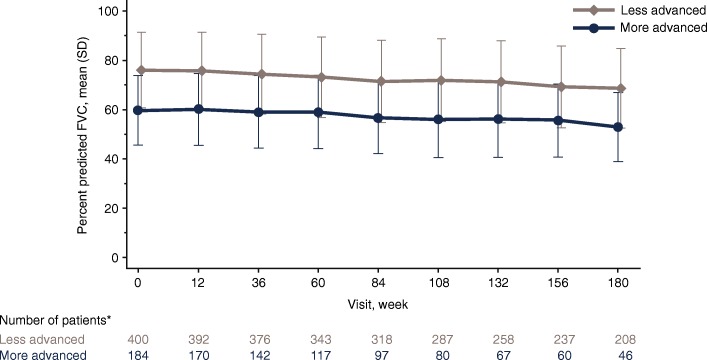
Data from controlled clinical studies in patients with more advanced idiopathic pulmonary fibrosis (IPF) could inform clinical practice, but they are limited, since this sub-population is usually excluded from clinical trials. These exploratory post-hoc analyses of the open-label, long-term extension study RECAP (NCT00662038) aimed to assess the efficacy and safety of pirfenidone in patients with more advanced IPF. Patients were categorised according to the extent of lung function impairment at baseline: more advanced (percent predicted FVC <50% and/or DLco <35%) and less advanced (percent predicted FVC ≥50% and DLco ≥35%).Overall, 596 patients with baseline FVC and/or DLco values available were included in the analyses; 187 patients had more advanced disease, and 409 patients had less advanced disease. Mean percent predicted FVC declined throughout 180 weeks of treatment in both more and less advanced disease subgroups. Both subgroups exhibited a similar pattern of adverse events; however, adverse events related to IPF progression were experienced by a higher proportion of patients with more advanced versus less advanced disease. Discontinuation rates due to any reason, adverse events related to IPF progression, or deaths were each higher in the more advanced versus the less advanced disease subgroup.These analyses found that longer-term pirfenidone treatment resulted in a similar rate of lung function decline and safety profile in patients with more advanced versus less advanced IPF, and the data suggest that pirfenidone is efficacious, well tolerated, and a feasible treatment option in patients with more advanced IPF.
Overview
The claims and statistics of this paper haven’t been checked yet.
Free: it reads the open-access text and checks the first 5 claims that cite a source we can check. Create a free account to check every claim.
Integrity signals
Registry
Cites
Statistics
Figures
Verification
Claims the paper makes
The claims and statistics of this paper haven’t been checked yet.
Free: it reads the open-access text and checks the first 5 claims that cite a source we can check. Create a free account to check every claim.
Claims other papers make about this one
Each is checked against this paper’s own text: does it say what the citing paper says it does?
The check wasn’t confident either way, so it gives no verdict — never disputed.
In the citing paper
“Multiple systematic reviews and meta-analyses have also confirmed the efficacy of nintedanib in reducing the decline in FVC seen in IPF patients [27,28,31,43,44].”
From Emerging pharmacological options in the treatment of idiopathic pulmonary fibrosis (IPF) (2024) · cites this paper as [43]
Experimental — accuracy not yet measured
Self-check
Percentages, sums and reported differences re-computed from the paper’s own numbers.
The self-check needs the paper’s full text.
Citations
Cites
Raghu, G., Collard, H. R., Egan, J. J., Martinez, F. J., Behr, J., Brown, K. K., Colby, T. V., Cordier, J.-F., Flaherty, K. R., Lasky, J. A., et al. (2011) · American Journal of Respiratory and Critical Care Medicine · doi:10.1164/rccm.2009-040gl · Cited by 7,186
Self-citationEfficacy and Safety of Nintedanib in Idiopathic Pulmonary Fibrosis
Richeldi, L., du Bois, R. M., Raghu, G., Azuma, A., Brown, K. K., Costabel, U., Cottin, V., Flaherty, K. R., Hansell, D. M., Inoue, Y., et al. (2014) · New England Journal of Medicine · doi:10.1056/nejmoa1402584 · Cited by 4,654
Self-citationA phase 3 trial of pirfenidone in patients with idiopathic pulmonary fibrosis.
King, T. E., Bradford, W. Z., Castro-Bernardini, S., Fagan, E. A., Glaspole, I., Glassberg, M. K., Gorina, E., Hopkins, P. M., Kardatzke, D., Lancaster, L., et al. (2014) · New England Journal of Medicine · doi:10.1056/nejmoa1402582 · Cited by 3,975
Self-citationPirfenidone in patients with idiopathic pulmonary fibrosis (CAPACITY): two randomised trials
Noble, P. W., Albera, C., Bradford, W. Z., Costabel, U., Glassberg, M. K., Kardatzke, D., King, T. E., Lancaster, L., Sahn, S. A., Szwarcberg, J., et al. (2011) · The Lancet · doi:10.1016/s0140-6736(11)60405-4 · Cited by 2,154
Self-citationClinical course and prediction of survival in idiopathic pulmonary fibrosis
Ley, B., Collard, H. R., & King, T. E. (2011) · American Journal of Respiratory and Critical Care Medicine · doi:10.1164/rccm.201006-0894ci · Cited by 1,765
Long-term Course and Prognosis of Idiopathic Pulmonary Fibrosis in the New Millennium
Nathan, S. D., Shlobin, O. A., Weir, N., Ahmad, S., Kaldjob, J. M., Battle, E., Sheridan, M. J., & du Bois, R. M. (2011) · Chest · doi:10.1378/chest.10-2572 · Cited by 369
Costabel, U., Albera, C., Lancaster, L. H., Lin, C.-Y., Hormel, P., Hulter, H. N., & Noble, P. W. (2017) · Respiration · doi:10.1159/000479976 · Cited by 150
Self-citationGlaspole, I. N., Chapman, S. A., Cooper, W. A., Ellis, S. J., Goh, N. S., Hopkins, P. M., Macansh, S., Mahar, A., Moodley, Y. P., Paul, E., et al. (2017) · Respirology · doi:10.1111/resp.12989 · Cited by 123
Wuyts, W. A., Kolb, M., Stowasser, S., Stansen, W., Huggins, J. T., & Raghu, G. (2016) · Lung · doi:10.1007/s00408-016-9912-1 · Cited by 119
Self-citation
Cited by
Current and Future Treatment Landscape for Idiopathic Pulmonary Fibrosis
Bonella, F., Spagnolo, P., & Ryerson, C. (2023) · Drugs · doi:10.1007/s40265-023-01950-0 · Cited by 182
“Although post hoc analyses have suggested that nintedanib [35] and pirfenidone [36] have a similar effect on FVC decline in IPF patients with more versus less severe functional impairment, patients with FVC 50% or with significant comorbidities such as lung cancer and cardiovascular disease,…”
BackgroundBehr, J., Nathan, S. D., Wuyts, W. A., Mogulkoc Bishop, N., Bouros, D. E., Antoniou, K., Guiot, J., Kramer, M. R., Kirchgaessler, K.-U., Bengus, M., et al. (2021) · The Lancet Respiratory Medicine · doi:10.1016/s2213-2600(20)30356-8 · Cited by 134
Self-citationRegulatory Immune Cells in Idiopathic Pulmonary Fibrosis: Friends or Foes?
van Geffen, C., Deißler, A., Quante, M., Renz, H. E., Hartl, D., & Kolahian, S. (2021) · Frontiers in Immunology · doi:10.3389/fimmu.2021.663203 · Cited by 88
Faverio, P., Bocchino, M., Caminati, A., Fumagalli, A., Gasbarra, M., Iovino, P., Petruzzi, A., Scalfi, L., Sebastiani, A., Stanziola, A. A., et al. (2020) · Nutrients · doi:10.3390/nu12041131 · Cited by 82
Management of Idiopathic Pulmonary Fibrosis
Pleasants, R., & Tighe, R. M. (2019) · Annals of Pharmacotherapy · doi:10.1177/1060028019862497 · Cited by 63
“Data from the open-label INPULSIS-ON study of nintedanib and RECAP study of pirfenidone suggest that the efficacy and safety of these treatments are similar in patients with severe lung function impairment (FVC ≤50% predicted in INPULSIS-ON and FVC <50% and/or DLco <35% predicted in RECAP) as in those with less advanc…”
Deep learning in interstitial lung disease—how long until daily practice
Trușculescu, A. A., Manolescu, D., Tudorache, E., & Oancea, C. I. (2020) · European Radiology · doi:10.1007/s00330-020-06986-4 · Cited by 68
Scarred Lung. An Update on Radiation-Induced Pulmonary Fibrosis
Jarzebska, N., Karetnikova, E. S., Markov, A. G., Kasper, M. E., Rodionov, R. N., & Spieth, P. M. (2021) · Frontiers in Medicine · doi:10.3389/fmed.2020.585756 · Cited by 62
Mackintosh, J. A., Keir, G. J., Troy, L. K., Holland, A. E., Grainge, C., Chambers, D. C., Sandford, D., Jo, H. E., Glaspole, I., WILSHER, M. L., et al. (2024) · Respirology · doi:10.1111/resp.14656 · Cited by 60
“35,36 40 The reported rate of AEs is similar irrespective of disease severity, although patients with more severe disease have a higher discontinuation rate.”
BackgroundAntifibrotic Drug Use in Patients with Idiopathic Pulmonary Fibrosis. Data from the IPF-PRO Registry
Salisbury, M. L., Conoscenti, C., Culver, D. A., Yow, E. S., Neely, M. L., Bender, S. D., Hartmann, N., Palmer, S. M., & Leonard, T. B. (2020) · Annals of the American Thoracic Society · doi:10.1513/annalsats.201912-880oc · Cited by 56
Shah, P., Balani, P., Lopez, A. R., Nobleza, C. M. N., Siddiqui, M., & Khan, S. (2021) · Cureus · doi:10.7759/cureus.12482 · Cited by 56
“[18] 2019 To analyze and know the efficacy and safety of PFD in patients classified under more advanced IPF After taking PFD, the rate of FVC decline and safety profile in more advanced IPF patients was similar to less advanced IPF patients, and the information suggests that PFD is efficacious, tolerable, and feasible…”
ResultGulati, S., & Luckhardt, T. (2020) · Drug Healthcare and Patient Safety · doi:10.2147/dhps.s224007 · Cited by 48
Chung, M. P., Park, M. S., Oh, I., Lee, H. B., Kim, Y. W., Park, J. S., Uh, S. T., Kim, Y. S., Jegal, Y., & Song, J. W. (2020) · Advances in Therapy · doi:10.1007/s12325-020-01328-8 · Cited by 44
Advances in Targeted Therapy for Progressive Fibrosing Interstitial Lung Disease
Gibson, C. D., Kugler, M. C., Deshwal, H., Munger, J. S., & Condos, R. (2020) · Lung · doi:10.1007/s00408-020-00370-1 · Cited by 32
“IPF patients, with varying disease severity, did tolerate not only the long-term use of pirfenidone but also had a similar rate of FVC decline over time [56].”
BackgroundChanges in management of idiopathic pulmonary fibrosis: impact on disease severity and mortality
Hyldgaard, C., Møller, J., & Bendstrup, E. M. (2020) · European Clinical Respiratory Journal · doi:10.1080/20018525.2020.1807682 · Cited by 29
“One study reported results from RECAP, the extension study from the phase 3 trials of pirfenidone in patients with IPF, ASCEND and CAPACITY, [25] and another study reported the outcomes of participants in the ASCEND and CAPACITY trials whose pulmonary function for different reasons were below the screening criteria [2…”
ResultReal-world experiences: Efficacy and tolerability of pirfenidone in clinical practice
Fang, C., Huang, H. F., Guo, J., Ferianc, M., & Xu, Z. (2020) · PLoS ONE · doi:10.1371/journal.pone.0228390 · Cited by 29
Behr, J., Bonella, F., Frye, B. C., Günther, A., Hagmeyer, L., Henes, J. C., Klemm, P., Koschel, D., Kreuter, M., Leuschner, G., et al. (2023) · Pneumologie · doi:10.1055/a-1983-6796 · Cited by 26
Self-citationPharmacological management of Idiopathic Pulmonary Fibrosis: current and emerging options
Trachalaki, A., Irfan, M., & Wells, A. U. (2020) · Expert Opinion on Pharmacotherapy · doi:10.1080/14656566.2020.1822326 · Cited by 26
Krauss, E., Tello, S., Wilhelm, J., Schmidt, J., Stoehr, M., Seeger, W., Dartsch, R. C., Crestani, B., & Günther, A. (2020) · Journal of Clinical Medicine · doi:10.3390/jcm9113763 · Cited by 24
“published data on pirfenidone treatment in 187 patients with more advanced disease, and 409 patients with less advanced disease; it was shown that longer-term pirfenidone treatment resulted in a similar rate of lung function decline and safety profile in patients with more advanced versus less advanced IPF [26].”
Behr, J., Nathan, S. D., Costabel, U., Albera, C., Wuyts, W. A., Glassberg, M. K., Haller, H., Alvaro, G., Gilberg, F., Samara, K. D., et al. (2023) · Advances in Therapy · doi:10.1007/s12325-023-02565-3 · Cited by 22
“Additionally, the safety profile of pirfenidone was generally similar between patients with more and less advanced disease, with the exception of adverse events related to the higher severity of the underlying disease, which were experienced more frequently in patients with more advanced IPF [26].”
BackgroundResultSelf-citationManagement of Idiopathic Pulmonary Fibrosis
Salisbury, M. L., & Wijsenbeek, M. S. (2021) · Clinics in Chest Medicine · doi:10.1016/j.ccm.2021.03.004 · Cited by 20
Pastré, J., Barnett, S. D., Ksovreli, I., Taylor, J., Brown, A. W., Shlobin, O. A., Ahmad, K., Khangoora, V. S., Aryal, S., King, C. S., et al. (2021) · Respiratory Research · doi:10.1186/s12931-020-01600-z · Cited by 19
Treatment of Idiopathic Pulmonary Fibrosis
Abuserewa, S. T. H., Duff, R., & Becker, G. (2021) · Cureus · doi:10.7759/cureus.15360 · Cited by 18
“However, clinical worsening of IPF and treatment interruption were more common in severe disease than non-severe [25,26].”
BackgroundAn updated safety review of the drug treatments for idiopathic pulmonary fibrosis
Sgalla, G., Comes, A., & Richeldi, L. (2021) · Expert Opinion on Drug Safety · doi:10.1080/14740338.2021.1921143 · Cited by 18
“categorizing patients according to IPF severity (more advanced (187 patients): percent predicted FVC<50% and/or DLCO<35%, and less advanced (409 patients): percent predicted FVC≥50% and DLCO≥35%) [19].”
MethodEmerging pharmacological options in the treatment of idiopathic pulmonary fibrosis (IPF)
Aribindi, K., Liu, G. Y., & Albertson, T. E. (2024) · Expert Review of Clinical Pharmacology · doi:10.1080/17512433.2024.2396121 · Cited by 17
“A sub-analysis of RECAP patients with IPF demonstrated a similar improvement in cough with pirfenidone even in more advanced IPF patients [43].”
Suriya Prakaash, K. K., & Narayanasamy, D. (2025) · Drug Development and Industrial Pharmacy · doi:10.1080/03639045.2025.2468811 · Cited by 16
“…pirfenidone resulted in similar rates of lung function decline and safety profiles for both groups, suggesting that pirfenidone may be effective for patients with varying stages of iPF [40]. the impact of nintedanib on different subgroups of iPF patients was analyzed based on diagnostic criteria.”
A comprehensive and practical approach to the management of idiopathic pulmonary fibrosis
Moran‐Mendoza, O., Colman, R., Kalluri, M., Cabalteja, C., & Harle, I. A. (2019) · Expert Review of Respiratory Medicine · doi:10.1080/17476348.2019.1627204 · Cited by 15
Behr, J., Bonella, F., Frye, B. C., Günther, A., Hagmeyer, L., Henes, J., Klemm, P., Koschel, D., Kreuter, M., Leuschner, G., et al. (2024) · Respiration · doi:10.1159/000540856 · Cited by 13
“Even patients with severe IPF still bene fi t from anti fi brotic therapy [35, 63, 67].”
Self-citationXia, Y., Lei, C., Yang, D., & Luo, H. (2020) · PeerJ · doi:10.7717/peerj.9848 · Cited by 11
“However, these treatments merely slow the progression of IPF, without improving lung function (Costabel et al., 2019; Costabel et al., 2017; Richeldi et al., 2014; Richeldi et al., 2020).”
BackgroundMájek, O., Gregor, J., Moğulkoç, N., Lewandowska, K. B., Šterclová, M., Müller, V., Hájková, M., Kramer, M. R., Tekavec-Trkanjec, J., Jovanović, D. M., et al. (2022) · PLoS ONE · doi:10.1371/journal.pone.0273854 · Cited by 11
Bibliometric analysis of the pirfenidone and nintedanib in interstitial lung diseases
Liu, J., Wang, F., Hong, Y., & Luo, F. (2024) · Heliyon · doi:10.1016/j.heliyon.2024.e29266 · Cited by 8
Pharmacological treatment of pulmonary fibrosis
Choi, W.-I. (2020) · Journal of Korean Medical Association · doi:10.5124/jkma.2020.63.1.47 · Cited by 5
Cano-Jiménez, E., Ortíz, A. D. R., Villar, A., Rodríguez‐Nieto, M. J., Ramón, A., & Armengol, S. (2022) · Respiratory Research · doi:10.1186/s12931-022-02154-y · Cited by 5
“Receiving antifibrotic treatment is associated with a reduction of disease progression and an increased median survival irrespective of FVC % predicted at baseline [5, 11, 19, 36].”
BackgroundDrugs that act on the respiratory tract
Yogaratnam, D., Carey, K. M., Coppenrath, V. A., Dawson, A., Harris, M., LaMothe, A. B. W., Pourhosseini, P., & Lynch, A. M. (2021) · Side effects of drugs annual · doi:10.1016/bs.seda.2021.09.001 · Cited by 4
Touil, I., Boudawara, N. K., Bouchareb, S., Saad, A. B., Migaou, A., Mhamed, S. C., Fahem, N., Mribah, H., Knani, J., Boussoffara, L., et al. (2021) · Revue des Maladies Respiratoires · doi:10.1016/j.rmr.2021.04.015 · Cited by 4
Drugs that act on the respiratory tract
Yogaratnam, D., Carey, K. M., Coppenrath, V. A., Dawson, A., Havkins, D., LaMothe, A. B. W., & Lynch, A. M. (2020) · Side effects of drugs annual · doi:10.1016/bs.seda.2020.09.014 · Cited by 4
Tratamiento farmacológico en la fibrosis pulmonar idiopática. Drogas modificadoras de enfermedad
FLORENZANO, M., V, & C, F. R. (2019) · Revista chilena de enfermedades respiratorias · doi:10.4067/s0717-73482019000400287 · Cited by 3
Management of idiopathic pulmonary fibrosis: A survey of Canadian respirologists
Fidler, L. M., Burns, K. E. A., Singer, L. G., Kiss, A., Shapera, S., & Stanbrook, M. B. (2020) · Canadian Journal of Respiratory Critical Care and Sleep Medicine · doi:10.1080/24745332.2020.1767524 · Cited by 3
Choi, W.-I. (2021) · Precision and Future Medicine · doi:10.23838/pfm.2020.00205 · Cited by 3
“Subsequent studies have analyzed the effect of pirfenidone treatment in patients with mild (% predicted FVC 90%) and severe (percent predicted FVC <50%) IPF [24,25].”
BackgroundResultChhajed, P. N., Gogtay, J. A., Rajan, S. K., Meshram, S., Mehta, M., & Lopez, M. (2024) · The Indian Journal of Chest Diseases and Allied Sciences · doi:10.5005/jp-journals-11007-0116 · Cited by 2
Carlos Inzunza, P., Raúl Riquelme, O., Krikor Koury, K., Gabriela Altamirano, U., Mauricio Riquelme, O., Cristian Medina, A., Javier Riquelme, D., Cristián Acevedo, H., & Loreto Araya, S. (2025) · Revista chilena de enfermedades respiratorias · doi:10.4067/s0717-73482025000300176 · Cited by 1
Antifibrotische Therapie der idiopathischen pulmonalen Fibrose
Markart, P., Drakopanagiotakis, F., & Wygrecka, M. (2020) · Der Pneumologe · doi:10.1007/s10405-019-00296-3
The art of clinical trial design in pulmonary fibrosis
Behr, J. (2023) · European Respiratory Journal · doi:10.1183/13993003.00346-2023
İdiyopatik Pulmoner Fibrozis Tanıdan Tedaviye Güncel Yaklaşım
Ölmez, H. (2025) · Akademisyen Kitabevi eBooks · doi:10.37609/akya.3774
Levra, S., Rivero, C., Giannoccaro, F., Guida, G., Bertolini, F., Carriero, V. M. A., Arrigo, E., Balbi, M., Albera, C., & Ricciardolo, F. L. M. (2025) · Biomedicines · doi:10.3390/biomedicines13112809
“Post hoc analysis of the extension study RECAP (NCT00662038) also confirmed that long-term pirfenidone treatment results in a similar decline in lung function in patients with more advanced than those with less advanced IPF [5].”
InfluentialSelf-citationCano-Jiménez, E., Romero Ortiz, A. D., Villar, A., Rodríguez-Nieto, M. J., Ramón, A., & Armengol, S. (2022) · Figshare · doi:10.6084/m9.figshare.21062151
Onyango, V. C. (2024) · Zenodo (CERN European Organization for Nuclear Research) · doi:10.5281/zenodo.11235213
Wójcik, G., Sahu-Osen, A., Waked, P., Gindlhuber, J., Syarif, A. H., Hrzenjak, A., Nagaraj, C., Birnhuber, A., Hoffmann, J., Mischkulnig, L., et al. (2026) · Cellular and Molecular Life Sciences · doi:10.1007/s00018-026-06256-4
Fyles, F., McKinnon, A., Agnew, S., Sutcliffe, J., Brooks, S., Barnett, J., McGarvie, S., Simons, A., Kwok, A., Yioe, V., et al. (2026) · The Clinical Respiratory Journal · doi:10.1111/crj.70239
“…to predict discontinuation; although our study did not demonstrate that FVC was a marker for early discontinuation, as has been shown in other studies [23, 24], both FVC and TLCO can be used as proxy markers for ILD severity [22], which has been shown to affect AF adherence by Ogura et al. [25].”
Metadata
- Authors
- Costabel, U., Albera, C., Glassberg, M. K., Lancaster, L. H., Wuyts, W. A., Petzinger, U., Gilberg, F., Kirchgaessler, K.-U., & Noble, P. W.
- Affiliations
- Ruhrlandklinik (DE)
- University of Turin (IT)
- University of Miami Health System (US)
- Vanderbilt University Medical Center (US)
- Universitair Ziekenhuis Leuven (BE)
- F. Hoffmann-La Roche AG (CH)
- Cedars-Sinai Medical Center (US)
- Corresponding author
- Costabel, Ulrich
- ORCID
- Venue
- Respiratory Research
- Published
- 2019-03-12
- Volume
- 20
- Issue
- 1
- Pages
- 55-55
- ISSN
- 1465-9921 (ISSN-L)
- 1465-993X
- PMC
- PMC6416878
- OpenAlex
- W2939662940
- Cited by
- 43
- References
- 9
- Citations by year
- 2025: 2 · 2024: 5 · 2023: 4 · 2022: 3 · 2021: 10 · 2020: 16 · 2019: 3
- FWCI
- 5.88
- Type
- journal article
- Language
- en
- Open access
- gold
- doi.org
- Licence
- cc-by
- creativecommons.org/licenses/by/4.0/ (tdm)
- Locations
- Respiratory Research (publishedVersion, cc-by)
- Europe PMC (PubMed Central) (publishedVersion, cc-by)
- PubMed Central (publishedVersion, cc-by)
- PubMed (publishedVersion)
- Lirias (KU Leuven) (submittedVersion, other-oa)
- DOAJ (DOAJ: Directory of Open Access Journals) (submittedVersion)
- Institutional Research Information System University of Turin (University of Turin) (submittedVersion)
- Funders
- F. Hoffmann-La Roche, Ltd. (.)
- Topics
- Health Sciences › Medicine › Pulmonary and Respiratory Medicine › Interstitial Lung Diseases and Idiopathic Pulmonary Fibrosis
- Health Sciences › Medicine › Pulmonary and Respiratory Medicine › Chronic Obstructive Pulmonary Disease (COPD) Research
- Health Sciences › Medicine › Pulmonary and Respiratory Medicine › Pulmonary Hypertension Research and Treatments
- Keywords
- pirfenidone, idiopathic pulmonary fibrosis, advanced disease, lung function decline, forced vital capacity, diffusing capacity for carbon monoxide, disease progression, adverse events, treatment discontinuation, post hoc analysis
- MeSH terms
- Aged, Anti-Inflammatory Agents, Non-Steroidal, Female, Humans, Male, Middle Aged, Pyridones, Treatment Outcome, Disease Progression, Idiopathic Pulmonary Fibrosis
About these checks
Registry, retraction, Cites and statistics results are computed, not judged, with one exception: a printed reference that no index lists is read once by a model before it counts as a citation error. Claims are extracted by a model and kept only when their quote appears verbatim in the text; each cited source is then checked, with a model’s help, for whether it says what the claim relies on. Those verdicts can be wrong — read the claim’s quote and the cited source before relying on one.
Statistics and arithmetic are recomputed, not judged.
Confidence bands are shown only for fields calibrated on our annotated test set. None is calibrated yet, so no band is shown.
What counts as a claim ›How we measure confidence ›How we check this ›
Are you an author, or do you see a problem with this page? Request a review
Data sources
Bibliographic data: Semantic Scholar, OpenAlex, Crossref.
Contains information from the Semantic Scholar Academic Graph Datasets, made available under the ODC Attribution License (ODC-BY 1.0).
Semantic Scholar’s data is described in: Kinney, R., et al. (2023). The Semantic Scholar Open Data Platform. arXiv:2301.10140.
