

The DOI matches its Crossref record; 208 of the 208 references it cites were found in a registry or an index.
Endocrine-disrupting chemicals exposure: cardiometabolic health risk in humans
Open accessAbstract
Endocrine-disrupting chemicals (EDCs) are exogenous compounds that interfere with hormone action, and growing evidence suggests that human exposure to certain EDCs may increase the risk of obesity, type 2 diabetes mellitus (T2DM), and cardiovascular disease (CVD). To clarify the impact of EDC exposure on cardiometabolic health, we conducted a review of the literature (2005-2025) to identify both human epidemiological studies and animal mechanistic studies. In this narrative review, we primarily summarize the existing human epidemiological evidence on the cardiometabolic effects of EDCs, while also considering mechanistic insights, including selected animal studies, to illustrate biological plausibility. Key findings indicate that EDC exposures are consistently associated with elevated risks of cardiometabolic conditions. Notably, prenatal and early-life EDC exposures appear to increase susceptibility to obesity, impaired glucose metabolism, and cardiovascular dysfunction later in life, while adult exposures are linked to a higher incidence of metabolic syndrome, type 2 diabetes, and related cardiovascular complications. In conclusion, this review underscores EDC exposure as a significant environmental risk factor for cardiometabolic disease. Accordingly, strengthening regulatory policies to reduce human exposure to these chemicals-alongside further research into underlying mechanisms-may be crucial for improving cardiometabolic health outcomes.
Overview
The claims and statistics of this paper haven’t been checked yet.
Run the check — free, no account needed. It reads the open-access text and checks the sources it cites.
Integrity signals
Registry
Cites
Statistics
Figures
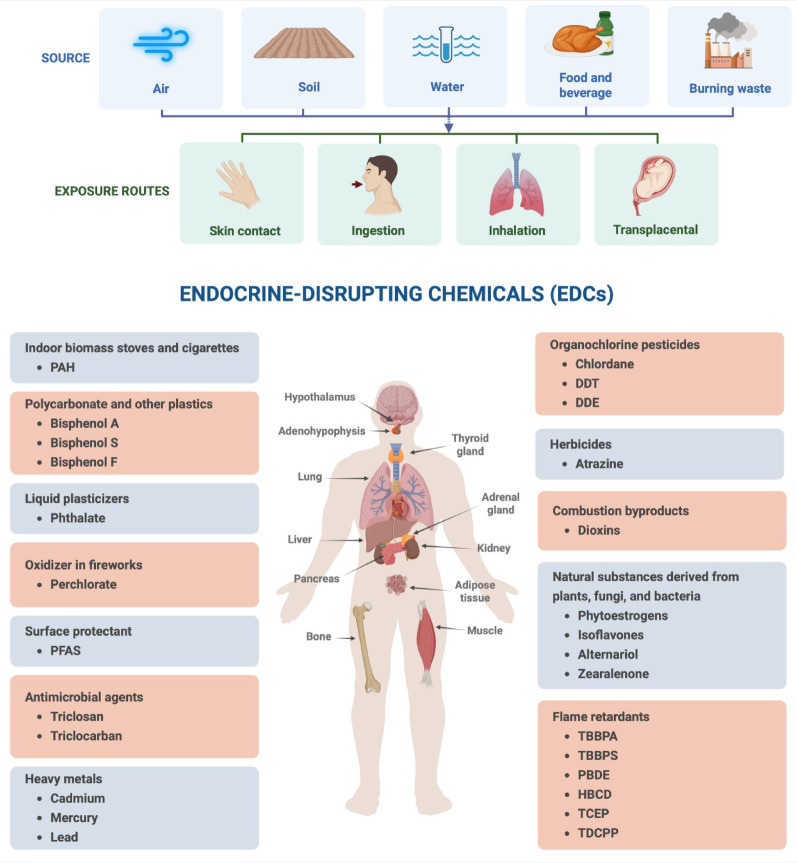
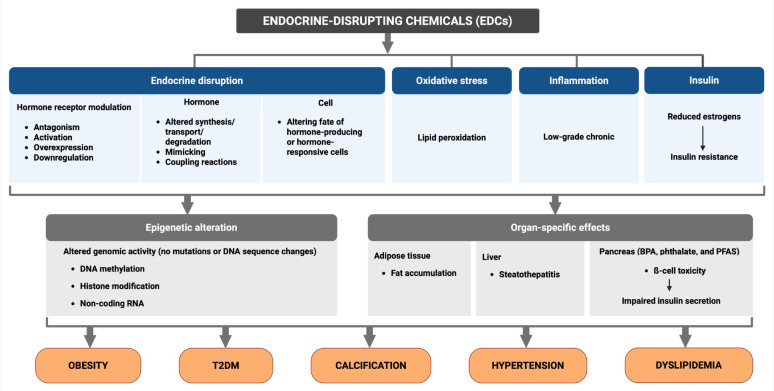
Verification
Claims the paper makes
The claims and statistics of this paper haven’t been checked yet.
Run the check — free, no account needed. It reads the open-access text and checks the sources it cites.
Claims other papers make about this one
Each is checked against this paper’s own text: does it say what the citing paper says it does?
The source backs part of the claim, not all of it — or backs it for a different population, condition or comparison.
In the citing paper
“The most consistent evidence base relates to ambient air pollution, persistent pollutants such as per- and polyfluoroalkyl substances (PFAS), and selected endocrine-disrupting chemicals (EDCs), with diet and built-environment features functioning as modifiers and correlated determinants of risk across the life course [75,76,77].”
From Placental Pathophysiology and Developmental Programming of Adult Cardiometabolic Risk: A Narrative Review of Pregnancy Exposures (2026) · cites this paper as [77]
Experimental — accuracy not yet measured
Self-check
Percentages, sums and reported differences re-computed from the paper’s own numbers.
The self-check needs the paper’s full text.
Citations
Cites
Items 201–208 of 208
Shin, S., Kim, Y., Choe, Y., Kim, S. H., Cho, J., Kim, C., & Kim, K. (2025) · Environmental Health · doi:10.1186/s12940-025-01185-4 · Cited by 8
Xu, C. Y., Zhang, S., An, J., Jia, C., Zhang, X., Li, P., Guan, Y., Yan, Y., Zhao, Z., Liu, Y., et al. (2024) · Environmental Pollution · doi:10.1016/j.envpol.2024.125008 · Cited by 6
Phthalate exposure and blood pressure in U.S. children aged 8–17 years (NHANES 2013–2018)
Cheng, T., Lou, C., Jing, X., Ding, S., Hong, H., Ding, G., & Shen, L. (2024) · European journal of medical research · doi:10.1186/s40001-024-01785-9 · Cited by 6
Mengozzi, A., Carli, F., Pezzica, S., Biancalana, E., Gastaldelli, A., & Solini, A. (2022) · Diabetology & Metabolic Syndrome · doi:10.1186/s13098-022-00875-0 · Cited by 5
Tabęcka-Łonczyńska, A., Koszła, O., & Sołek, P. (2024) · Chemosphere · doi:10.1016/j.chemosphere.2024.142802 · Cited by 4
Preston, E. V., Quinn, M. R., Williams, P. L., McElrath, T. F., Cantonwine, D. E., Seely, E. W., Wylie, B. J., Hacker, M. R., O'Brien, K., Brown, F. M., et al. (2024) · BMJ Open · doi:10.1136/bmjopen-2023-079782 · Cited by 4
Pothisiri, P., & Kongchuntuk, H. (2009) · Nutrition Reviews · doi:10.1111/j.1753-4887.1996.tb03836.x · Cited by 3
Toward a Better Beauty Regimen: Reducing Potential EDC Exposures from Personal Care Products
Arnold, C. (2016) · Environmental Health Perspectives · doi:10.1289/ehp.124-a188 · Cited by 2
Research works printed but not linked: 2
- Zangiabadian M, Jolfayi AG, Nejadghaderi SA, Amirkhosravi L, Sanjari M. The association between heavy metal exposure and obesity: a systematic review and meta-analysis. J Diabet Metabolic Disorders. 2024;23(1):11–26. · DOI
- Mohd Efendy Goon MD, Zulkifli S, Abdullah Soheimi SS, Ab Rahim S, Abd Latip N, Hashim N, et al. Association between polychlorinated biphenyl (PCB) and dioxin with metabolic syndrome (METS): a systematic review and meta-analysis. Sci Rep. 2024;14(1):17941. · DOI
Cited by
Sorted by citations
Shao, X., Yu, T., Luo, L., Zheng, H., Yang, F., & Dong, J. (2026) · Cardiovascular Diabetology · doi:10.1186/s12933-026-03195-z · Cited by 4
Priya, G., Kotwal, N., Madhu, S. V., Patra, S., Pandit, K., Anne, B., Shenoy, M. T., Swain, J., Das, S., Kopalle, L. N., et al. (2026) · Indian Journal of Endocrinology and Metabolism · doi:10.4103/ijem.ijem_976_25 · Cited by 2
Tovar‐Parra, D., McDermott, A., Cardot, J., Juarez, M. N., Joao, F., Omri-Charai, R. E., Berthiaume, L., Dhawan, B., Aghigh, A., Breton, Y., et al. (2025) · Toxicological Sciences · doi:10.1093/toxsci/kfaf157 · Cited by 1
Zhu, X., Xu, W., & Lu, A.-F. (2026) · Reproductive Toxicology · doi:10.1016/j.reprotox.2026.109233 · Cited by 1
The hepato-exposome axis: How endocrine disruptors hijack liver receptors to drive MASLD
Martín-Grau, M., Kamstra, J. H., Hyötyläinen, T., Orešič, M., Song, Y., Veličković, N. A., Djordjevic, A. D., Milutinović, D. V., Jackson, R. F., van Vorstenbosch, R., et al. (2026) · Journal of Hepatology · doi:10.1016/j.jhep.2026.06.021 · Cited by 1
Metadata
- Authors
- Ma, C.-X., Ma, X.-N., Li, H.-L., Mauricio, D., & Fu, S.-B.
- Venue
- Cardiovascular Diabetology
- Published
- 2025-10-01
- Volume
- 24
- Issue
- 1
- Pages
- 381-381
- ISSN
- 1475-2840 (ISSN-L)
- PMC
- PMC12487381
- OpenAlex
- W4414700639
- Cited by
- 19
- References
- 208
- Citations by year
- 2026: 18 · 2025: 1
- FWCI
- 2.16
- Type
- journal article
- Language
- en
- Open access
- gold
- doi.org
- Licence
- Locations
- Cardiovascular Diabetology (publishedVersion, cc-by-nc-nd)
- Europe PMC (PubMed Central) (publishedVersion, cc-by-nc-nd)
- PubMed (publishedVersion)
- PubMed Central (publishedVersion, cc-by-nc-nd)
- Dipòsit Digital de Documents de la UAB (Universitat Autònoma de Barcelona) (submittedVersion, cc-by-nc-nd)
- DOAJ (DOAJ: Directory of Open Access Journals) (submittedVersion, cc-by-sa)
- Funders
- the Technique Plans Foundation of Lanzhou City (2022-ZD-97)
- National Natural Science Foundation of China (82260050, 82460177)
- Lanzhou University 2023 College Students Innovation and Entrepreneurship (20230060190)
- The Hospital Fund of the First Hospital of Lanzhou University (ldyyyn2020-93)
- Gansu Province Science and Technology Plan Project - Joint Research Fund (25JRRA1251)
- Topics
- Physical Sciences › Environmental Science › Health, Toxicology and Mutagenesis › Effects and risks of endocrine disrupting chemicals
- Physical Sciences › Environmental Science › Health, Toxicology and Mutagenesis › Toxic Organic Pollutants Impact
- Physical Sciences › Environmental Science › Health, Toxicology and Mutagenesis › Health, Environment, Cognitive Aging
- Keywords
- endocrine disruptors, cardiometabolic health, obesity, type 2 diabetes, cardiovascular disease, metabolic syndrome, impaired glucose metabolism, prenatal exposure, early life exposure, environmental risk factors, endocrine disruption, chemical regulation
- MeSH terms
- Cardiometabolic Risk Factors, Animals, Cardiovascular Diseases, Diabetes Mellitus, Type 2, Environmental Exposure, Female, Humans, Obesity, Pregnancy, Prenatal Exposure Delayed Effects, Risk Assessment, Metabolic Syndrome, Endocrine Disruptors
About these checks
Registry, retraction, Cites and statistics results are computed, not judged, with one exception: a printed reference that no index lists is read once by a model before it counts as a citation error. Claims are extracted by a model and kept only when their quote appears verbatim in the text; each cited source is then checked, with a model’s help, for whether it says what the claim relies on. Those verdicts can be wrong — read the claim’s quote and the cited source before relying on one.
Statistics and arithmetic are recomputed, not judged.
Confidence bands are shown only for fields calibrated on our annotated test set. None is calibrated yet, so no band is shown.
What counts as a claim ›How we measure confidence ›How we check this ›
Are you an author, or do you see a problem with this page? Request a review
