

The DOI matches its Crossref record; 264 of the 264 references it cites were found in a registry or an index.
Microalgae-based bioremediation of refractory pollutants: an approach towards environmental sustainability
Open accessAbstract
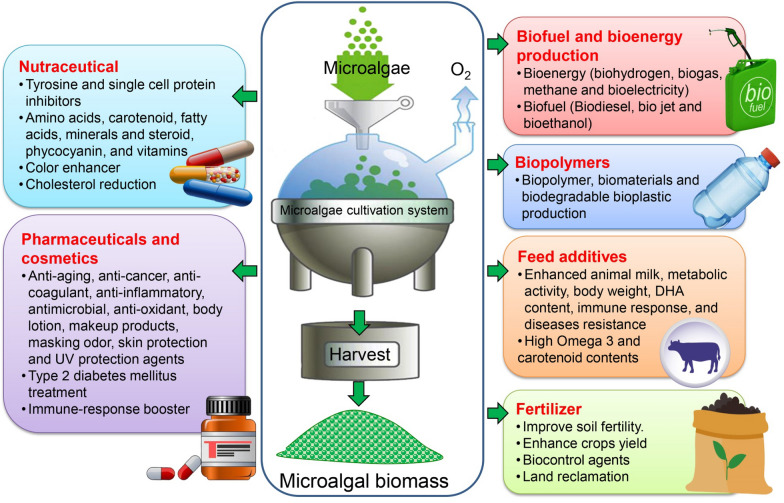
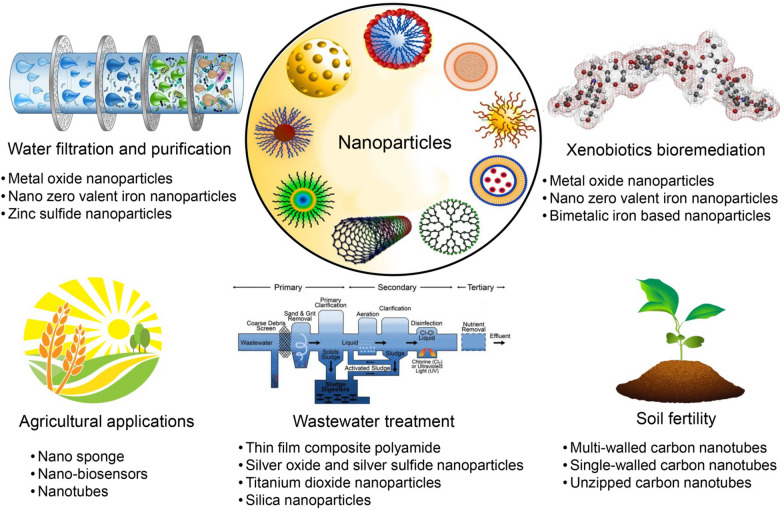
Abstract Extensive anthropogenic activity has led to the accumulation of organic and inorganic contaminants in diverse ecosystems, which presents significant challenges for the environment and its inhabitants. Utilizing microalgae as a bioremediation tool can present a potential solution to these challenges. Microalgae have gained significant attention as a promising biotechnological solution for detoxifying environmental pollutants. This is due to their advantages, such as rapid growth rate, cost-effectiveness, high oil-rich biomass production, and ease of implementation. Moreover, microalgae-based remediation is more environmentally sustainable for not generating additional waste sludge, capturing atmospheric CO 2 , and being efficient for nutrient recycling and sustainable algal biomass production for biofuels and high-value-added products generation. Hence, microalgae can achieve sustainability's three main pillars (environmental, economic, and social). Microalgal biomass can mediate contaminated wastewater effectively through accumulation, adsorption, and metabolism. These mechanisms enable the microalgae to reduce the concentration of heavy metals and organic contaminants to levels that are considered non-toxic. However, several factors, such as microalgal strain, cultivation technique, and the type of pollutants, limit the understanding of the microalgal removal mechanism and efficiency. Furthermore, adopting novel technological advancements (e.g., nanotechnology) may serve as a viable approach to address the challenge of refractory pollutants and bioremediation process sustainability. Therefore, this review discusses the mechanism and the ability of different microalgal species to mitigate persistent refractory pollutants, such as industrial effluents, dyes, pesticides, and pharmaceuticals. Also, this review paper provided insight into the production of nanomaterials, nanoparticles, and nanoparticle-based biosensors from microalgae and the immobilization of microalgae on nanomaterials to enhance bioremediation process efficiency. This review may open a new avenue for future advancing research regarding a sustainable biodegradation process of refractory pollutants.
Overview
The claims and statistics of this paper haven’t been checked yet.
Run the check — free, no account needed. It reads the open-access text and checks the sources it cites.
Integrity signals
Registry
Cites
Statistics
Figures
Verification
Claims the paper makes
The claims and statistics of this paper haven’t been checked yet.
Run the check — free, no account needed. It reads the open-access text and checks the sources it cites.
Claims other papers make about this one
Each is checked against this paper’s own text: does it say what the citing paper says it does?
The cited source says what the claim attributes to it.
In the citing paper
“From an environmental perspective, the narrative surrounding microalgae is about their major impact on bioremediation, where they capture CO2 from the atmosphere and absorb pollutants from wastewater, while also producing value-added biomass (Bhatt et al., 2022; El-Sheekh et al., 2025).”
From Microalgae biotechnology and its role in sustainable and healthy food design (2025) · cites this paper as El-Sheekh et al., 2025
Self-check
Percentages, sums and reported differences re-computed from the paper’s own numbers.
The self-check needs the paper’s full text.
Citations
Cites
Al-Tohamy, R., Ali, S. S., Li, F., Okasha, K. M., Mahmoud, Y. A.-G., Elsamahy, T., Jiao, H., Fu, Y., & Sun, J. (2022) · Ecotoxicology and Environmental Safety · doi:10.1016/j.ecoenv.2021.113160 · Cited by 3,479
Self-citationAgriculture Development, Pesticide Application and Its Impact on the Environment
Tudi, M., Ruan, H. D., Wang, L., Lyu, J., Sadler, R., Connell, D., Chu, C. M.-Y., & Phung, D. T. (2021) · International Journal of Environmental Research and Public Health · doi:10.3390/ijerph18031112 · Cited by 2,693
A Review on Biosensors and Recent Development of Nanostructured Materials-Enabled Biosensors
Naresh, V., & Lee, N. (2021) · Sensors · doi:10.3390/s21041109 · Cited by 2,213
Reddy, L. H., Arias, J. L., Nicolas, J., & Couvreur, P. (2012) · Chemical Reviews · doi:10.1021/cr300068p · Cited by 2,010
Wastewater treatment high rate algal ponds for biofuel production
Park, J. B. K., Craggs, R. J., & Shilton, A. N. (2010) · Bioresource Technology · doi:10.1016/j.biortech.2010.06.158 · Cited by 1,155
Aziz, K. H. H., Mustafa, F. S., Omer, K. M., Hama, S. M. L., HamaRawf, R. F., & Rahman, K. O. (2023) · RSC Advances · doi:10.1039/d3ra00723e · Cited by 1,117
A review on environmental monitoring of water organic pollutants identified by EU guidelines
Sousa, J. C. G., Ribeiro, A. R., Barbosa, M. O., Pereira, M. F. R., & Silva, A. M. T. (2017) · Journal of Hazardous Materials · doi:10.1016/j.jhazmat.2017.09.058 · Cited by 899
Microalgae-based wastewater treatment: Mechanisms, challenges, recent advances, and future prospects
Abdelfattah, A., Ali, S. S., Ramadan, H., El-Aswar, E. I., Eltawab, R., Ho, S.-H., Elsamahy, T., Li, S., El-Sheekh, M. M., Schagerl, M., et al. (2023) · Environmental Science and Ecotechnology · doi:10.1016/j.ese.2022.100205 · Cited by 894 · cited 2×
“In recent years, the significance of low-cost biological wastewater treatment with algae has been emphasized as a viable alternative to conventional waste-water treatment methods [17].”
Self-citationIntegrating micro-algae into wastewater treatment: a review
Mohsenpour, S. F., Hennige, S., Willoughby, N., Adeloye, A., & Gutierrez, T. (2021) · Science of The Total Environment · doi:10.1016/j.scitotenv.2020.142168 · Cited by 828
Biological Methods for Textile Dye Removal from Wastewater: A Review
Bhatia, D., Sharma, N. R., Singh, J., & Kanwar, R. S. (2017) · Critical Reviews in Environmental Science and Technology · doi:10.1080/10643389.2017.1393263 · Cited by 816
Research works printed but not linked: 12
- Sforza E, Gris B, de Farias Silva C, Morosinotto T, Bertucco A. Effects of light on cultivation of Scenedesmus obliquus in batch and continuous flat plate photobioreactor. Chem Eng. 2014;38:211.
- Gani P, Sunar NM, Matias-Peralta HM, Apandi N. An overview of environmental factor’s effect on the growth of microalgae. J Appl Chem Nat Resour. 2019;1(2):1–5.
- Athira K, Sathish A, Nithya K, Guhananthan A. Corn cob immobilised Chlorella sorokiniana for the sequestration of chromium ions from aqueous solution. Mater TodayProc. 2020;33:2148–55.
- Rajasulochana P, Dhamotharan R, Murugesan S, Murthy ARC. Bioremediation of oil refinery effluent by using Scenedesmus obliquus. J Am Sci. 2009;5(4):17–22.
- Abraham J, Nanda S. Evaluation of textile effluents before and after treatment with cyanobacteria. J Ind Pollut Control. 2010;26:149–52.
- Gelebo GG, Tessema LH, Kehshin KT, Gebremariam HH, Gebremikal ET, Motuma MT, Ayele A, Getachew D, Benor S, Suresh A. Phycoremediation of synthetic dyes in an aqueous solution using an indigenous Oscillatoria sp., from Ethiopia. Ethiop J Sci Sustain Dev. 2020;7(2):14–20.
- Naji NS, Salman JM. Effect of temperature variation on the efficacy of Chlorella vulgaris in decolorization of Congo red from aqueous solutions. Biochem Cell Arch. 2019;19(2):4169–74.
- Brahmbhatt NH, Jasrai RT. Biodegradation of reactive dyes by two microalgal species. Int J Sci Res. 2016;4(5):1697–702.
- Brahmbhatt NH, Jasrai RT. The role of algae in bioremediation of textile effluent. Methods. 2016;21:28.
- Kiruthika S, Rajendran R. A review on bioremediation of a zo dyes using microbial consortium from different sources. Asian J Microbiol Biotech Environ Sci. 2020;22(4):614–30.
- Kehrein P, Van Loosdrecht M, Osseweijer P, Garfí M, Dewulf J, Posada J. A critical review of resource recovery from municipal wastewater treatment plants–market supply potentials, technologies and bottlenecks. Environ Sci: Water Res Technol. 2020;6(4):877–910.
- Agarwal P, Gupta R, Agarwal N. Advances in synthesis and applications of microalgal nanoparticles for wastewater treatment. J Nanotechnol. 2019;2019(1):7392713.
Cited by
Sorted by citations
Al‐Sahlany, S. T. G., Niamah, A. K., Verma, D. K., Prabhakar, P., Patel, A. R., Thakur, M., & Sıngh, S. (2025) · Processes · doi:10.3390/pr13051560 · Cited by 40
Chen, X., Wang, Q., Xu, Q., Wang, J., Lei, Z., & Lee, D. (2025) · Water Research · doi:10.1016/j.watres.2025.124906 · Cited by 27
Maturi, K. C., Madeti, S. R. K., Sinha, S., Saikia, S., Srivastava, A. N., & Haq, I. (2026) · Bioresources and Bioprocessing · doi:10.1186/s40643-025-01001-4 · Cited by 21
Kyratzopoulou, E., Kyzaki, N., Malletzidou, L., Nerantzis, E., & Kazakis, N. A. (2025) · Clean Technologies · doi:10.3390/cleantechnol7020035 · Cited by 20
Meneses-Montero, K., Rojas-Villalta, D., Orozco-Ortiz, C., Jerez-Navarro, A., & Gómez-Espinoza, O. (2025) · BioEnergy Research · doi:10.1007/s12155-025-10837-9 · Cited by 16
Metadata
- Authors
- El-Sheekh, M. M., El-Kassas, H. Y., & Ali, S. S.
- Affiliations
- Tanta University (EG)
- National Institute of Oceanography and Fisheries (EG)
- Corresponding author
- El-Sheekh, Mostafa M.
- Venue
- Microbial Cell Factories
- Published
- 2025-01-14
- Volume
- 24
- Issue
- 1
- Pages
- 19-19
- ISSN
- 1475-2859 (ISSN-L)
- PMC
- PMC11734528
- OpenAlex
- W4406362337
- Cited by
- 86
- References
- 263
- Citations by year
- 2026: 49 · 2025: 37
- FWCI
- 3.94
- Type
- journal article
- Language
- en
- Open access
- gold
- doi.org
- Locations
- Microbial Cell Factories (publishedVersion, cc-by)
- PubMed Central (publishedVersion, cc-by)
- PubMed (publishedVersion)
- DOAJ (DOAJ: Directory of Open Access Journals) (submittedVersion, cc-by-sa)
- Funders
- Tanta University
- Topics
- Physical Sciences › Energy › Renewable Energy, Sustainability and the Environment › Algal biology and biofuel production
- Physical Sciences › Environmental Science › Water Science and Technology › Adsorption and biosorption for pollutant removal
- Physical Sciences › Environmental Science › Water Science and Technology › Environmental and Analytical Chemistry Studies
- Keywords
- microalgae, bioremediation, recalcitrant pollutants, heavy metals, organic pollutants, dye removal, pesticide removal, pharmaceutical pollutants, industrial wastewater, microalgal biomass, nanomaterials, nanoparticle biosensors, microalgae immobilization, wastewater treatment, CO2 capture, biofuels, nanotechnology
- MeSH terms
- Biodegradation, Environmental, Environmental Pollutants, Biomass, Metals, Heavy, Microalgae
About these checks
Registry, retraction, Cites and statistics results are computed, not judged, with one exception: a printed reference that no index lists is read once by a model before it counts as a citation error. Claims are extracted by a model and kept only when their quote appears verbatim in the text; each cited source is then checked, with a model’s help, for whether it says what the claim relies on. Those verdicts can be wrong — read the claim’s quote and the cited source before relying on one.
Statistics and arithmetic are recomputed, not judged.
Confidence bands are shown only for fields calibrated on our annotated test set. None is calibrated yet, so no band is shown.
What counts as a claim ›How we measure confidence ›How we check this ›
Are you an author, or do you see a problem with this page? Request a review
