

The DOI matches its Crossref record; 64 of the 64 references it cites were found in a registry or an index.
The role of early detection and treatment in malaria elimination
Open accessAbstract
Falciparum malaria persists in hard-to-reach areas or demographic groups that are missed by conventional healthcare systems but could be reached by trained community members in a malaria post (MP). The main focus of a MP is to provide uninterrupted and rapid access to rapid diagnostic tests (RDTs) and artemisinin-based combination therapy (ACT) too all inhabitants of a village. RDTs allow trained community members to perform malaria diagnosis accurately and prescribe appropriate treatment, reducing as much as possible any delay between the onset of fever and treatment. Early treatment with ACT and with a low-dose of primaquine prevents further transmission from human to mosquito. A functioning MP represents an essential component of any malaria elimination strategy. Implementing large-scale, high-coverage, community-based early diagnosis and treatment through MPs requires few technological innovations but relies on a very well structured organization able to train, supervise and supply MPs, to monitor activity and to perform strict malaria surveillance.
Overview
The claims and statistics of this paper haven’t been checked yet.
Run the check — free, no account needed. It reads the open-access text and checks the sources it cites.
Integrity signals
Registry
Cites
Statistics
Figures
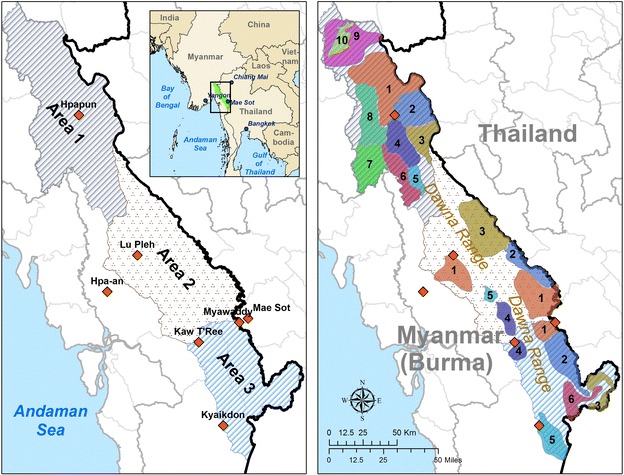
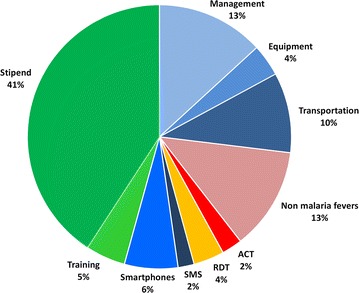
Verification
Claims the paper makes
The claims and statistics of this paper haven’t been checked yet.
Run the check — free, no account needed. It reads the open-access text and checks the sources it cites.
Claims other papers make about this one
Each is checked against this paper’s own text: does it say what the citing paper says it does?
The source backs part of the claim, not all of it — or backs it for a different population, condition or comparison.
In the citing paper
“The early detection and prompt treatment approach with combination therapy artesunate/mefloquine for P. falciparum and chloroquine for non-falciparum (principally P. vivax) infections, introduced in 1995, has been very effective and consistent with previous publications on malaria control in the Thailand-Myanmar border camps and for migrant populations (Landier et al., 2016; Carrara et al., 2013;”
From Mother, child and adolescent health outcomes in two long-term refugee camp settings at the Thai-Myanmar border 2000–2018: a retrospective analysis (2024) · cites this paper as Landier et al., 2016
Experimental — accuracy not yet measured
Self-check
Percentages, sums and reported differences re-computed from the paper’s own numbers.
The self-check needs the paper’s full text.
Citations
Cites
The effect of malaria control on Plasmodium falciparum in Africa between 2000 and 2015
Bhatt, S., Weiss, D. J., Cameron, E., Bisanzio, D., Mappin, B., Dalrymple, U., Battle, K. E., Moyes, C. L., Henry, A., Eckhoff, P. A., et al. (2015) · Nature · doi:10.1038/nature15535 · Cited by 3,225
A molecular marker of artemisinin-resistant Plasmodium falciparum malaria
Ariey, F., Witkowski, B., Amaratunga, C., Beghain, J., Langlois, A.-C., Khim, N., Kim, S., Duru, V., Bouchier, C., Ma, L., et al. (2013) · Nature · doi:10.1038/nature12876 · Cited by 2,099
Poverty and Access to Health Care in Developing Countries
Peters, D. H., Garg, A., Bloom, G., Walker, D. G., Brieger, W. R., & Hafizur Rahman, M. (2008) · Annals of the New York Academy of Sciences · doi:10.1196/annals.1425.011 · Cited by 1,522
White, N. J., Pukrittayakamee, S., Hien, T. T., Faiz, M. A., Mokuolu, O. A., & Dondorp, A. M. (2013) · The Lancet · doi:10.1016/s0140-6736(13)60024-0 · Cited by 1,220
Self-citationMefloquine resistance in Plasmodium falciparum and increased pfmdr1 gene copy number
Price, R. N., Uhlemann, A., Brockman, A., McGready, R. M., Ashley, E. A., Phaipun, L., Patel, R., Laing, K. G., Looareesuwan, S., White, N. J., et al. (2004) · The Lancet · doi:10.1016/s0140-6736(04)16767-6 · Cited by 849
Self-citationBousema, T., & DRAKELEY, C. J. (2011) · Clinical Microbiology Reviews · doi:10.1128/cmr.00051-10 · Cited by 776
Determinants of relapse periodicity in Plasmodium vivax malaria
White, N. J. (2011) · Malaria Journal · doi:10.1186/1475-2875-10-297 · Cited by 680
Hitting Hotspots: Spatial Targeting of Malaria for Control and Elimination
Bousema, T., Griffin, J. T., Sauerwein, R. W., Smith, D. L., Churcher, T. S., Takken, W., Ghani, A. C., DRAKELEY, C. J., & Gosling, R. D. (2012) · PLoS Medicine · doi:10.1371/journal.pmed.1001165 · Cited by 566
Malaria resurgence: a systematic review and assessment of its causes
Cohen, J. M., Smith, D. L., Cotter, C., Ward, A., Yamey, G., Sabot, O. J., & Moonen, B. (2012) · Malaria Journal · doi:10.1186/1475-2875-11-122 · Cited by 518
Nosten, F., van Vugt, M., Price, R., Luxemburger, C., Thway, K., Brockman, A., McGready, R., ter Kuile, F., Looareesuwan, S., & White, N. (2000) · The Lancet · doi:10.1016/s0140-6736(00)02505-8 · Cited by 500
Self-citation
Cited by
Sorted by citations
Malaria incidence in Myanmar 2005–2014: steady but fragile progress towards elimination
Mu, T. T., Sein, A. A., Kyi, T. T., Min, M. C., Aung, N. M., Anstey, N. M., Kyaw, M. P., Soe, C., Kyi, M. M., & Hanson, J. (2016) · Malaria Journal · doi:10.1186/s12936-016-1567-0 · Cited by 332
Landier, J., Parker, D. M., Thu, A. M., Lwin, K. M., Delmas, G., Nosten, F. H., Andolina, C., Aguas, R. J., Ang, S. M., Aung, E. P., et al. (2018) · The Lancet · doi:10.1016/s0140-6736(18)30792-x · Cited by 178
Self-citationCombating multidrug‐resistant Plasmodium falciparum malaria
Thu, A. M., Phyo, A. P., Landier, J., Parker, D. M., & Nosten, F. H. (2017) · FEBS Journal · doi:10.1111/febs.14127 · Cited by 185
Self-citationAfriyie, S. O., Addison, T. K., Gebre, Y., Mutala, A., Antwi, K. B., Abbas, D. A., Addo, K. A., Tweneboah, A., Ayisi‐Boateng, N. K., Koepfli, C., et al. (2023) · Malaria Journal · doi:10.1186/s12936-023-04506-5 · Cited by 122
COVID-19 and malaria: A symptom screening challenge for malaria endemic countries
Chanda‐Kapata, P., Kapata, N., & Zumla, A. I. (2020) · International Journal of Infectious Diseases · doi:10.1016/j.ijid.2020.04.007 · Cited by 97
Metadata
- Authors
- Landier, J., Parker, D. M., Thu, A. M., Carrara, V. I., Lwin, K. M., Bonnington, C. A., Pukrittayakamee, S., Delmas, G., & Nosten, F. H.
- Affiliations
- Mahidol University (TH)
- Corresponding author
- Landier, Jordi
- ORCID
- Venue
- Malaria Journal
- Published
- 2016-07-15
- Volume
- 15
- Issue
- 1
- Pages
- 363-363
- ISSN
- 1475-2875 (ISSN-L)
- PMC
- PMC4946177
- OpenAlex
- W2463148194
- Cited by
- 170
- References
- 64
- Citations by year
- 2026: 8 · 2025: 23 · 2024: 18 · 2023: 13 · 2022: 33 · 2021: 24 · 2020: 13 · 2019: 10 · 2018: 14 · 2017: 12 · 2016: 2
- FWCI
- 1.89
- Type
- journal article
- Language
- en
- Open access
- gold
- doi.org
- Locations
- Malaria Journal (publishedVersion, cc-by)
- PubMed Central (publishedVersion, cc-by)
- PubMed (publishedVersion)
- eScholarship (California Digital Library) (submittedVersion, cc-by)
- Funders
- Bill and Melinda Gates Foundation
- Global Fund to Fight AIDS, Tuberculosis and Malaria
- Topics
- Health Sciences › Medicine › Public Health, Environmental and Occupational Health › Malaria Research and Control
- Social Sciences › Arts and Humanities › History › History of Medicine and Tropical Health
- Health Sciences › Medicine › Public Health, Environmental and Occupational Health › Travel-related health issues
- Keywords
- malaria elimination, early diagnosis and treatment, falciparum malaria, rapid diagnostic tests, artemisinin-based combination therapy, primaquine, community health workers, malaria surveillance, hard-to-reach populations, malaria transmission reduction
- MeSH terms
- Antimalarials, Diagnostic Tests, Routine, Drug Therapy, Combination, Humans, Lactones, Malaria, Primaquine, Disease Transmission, Infectious, Artemisinins, Early Diagnosis, Secondary Prevention, Disease Eradication
About these checks
Registry, retraction, Cites and statistics results are computed, not judged, with one exception: a printed reference that no index lists is read once by a model before it counts as a citation error. Claims are extracted by a model and kept only when their quote appears verbatim in the text; each cited source is then checked, with a model’s help, for whether it says what the claim relies on. Those verdicts can be wrong — read the claim’s quote and the cited source before relying on one.
Statistics and arithmetic are recomputed, not judged.
Confidence bands are shown only for fields calibrated on our annotated test set. None is calibrated yet, so no band is shown.
What counts as a claim ›How we measure confidence ›How we check this ›
Are you an author, or do you see a problem with this page? Request a review
