

Antibody levels to recombinant VAR2CSA domains vary with Plasmodium falciparum parasitaemia, gestational age, and gravidity, but do not predict pregnancy outcomes
Open accessThe DOI matches its Crossref record; 36 of the 36 references it cites were found in a registry or an index; 2 of the 7 sources its claims cite were checked for support.
Abstract
Study showing VAR2CSA antibody levels vary with parasitaemia, gestational age, and gravidity in pregnancy-associated malaria.
Overview
CoChat Summary
TL;DR
In a longitudinal cohort of pregnant women in Ouelessebougou, Mali, VAR2CSA antibody levels varied by gravidity, infection status, and gestational stage, with primigravidae showing short-lived boosts after malaria infection. However, these recombinant VAR2CSA domain antibody levels did not predict better pregnancy outcomes.
Key findings
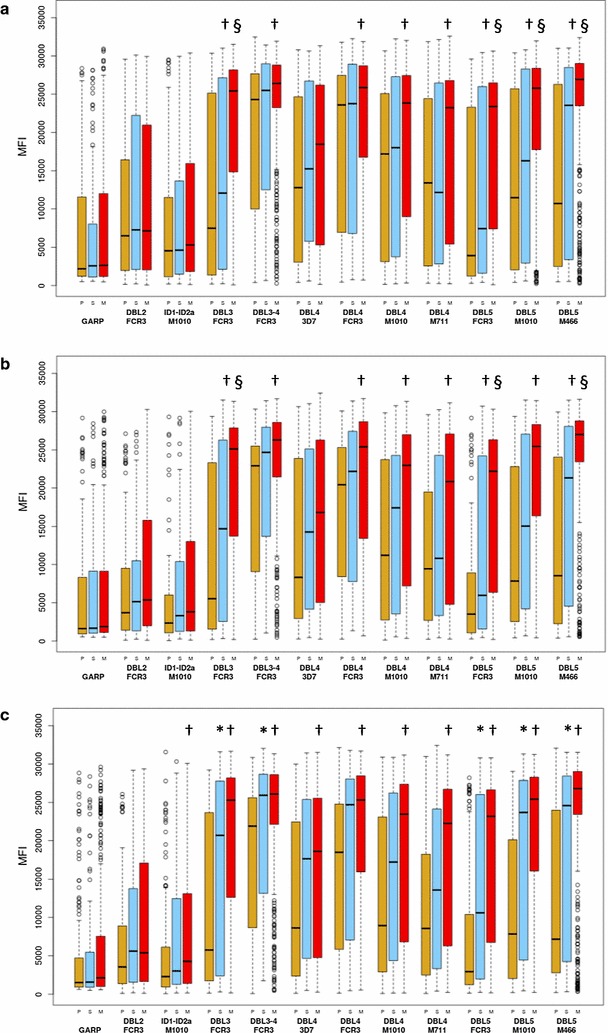
- Antibody levels to most VAR2CSA domains were higher in multigravidae than primigravidae at enrollment, gestational week 30–32, and delivery; GARP reactivity did not differ by gravidity.
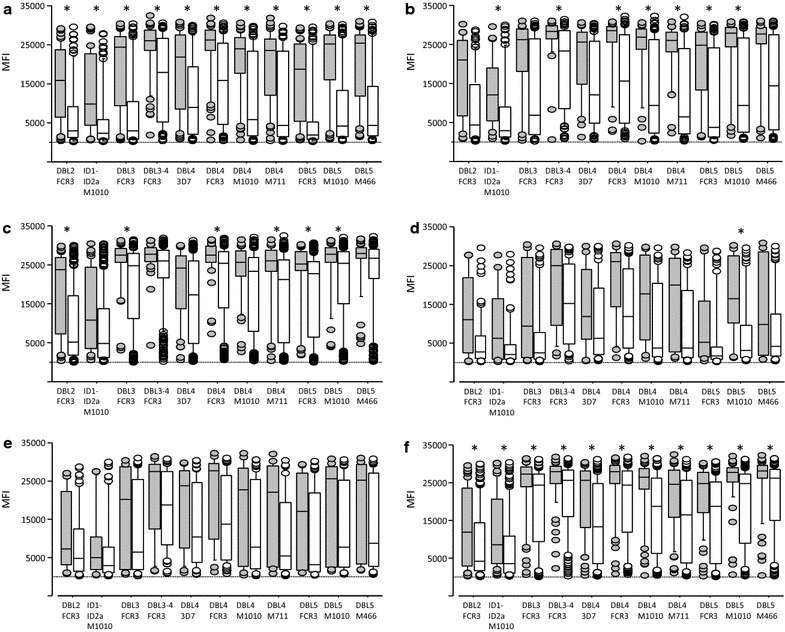
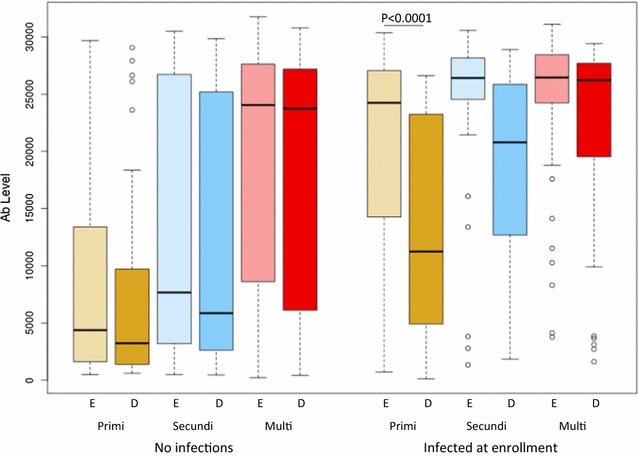
- Malaria infection increased VAR2CSA antibody levels, but the effect was gravidity-dependent: at enrollment, infected primigravidae had higher levels to all 11 domains, while infected secundigravidae and multigravidae had increases to 7 and 6 of 11 domains, respectively.
- In women with no further infections, antibody levels in BS+ primigravidae declined sharply by delivery: 10/11 VAR2CSA domains were significantly lower at delivery, suggesting short-lived IgG; secundigravidae and multigravidae showed no significant decline.
- Mean VAR2CSA antibody level was not associated with reduced risk of preterm delivery or pregnancy loss: HR 1.08 (95% CI 0.51–2.30) for preterm delivery and HR 1.13 (0.55–2.34) for pregnancy loss; similarly, no prediction was seen for LBW, SGA, maternal anaemia, birthweight, or gestational age.
Methods
- Longitudinal cohort study of pregnant women (aged 15–45) in Ouelessebougou, Mali, enrolled Nov 2010–Oct 2013; plasma sampled at enrollment, gestational week 30–32, and delivery.
- Antibodies to 11 recombinant VAR2CSA domains were measured by multiplex bead-based assay; analyses included singleton deliveries only.
- Nonparametric group comparisons and multivariable regression/competing-risks models were used, adjusting for gravidity, malaria infection, IPTp, ITN use, and other covariates as specified.
Limitations
- The paper explicitly notes a limitation of the pregnancy loss/preterm delivery analysis: relatively few cases of pregnancy loss and preterm delivery (6.8% and 7.8%, respectively).
- Evident from the text: some women were not included at gestational week 30–32 because of miscarriage, stillbirth, preterm delivery, late enrollment, or missing shipped samples, which reduced sample size for that timepoint.
- Evident from the text: the authors themselves suggest the recombinant VAR2CSA proteins may not present native protective epitopes, which limits interpretation of negative associations with outcomes.
Model-written summary. Check it against the paper before relying on it.
Integrity signals
Registry
Cites
Statistics
Figures
Verification
Claims the paper makes
1 Valid · 0 Not valid · 4 Not checked · 41 Own results and interpretations
A result the paper reports from its own data — it cites no other source for it, so there is none to check. The quote shows it is in the paper.
In the paper
“At enrollment and at gestational week 30–32, antibody levels were significantly higher in multigravidae than primigravidae to most of the domains except DBL2, ID1-ID2a and DBL4-3D7.”
- Also stated in: § Results · plain
“Antibody levels to VAR2CSA were higher in multigravidae than primigravidae.”
§ Antibody levels to recombinant VAR2CSA domains vary with Plasmodium falciparum parasitaemia, gestational age, and gravidity, but do not predict pregnancy outcomes > Results > Antibody levels differ between gravidity groups
plainstates an association- Asserted: passes — The authors put it forward as true.
- Checkable: passes — It can be checked against evidence.
- Load-bearing: unclear — It is unclear whether the paper’s conclusions depend on it.
- Based: passes — The paper gives a reason why it holds.
- Also stated in: § Results · plain
A result the paper reports from its own data — it cites no other source for it, so there is none to check. The quote shows it is in the paper.
In the paper
“At delivery, antibody levels to all the domains except DBL2 were higher in multigravidae compared to primigravidae.”
§ Antibody levels to recombinant VAR2CSA domains vary with Plasmodium falciparum parasitaemia, gestational age, and gravidity, but do not predict pregnancy outcomes > Results > Antibody levels differ between gravidity groups
plainstates an association- Asserted: passes — The authors put it forward as true.
- Checkable: passes — It can be checked against evidence.
- Load-bearing: unclear — It is unclear whether the paper’s conclusions depend on it.
- Based: passes — The paper gives a reason why it holds.
A result the paper reports from its own data — it cites no other source for it, so there is none to check. The quote shows it is in the paper.
In the paper
“Among women with negative blood smears at enrollment, at gestational week 30–32 and at delivery, differences between primigravidae and multigravidae were similar to the differences observed in the comparison between primigravidae and multigravidae in the non-stratified analysis (Fig. 1).”
§ Antibody levels to recombinant VAR2CSA domains vary with Plasmodium falciparum parasitaemia, gestational age, and gravidity, but do not predict pregnancy outcomes > Results > Infection increases antibody levels in a gravidity-dependent pattern
plain- Asserted: passes — The authors put it forward as true.
- Checkable: passes — It can be checked against evidence.
- Load-bearing: unclear — It is unclear whether the paper’s conclusions depend on it.
- Based: passes — The paper gives a reason why it holds.
A result the paper reports from its own data — it cites no other source for it, so there is none to check. The quote shows it is in the paper.
In the paper
“Antibody levels to glutamic acid rich protein (GARP), a protein that is not unique to placental parasites, were similar at the three timepoints between women regardless of gravity (Fig. 1).”
§ Antibody levels to recombinant VAR2CSA domains vary with Plasmodium falciparum parasitaemia, gestational age, and gravidity, but do not predict pregnancy outcomes > Results > Antibody levels differ between gravidity groups
plain- Asserted: passes — The authors put it forward as true.
- Checkable: passes — It can be checked against evidence.
- Load-bearing: unclear — It is unclear whether the paper’s conclusions depend on it.
- Based: passes — The paper gives a reason why it holds.
A result the paper reports from its own data — it cites no other source for it, so there is none to check. The quote shows it is in the paper.
In the paper
“At gestational week 30–32, antibody levels to the 11 VAR2CSA domains were significantly higher in primigravidae with past infection versus no past infection.”
§ Antibody levels to recombinant VAR2CSA domains vary with Plasmodium falciparum parasitaemia, gestational age, and gravidity, but do not predict pregnancy outcomes > Results > Infection increases antibody levels in a gravidity-dependent pattern
plainstates an association- Asserted: passes — The authors put it forward as true.
- Checkable: passes — It can be checked against evidence.
- Load-bearing: unclear — It is unclear whether the paper’s conclusions depend on it.
- Based: passes — The paper gives a reason why it holds.
14 more claims
Create a free account to see all 46 claims and every source verdict.
- Probably not a substantial claim. 6
- It may state two separate claims as one. 24
Citations
Cites
Snounou, G., Viriyakosol, S., Zhu, X. P., Jarra, W., Pinheiro, L., do Rosario, V. E., Thaithong, S., & Brown, K. N. (1993) · Molecular and Biochemical Parasitology · doi:10.1016/0166-6851(93)90077-b · Cited by 1,591 · cited 1×
“Submicroscopic infections were defined by nested PCR as previously described [18].”
Epidemiology and burden of malaria in pregnancy
Desai, M., ter Kuile, F. O., Nosten, F., McGready, R., Asamoa, K., Brabin, B., & Newman, R. D. (2007) · The Lancet Infectious Diseases · doi:10.1016/s1473-3099(07)70021-x · Cited by 1,432
Adherence of Plasmodium falciparum to Chondroitin Sulfate A in the Human Placenta
Fried, M., & Duffy, P. E. (1996) · Science · doi:10.1126/science.272.5267.1502 · Cited by 1,108 · cited 1×
“During pregnancy, Plasmodium falciparum parasites sequester in the placenta and adhere to chondroitin sulfate A (CSA) expressed on the surface of syncytiotrophoblast [2].”
Self-citationApplying Cox Regression to Competing Risks
Lunn, M., & McNeil, D. (1995) · Biometrics · doi:10.2307/2532940 · Cited by 975
Maternal antibodies block malaria
Fried, M., Nosten, F., Brockman, A., Brabin, B. J., & Duffy, P. E. (1998) · Nature · doi:10.1038/27570 · Cited by 659
Self-citationEvidence for the Involvement of VAR2CSA in Pregnancy-associated Malaria
Salanti, A., Dahlbäck, M., Turner, L., Nielsen, M. A., Barfod, L., Magistrado, P., Jensen, A. T. R., Lavstsen, T., Ofori, M. F., Marsh, K., et al. (2004) · The Journal of Experimental Medicine · doi:10.1084/jem.20041579 · Cited by 604
Epidemiology, Malaria and Pregnancy
McGregor, I. A. (1984) · The American Journal of Tropical Medicine and Hygiene · doi:10.4269/ajtmh.1984.33.517 · Cited by 452 · cited 1×
“falciparum pregnancy malaria and women develop resistance over 1–2 pregnancies that controls infection and prevents severe sequelae [6, 7].”
Duffy, P. E., & Fried, M. (2003) · Infection and Immunity · doi:10.1128/iai.71.11.6620-6623.2003 · Cited by 260 · cited 1×
“The presence of anti-adhesion antibodies has been associated with increased birth weight and gestational age [12, 28].”
Self-citationHigh Level of var2csa Transcription by Plasmodium falciparum Isolated from the Placenta
Tuikue Ndam, N. G., Salanti, A., Bertin, G., Dahlbäck, M., Fievet, N., Turner, L., Gaye, A., Theander, T., & Deloron, P. (2005) · The Journal of Infectious Diseases · doi:10.1086/430933 · Cited by 179
Clausen, T. M., Christoffersen, S., Dahlbäck, M., Langkilde, A. E., Jensen, K. E., Resende, M., Agerbæk, M. Ø., Andersen, D., Berisha, B., Ditlev, S. B., et al. (2012) · Journal of Biological Chemistry · doi:10.1074/jbc.m112.348839 · Cited by 173 · cited 1×
“These fragments were selected for placental malaria vaccine (PMV) development based on their binding affinity to CSA [33, 34].”
Staalsoe, T., Megnekou, R., Fievét, N., Ricke, C. H., Zornig, H. D., Leke, R., Taylor, D. W., Deloron, P., & Hviid, L. (2001) · The Journal of Infectious Diseases · doi:10.1086/322809 · Cited by 161 · cited 1×
“Changes in IgG levels during pregnancy Previous studies reported that antibody reactivities to the IE surface of CSA-binding parasites in primigravidae and to recombinant VAR2CSA in both primigravidae and multigravidae declined after pregnancy [25, 26].”
Malaria-Induced Acquisition of Antibodies to Plasmodium falciparum Variant Surface Antigens
Ofori, M. F., Dodoo, D., Staalsoe, T., Kurtzhals, J. A. L., Koram, K., Theander, T. G., Akanmori, B. D., & Hviid, L. (2002) · Infection and Immunity · doi:10.1128/iai.70.6.2982-2988.2002 · Cited by 134 · cited 1×
“Malaria infections boost antibody levels to the IE surface [17], and this could confound efforts to relate specific antibody titers to protection.”
Cham, G. K. K., Turner, L., Lusingu, J., Vestergaard, L. S., Mmbando, B. P., Kurtis, J. D., Jensen, A. T. R., Salanti, A., Lavstsen, T., & Theander, T. G. (2009) · The Journal of Immunology · doi:10.4049/jimmunol.0901331 · Cited by 124
Self-citationNew Insights into Acquisition, Boosting, and Longevity of Immunity to Malaria in Pregnant Women
Fowkes, F. J., McGready, R., Cross, N. J., Hommel, M., Simpson, J. A., Elliott, S. R., Richards, J. S., Lackovic, K., Viladpai-Nguen, J., Narum, D., et al. (2012) · The Journal of Infectious Diseases · doi:10.1093/infdis/jis566 · Cited by 101
Self-citationElliott, S. R., Kuns, R. D., & Good, M. F. (2005) · Infection and Immunity · doi:10.1128/iai.73.4.2478-2485.2005 · Cited by 101
Protective Antibodies against Placental Malaria and Poor Outcomes during Pregnancy, Benin
Ndam, N. T., Denoeud-Ndam, L., Doritchamou, J., Viwami, F., Salanti, A., Nielsen, M. A., Fievet, N., Massougbodji, A., Luty, A. J. F., & Deloron, P. (2015) · Emerging Infectious Diseases · doi:10.3201/eid2105.141626 · Cited by 98 · cited 4×
“The presence of anti-adhesion antibodies has been associated with increased birth weight and gestational age [12, 28].”
InfluentialDesigning a VAR2CSA-based vaccine to prevent placental malaria
Fried, M., & Duffy, P. E. (2015) · Vaccine · doi:10.1016/j.vaccine.2015.10.011 · Cited by 86 · cited 3×
“Most studies reported that multigravidae have higher antibody levels to the relatively immunogenic DBL5 domain, while parity-dependent reactivity to other domains was less consistent [8].”
InfluentialSelf-citationVar2CSA minimal CSA binding region is located within the N-terminal region
Srivastava, A., Gangnard, S., Dechavanne, S., Amirat, F., Lewit Bentley, A., Bentley, G. A., & Gamain, B. (2011) · PLoS ONE · doi:10.1371/journal.pone.0020270 · Cited by 76 · cited 1×
“These fragments were selected for placental malaria vaccine (PMV) development based on their binding affinity to CSA [33, 34].”
High Avidity Antibodies to Full-Length VAR2CSA Correlate with Absence of Placental Malaria
Tutterrow, Y. L., Salanti, A., Avril, M., Smith, J. D., Pagano, I. S., Ako, S., Fogako, J., Leke, R. G. F., & Taylor, D. W. (2012) · PLoS ONE · doi:10.1371/journal.pone.0040049 · Cited by 67
Tutterrow, Y. L., Avril, M., Singh, K., Long, C. A., Leke, R. J., Sama, G., Salanti, A., Smith, J. D., Leke, R. G. F., & Taylor, D. W. (2012) · Infection and Immunity · doi:10.1128/iai.00071-12 · Cited by 65
Bigey, P., Gnidehou, S., Doritchamou, J., Quiviger, M., Viwami, F., Couturier, A., Salanti, A., Nielsen, M. A., Scherman, D., Deloron, P., et al. (2011) · The Journal of Infectious Diseases · doi:10.1093/infdis/jir499 · Cited by 63 · cited 1×
“In addition, these fragments elicited heterologous functional antibodies that inhibited IE binding to CSA [35, 36].”
Barfod, L., Dobrilovic, T., Magistrado, P., Khunrae, P., Viwami, F., Bruun, J., Dahlbäck, M., Bernasconi, N. L., Fried, M., John, D., et al. (2010) · The Journal of Immunology · doi:10.4049/jimmunol.1002390 · Cited by 62
Self-citationSchmiegelow, C., Scheike, T., Oesterholt, M., Minja, D. T. R., Pehrson, C., Magistrado-Coxen, P., Lemnge, M., Rasch, V., Lusingu, J., Theander, T. G., et al. (2012) · PLoS ONE · doi:10.1371/journal.pone.0044773 · Cited by 61
Oleinikov, A. V., Rossnagle, E., Francis, S., Mutabingwa, T. K., Fried, M., & Duffy, P. E. (2007) · The Journal of Infectious Diseases · doi:10.1086/518513 · Cited by 59
Self-citationNielsen, M. A., Resende, M., de Jongh, W. A., Ditlev, S. B., Mordmüller, B., Houard, S., Ndam, N. T., Agerbæk, M. Ø., Hamborg, M., Massougbodji, A., et al. (2015) · PLOS ONE · doi:10.1371/journal.pone.0135406 · Cited by 48
Ampomah, P., Stevenson, L., Ofori, M. F., Barfod, L., & Hviid, L. (2014) · The Journal of Immunology · doi:10.4049/jimmunol.1400325 · Cited by 45
Mayor, A., Kumar, U., Bardají, A., Gupta, P., Jiménez, A., Hamad, A., Sigaúque, B., Singh, B., Quintó, L., Kumar, S., et al. (2013) · The Journal of Infectious Diseases · doi:10.1093/infdis/jit083 · Cited by 45
Several domains from VAR2CSA can induce Plasmodium falciparum adhesion-blocking antibodies
Salanti, A., Resende, M., Ditlev, S. B., Pinto, V. V., Dahlbäck, M., Andersen, G., Manczak, T., Theander, T. G., & Nielsen, M. A. (2010) · Malaria Journal · doi:10.1186/1475-2875-9-11 · Cited by 42
Clinical development of placental malaria vaccines and immunoassays harmonization: a workshop report
Chêne, A., Houard, S., Nielsen, M. A., Hundt, S., D’Alessio, F., Sirima, S. B., Luty, A. J. F., Duffy, P., Leroy, O., Gamain, B., et al. (2016) · Malaria Journal · doi:10.1186/s12936-016-1527-8 · Cited by 39
Self-citationAmpomah, P., Stevenson, L., Ofori, M. F., Barfod, L. K., & Hviid, L. (2014) · Infection and Immunity · doi:10.1128/iai.01514-13 · Cited by 37
Doritchamou, J. Y. A., Herrera, R., Aebig, J. A., Morrison, R., Nguyen, V., Reiter, K., Shimp, R. L., MacDonald, N. J., Narum, D. L., Fried, M., et al. (2016) · Journal of Infectious Diseases · doi:10.1093/infdis/jiw197 · Cited by 35
Self-citationDechavanne, S., Srivastava, A., Gangnard, S., Nunes-Silva, S., Dechavanne, C., Fievet, N., Deloron, P., Chêne, A., & Gamain, B. (2015) · Infection and Immunity · doi:10.1128/iai.03116-14 · Cited by 31
Babakhanyan, A., Fang, R., Wey, A. R., Salanti, A., Sama, G., Efundem, C., LEKE, R. J. I., Chen, J. J., Leke, R. G. F., & Taylor, D. W. (2015) · Malaria Journal · doi:10.1186/s12936-015-1023-6 · Cited by 28
Babakhanyan, A., Leke, R. G. F., Salanti, A., Bobbili, N., Gwanmesia, P., Leke, R. J. I., Quakyi, I. A., Chen, J. J., & Taylor, D. W. (2014) · PLoS ONE · doi:10.1371/journal.pone.0088173 · Cited by 26
Brolin, K. J. M., Persson, K. E. M., Wahlgren, M., Rogerson, S. J., & Chen, Q. (2010) · PLoS ONE · doi:10.1371/journal.pone.0009230 · Cited by 24
Obiakor, H., Avril, M., MacDonald, N. J., Srinivasan, P., Reiter, K., Anderson, C., Holmes, K. L., Fried, M., Duffy, P. E., Smith, J. D., et al. (2013) · Clinical and Vaccine Immunology · doi:10.1128/cvi.00638-12 · Cited by 22
Self-citation
Cited by
Cutts, J. C., Agius, P. A., Lin, Z., Powell, R., Moore, K. A., Draper, B. L., Simpson, J. A., & Fowkes, F. J. I. (2020) · BMC Medicine · doi:10.1186/s12916-019-1467-6 · Cited by 103
Pathogenicity and virulence of malaria: Sticky problems and tricky solutions
Walker, I. S., & Rogerson, S. J. (2023) · Virulence · doi:10.1080/21505594.2022.2150456 · Cited by 71
Thompson, J. M., Eick, S. M., Dailey, C., Dale, A. P., Mehta, M., Nair, A., Cordero, J. F., & Welton, M. (2019) · Journal of Tropical Pediatrics · doi:10.1093/tropej/fmz068 · Cited by 61
Aitken, E. H., Damelang, T., Ortega-Pajares, A., Alemu, A., Hasang, W., Dini, S., Unger, H. W., Ome‐Kaius, M., Nielsen, M. A., Salanti, A., et al. (2021) · eLife · doi:10.7554/elife.65776 · Cited by 51
Blood-Stage Malaria Parasite Antigens: Structure, Function, and Vaccine Potential
Salinas, N. D., Tang, W. K., & Tolia, N. H. (2019) · Journal of Molecular Biology · doi:10.1016/j.jmb.2019.05.018 · Cited by 40
Metadata
- Authors
- Fried, M., Kurtis, J. D., Swihart, B., Morrison, R., Pond-Tor, S., Barry, A., Sidibe, Y., Keita, S., Mahamar, A., Andemel, N., Attaher, O., Dembele, A. B., Cisse, K. B., Diarra, B. S., Kanoute, M. B., Narum, D. L., Dicko, A., & Duffy, P. E.
- Affiliations
- National Institutes of Health (US)
- Brown University (US)
- Université des Sciences, des Techniques et des Technologies de Bamako (ML)
- Corresponding author
- Fried, Michal
- ORCID
- Venue
- Malaria Journal
- Published
- 2018-03-09
- Volume
- 17
- Issue
- 1
- Pages
- 106-106
- ISSN
- 1475-2875 (ISSN-L)
- PMC
- PMC5845157
- OpenAlex
- W2794369759
- Cited by
- 30
- References
- 36
- Citations by year
- 2026: 2 · 2025: 3 · 2024: 3 · 2023: 4 · 2022: 3 · 2021: 5 · 2020: 4 · 2019: 6
- FWCI
- 3.57
- Type
- journal article
- Language
- en
- Open access
- gold
- doi.org
- Licence
- cc-by
- creativecommons.org/licenses/by/4.0/ (tdm)
- Locations
- Malaria Journal (publishedVersion, cc-by)
- PubMed Central (publishedVersion, cc-by)
- PubMed (publishedVersion)
- DOAJ (DOAJ: Directory of Open Access Journals) (submittedVersion, cc-by-sa)
- Funders
- Intramural Research Program of the NIAID-NIH
- Topics
- Health Sciences › Medicine › Public Health, Environmental and Occupational Health › Malaria Research and Control
- Health Sciences › Medicine › Hematology › Blood groups and transfusion
- Life Sciences › Immunology and Microbiology › Immunology › Reproductive System and Pregnancy
- Keywords
- VAR2CSA, Plasmodium falciparum, maternal malaria, pregnancy outcomes, gravidity, primigravida, parasitemia, antibody levels, vaccine candidate, epitope specificity, placental malaria
- MeSH terms
- Adolescent, Adult, Antibodies, Protozoan, Antigens, Protozoan, Female, Gestational Age, Humans, Infant, Newborn, Longitudinal Studies, Mali, Middle Aged, Pregnancy, Pregnancy Complications, Infectious, Pregnancy Outcome, Malaria, Falciparum, Parasitemia, Young Adult
About these checks
Registry, retraction, Cites and statistics results are computed, not judged, with one exception: a printed reference that no index lists is read once by a model before it counts as a citation error. Claims are extracted by a model and kept only when their quote appears verbatim in the text; each cited source is then checked, with a model’s help, for whether it says what the claim relies on. Those verdicts can be wrong — read the claim’s quote and the cited source before relying on one.
The claim verdicts this report counts are experimental: their accuracy is not yet measured.
A language model drew the claims from the paper on 2026-10-10, under version 3 of the claim definition (model deepseek-v4.1-flash, prompt extract-v3).
A second model labelled each claim on 2026-10-10 (model jev-1.13-20260917, definition revision gold-guideline-v0.2).
Statistics and arithmetic are recomputed, not judged.
Confidence bands are shown only for fields calibrated on our annotated test set. None is calibrated yet, so no band is shown.
What counts as a claim ›How we measure confidence ›How we check this ›
Are you an author, or do you see a problem with this page? Request a review
Data sources
Bibliographic data: Semantic Scholar, OpenAlex, Crossref.
Contains information from the Semantic Scholar Academic Graph Datasets, made available under the ODC Attribution License (ODC-BY 1.0).
Semantic Scholar’s data is described in: Kinney, R., et al. (2023). The Semantic Scholar Open Data Platform. arXiv:2301.10140.
