

The DOI matches its Crossref record; 1 of the 1 references it cites were found in a registry or an index.
Evaluation of long-lasting indoor residual spraying of deltamethrin 62.5 SC-PE against malaria vectors in India
Open accessAbstract
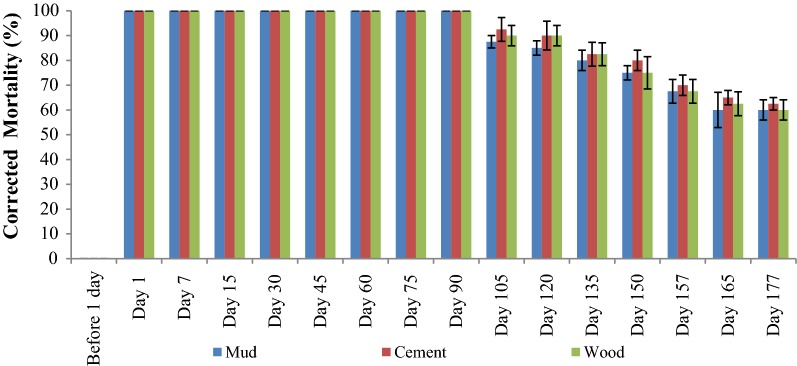
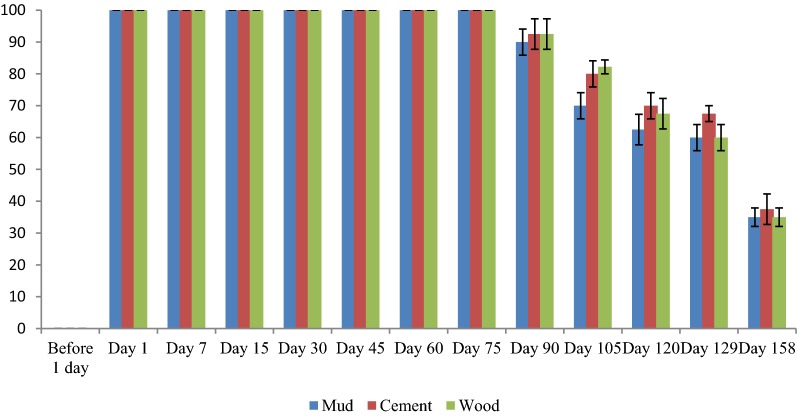
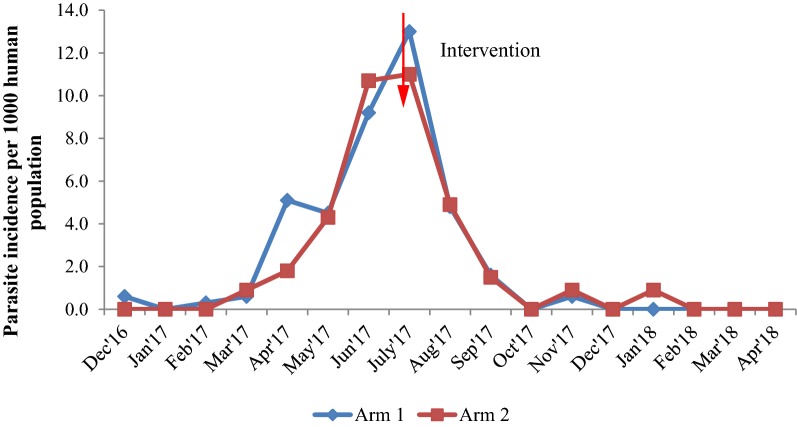
Background: Deltamethrin 62.5 polymer-enhanced suspension concentrate (SC-PE) is one of the World Health Organization-approved insecticides for indoor residual spraying and was recommended to evaluate its residual activity for determination of appropriate spray cycles in different eco-epidemiologic settings. In the current study, efficacy of deltamethrin 62.5 SC-PE was evaluated against vectors of malaria and its impact on malaria incidence in a Plasmodium falciparum hyper-endemic area in Koraput district, Odisha State, India. Methods: The trial had two comparable arms, arm 1 with residual spraying of deltamethrin 62.5 SC-PE and arm 2 with deltamethrin 2.5% WP (positive control). Comparative assessment of the impact of each intervention arm on entomological (density, parity, infection and human blood index), epidemiological (malaria incidence) parameters, residual efficacy and adverse effects were evaluated. Results: Both the arms were comparable in terms of entomological and epidemiological parameters. While, deltamethrin 62.5 SC-PE was found to be effective for 150 days in mud and wood surfaces and 157 days in cement surfaces; deltamethrin 2.5% was effective only for 105 days on mud surfaces and 113 days on cement and wood surfaces. Conclusions: Deltamethrin 62.5 SC-PE had prolonged killing effectiveness up to 5 months. Hence, one round of IRS with deltamethrin 62.5 SC-PE would be sufficient to cover two existing malaria peak transmission seasons (July–August and October–November) in many parts of India.
Overview
The claims and statistics of this paper haven’t been checked yet.
Run the check — free, no account needed. It reads the open-access text and checks the sources it cites.
Integrity signals
Registry
Cites
Statistics
Figures
Verification
Claims the paper makes
The claims and statistics of this paper haven’t been checked yet.
Run the check — free, no account needed. It reads the open-access text and checks the sources it cites.
Claims other papers make about this one
Each is checked against this paper’s own text: does it say what the citing paper says it does?
The cited source says what the claim attributes to it.
In the citing paper
“several of these new molecules or formulations are now in the pipe line [73, 78, 121–127].”
From Evolution of insecticide resistance and its mechanisms in Anopheles stephensi in the WHO Eastern Mediterranean Region (2020) · cites this paper as [124]
Self-check
Percentages, sums and reported differences re-computed from the paper’s own numbers.
The self-check needs the paper’s full text.
Citations
Cites
Kanyangarara, M., Mamini, E., Mharakurwa, S., Munyati, S., Gwanzura, L., Kobayashi, T., Shields, T., Mullany, L. C., Mutambu, S., Mason, P. R., et al. (2016) · PLOS ONE · doi:10.1371/journal.pone.0151971 · Cited by 40
Research works printed but not linked: 32
- Dunford JC, Estep AS, Waits CM, Richardson AG, Hoel DF, Horn K, et al. Evaluation of the long-term efficacy of K-Othrine® PolyZone on three surfaces against laboratory reared Anopheles gambiae in semi-field conditions. Malar J. 2018;17:94. · DOI
- Roberts D, Curtis C, Tren R, Sharp B, Shiff C, Bate R. Malaria control and public health. Emerg Infect Dis. 2004;10:1170–1. · DOI
- Gunasekaran K, Sahu SS, Krishnamoorthy N, Vijayakumar T, Subramanian S, Behera KP, et al. Comparative efficacy of two rounds of indoor residual spraying of DDT 75% @ 1 g/m2 with that of DDT 50% @ 1 g/m2 against the malaria vectors in India. Acta Trop. 2019;194:123–34. · DOI
- Dengela D, Seyoum A, Lucas B, Johns B, George K, Belemvire A, et al. Multi-country assessment of residual bio-efficacy of insecticides used for indoor residual spraying in malaria control on different surface types: results from program monitoring in 17 PMI/USAID supported IRS countries. Parasit Vectors. 2018;11:71. · DOI
- WHO. World Malaria Report 2018. Geneva: World Health Organization; 2018.
- Dash AP, Adak T, Raghavendra K, Singh OP. The biology and control of malaria vectors in India. Curr Sci. 2007;92:1571–8.
- Raghavendra K, Velamuri PS, Verma V, Elamathi N, Barik TK, Bhatt RM, et al. Temporo-spatial distribution of insecticide-resistance in Indian malaria vectors in the last quarter-century: need for regular resistance monitoring and management. J Vector Borne Dis. 2017;54:111–30. · DOI · Paper page
- Sahu SS, Gunasekaran K, Vijayakumar T, Jambulingam P. Triple insecticide resistance in Anopheles culicifacies: a practical impediment for malaria control in Odisha State, India. Indian J Med Res. 2015;142:12–6. · DOI
- WHO. Report of the sixteenth WHOPES working group meeting. Geneva: World Health Organization; 2013.
- Sahu SS, Gunasekaran K, Krishnamoorthy N, Vanamail P, Mathivanan A, Manonmani A, et al. Bionomics of Anopheles fluviatilis and Anopheles culicifacies (Diptera: culicidae) in Relation to Malaria Transmission in East-Central India. J Med Entomol. 2017;54:821–30. · DOI
- Anuse SS, Sahu SS, Subramanian S, Gunasekaran K. Usage pattern and insecticidal efficacy of PermaNets 2.0 (long-lasting insecticidal net) after 2 to 5 years of household use in Odisha State. India. Indian J Med Res. 2015;142:109–16. · DOI
- Gunasekaran K, Sahu SS, Vijayakumar T, Subramanian S, Manju R, Jambulingam P. Evaluation of MAGNet, a long-lasting insecticidal mosquito net against Anopheles fluviatilis in experimental huts in India. Malar J. 2019;18:59. · DOI
- Christophers SR. The fauna of British India, including Ceylon and Burma. Diptera. Vol. IV. Family Culicidae. Tribe Anophelini. London: Taylor and Francis; 1933.
- Polovodova VP. The determination of the physiological age of the female Anopheles by the number of gonotrophic cycles completed. Med Parazitol (Mosk). 1949;18:352 (in Russian).
- Crans WJ. An agar-gel diffusion method for identification of mosquito blood meal. Mosq News. 1969;29:563–6.
- Snounou G, Viriyakosola S, Zhua XP, Jarraa W, Pinheirob L, Rosariob VE, et al. High sensitivity of detection of human malaria parasites by the use of nested polymerase chain reaction. Mol Biochem Parasitol. 1993;61:315–20. · DOI · Paper page
- Biggerstaff BJ. PooledInfRate, Version 4.0: a MicrosoftVR Office ExcelVC Add-Into compute prevalence estimates from pooled samples. Fort Collins: Centers for Disease Control and Prevention; 2009.
- WHO. Test procedures for insecticide resistance monitoring in malaria vector mosquitoes. 2nd ed. Geneva: World Health Organization; 2016.
- WHO. Guidelines for testing mosquito adulticides for indoor residual spraying and treatment of mosquito nets. Geneva: World Health Organization; 2006.
- Gunasekaran K, Sahu SS, Jambulingam P, Das PK. DDT Indoor residual spray, still an effective tool to control Anopheles fluviatilis transmitted Plasmodium falciparum malaria in India. Trop Med Int Health. 2005;10:160–8. · DOI · Paper page
- WHO. Global plan for insecticide resistance management in malaria vectors. Geneva: World Health Organization; 2012.
- WHO. Indoor Residual Spraying: an operational manual for IRS for malaria transmission, control and elimination. 2nd ed. Geneva: World Health Organization; 2015.
- Maharaj R, Casimiro S, Mthembu SD, Sharp LB. The residual life of bendiocarb: a field-based evaluation from Mozambique. J Med Entomol. 2004;41:130–2. · DOI
- Raeisi A, Abai M, Akbarzadeh K, Nateghpour M, Sartipi M, Hassaanzehi A, et al. Residual effect of deltamethrin WG 25% as a new formulation on different surfaces against Anopheles stephensi in southeastern Iran. Iran J Arthropod Borne Dis. 2010;4:60–5.
- Yeebiyo Y, Dengela D, Tesfaye AG, Anshebo GY, Koiyada L, Wirtz R, et al. Short persistence of bendiocarb sprayed on pervious walls and its implication for the indoor residual spraying program in Ethiopia. Parasit Vectors. 2016;9:266. · DOI
- Pates H, Curtis C. Mosquito behavior and vector control. Ann Rev Entomol. 2005;50:53–70. · DOI · Paper page
- Hamusse SD, Balcha TT, Belachew T. The impact of indoor residual spraying on malaria incidence in East Shoa Zone, Ethiopia. Glob Health Action. 2012;5:11619. · DOI
- Sharma VP, Chandrahas RK, Ansari MA, Srivastaba PK, Razdan RK, Batra CP, et al. Impact of DDT and HCH spraying on malaria transmission in villages with DDT and HCH resistant Anopheles culicifacies. Indian J Malariol. 1986;23:27–38.
- Kafy H. Combination of IRS with LLINs versus LLINs alone in Sudan: results of a very large randomised trial. In: Proceedings of the 6th Pan-African malaria conference; 7 October 2013; Durban, South Africa. Multilateral initiative on malaria; 2013.
- West PA, Protopopoff N, Wright A, Kivaju Z, Tigererwa R, Mosha FW, et al. Indoor residual spraying in combination with insecticide-treated nets compared to insecticide-treated nets alone for protection against malaria: a cluster randomised trial in Tanzania. PLoS Med. 2014;11:e1001630. · DOI
- Hamainza B, Sikaala CH, Moonga HB, Chanda J, Chinula D, Mwenda M, et al. Incremental impact upon malaria transmission of supplementing pyrethroid-impregnated long-lasting insecticidal nets with indoor residual spraying using pyrethroids or the organophosphate, pirimiphos methyl. Malar J. 2016;15:100. · DOI
- Tukei BB, Beke A, Lamadrid-Figueroa H. Assessing the effect of indoor residual spraying (IRS) on malaria morbidity in Northern Uganda: a before and after study. Malar J. 2017;16:4. · DOI
Cited by
Enayati, A., Hanafi-Bojd, A. A., Sedaghat, M. M., Zaim, M., & Hemingway, J. (2020) · Malaria Journal · doi:10.1186/s12936-020-03335-0 · Cited by 62
Metadata
- Authors
- Sahu, S. S., Thankachy, S., Dash, S., Nallan, K., Swaminathan, S., Kasinathan, G., & Purushothaman, J.
- Affiliations
- Indian Council of Medical Research (IN)
- Corresponding author
- Sahu, Sudhansu Sekhar
- Venue
- Malaria Journal
- Published
- 2020-01-14
- Volume
- 19
- Issue
- 1
- Pages
- 19-19
- ISSN
- 1475-2875 (ISSN-L)
- PMC
- PMC6961237
- OpenAlex
- W3012923215
- Cited by
- 14
- References
- 1
- Citations by year
- 2026: 2 · 2025: 1 · 2024: 3 · 2023: 3 · 2022: 1 · 2021: 3 · 2020: 1
- FWCI
- 1.50
- Type
- journal article
- Language
- en
- Open access
- gold
- doi.org
- Locations
- Malaria Journal (publishedVersion, cc-by)
- PubMed Central (publishedVersion, cc-by)
- PubMed (publishedVersion)
- DOAJ (DOAJ: Directory of Open Access Journals) (submittedVersion, cc-by-sa)
- Funders
- Bayer CropScience (2017)
- Topics
- Health Sciences › Medicine › Public Health, Environmental and Occupational Health › Malaria Research and Control
- Health Sciences › Medicine › Public Health, Environmental and Occupational Health › Dengue and Mosquito Control Research
- Life Sciences › Agricultural and Biological Sciences › Plant Science › Insect Pest Control Strategies
- Keywords
- indoor residual spraying, deltamethrin, malaria vectors, residual efficacy, Plasmodium falciparum, malaria incidence, vector density, human blood index, malaria vector control, Koraput district
- MeSH terms
- Adult, Aerosols, Animals, Anopheles, Female, Housing, Humans, India, Insect Vectors, Insecticides, Interviews as Topic, Male, Middle Aged, Mosquito Control, Nitriles, Pesticide Residues, Plasmodium falciparum, Pyrethrins, Surveys and Questionnaires, Random Allocation, Seasons, Suspensions, Time Factors, Incidence, Cluster Analysis, Malaria, Falciparum, Endemic Diseases, Young Adult
About these checks
Registry, retraction, Cites and statistics results are computed, not judged, with one exception: a printed reference that no index lists is read once by a model before it counts as a citation error. Claims are extracted by a model and kept only when their quote appears verbatim in the text; each cited source is then checked, with a model’s help, for whether it says what the claim relies on. Those verdicts can be wrong — read the claim’s quote and the cited source before relying on one.
Statistics and arithmetic are recomputed, not judged.
Confidence bands are shown only for fields calibrated on our annotated test set. None is calibrated yet, so no band is shown.
What counts as a claim ›How we measure confidence ›How we check this ›
Are you an author, or do you see a problem with this page? Request a review
Data sources
Bibliographic data: Semantic Scholar, OpenAlex, Crossref.
Contains information from the Semantic Scholar Academic Graph Datasets, made available under the ODC Attribution License (ODC-BY 1.0).
Semantic Scholar’s data is described in: Kinney, R., et al. (2023). The Semantic Scholar Open Data Platform. arXiv:2301.10140.
