

Towards health equity: a framework for the application of proportionate universalism
Open accessThe DOI matches its Crossref record; 51 of the 53 references it cites were found in a registry or an index.
Abstract
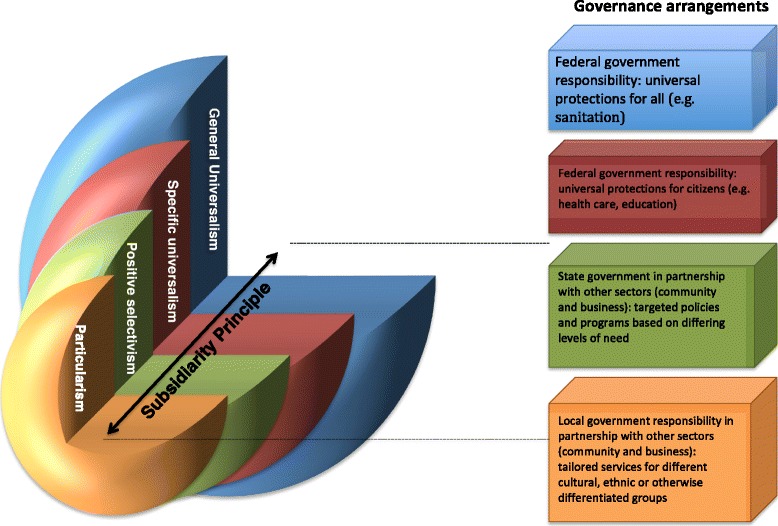
INTRODUCTION: The finding that there is a social gradient in health has prompted considerable interest in public health circles. Recent influential works describing health inequities and their causes do not always argue cogently for a policy framework that would drive the most appropriate solutions differentially across the social gradient This paper aims to develop a practice heuristic for proportionate universalism. METHODS: Through a review the proposed heuristic integrates evidence from welfare state and policy research, the literature on universal and targeted policy frameworks, and a multi-level governance approach that adopts the principle of subsidiarity. RESULTS: The proposed heuristic provides a more-grained analysis of different policy approaches, integral for operationalizing the concept of proportionate universalism. CONCLUSION: The proposed framework would allow governments at all levels, social policy developers and bureaucrats, public health professionals and activists to consider the appropriateness of distinctive policy objectives across distinctive population needs within universal welfare state principles.
Overview
The claims and statistics of this paper haven’t been checked yet.
Free: it reads the open-access text and checks the first 5 claims that cite a source we can check. Create a free account to check every claim.
Integrity signals
Registry
Cites
Statistics
Figures
Verification
Claims the paper makes
The claims and statistics of this paper haven’t been checked yet.
Free: it reads the open-access text and checks the first 5 claims that cite a source we can check. Create a free account to check every claim.
Claims other papers make about this one
Each is checked against this paper’s own text: does it say what the citing paper says it does?
The source backs part of the claim, not all of it — or backs it for a different population, condition or comparison.
In the citing paper
“In our review, most of interventions were either home visiting and then by nature PU because they are almost individual care, either a sum of actions targeting the most deprived (45,61).”
From Theoretical and practical challenges of proportionate universalism: a review (2020) · cites this paper as [45]
Experimental — accuracy not yet measuredThe cited source says what the claim attributes to it.
In the citing paper
“It appears that the precise and practical definition of the principle is not consensual and may lead to different interpretations (45).”
From Theoretical and practical challenges of proportionate universalism: a review (2020) · cites this paper as [45]
Self-check
Percentages, sums and reported differences re-computed from the paper’s own numbers.
The self-check needs the paper’s full text.
Citations
Cites
Hamilton, H., & Marshall, T. H. (1951) · The British Journal of Sociology · doi:10.2307/587460 · Cited by 4,094
Tudor Hart, J. (1971) · The Lancet · doi:10.1016/s0140-6736(71)92410-x · Cited by 3,253
The Concepts and Principles of Equity and Health
Whitehead, M. (1992) · International Journal of Health Services · doi:10.2190/986l-lhq6-2vte-yrrn · Cited by 2,284 · cited 1×
“grammes and workplace smoking bans increase health inequity [32, 33, 34].”
BackgroundThe Three Worlds of Welfare Capitalism.
O'Connell, P. J., & Esping-Anderson, G. (1991) · Social Forces · doi:10.2307/2580262 · Cited by 2,148
Marmot, M. G., Allen, J., Goldblatt, P., Boyce, T., McNeish, D., Grady, M., & Geddes, I. (2010) · Europe PMC (PubMed Central) · Cited by 1,404
What types of interventions generate inequalities? Evidence from systematic reviews
Lorenc, T., Petticrew, M., Welch, V., & Tugwell, P. (2013) · Journal of Epidemiology and Community Health · doi:10.1136/jech-2012-201257 · Cited by 927
Marshall, T. H. (1987) · Citizenship and Social Class · doi:10.2307/j.ctt18mvns1.5 · Cited by 836
Classifying Welfare States: a Two-dimension Approach
BONOLI, G. (1997) · Journal of Social Policy · doi:10.1017/s0047279497005059 · Cited by 697 · cited 1×
“erate social policies either universally available to all, or focused on categorical entitlements [8].”
BackgroundHill, M. R. H., & Hupe, P. L. (2002) · Andalas University Repository (Andalas University) · Cited by 646
Watts, H. W., Jencks, C., & Peterson, P. E. (1992) · Industrial and Labor Relations Review · doi:10.2307/2524605 · Cited by 598
Titmuss, R. M. (2018) · Policy Press eBooks · doi:10.1332/policypress/9781447349518.001.0001 · Cited by 453
The Other Invisible Hand: Delivering Public Services through Choice and Competition
Le Grand, J. (2009) · Princeton University Press eBooks · doi:10.1515/9781400828005 · Cited by 452
"Targeting Within Universalism: Politically Viable Policies to Combat Poverty in the United States"
Skocpol, T. R., Jencks, C., & Peterson, P. E. (1991) · Cited by 387
Normative Foundations of the Welfare State: The Nordic Experience
Kildal, N., & Kuhnle, S. (2005) · Cited by 286
6, P. (2004) · Journal of Public Administration Research and Theory · doi:10.1093/jopart/muh006 · Cited by 221
Health Promotion and the Policy Process
(2013) · Oxford University Press eBooks · doi:10.1093/acprof:oso/9780199658039.001.0001 · Cited by 205 · cited 2×
“, the eradication of smallpox) albeit by mobilising broader social investment [49, 50]).”
BackgroundImprovement of child survival in Mexico: the diagonal approach
Sepúlveda, J., Bustreo, F., Tapia, R., Rivera, J., Lozano, R., Oláiz, G., Partida, V., García-García, L., & Valdespino, J. L. (2006) · The Lancet · doi:10.1016/s0140-6736(06)69569-x · Cited by 200 · cited 3×
“, the eradication of smallpox) albeit by mobilising broader social investment [49, 50]).”
BackgroundPublic Administration and Management
(2015) · The SAGE Encyclopedia of Quality and the Service Economy · doi:10.4135/9781483346366.n148 · Cited by 181
Welfare regimes, population health and health inequalities: a research synthesis
Brennenstuhl, S., Quesnel-Vallée, A., & McDonough, P. (2012) · Journal of Epidemiology and Community Health · doi:10.1136/jech-2011-200277 · Cited by 172 · cited 1×
“A strong core of universal policies is critical to ensuring the health of populations [42].”
BackgroundWork, worklessness and the political economy of health inequalities: Figure 1
Bambra, C. (2011) · Journal of Epidemiology and Community Health · doi:10.1136/jech.2009.102103 · Cited by 152 · cited 1×
“This field of scholarship has become increasingly sophisticated, from a simple ‘state expenditures and allocations’ approach, through Esping-Andersen’s ‘decommodification’ approach (‘the degree to which individuals or families can uphold a socially acceptable standard of living independently of market participation’),…”
BackgroundOliveira‐Cruz, V., Kurowski, C., & Mills, A. (2003) · Journal of International Development · doi:10.1002/jid.966 · Cited by 141 · cited 1×
“The binary between horizontal and vertical is untenable and synergies should be sought [51, 52].”
BackgroundAction on the social determinants of health: Views from inside the policy process
Carey, G. E., & Crammond, B. R. (2015) · Social Science & Medicine · doi:10.1016/j.socscimed.2015.01.024 · Cited by 117 · cited 1×
“This conceptualisation of subsidiarity therefore draws strongly on concepts of joined-up (or horizontal) government – where different administrative levels require integrated and complementary action to address social problems [44, 45].”
BackgroundSelf-citationSubsidiarity as a Principle of Governance: Beyond Devolution
Vischer, R. K. (2001) · Indiana Law Review · doi:10.18060/3505 · Cited by 113 · cited 2×
“Subsidiarity is both a principle of governance and a practical framework for solving social problems [35].”
BackgroundManning, N. P., & Page, R. (1989) · Longman eBooks · Cited by 95
Vertical vs horizontal health programmes in Africa: Idealism, pragmatism, resources and efficiency
MILLS, A. J. (1983) · Social Science & Medicine · doi:10.1016/0277-9536(83)90137-5 · Cited by 90 · cited 1×
“The binary between horizontal and vertical is untenable and synergies should be sought [51, 52].”
BackgroundCrossing boundaries in public management and policy : the international experience
O’Flynn, J., Blackman, D. A., & Halligan, J. (2013) · Cited by 87
A glossary of policy frameworks: the many forms of ‘universalism’ and policy ‘targeting’
Carey, G., & Crammond, B. (2017) · Journal of Epidemiology and Community Health · doi:10.1136/jech-2014-204311 · Cited by 66 · cited 1×
“We contend that, in practice, this selectivism or tailoring of resources will necessitate a degree of targeting; while universalism is regarded as a precondition of equality, it does little to promote redistribution and ignores existing inequalities [19].”
BackgroundSelf-citationUniversalism, selectivism and particularism: Towards a postmodern social policy
Thompson, S., & Hoggett, P. (1996) · Critical Social Policy · doi:10.1177/026101839601604602 · Cited by 66
(2003) · Routledge eBooks · doi:10.4324/9780203166499 · Cited by 60
Universalism in the British and Scandinavian Social Policy Debates
Anttonen, A., & Sipilä, J. (2012) · Edward Elgar Publishing eBooks · doi:10.4337/9781849805940.00007 · Cited by 60
Social policy : a conceptual and theoretical introduction
Lavalette, M., & Pratt, A. (1997) · Sage eBooks · Cited by 52
Subsidiarity as a Principle of Governance in the European Union
van Kersbergen, K., & Verbeek, B. (2004) · Comparative European Politics · doi:10.1057/palgrave.cep.6110033 · Cited by 52
Targeting deprived areas within small areas in Scotland: population study
McLoone, P. (2001) · BMJ · doi:10.1136/bmj.323.7309.374 · Cited by 52 · cited 1×
“place-based targeting that fails to adequately capture disadvantaged groups [46]), the decision may be reached that a universal approach – implemented federally – is in fact the only way to overcome such failures.”
BackgroundCommentary: Mental health and public health
Marmot, M. G. (2014) · International Journal of Epidemiology · doi:10.1093/ije/dyu054 · Cited by 51 · cited 1×
“Targeting only those at highest risk misses much of the problem ([5], p.”
BackgroundUniversalism and the Challenge of Diversity
Anttonen, A., Häikiö, L., Stefánsson, K., & Sipilä, J. (2012) · Welfare State, Universalism and Diversity · doi:10.4337/9781849805940.00006 · Cited by 51
Canning, D., & H, D. B. M. P. (2010) · Social Science & Medicine · doi:10.1016/j.socscimed.2010.07.009 · Cited by 50 · cited 1×
“Canning and Browser [3] suggest that a proportionate response would see direct health interventions for the most disadvantaged.”
BackgroundEducational Governance and the New Public Management
Fusarelli, L. D., & Johnson, B. J. (2004) · Cited by 49
Crossing Boundaries in Public Management and Policy
O’Flynn, J., Blackman, D., & Halligan, J. (2013) · Routledge eBooks · doi:10.4324/9780203106907 · Cited by 47
Global Handbook on Noncommunicable Diseases and Health Promotion
McQueen, D. V. (2013) · Springer eBooks · doi:10.1007/978-1-4614-7594-1 · Cited by 45
Spicker, P. (1994) · Critical Social Policy · doi:10.1177/026101839401303901 · Cited by 40
Designing and Implementing In-Work Benefits
Whitehouse, E. (1996) · The Economic Journal · doi:10.2307/2234937 · Cited by 29 · cited 1×
“For example, meanstested taxation systems, where those on low incomes receive proportionally greater benefits from those on higher incomes, have been found to cost more due to high administrative burden than simply offering universal tax benefits [47, 48].”
BackgroundCrossing boundaries: the fundamental questions in public management and policy
Head, B. W. (2013) · Routledge eBooks · doi:10.4324/9780203106907-11 · Cited by 28
Syrpis, P. A. J. (2004) · Oxford Journal of Legal Studies · doi:10.1093/ojls/24.2.323 · Cited by 26 · cited 4×
“As subsidiarity aims to empower individuals and voluntary associations, it places a focus on “fostering vitality of [these] mediating structures in society” ([36], p.”
BackgroundInfluentialThe powerful pull of policy targeting: examining residualisation in Australia
Carey, G. E., & McLoughlin, P. J. (2014) · Critical Public Health · doi:10.1080/09581596.2014.973018 · Cited by 19 · cited 3×
“To construct the framework, we draw on relevant literature in political science and social policy, in addition to a glossary of different principles that are applied when making decisions about health policy and action aimed at universal and targeted health programmes [6].”
BackgroundMethodInfluentialSelf-citationMcLaren, L., & McIntyre, L. (2013) · Critical Public Health · doi:10.1080/09581596.2013.803035 · Cited by 18
Cole, I., & Etherington, D. (2005) · International Journal of Housing Policy · doi:10.1080/14616710500055703 · Cited by 18 · cited 1×
“Within our framework, decisions regarding what services need to be tailored to which individuals will be made by the level of governance closest to them; the rationale being that local government and nongovernment organisations, embedded in local communities, are more likely than federal governments to understand the…”
BackgroundPainter, J. E., Orton, A., MacLeod, G., Dominelli, L., & Pande, R. P. A. (2011) · Durham Research Online (Durham University) · Cited by 16
Cole, M. (1944) · The Political Quarterly · doi:10.1111/j.1467-923x.1944.tb02646.x · Cited by 9
Howden‐Chapman, P. (2010) · Social Science & Medicine · doi:10.1016/j.socscimed.2010.07.012 · Cited by 8
The Public Policy Approach: Governments, Institutions, Welfare States and Social Justice
de Leeuw, E. (2013) · Springer eBooks · doi:10.1007/978-1-4614-7594-1_15 · Cited by 6
I dreamed a dream: England reduces health inequalities and wins the world cup
Birch, S. (2010) · Health Economics · doi:10.1002/hec.1637 · Cited by 6 · cited 1×
“Birch, in contrast, equates it with a dose–response approach, where those at the bottom of the gradient require more ‘health action’ than those higher up [4].”
Background
Research works printed but not linked: 7
- 11. Wilensky H. The Welfare State and Equality. Berkeley: University of California Press; 1975.
- 16. Williams JF. Somewhere over the rainbow: universality and diversity in social policy. In: Manning N, Page R, editors. Social Policy Review. Canterbury: Social Policy Association; 1992. p. 200-19.
- 22. Carey G, Crammond B. Online Firest. A glossary of policy frameworks: the many forms of "universalism" and policy "targeting." Journal of Epidemiology and Community Health. 2014. doi:10.1136/jech-2014-204311. · DOI · Paper page
- 26. Department of Social Services. Consumer directed care (CDC) in home care packages. 2015. Australian Government.
- 34. Whitehead M, Dahlgren G. Concepts and Principles for Tackling Social Inequities in Health: Levelling Up Part 1. Copenhagen: WHO Regional Office for Europe, Copenhagen; 2006.
- 41. House of Commons. The Localism Act 2011. London: House of Commons; 2011.
- 47. Carcillo S, Grubb D. From inactivity to work (OECD social, employment and migration working papers No. 36). 2006.
Cited by
Understanding and Responding to Health Literacy as a Social Determinant of Health
Nutbeam, D., & Lloyd, J. E. (2021) · Annual Review of Public Health · doi:10.1146/annurev-publhealth-090419-102529 · Cited by 1,178
Kola, L., Kohrt, B. A., Hanlon, C., Naslund, J. A., Sikander, S., Balaji, M., Benjet, C., Cheung, E. Y. L., Eaton, J., Gonsalves, P., et al. (2021) · The Lancet Psychiatry · doi:10.1016/s2215-0366(21)00025-0 · Cited by 835
Garner, A., Yogman, M., COMMITTEE ON PSYCHOSOCIAL ASPECTS OF CHILD AND FAMILY HEALTH, Lavin, A., Askew, G. L., Baum, R. A., Berger-Jenkins, E., Johnson, T. J., Jutte, D., Nasir, A. A., et al. (2021) · Pediatrics · doi:10.1542/peds.2021-052582 · Cited by 392
Health inequalities: Persistence and change in European welfare states
Mackenbach, J. P. (2019) · doi:10.1093/oso/9780198831419.001.0001 · Cited by 170
Taking stock of the social determinants of health: A scoping review
Lucyk, K., & McLaren, L. (2017) · PLOS ONE · doi:10.1371/journal.pone.0177306 · Cited by 163
Metadata
- Authors
- Carey, G., Crammond, B., & De Leeuw, E.
- Affiliations
- Australian National University (AU)
- Monash University (AU)
- Corresponding author
- Carey, Gemma
- ORCID
- Carey, Gemma
- Venue
- International Journal for Equity in Health
- Published
- 2015-09-15
- Volume
- 14
- Issue
- 1
- Pages
- 81-81
- ISSN
- 1475-9276 (ISSN-L)
- PMC
- PMC4570091
- OpenAlex
- W2157527617
- Cited by
- 328
- References
- 53
- Citations by year
- 2026: 32 · 2025: 38 · 2024: 27 · 2023: 50 · 2022: 38 · 2021: 37 · 2020: 40 · 2019: 33 · 2018: 14 · 2017: 12 · 2016: 7
- FWCI
- 2.00
- Type
- journal article
- Language
- en
- Open access
- gold
- doi.org
- Licence
- cc-by
- Locations
- International Journal for Equity in Health (publishedVersion, cc-by)
- Europe PMC (PubMed Central) (publishedVersion, cc-by)
- PubMed Central (publishedVersion, cc-by)
- PubMed (publishedVersion)
- UNSWorks (UNSW Sydney) (submittedVersion, cc-by-nc-nd)
- Minerva Access (University of Melbourne) (submittedVersion, cc-by)
- ANU Open Research (Australian National University) (submittedVersion, cc-by)
- UNSWorks (UNSW Sydney) (submittedVersion, cc-by)
- Topics
- Health Sciences › Medicine › Public Health, Environmental and Occupational Health › Public Health Policies and Education
- Social Sciences › Health › Public Health and Social Inequalities
- Social Sciences › Health › Health disparities and outcomes
- Keywords
- proportionate universalism, health equity, social gradient in health, health disparities, universal welfare state, targeted policy, multi-level governance, subsidiarity, policy framework, social policy
- MeSH terms
- Health Equity, Health Policy, Social Welfare, Healthcare Disparities
About these checks
Registry, retraction, Cites and statistics results are computed, not judged, with one exception: a printed reference that no index lists is read once by a model before it counts as a citation error. Claims are extracted by a model and kept only when their quote appears verbatim in the text; each cited source is then checked, with a model’s help, for whether it says what the claim relies on. Those verdicts can be wrong — read the claim’s quote and the cited source before relying on one.
Statistics and arithmetic are recomputed, not judged.
Confidence bands are shown only for fields calibrated on our annotated test set. None is calibrated yet, so no band is shown.
What counts as a claim ›How we measure confidence ›How we check this ›
Are you an author, or do you see a problem with this page? Request a review
Data sources
Bibliographic data: Semantic Scholar, OpenAlex, Crossref.
Contains information from the Semantic Scholar Academic Graph Datasets, made available under the ODC Attribution License (ODC-BY 1.0).
Semantic Scholar’s data is described in: Kinney, R., et al. (2023). The Semantic Scholar Open Data Platform. arXiv:2301.10140.
