

The DOI matches its Crossref record; 12 of the 12 references it cites were found in a registry or an index.
Mutations in gonadotropin-releasing hormone signaling pathway in two nIHH patients with successful pregnancy outcomes
Open accessAbstract
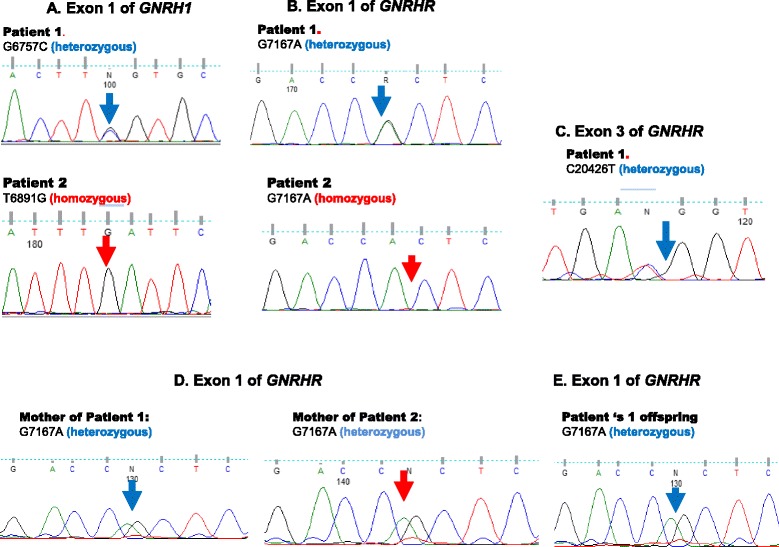
BACKGROUND: Anomalous levels of gonadotropin-releasing hormone (GnRH) secretion result in a variety of reproductive phenotypes associated with infertility or subfertility. The normosmic isolated hypogonadotropic hypogonadism (nIHH) is due to a failure of either GnRH pulsatile secretion in hypothalamus or its reception in pituitary. The spectrum of nIHH-associated alterations continues to expand, especially when additional ethnic populations are investigated. The aim of this study was to uncover genetic causes for nIHH in patients of Russian origin. METHODS: For two nIHH patients referred to infertility clinic, both exons and promoter sequences of 6 GnRH signaling genes were sequenced. RESULTS: Patient 1 was a compound heterozygote for mutations in GnRH and its receptor encoding genes, while in Patient 2 GnRHR mutations were found in homozygous state. In both patients, the coding frame of GnRHR gene harbored missense-mutation Arg139His previously described as founder mutation in Polish and Brazilan patients. IVF/ET treatments were successful, with phenotypically healthy offsprings delivered. CONCLUSION: Polish founder mutation Arg139His in GnRHR was found in two nIHH patients originating from Western region of Russia. Common variant of GnRH-encoding gene, Trp16Ser, could possibly contribute to reproductive phenotypes in patients with heterozygous mutations of other GnRH signaling pathway genes.
Overview
The claims and statistics of this paper haven’t been checked yet.
Run the check — free, no account needed. It reads the open-access text and checks the sources it cites.
Integrity signals
Registry
Cites
Statistics
Figures
Verification
Claims the paper makes
The claims and statistics of this paper haven’t been checked yet.
Run the check — free, no account needed. It reads the open-access text and checks the sources it cites.
Claims other papers make about this one
Each is checked against this paper’s own text: does it say what the citing paper says it does?
In the citing paper
“Not all patients with these mutations showed early pregnancy losses, indicating a non-genetic component, such as alterations in placental function as a potentially contributing factor67,69,70.”
From Conditional loss of ERK1 and ERK2 results in abnormal placentation and delayed parturition in the mouse (2019) · cites this paper as [70]
Self-check
Percentages, sums and reported differences re-computed from the paper’s own numbers.
The self-check needs the paper’s full text.
Citations
Cites
Boehm, U., Bouloux, P.-M., Dattani, M. T., de Roux, N., Dodé, C., Dunkel, L., Dwyer, A. A., Giacobini, P., Hardelin, J.-P., Juul, A., et al. (2015) · Nature Reviews Endocrinology · doi:10.1038/nrendo.2015.112 · Cited by 874
Valdes‐Socin, H., Rubio-Almanza, M., Fernández-Ladreda, M. T., Debray, F. G., Bours, V., & Beckers, A. M. (2014) · Frontiers in Endocrinology · doi:10.3389/fendo.2014.00109 · Cited by 132
Valkenburg, O., Uitterlinden, A. G., Piersma, D., Albert Hofman, D., Themmen, A. P. N., de Jong, F. H., Fauser, B. C. J. M., & Laven, J. S. E. (2009) · Human Reproduction · doi:10.1093/humrep/dep113 · Cited by 122
Seminara, S. B., Beranova, M., Oliveira, L. M. B., Martin, K. A., Crowley, W. F., & Hall, J. E. (2000) · The Journal of Clinical Endocrinology & Metabolism · doi:10.1210/jcem.85.2.6357 · Cited by 107
Beneduzzi, D., Trarbach, E. B., Min, L., Jorge, A. A. L., Garmes, H. M., Renck, A. C., Fichna, M., Fichna, P., Arantes, K. A., Costa, E. M. F., et al. (2014) · Fertility and Sterility · doi:10.1016/j.fertnstert.2014.05.044 · Cited by 57
Ulloa‐Aguirre, A. (2004) · Human Reproduction Update · doi:10.1093/humupd/dmh015 · Cited by 50
Topaloglu, A. K., Lu, Z.-L., Farooqi, I. S., Mungan, N. Ö., Yüksel, B., O’Rahilly, S., & Millar, R. P. (2006) · Neuroendocrinology · doi:10.1159/000098147 · Cited by 45
Congenital hypogonadotropic hypogonadism in females: Clinical spectrum, evaluation and genetics
Bry‐Gauillard, H., Trabado, S., Bouligand, J., Sarfati, J., Francou, B., Salenave, S., Chanson, P., Brailly‐Tabard, S., Guiochon‐Mantel, A., & Young, J. (2010) · Annales d Endocrinologie · doi:10.1016/j.ando.2010.02.024 · Cited by 43
Gürbüz, F., Kotan, L. D., Mengen, E., Şıklar, Z., Berberoğlu, M., Dökmetaş, H. S., Kılıçlı, M. F., Güven, A., Kırel, B., Saka, N., et al. (2012) · Journal of Clinical Research in Pediatric Endocrinology · doi:10.4274/jcrpe.725 · Cited by 30
Choi, J., Balasubramanian, R., Lee, P. H., Shaw, N. D., Hall, J. E., Plummer, L., Buck, C. L., Kottler, M., Jarząbek, K., Wołczyński, S., et al. (2015) · The Journal of Clinical Endocrinology & Metabolism · doi:10.1210/jc.2015-2262 · Cited by 26
Cited by
Brown, J. L., Sones, J. L., Angulo, C. N., Abbott, K., Miller, A. D., Boehm, U., & Roberson, M. S. (2019) · Scientific Reports · doi:10.1038/s41598-019-45997-0 · Cited by 13
Metadata
- Authors
- Zernov, N., Skoblov, M., Baranova, A., & Boyarsky, K.
- Affiliations
- Research Centre for Medical Genetics (RU)
- Moscow Institute of Physics and Technology (RU)
- Saint Petersburg State Pediatric Medical University (RU)
- Corresponding author
- Baranova, Ancha
- Venue
- Reproductive Biology and Endocrinology
- Published
- 2016-08-20
- Volume
- 14
- Issue
- 1
- Pages
- 48-48
- ISSN
- 1477-7827 (ISSN-L)
- PMC
- PMC4992333
- OpenAlex
- W2515975096
- Cited by
- 18
- References
- 12
- Citations by year
- 2025: 1 · 2024: 2 · 2023: 2 · 2022: 2 · 2021: 1 · 2020: 3 · 2019: 2 · 2018: 3 · 2017: 1
- FWCI
- 2.66
- Type
- journal article
- Language
- en
- Open access
- gold
- doi.org
- Licence
- cc-by
- Locations
- Reproductive Biology and Endocrinology (publishedVersion, cc-by)
- PubMed Central (publishedVersion, cc-by)
- PubMed (publishedVersion)
- Topics
- Health Sciences › Medicine › Reproductive Medicine › Hypothalamic control of reproductive hormones
- Health Sciences › Medicine › Endocrinology, Diabetes and Metabolism › Growth Hormone and Insulin-like Growth Factors
- Health Sciences › Medicine › Endocrinology, Diabetes and Metabolism › Pituitary Gland Disorders and Treatments
- Keywords
- gonadotropin-releasing hormone, GnRH receptor, GnRH signaling, compound heterozygosity, infertility, pregnancy outcomes, Russian patients, genetic diagnosis
- MeSH terms
- Adult, Female, Humans, Hypogonadism, Infant, Newborn, Infertility, Female, Gonadotropin-Releasing Hormone, Male, Pregnancy, Pregnancy Outcome, Signal Transduction, Mutation, Missense, Sperm Injections, Intracytoplasmic
About these checks
Registry, retraction, Cites and statistics results are computed, not judged, with one exception: a printed reference that no index lists is read once by a model before it counts as a citation error. Claims are extracted by a model and kept only when their quote appears verbatim in the text; each cited source is then checked, with a model’s help, for whether it says what the claim relies on. Those verdicts can be wrong — read the claim’s quote and the cited source before relying on one.
Statistics and arithmetic are recomputed, not judged.
Confidence bands are shown only for fields calibrated on our annotated test set. None is calibrated yet, so no band is shown.
What counts as a claim ›How we measure confidence ›How we check this ›
Are you an author, or do you see a problem with this page? Request a review
Data sources
Bibliographic data: Semantic Scholar, OpenAlex, Crossref.
Contains information from the Semantic Scholar Academic Graph Datasets, made available under the ODC Attribution License (ODC-BY 1.0).
Semantic Scholar’s data is described in: Kinney, R., et al. (2023). The Semantic Scholar Open Data Platform. arXiv:2301.10140.
