

Migration motives and integration of international human resources of health in the United Kingdom: systematic review and meta-synthesis of qualitative studies using framework analysis
Open accessThe DOI matches its Crossref record; 57 of the 59 references it cites were found in a registry or an index.
Abstract
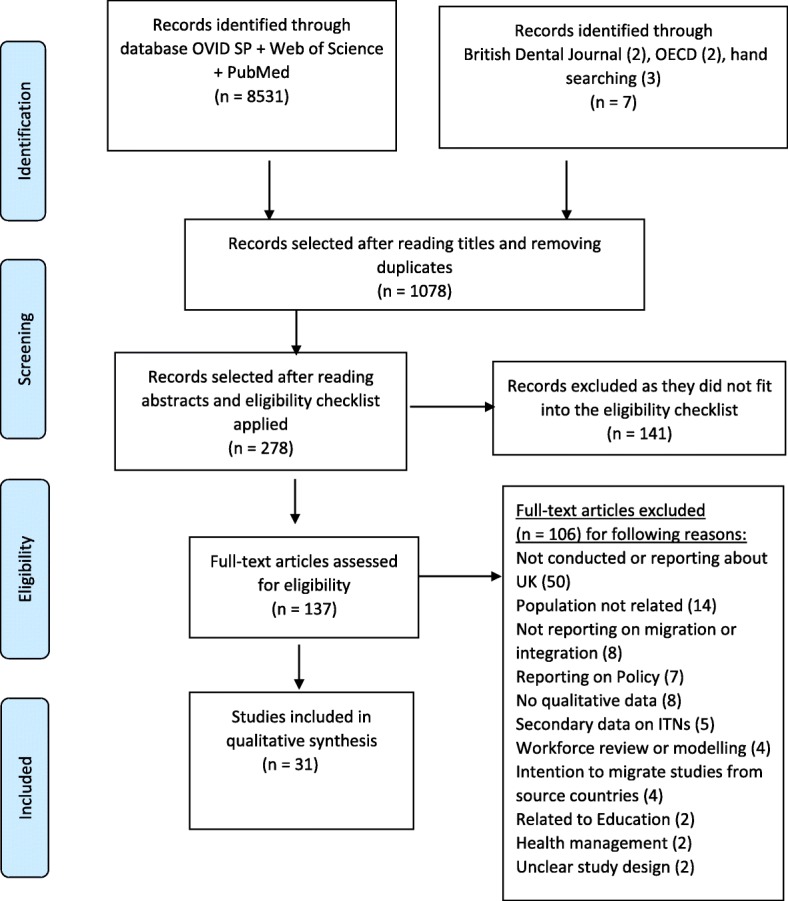
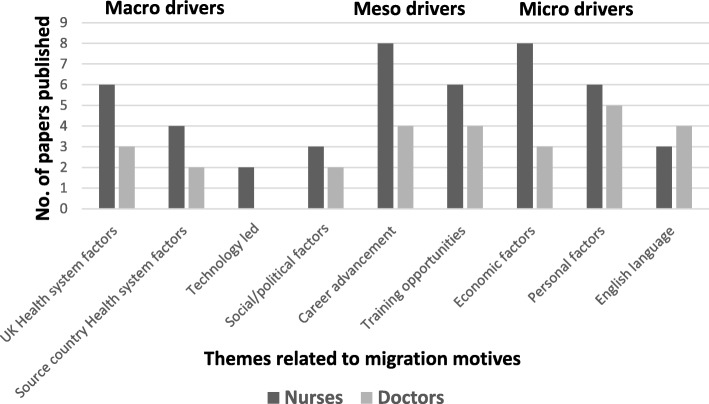
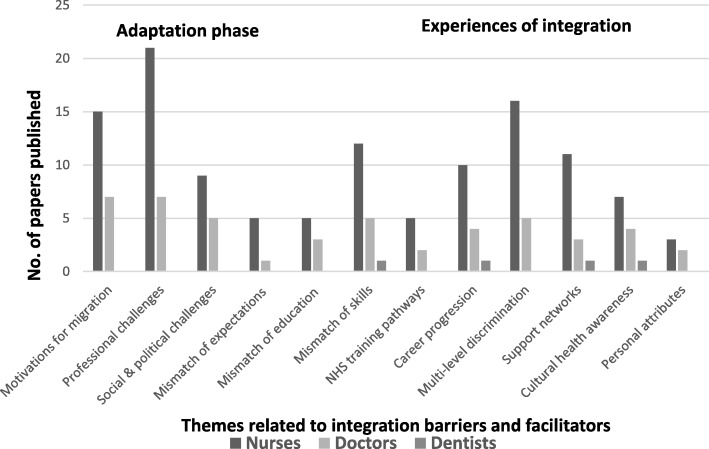
OBJECTIVE: The aim of this review was to examine the migration motives, the barriers to and facilitators of integration of international dental graduates, compared with nurses and doctors in the United Kingdom. METHODS: Electronic databases Ovid MEDLINE, EMBASE, PubMed, Web of Knowledge and OECD publications were systematically searched for English language publications from January 2000 to January 2017. A total of 31 qualitative studies were selected and quality appraised and meta-synthesis of the qualitative data was carried out using framework synthesis. The Preferred Reporting Items for Systematic Reviews and Meta-Analyses (PRISMA) guidelines were applied to present the findings. RESULTS: There were no studies on migration motives and one study on integration experiences of international dentists in the UK. The nursing literature had the highest volume and quality of evidence on nursing workforce, whilst there was limited literature on international doctors in the UK. Migration of health professionals to the UK is determined by personal and professional factors, together with source country-specific and UK drivers. Active recruitment, post graduate training and financial gain act as strong common macro, meso and micro drivers that perpetuate migration into the UK, but the extent to which each of these drivers influence nurses' and doctors' migration is different. Integration experiences for international nurses and doctors differed based on their source country experiences and the work environment they entered. Nurses reported a wider knowledge and skills gap, more multi-level discrimination and less career progression compared to the doctors. The migrants' integration experiences depend on their cultural awareness, discrimination exposure, English language and communication skills, social and professional support networks, social integration and personal attributes. CONCLUSION: Migration of international health professionals is motivated by macro, meso and micro drivers at the international, national, professional and personal levels. The UK has strong common macro pull factors which attract nurses, doctors and dentists and may impact on the effectiveness of policies to restrict their migration. The integration experiences of nurses and doctors differ and further research is required to understand the integration experiences of dentists, in order to retain these professionals by tailoring policies to each of these professions.
Overview
The claims and statistics of this paper haven’t been checked yet.
Free: it reads the open-access text and checks the first 5 claims that cite a source we can check. Create a free account to check every claim.
Integrity signals
Registry
Cites
Statistics
Figures
Verification
Claims the paper makes
The claims and statistics of this paper haven’t been checked yet.
Free: it reads the open-access text and checks the first 5 claims that cite a source we can check. Create a free account to check every claim.
Claims other papers make about this one
Each is checked against this paper’s own text: does it say what the citing paper says it does?
The source backs part of the claim, not all of it — or backs it for a different population, condition or comparison.
In the citing paper
“Our findings are consistent with prior research demonstrating that financial safety needs, opportunities for professional development through training and research, and the desire for improved quality of life for HRH and their families are critical drivers of HRH emigration.19 141–143”
From Drivers of health workers’ migration, intention to migrate and non-migration from low/middle-income countries, 1970–2022: a systematic review (2023) · cites this paper as [19]
Experimental — accuracy not yet measured
Self-check
Percentages, sums and reported differences re-computed from the paper’s own numbers.
The self-check needs the paper’s full text.
Citations
Cites
Preferred reporting items for systematic reviews and meta-analyses: the PRISMA Statement.
(2009) · PubMed Central · Cited by 44,859
PRISMA-P Group, Moher, D., Shamseer, L., Clarke, M., Ghersi, D., Liberati, A., Petticrew, M., Shekelle, P., & Stewart, L. A. (2015) · Systematic Reviews · doi:10.1186/2046-4053-4-1 · Cited by 26,223
Standards for Reporting Qualitative Research: A Synthesis of Recommendations
O’Brien, B. C., Harris, I. B., Beckman, T. J., Reed, D. A., & Cook, D. A. (2014) · Academic Medicine · doi:10.1097/acm.0000000000000388 · Cited by 12,211 · cited 1×
“Reporting qualitative systematic review using PRISMA guidelines showed that some items on the reporting checklist were applicable to quantitative studies and using qualitative reporting tools [18, 19] would have been an alternative approach.”
MethodMethods for the synthesis of qualitative research: a critical review
Barnett-Page, E., & Thomas, J. (2009) · BMC Medical Research Methodology · doi:10.1186/1471-2288-9-59 · Cited by 2,042
Establishing confidence in the output of qualitative research synthesis: the ConQual approach.
Munn, Z., Porritt, K., Lockwood, C., Aromataris, E., & Pearson, A. (2014) · BMC Medical Research Methodology · doi:10.1186/1471-2288-14-108 · Cited by 803 · cited 1×
“Reporting qualitative systematic review using PRISMA guidelines showed that some items on the reporting checklist were applicable to quantitative studies and using qualitative reporting tools [18, 19] would have been an alternative approach.”
MethodWHO Global Code of Practice on the International Recruitment of Health Personnel
Aistleithner, R., & Pfabigan, D. (2016) · PUBLISSO (German National Library of Medicine) · doi:10.4126/frl01-0064150 · Cited by 234
Xu, Y. (2007) · Advances in Nursing Science · doi:10.1097/01.ans.0000286623.84763.e0 · Cited by 185 · cited 2×
“Integration studies have focused on qualitative thematic analyses of lived experiences, particularly in relation to nurses [54, 58, 59] and on doctors [60], but none on dentists.”
BackgroundStilwell, B., Diallo, K., Zurn, P., Dal Poz, M. R., Adams, O., & Buchan, J. (2003) · Human Resources for Health · doi:10.1186/1478-4491-1-8 · Cited by 174
Crowe, M., Sheppard, L., & Campbell, A. (2011) · International Journal of Evidence-Based Healthcare · doi:10.1111/j.1744-1609.2011.00237.x · Cited by 160 · cited 5×
“Barrier and facilitators of Integration of the above populations Study design Eligibility criteria was set for selection of qualitative and mixed method papers Information sources selected Search strategy designed Data collected Quality of papers appraised with CCAT Framework analysis used for meta-synthesis of data p…”
MethodInfluentialThe migration and transitioning experiences of internationally educated nurses: a global perspective
Newton, S., Pillay, J., & Higginbottom, G. A. (2011) · Journal of Nursing Management · doi:10.1111/j.1365-2834.2011.01222.x · Cited by 157
Research works printed but not linked: 4
- World Health Organisation Global strategy on human resources for health: workforce 2030 2016 Geneva World health organisation
- Nursing and Midwivery Council The NMC Register 2012/13–2016/2017 2017 London Nursing and Midwivery Council
- General Medical Council The state of medical education and practice in the UK 2017 2017 London General Medical Council
- Illing J The experiences of UK, EU and non-EU medical graduates making the transition to the UK workplace 2009 Swindon ESRC
Cited by
Toyin-Thomas, P., Ikhurionan, P., Omoyibo, E. E., Iwegim, C., Ukueku, A. O., Okpere, J., Nnawuihe, U. C., Atat, J., Otakhoigbogie, U., Orikpete, E. V., et al. (2023) · BMJ Global Health · doi:10.1136/bmjgh-2023-012338 · Cited by 160
“19 This review shows that most of the included studies focused on doctors and nurses, which is unsurprising since these cadres are the largest and disproportionately represented in the health work-force of many countries globally.”
BackgroundPressley, C., Newton, D., Garside, J., Simkhada, P. P., & Simkhada, B. (2022) · International Journal of Nursing Studies Advances · doi:10.1016/j.ijnsa.2022.100083 · Cited by 159
“Some reviews have enabled understanding of the experiences of international nurses working across a range of countries, and within specific countries (Nichols and Campbell, 2010; Davda et al., 2018; Bond et al., 2020; Abuliezi et al., 2021).”
BackgroundKamau, S., Koskenranta, M., Kuivila, H., Oikarainen, A., Tomietto, M., Juntunen, J., Tuomikoski, A., & Mikkonen, K. (2022) · International Journal of Nursing Studies · doi:10.1016/j.ijnurstu.2022.104377 · Cited by 112
“was deemed sufficient, there was a noted reduction in deskilling and helped improve integration and retention in the workforce and organization (Davda et al., 2018).”
BackgroundRajpoot, A., Merriman, C., Rafferty, A. M., & Henshall, C. L. (2024) · International Journal of Nursing Studies Advances · doi:10.1016/j.ijnsa.2024.100195 · Cited by 88
“Although evidence exists exploring the integration challenges internationally educated nurses face (Davda et al., 2018; Bond et al., 2020; Abuliezi et al., 2021), most studies focused on either internationally educated nurses from a specific healthcare setting (Almansour et al., 2022), ethnicity…”
BackgroundBrennan, N., Langdon, N., Bryce, M., Burns, L., Humphries, N., Knapton, A., & Gale, T. C. E. (2023) · Human Resources for Health · doi:10.1186/s12960-022-00789-y · Cited by 70
“As a coding framework had already been developed by Young [24] and successfully used in the Davda [20] systematic review we decided to use the same framework as a starting point for coding our data.”
Ung, D. S. K., Goh, Y. S., Poon, Y.-S. R., Lin, Y. P., Seah, B., López, V., Mikkonen, K., Yong, K. K., & Liaw, S. Y. (2024) · Human Resources for Health · doi:10.1186/s12960-024-00900-5 · Cited by 60
“Many studies have investigated IENs’ lived experiences about aspects such as transition [19], integration [20] and resilience [21].”
BackgroundBond, S., Merriman, C., & Walthall, H. (2020) · International Journal of Nursing Studies · doi:10.1016/j.ijnurstu.2020.103693 · Cited by 56
Eriksson, E., Berg, S., & Engström, M. (2018) · BMC Medical Education · doi:10.1186/s12909-018-1399-4 · Cited by 50
Intention to migrate among the next generation of Turkish nurses and drivers of migration
Öncü, E., Vayısoğlu, S. K., Karadağ, G., Alaçam, B., Göv, P., Tosun, A. S., Orak, N. Ş., & Çatıker, A. (2020) · Journal of Nursing Management · doi:10.1111/jonm.13187 · Cited by 48
A meta-synthesis of the transitioning experiences and career progression of migrant African nurses
Bayuo, J., Abboah‐Offei, M., Duodu, P. A., & Salifu, Y. (2023) · BMC Nursing · doi:10.1186/s12912-023-01273-1 · Cited by 44
Pressley, C., Newton, D., Garside, J., Stephenson, J. R., & Mejia-Olivares, J. (2023) · International Journal of Nursing Studies Advances · doi:10.1016/j.ijnsa.2023.100154 · Cited by 44
“Healthcare systems are thus counselled against predominantly considering this short-term solution to the detriment of distracting focus from longer term stability options such as prioritising efforts to advance growing the domestic workforce (Davda et al., 2018).”
BackgroundResultEden, A., Fleet, J., & Cominos, N. (2021) · Nurse Education in Practice · doi:10.1016/j.nepr.2021.103027 · Cited by 41
Hajian, S., Yazdani, S., Jadidfard, M., & Khoshnevisan, M. H. (2020) · Journal of Contemporary Medical Sciences · doi:10.22317/jcms.v6i6.897 · Cited by 41
How do Individuals Form Their Motivations to Expatriate? A Review and Future Research Agenda
Arifa, Y. N., Baroudi, S. E., & Khapova, S. N. (2021) · Frontiers in Sociology · doi:10.3389/fsoc.2021.631537 · Cited by 35
I speak a little Arabic: Nursing communication in a cross‐cultural context
Kuzemski, D., Thirlwall, A., Brunton, M. A., & Brownie, S. M. (2021) · Journal of Clinical Nursing · doi:10.1111/jocn.15891 · Cited by 23
Botezat, A., Încalțărău, C., & Nijkamp, P. J. (2023) · World Development · doi:10.1016/j.worlddev.2023.106445 · Cited by 26
Wearne, S. M., Brown, J. B., Kirby, C. N., & Snadden, D. (2019) · Medical Teacher · doi:10.1080/0142159x.2019.1616681 · Cited by 22
Profiles of registrant dentists and policy directions from 2000 to 2020
Davda, L., Radford, D. R., Scambler, S., & Gallagher, J. E. (2020) · BDJ Open · doi:10.1038/s41405-020-00054-1 · Cited by 22
Self-citationSturesson, L., Öhlander, M., Nilsson, G. H., Palmgren, P. J., & Stenfors, T. (2019) · Human Resources for Health · doi:10.1186/s12960-019-0414-0 · Cited by 27
“ment, although available findings indicate that MPs struggle to find employment [8, 15].”
BackgroundInternational Nurse Migration Experience of the First Two Years: A Mixed Methods Study
Pressley, C., Newton, D., Sanderson, L., Simkhada, B., Stephenson, J. R., Duodu, P. A., Gillibrand, W. P., Pallam, M. C., & Garside, J. (2024) · Journal of Advanced Nursing · doi:10.1111/jan.16543 · Cited by 20
Davda, L., Radford, D. R., Scambler, S., & Gallagher, J. E. (2022) · Human Resources for Health · doi:10.1186/s12960-021-00703-y · Cited by 23
“Whilst, deskilling, career stagnation, lack of equal opportunities have been reported amongst/by international doctors and nurses migrating to the UK [14], there are no studies reporting the professional integration experiences of internationally qualified dentists has increased in the past two decades, however, it is…”
BackgroundSelf-citationSchumann, M., Sepke, M., & Peters, H. (2022) · Globalization and Health · doi:10.1186/s12992-022-00871-z · Cited by 23
“While some authors prefer the system integration approach that focuses on the integration of the physician workforce on the societal level as a whole, others prefer the social integration approach that examines sociocultural integration on the level of individual actors and their inclusion into the existing social sys…”
BackgroundÖnal, F. G., & Akay, F. E. (2023) · Developing World Bioethics · doi:10.1111/dewb.12426 · Cited by 20
Bourgeault, I. L., Runnels, V., Atanackovic, J., Spitzer, D. L., & Walton‐Roberts, M. (2021) · Human Resources for Health · doi:10.1186/s12960-021-00571-6 · Cited by 21
“Pull factors include better and more comfortable living and working conditions, higher wages and greater opportunities for advancement and promotion [3, 14, 20, 93].”
BackgroundWorkforce research priorities for resilience to future health shocks—and the workforce crisis
Walshe, K., Smith, J., Lamont, T., & Leary, A. (2024) · BMJ · doi:10.1136/bmj-2023-078997 · Cited by 18
International Migration of Human Resources in the Conditions of Social Transformations
Lami, B., Tarasenko, I. O., Shyshova, O., Voropayeva, T., & Verhun, A. (2022) · Economies · doi:10.3390/economies10090216 · Cited by 18
Role of green data center in human resources development model
Da, Z. (2020) · Sustainable Computing Informatics and Systems · doi:10.1016/j.suscom.2020.100492 · Cited by 18
In their own time: Refugee healthcare professionals’ attempts at temporal re-appropriation
Mozetič, K. (2022) · Time & Society · doi:10.1177/0961463x221083788 · Cited by 15
“The lengthy procedures are problematic because they put the candidates in financial difficulties and lead to deskilling; they also potentially lead to decreased motivation (Davda et al., 2018).”
BackgroundIkhurionan, P., Kwarshak, Y. K., Agho, E. T., Akhirevbulu, I. C. G., Atat, J., Erhiawarie, F., Gbejewoh, E. O., Iwegim, C., Nnawuihe, U. C., Odogu, U., et al. (2022) · BMJ Open · doi:10.1136/bmjopen-2022-068522 · Cited by 17
“20 21 Importantly, the existing reviews have not considered factors driving the non-migration of those HWs who stay behind in source countries.”
Exploring recent patterns of migration of doctors to the United Kingdom: a mixed-methods study
Brennan, N., Langdon, N., Gale, T. C. E., Humphries, N., Knapton, A., & Bryce, M. (2023) · BMC Health Services Research · doi:10.1186/s12913-023-10199-y · Cited by 16
“The opportunity to train in the UK remains a core driver for overseas qualified doctors coming to the UK [25].”
BackgroundA review of support for International Medical Graduates (IMGs): a scoping review
Nwankwo, E. P., Onyejesi, D. C., & Onyia, O. (2025) · BMC Medical Education · doi:10.1186/s12909-025-07389-z · Cited by 11
Migration intentions of nurses and nursing students from Slovakia: A study on drivers
Mozolová, V., & Tupá, M. (2024) · Problems and Perspectives in Management · doi:10.21511/ppm.22(1).2024.43 · Cited by 11
“Davda et al. (2018) showed that macro drivers for nurses are career advancement, training, safety and security, migration networks, and social and political factors of a tolerant society.”
BackgroundDavda, L., Radford, D. R., & Gallagher, J. E. (2020) · International Journal of Health Policy and Management · doi:10.34172/ijhpm.2020.225 · Cited by 11
Self-citationPredictors of Croatian nurses' turnover intention: A cross-sectional study
Gusar, I., Šijan, D., Sorić, T., Šare, S., Županović, M., & Ljubičić, M. (2024) · Health Policy · doi:10.1016/j.healthpol.2024.105198 · Cited by 12
[Retracted] Human Resource Data Integration System Based on Artificial Intelligence Environment
Xie, F. (2022) · Journal of Environmental and Public Health · doi:10.1155/2022/1650583 · Cited by 10
RetractedVillamin, P., López, V., Thapa, D. K., & Cleary, M. L. (2025) · Journal of Advanced Nursing · doi:10.1111/jan.16620 · Cited by 11
“…widely published in the literature, which states that nurses are primarily motivated to migrate due to financial, professional, and social factors (Davda, Gallagher, and Radford 2018; Konlan, Lee, and Damiran 2023), the findings in this study provide further insight on motivations which may not…”
What can we learn from general practitioners who left Spain? A mixed methods international study
Calderón‐Larrañaga, S., de la Fuente, Á. G., Espinosa-González, A. B., Casado‐Vicente, V., Fernandes, Ó. B., Klazinga, N., & Kringos, D. S. (2024) · Human Resources for Health · doi:10.1186/s12960-023-00888-4 · Cited by 9
Hajian, S., Jadidfard, M., Yazdani, S., Randall, G. E., & Khoshnevisan, M. H. (2023) · Global Health Action · doi:10.1080/16549716.2023.2190652 · Cited by 8
“mentioned by international doctors who migrated to the UK [28].”
BackgroundTowards more effective health workforce governance: The case of overseas‐trained doctors
Marcus, K., Purwaningrum, F., & Short, S. D. (2021) · Australian Journal of Rural Health · doi:10.1111/ajr.12692 · Cited by 8
Recruitment of internationally trained nurses: Time for a global model for shared responsibility
Al‐Yateem, N., Timmins, F., Alameddine, M. S., Dias, J. M., Saifan, A. R., AbuRuz, M., Subu, M. A., Rahman, S. A., & Hijazi, H. H. A. (2022) · Journal of Nursing Management · doi:10.1111/jonm.13785 · Cited by 8
Why Do Hungarian Health Workers Migrate? A Micro-Level Analysis
Pál, V., Fabula, S., & Boros, L. (2024) · Sustainability · doi:10.3390/su16041386 · Cited by 8
Jack, F. J. G., & Kotronoulas, G. (2023) · Journal of Religion and Health · doi:10.1007/s10943-023-01803-w · Cited by 8
“The Population, Issue, Context, Outcome (PICO) model (Davda et al., 2018) was used to structure and refine the question and search terms.”
MethodKumpikaitè-Valiüniené, V., Žičkutė, I., Glińska, E., Rollnik‐Sadowska, E., & Mockaitis, A. I. (2025) · International Journal of Intercultural Relations · doi:10.1016/j.ijintrel.2025.102296 · Cited by 7
Bryce, M., Hanks, S., Burns, L., Zahra, D., & Gale, T. C. E. (2024) · Human Resources for Health · doi:10.1186/s12960-024-00918-9 · Cited by 6
“…that countries can recruit the international workforce they need, and that health workers seeking to migrate are neither deterred nor penalised by overly prescriptive processes, as registration processes have been found to be a barrier to integration for healthcare workers migrating to the UK [21].”
BackgroundElmer, D., Endrei, D., Németh, N., Csákvári, T., Kajos, L., Molics, B., & Boncz, I. (2022) · Orvosi Hetilap · doi:10.1556/650.2022.32580 · Cited by 6
Pressley, C., Garside, J., Wu, L., & Stephenson, J. R. (2023) · Clinical Nursing Studies · doi:10.5430/cns.v11n1p40 · Cited by 5
How Official Language and Country of Origin Impacts Health Workforce Integration in Canada
Lum, L., & Vu, J. (2020) · Medical Research Archives · doi:10.18103/mra.v8i6.2146 · Cited by 5
Osei, S. K. J., Owusu, M. B., Frimpong, S., Bosro, D. D., Asamoah, C. F., Owusu, D., Amoako-Mensah, D. N., Barimah, S. K., Agbavor, J. K. E., & Delanyo, B. A. A. (2023) · BMJ Open · doi:10.1136/bmjopen-2023-073203 · Cited by 5
Davda, L., Gallagher, J. E., Short, S. D., & Balasubramanian, M. (2023) · Journal of Ethnic and Migration Studies · doi:10.1080/1369183x.2023.2279738 · Cited by 5
“The patterns of and reasons for dentist migration appear to be changing (Ayers et al. 2008; Balasubramanian et al. 2016; Davda, Gallagher, and Radford 2018; Davda et al. (2023)).”
BackgroundMethodInfluentialSelf-citationSmythe, A., & Laing, D. (2025) · Journal of Transcultural Nursing · doi:10.1177/10436596251397361 · Cited by 4
“…highlighted the need for organizations to include diversity training and raise awareness of the unique challenges faced by IENs, including othering, discrimination, racism, and ste-reotyping (Davda et al., 2018; Lanada & Culligan, 2024; Pressley et al., 2022; Pung & Goh, 2017; Roth et al., 2023).”
Bond, S., Ricketts, B., Walthall, H., & Merriman, C. (2023) · Contemporary Nurse · doi:10.1080/10376178.2023.2166549 · Cited by 4
“With recorded instances of hate crime in the UK on the rise (Home Office, 2019), the experiences of recruits have been well documented for some time (Bond et al., 2020; Davda et al., 2018; Nichols & Campbell, 2010).”
BackgroundRestrepo-Pérez, L. F., Rubio, A. P., García, L. M., & Tapia, G. (2024) · Odontoestomatología · doi:10.22592/ode2024n44e335 · Cited by 4
The Status Related to Migration and Working Conditions of Nurses Who Migrated from Türkiye
Duran, I., & Altuntaş, S. (2025) · Ordu Üniversitesi Hemşirelik Çalışmaları Dergisi · doi:10.38108/ouhcd.1406120 · Cited by 4
Spillover Effects of Opioid Abuse on Skilled Human Capital and Innovation Activity
Cornaggia, K. R., Hund, J. E., Pisciotta, K., & Ye, Z. (2025) · Management Science · doi:10.1287/mnsc.2023.02976 · Cited by 9
Achieving equity for International Medical Graduates: a systematic review
Saxena, S., Tisdell, E. J., Farace, E., Godfrey, T., Aumiller, B. B., Dell, E. Y., Razzak, O. P., Kumar, B., & Sznajder, K. K. (2025) · Frontiers in Medicine · doi:10.3389/fmed.2025.1601492 · Cited by 4
Reliance on migrant healthcare workers in the United Kingdom: A critical discourse analysis
Arfeen, Z., Nash, E., & Rashid, A. (2025) · PLOS Global Public Health · doi:10.1371/journal.pgph.0005141 · Cited by 3
Austin, Z., & Gregory, P. A. M. (2024) · Journal of Nursing Regulation · doi:10.1016/s2155-8256(24)00026-7 · Cited by 3
Schembri, N. (2024) · British Journal of Healthcare Management · doi:10.12968/bjhc.2023.0138 · Cited by 2
McBrien, B., Brien, F. O., Shetty, S. R., Keogh, S., Eustace‐Cook, J., & Byrne, G. (2026) · International Nursing Review · doi:10.1111/inr.70207 · Cited by 2
“…and teach others about their own nurses reporting positive integration experiences as an empathetic manager, or an understanding colleague (Bond et al. 2020 ) ∙ Country : United Kingdom – Understanding multi-disciplinary teams and their role in it (Davda et al. 2018 ) ∙ Country : United Kingdom –”
Sturesson, L., Öhlander, M., & Stenfors, T. (2023) · PLoS ONE · doi:10.1371/journal.pone.0282317 · Cited by 2
Ortega-de-Mora, F., & Terrón-Caro, M. T. (2023) · Revista Española de Educación Comparada · doi:10.5944/reec.43.2023.37360 · Cited by 2
DAVIS, D. D., Sharma, S., & Taylor, M. (2024) · Contemporary Nurse · doi:10.1080/10376178.2024.2318360 · Cited by 2
“The idea that Trusts focus on passing the OSCE, perhaps to the detriment of wider skills is depicted in this quote: why they do not go to clinical practice until after OSCE is taken as OSCE uses speci fi c paperwork for its assessment (Davda et al., 2018).”
Mentorship in Schools: A Co-Creation Programme That Gives a Voice to Migrant Children
de Carvalho, C. M., Garoufallidou, D., & Pinto, I. R. (2025) · Social Sciences · doi:10.3390/socsci14050252 · Cited by 2
Climate change and migration across the Great Wall of China during the Little Ice Age
Bu, X., Su, Y., Fan, L., Pei, Q., Pai, P.-L., & Jiang, D. (2025) · Geografie · doi:10.37040/geografie.2025.009 · Cited by 2
A typology of internationally qualified dentists in the United Kingdom
Davda, L., Radford, D. R., Scambler, S., & Gallagher, J. E. (2024) · Journal of Migration and Health · doi:10.1016/j.jmh.2024.100232 · Cited by 2
Self-citationFactors impacting health personnel migration in Slovakia: role of remuneration
Masárová, T., & Kordoš, M. (2023) · Journal of Entrepreneurship and Sustainability Issues · doi:10.9770/jesi.2023.11.1(2 · Cited by 1
Factors Associated With the Recruitment of Primary Care Workforce in Rural Vermont: A Pilot Study
Waeldner, K., Kruglik, C. P., Halvorson-Phelan, J., Lee, J. Y., Taylor-Olson, C., Hammond, M., Fung, M. K. Y., & Carney, J. K. (2024) · Cureus · doi:10.7759/cureus.71941 · Cited by 1
“…in this study, mirrored previous studies by Russell et al. and Davda et al. Specifically, these studies demonstrated that medical professionals moved for complex and individualized reasons that were ultimately rooted in personal values, upbringing, and vision of their careers and livelihoods [2,3].”
Welcome to the NHS—Evaluating an International Medical Graduate Induction Programme
Baryeh, K., Tarannum, S. T., & Cotzias, C. S. (2025) · British Journal of Hospital Medicine · doi:10.12968/hmed.2024.0621 · Cited by 1
Linkova, I., & Rohova, M. (2025) · Healthcare · doi:10.3390/healthcare13212723 · Cited by 1
A qualitative study exploring the migration decisions of Irish-trained specialist doctors
Pierse, T., Maguire, A., Casey, S. T., Creegan, D., Staddon, E., & Offiah, G. (2025) · Human Resources for Health · doi:10.1186/s12960-025-01025-z · Cited by 1
“The decision for a doctor to migrate is a complex balance between push and pull factors, reflecting individual priorities and opportunities [12, 13].”
The return of Chinese nurses from overseas (2009–2023): a mixed-method study on influencing factors
Liao, X., Li, S., Li, M., Wang, J., Li, J., Liu, H., Wang, L., Fu, L., Zhang, C., Li, M., et al. (2025) · Globalization and Health · doi:10.1186/s12992-025-01157-w · Cited by 2
“These patterns are consistent with other studies, underscoring that national-level factors—such as destination countries’ welfare systems, income levels, and cultural distance—shape nurses’ return migration decisions [25, 27].”
Teilhabe von Pflegekräften mit Migrationsgeschichte
Weidinger, T., Bendel, P., Kordel, S., Bekyol, Y., & Wagner, T. A. (2025) · doi:10.25593/978-3-96147-859-0 · Cited by 1
Kazana, L. M., Afolabi, L. O., & Kabanda, R. (2026) · Journal of African Development · doi:10.5325/jafrideve.27.1.0117 · Cited by 1
Carter, C., Kanyanta, M. M., & Notter, J. (2026) · Nursing in Critical Care · doi:10.1111/nicc.70456 · Cited by 1
“A more focussed second in-depth analysis includes reviewing data for context [28, 29].”
Focșa, A.-V., Lungu, I. I., Drăgan, M., Bîrsan, M., Caba, I.-C., Stan, R. T., Apostol, M.-M., Mititean, P., & Stan, C. D. (2026) · Healthcare · doi:10.3390/healthcare14193204 · Cited by 1
“This finding is consistent with research highlighting the relevance of language, cultural integration, social relationships, family circumstances, and professional support for the international mobility of healthcare professionals [30].”
Motivations of Israeli physicians to return, or not, to Israel after their fellowship abroad
Seluk, L., Weltsch, D., Segal, G., & Gilboa, M. (2024) · Israel Journal of Health Policy Research · doi:10.1186/s13584-024-00652-6 · Cited by 1
“Several countries have implemented immigration policies and financial incentives to attract and retain physicians, including the UK [11].”
BackgroundMutually Beneficial Immigration is Key to Global Healthcare Sustainability
Mehta, R., & Chakravorty, I. (2023) · The Physician · doi:10.38192/1.8.2.6
“The migrants' integration experiences depend on their cultural awareness, discrimination, proficiency of language and communication skills, availability of social and professional support networks, social integration and personal attributes.(16)”
BackgroundThe experiences of migrant pharmacists: A phenomenographical study
Flood, M., Strawbridge, J., & Barlow, J. W. (2023) · Exploratory Research in Clinical and Social Pharmacy · doi:10.1016/j.rcsop.2023.100367
The Higher Educational Processes in a Context of Migration and Displacement in Ecuador
Lozada, H. R. (2024) · Emerald Group Publishing Limited eBooks · doi:10.1108/s2055-364120240000055004
Masárová, T., & Kordoš, M. (2024) · AD ALTA Journal of Interdisciplinary Research · doi:10.33543/j.1402.232235
Hajian, S., & Randall, G. E. (2025) · International Journal of Environmental Research and Public Health · doi:10.3390/ijerph22050725
“However, similarly to another study’s findings, participants had expected to experience some level of discrimination, and they accepted or ignored it in order to focus on their career path [18].”
Calderón‐Larrañaga, S., de la Fuente, Á. G., Espinosa-González, A. B., Casado‐Vicente, V., Fernandes, Ó. B., Klazinga, N., & Kringos, D. S. (2024) · Figshare · doi:10.6084/m9.figshare.25052273
Ung, D. S. K., Goh, Y. S., Poon, R. Y. S., Lin, Y. P., Seah, B., Lopez, V., Mikkonen, K., Yong, K. K., & Liaw, S. Y. (2024) · Figshare · doi:10.6084/m9.figshare.26687444
Calderón‐Larrañaga, S., de la Fuente, Á. G., Espinosa-González, A. B., Casado‐Vicente, V., Fernandes, Ó. B., Klazinga, N., & Kringos, D. S. (2024) · Figshare · doi:10.6084/m9.figshare.25052494
Calderón‐Larrañaga, S., de la Fuente, Á. G., Espinosa-González, A. B., Casado‐Vicente, V., Fernandes, Ó. B., Klazinga, N., & Kringos, D. S. (2024) · Figshare · doi:10.6084/m9.figshare.26671503
Calderón‐Larrañaga, S., de la Fuente, Á. G., Espinosa-González, A. B., Casado‐Vicente, V., Fernandes, Ó. B., Klazinga, N., & Kringos, D. S. (2024) · Figshare · doi:10.6084/m9.figshare.26671506
Davda, L. S., Radford, D. R., Scambler, S., & Gallagher, J. E. (2022) · Figshare · doi:10.6084/m9.figshare.18132936
Self-citationBrennan, N., Langdon, N., Gale, T. C. E., Humphries, N., Knapton, A., & Bryce, M. (2023) · Figshare · doi:10.6084/m9.figshare.24499317
Högstedt, D. (2024) · DiVA (University of Gävle)
Toner, L. (2023) · BCU Open Access Repository (Birmingham City University)
Onboarding guidelines for Internationally Educated Nurses in the Nordic Countries: a Scoping Review
Husted, E.-K. (2024) · Theseus (Ammattikorkeakoulujen) · Cited by 2
Effect of personnel aspects on sustainable development of SMEs in the Visegrad region
Dvorský, J., & Škare, M. (2023) · Repository of TBU publications (Univerzita Tomase Bati ze Zline)
Nicholls, H. (2024) · UCL Discovery (University College London)
Impact of Social Support and Mentoring on Career Advancement of Internationally Educated Nurses
Venkatesaperumal, R. (2023) · York University Digital Library (York University)
(2020) · Repository of the Academy's Library (Library of the Hungarian Academy of Sciences)
Patel, N., Soltan, L., Rahim, A., Nehete, S., Stokes, J., & Kennedy, J. (2026) · Research Square · doi:10.21203/rs.3.rs-8800177/v1
Punnen, G. (2026) · ShodhPatra: International Journal of Science and Humanities. · doi:10.70558/spijsh.2026.v3.i5.45748
Nurse Identity, Global Belonging and the Professional Nurse Advocate Role
Smythe, A. (2026) · Wiley eBooks · doi:10.1002/9781394308101.ch2
Loquias, N. G. J., & Villaroman, J. J. (2026) · European Journal of Medical and Health Sciences · doi:10.24018/ejmed.2026.8.2.70188
Akrong, R., Simkhada, B., Simkhada, P. P., & Duodu, P. A. (2026) · Journal of Nursing Management · doi:10.1155/jonm/2847893
Metadata
- Authors
- Davda, L. S., Gallagher, J. E., & Radford, D. R.
- Affiliations
- King's College London (GB)
- Corresponding author
- Davda, Latha S.
- Venue
- Human Resources for Health
- Published
- 2018-06-27
- Volume
- 16
- Issue
- 1
- Pages
- 27-27
- ISSN
- 1478-4491 (ISSN-L)
- PMC
- PMC6020357
- OpenAlex
- W2810270391
- Cited by
- 94
- References
- 59
- Citations by year
- 2026: 12 · 2025: 15 · 2024: 22 · 2023: 19 · 2022: 11 · 2021: 5 · 2020: 7 · 2019: 2 · 2018: 1
- FWCI
- 1.02
- Type
- journal article
- Language
- en
- Open access
- gold
- doi.org
- Licence
- cc-by
- creativecommons.org/licenses/by/4.0/ (tdm)
- Locations
- Human Resources for Health (publishedVersion, cc-by)
- Europe PMC (PubMed Central) (publishedVersion, other-oa)
- PubMed Central (publishedVersion, cc-by)
- PubMed (publishedVersion)
- DOAJ (DOAJ: Directory of Open Access Journals) (submittedVersion, cc-by-sa)
- Research Portal (King's College London) (submittedVersion, other-oa)
- Funders
- King's College London
- Topics
- Health Sciences › Medicine › Public Health, Environmental and Occupational Health › Global Health Workforce Issues
- Social Sciences › Sociology and Political Science › Migration and Labor Dynamics
- Social Sciences › Sociology and Political Science › Migration, Identity, and Health
- Keywords
- migration motives, internationally educated nurses, pull factors, barriers to integration, discrimination, career development, social integration, professional support networks, health workforce policy, United Kingdom
- MeSH terms
- Dentists, Emigration and Immigration, Foreign Professional Personnel, United Kingdom, Health Workforce, Humans, Motivation, Nurses, Physicians, Professional Practice Location
About these checks
Registry, retraction, Cites and statistics results are computed, not judged, with one exception: a printed reference that no index lists is read once by a model before it counts as a citation error. Claims are extracted by a model and kept only when their quote appears verbatim in the text; each cited source is then checked, with a model’s help, for whether it says what the claim relies on. Those verdicts can be wrong — read the claim’s quote and the cited source before relying on one.
Statistics and arithmetic are recomputed, not judged.
Confidence bands are shown only for fields calibrated on our annotated test set. None is calibrated yet, so no band is shown.
What counts as a claim ›How we measure confidence ›How we check this ›
Are you an author, or do you see a problem with this page? Request a review
Data sources
Bibliographic data: Semantic Scholar, OpenAlex, Crossref.
Contains information from the Semantic Scholar Academic Graph Datasets, made available under the ODC Attribution License (ODC-BY 1.0).
Semantic Scholar’s data is described in: Kinney, R., et al. (2023). The Semantic Scholar Open Data Platform. arXiv:2301.10140.
