

The DOI matches its Crossref record; 251 of the 252 references it cites were found in a registry or an index.
Design, delivery and effectiveness of health practitioner regulation systems: an integrative review
Open accessPublished version of a preprint
Abstract
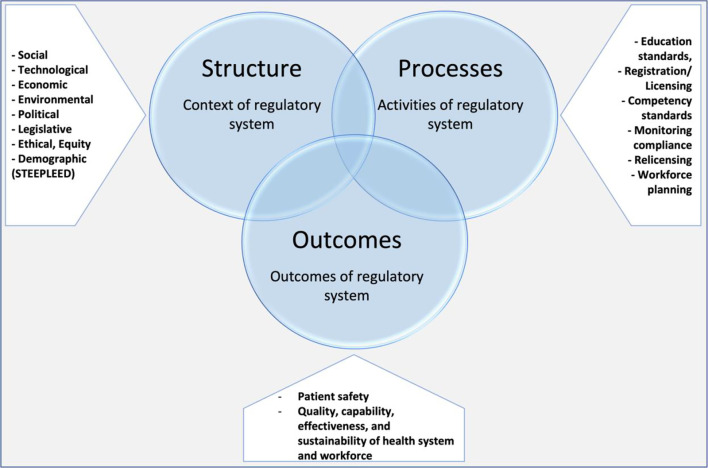
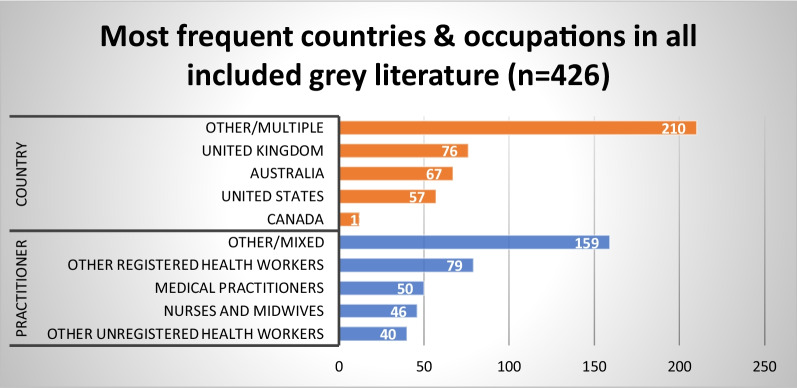
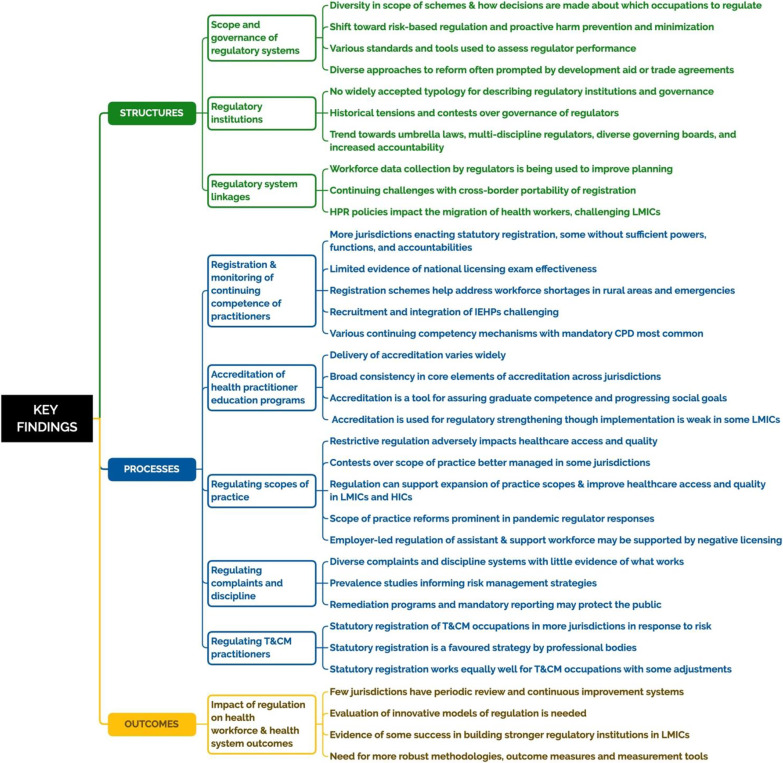
BACKGROUND: Health practitioner regulation (HPR) systems are increasingly recognized as playing an important role in supporting health workforce availability, accessibility, quality, and sustainability, while promoting patient safety. This review aimed to identify evidence on the design, delivery and effectiveness of HPR to inform policy decisions. METHODS: We conducted an integrative analysis of literature published between 2010 and 2021. Fourteen databases were systematically searched, with data extracted and synthesized based on a modified Donabedian framework. FINDINGS: This large-scale review synthesized evidence from a range of academic (n = 410) and grey literature (n = 426) relevant to HPR. We identified key themes and findings for a series of HPR topics organized according to our structures-processes-outcomes conceptual framework. Governance reforms in HPR are shifting towards multi-profession regulators, enhanced accountability, and risk-based approaches; however, comparisons between HPR models were complicated by a lack of a standardized HPR typology. HPR can support government workforce strategies, despite persisting challenges in cross-border recognition of qualifications and portability of registration. Scope of practice reform adapted to modern health systems can improve access and quality. Alternatives to statutory registration for lower-risk health occupations can improve services and protect the public, while standardized evaluation frameworks can aid regulatory strengthening. Knowledge gaps remain around the outcomes and effectiveness of HPR processes, including continuing professional development models, national licensing examinations, accreditation of health practitioner education programs, mandatory reporting obligations, remediation programs, and statutory registration of traditional and complementary medicine practitioners. CONCLUSION: We identified key themes, issues, and evidence gaps valuable for governments, regulators, and health system leaders. We also identified evidence base limitations that warrant caution when interpreting and generalizing the results across jurisdictions and professions. Themes and findings reflect interests and concerns in high-income Anglophone countries where most literature originated. Most studies were descriptive, resulting in a low certainty of evidence. To inform regulatory design and reform, research funders and governments should prioritize evidence on regulatory outcomes, including innovative approaches we identified in our review. Additionally, a systematic approach is needed to track and evaluate the impact of regulatory interventions and innovations on achieving health workforce and health systems goals.
Overview
The claims and statistics of this paper haven’t been checked yet.
Run the check — free, no account needed. It reads the open-access text and checks the sources it cites.
Integrity signals
Registry
Cites
Statistics
Figures
Verification
Claims the paper makes
The claims and statistics of this paper haven’t been checked yet.
Run the check — free, no account needed. It reads the open-access text and checks the sources it cites.
Claims other papers make about this one
Each is checked against this paper’s own text: does it say what the citing paper says it does?
The cited source says what the claim attributes to it.
In the citing paper
“These authors report the literature base to be diffuse, primarily descriptive, and insufficient for drawing strong conclusions about the effects of various regulatory approaches, policies, and practices on patient safety, the health workforce, and health system outcomes [17,18].”
From Nursing regulation in Canada: Insights from a scoping review (2025) · cites this paper as [18]
The cited source says what the claim attributes to it.
In the citing paper
“Although mandatory continuing professional development is an approach that is used widely by professional regulators globally, existing evidence about the design and outcomes of CCPs is mixed [18,247–251].”
From Nursing regulation in Canada: Insights from a scoping review (2025) · cites this paper as [18]
Self-check
Percentages, sums and reported differences re-computed from the paper’s own numbers.
The self-check needs the paper’s full text.
Citations
Cites
Items 201–251 of 251
Palatchie, B., Beban, A., & Andersen, B. (2021) · Health Sociology Review · doi:10.1080/14461242.2021.1987955 · Cited by 10
Osborne, K. (2015) · Journal of Midwifery & Women s Health · doi:10.1111/jmwh.12368 · Cited by 10
Lynch, M. R., & Kodate, N. (2019) · Research in Social and Administrative Pharmacy · doi:10.1016/j.sapharm.2019.05.007 · Cited by 9
Kwan, J. A., Wang, M., Cummings, G. G., Lemermeyer, G., Nordstrom, P., Blumer, L., Horne, N., & Giblin, C. (2019) · International Nursing Review · doi:10.1111/inr.12518 · Cited by 9
Ijaz, N. (2020) · Frontiers in Sociology · doi:10.3389/fsoc.2019.00089 · Cited by 9
Penner, J. D., Snively, A., Packham, T., Henderson, J., Principi, E., & Malstrom, B. (2020) · Physiotherapy Canada · doi:10.3138/ptc-2019-0011 · Cited by 9
Methods of nursing certification in North America–A scoping review
Chappell, K., Newhouse, R. P., Lundmark, V. A., ElChamaa, R., Jeong, D., Kendall‐Gallagher, D., Salt, E. G., & Kitto, S. C. (2020) · Nursing Outlook · doi:10.1016/j.outlook.2020.04.003 · Cited by 9
Touré, C. O., Bijou, S., Joiner, M., Brown, A. N., Tessougué, J., Maiga, H., Dicko, F., & Keïta, A. K. (2021) · Human Resources for Health · doi:10.1186/s12960-021-00654-4 · Cited by 9
Beyond Professional Licensure: A Statement of Principle on Culturally-Responsive Healthcare
Ijaz, N., Steinberg, M., Flaherty, T., Neubauer, T., & Thompson‐Lastad, A. (2021) · Global Advances in Health and Medicine · doi:10.1177/21649561211043092 · Cited by 9
National nursing registration in Australia: A way forward for nurse practitioner endorsement
Driscoll, A. L., Harvey, C. L., Green, A., Weatherby, R. P., Liew, D., Prentice, D. A., Lord, J., Lee, G., Crellin, D., Dobroff, N. K., et al. (2012) · Journal of the American Academy of Nurse Practitioners · doi:10.1111/j.1745-7599.2011.00711.x · Cited by 8
Goodwin, M., Higgins, S., & Lewis, S. A. (2011) · Seizure · doi:10.1016/j.seizure.2011.07.004 · Cited by 8
Neimeyer, G. J., Taylor, J. M., & Orwig, J. (2012) · Professional Psychology Research and Practice · doi:10.1037/a0030458 · Cited by 8
Knox, S., Dunne, S. S., Hughes, M., Cheeseman, S., & Dunne, C. P. (2016) · Irish Journal of Medical Science (1971 -) · doi:10.1007/s11845-016-1412-z · Cited by 8
The role of disengagement in the psychology of competence drift
Austin, Z., & Gregory, P. A. M. (2018) · Research in Social and Administrative Pharmacy · doi:10.1016/j.sapharm.2018.02.011 · Cited by 8
Evaluating Prescribing Competence in Nurse Practitioner Fellowship and Residency Programs
Klein, T., & Lugo, R. (2018) · The Journal for Nurse Practitioners · doi:10.1016/j.nurpra.2018.08.021 · Cited by 8
Effect of state regulatory environments on advanced psychiatric nursing practice
Phoenix, B. J., & Chapman, S. A. (2020) · Archives of Psychiatric Nursing · doi:10.1016/j.apnu.2020.07.001 · Cited by 8
Towards more effective health workforce governance: The case of overseas‐trained doctors
Marcus, K., Purwaningrum, F., & Short, S. D. (2021) · Australian Journal of Rural Health · doi:10.1111/ajr.12692 · Cited by 8
Fitness to practice of medical graduates: one programme's approach.
Braatvedt, C., Poole, P., Merry, A., Gorman, D., Reid, P., & Bagg, W. (2014) · PubMed · Cited by 7
Freckelton, I. R. (2008) · PubMed · Cited by 7
Mayberry, J. F. (2017) · Medico-Legal Journal · doi:10.1177/0025817217734482 · Cited by 7
Maxey, H. L., Norwood, C. W., O'Connell, J. B., & Liu, Z. (2017) · PubMed · Cited by 7
Regulation of nursing professionals in Cambodia: strategies to overcome underpinning challenges
Matsuoka, S., Fujita, N., Koto‐Shimada, K., & Zwi, A. B. (2021) · International Nursing Review · doi:10.1111/inr.12658 · Cited by 7
Nadareishvili, I., Pkhakadze, G., Japiashvili, N., & Lunze, K. (2021) · The International Journal of Health Planning and Management · doi:10.1002/hpm.3142 · Cited by 7
Study raises concerns over racial discrimination in MRCGP exam
Kmietowicz, Z. (2013) · BMJ · doi:10.1136/bmj.f5792 · Cited by 6
The creation of risk‐related information
Lloyd‐Bostock, S. (2010) · Journal of Health Organization and Management · doi:10.1108/14777261011088674 · Cited by 6
Ijaz, N., & Boon, H. S. (2018) · Springer eBooks · doi:10.1007/978-3-319-73939-7_8 · Cited by 6
Internationally educated nurses’ competency assessment and registration outcomes
Nordstrom, P. M., Kwan, J., Wang, M., Qiu, Z., Cummings, G. G., & Giblin, C. (2018) · International Journal of Migration Health and Social Care · doi:10.1108/ijmhsc-07-2017-0029 · Cited by 6
Can a medical regulatory system be implemented in Korea?
Huh, S. Y., & Chung, M.-H. (2013) · Journal of Korean Medical Association · doi:10.5124/jkma.2013.56.3.158 · Cited by 5
Sibbritt, D. W., Kaye, M., Millbank, J., Stuhmcke, A., Wardle, J., & Karpin, I. (2018) · Complementary Therapies in Medicine · doi:10.1016/j.ctim.2017.12.012 · Cited by 5
Ijaz, N., & Boon, H. S. (2018) · Law & Policy · doi:10.1111/lapo.12112 · Cited by 5
Definitions of Physician Certification Used in the North American Literature: A Scoping Review
Price, D., Campbell, C. B., Hoof, T. J. V., ElChamaa, R., Jeong, D., Chappell, K., Moore, D. E., Olson, C. A., Danilovich, N., & Kitto, S. C. (2020) · Journal of Continuing Education in the Health Professions · doi:10.1097/ceh.0000000000000312 · Cited by 5
Leung, T. I., Biskup, E. M., & DeWitt, D. E. (2020) · Rural and Remote Health · doi:10.22605/rrh6027 · Cited by 5
Morioka, Y., Higuchi, N., Kuroyanagi, T., & Nudeshima, J. (2014) · Europe PMC (PubMed Central) · Cited by 4
Ijaz, N., & Boon, H. S. (2018) · SAGE Open · doi:10.1177/2158244018768677 · Cited by 4
Eswatini Nursing Council Regulatory Reforms: Process towards Entry to Practice Examination
Msibi, G. S., Nkwanyana, N. R., & Kuebel, H. (2020) · Annals of Global Health · doi:10.5334/aogh.2800 · Cited by 4
Maintenance of certification for radiologists: an overview of European countries
Kwee, R. M., & Kwee, T. C. (2020) · Insights into Imaging · doi:10.1186/s13244-020-00893-4 · Cited by 4
Reinhart, E., & Alam, E. (2020) · BMJ · doi:10.1136/bmj.m4293 · Cited by 4
The socio-economic transition and health professions education in Mongolia: a qualitative study
Amgalan, N., Shin, J., Lee, S. H., Badamdorj, O., Ravjir, O., & Yoon, H. B. (2021) · Cost Effectiveness and Resource Allocation · doi:10.1186/s12962-021-00269-5 · Cited by 4
Knox, S., Dunne, S. S., Cullen, W., & Dunne, C. P. (2015) · BMC Emergency Medicine · doi:10.1186/s12873-015-0037-2 · Cited by 3
Acord, L. G., Dennik-Champion, G., Lundeen, S. P., & Schuler, S. G. (2010) · Policy Politics & Nursing Practice · doi:10.1177/1527154410382146 · Cited by 3
Southeast Asian countries to allow free flow of doctors
McCall, C. (2014) · The Lancet · doi:10.1016/s0140-6736(14)60391-3 · Cited by 3
Choi, J.-W., Kim, K., Lee, J., Choi, D.-J., & Kim, K. (2017) · Journal of Educational Evaluation for Health Professions · doi:10.3352/jeehp.2017.14.11 · Cited by 3
Regulation of unregistered birth workers in Australia: Homebirth and public safety
McWhirter, R. (2017) · Women and Birth · doi:10.1016/j.wombi.2017.06.023 · Cited by 3
Expecting the Unexpected: How Regulators Can Prepare for Serious Events
Reid, A., Leistikow, I. P., Paniagua, M. A., Udekwu, P. O., & Letlape, K. (2021) · Journal of Medical Regulation · doi:10.30770/2572-1852-107.3.28 · Cited by 3
Issues of a Federal Versus a State-Based Nurse Licensure System
Hudspeth, R. S. (2013) · Nursing Administration Quarterly · doi:10.1097/naq.0b013e3182669202 · Cited by 2
Leslie, K., & Nelson, S. (2018) · Nursing leadership · doi:10.12927/cjnl.2018.25682 · Cited by 2
Self-citationAboriginal and Torres Strait Islander health practitioner regulation.
Freckelton, I. R. (2014) · PubMed · Cited by 1
Prohibition Orders and the Regulation of Unregistered Health Practitioners.
Freckelton, I. R. (2020) · PubMed · Cited by 1
European Society of Radiology (ESR) (2020) · Insights into Imaging · doi:10.1186/s13244-019-0827-2 · Cited by 1
Flexibilization of regulations of health professionals' practices in response to the COVID-19
van Stralen, A. C. D. S., Carvalho, C., Girardi, S. N., Massote, A. W., & Cherchiglia, M. L. (2023) · Population Medicine · doi:10.18332/popmed/165733 · Cited by 1
Innes, S., Cope, V., Leboeuf-Yde, C., & Walker, B. (2019) · Figshare · doi:10.6084/m9.figshare.c.4663316 · Cited by 1
Research works printed but not linked: 13
- Carlton A-L. Review of the Allied Health Professions Act 2016: Final report for the Malaysian Ministry of Health on establishing an effective regulatory framework for the allied health professions - findings and recommendations from WHO consultancy conducted September 2020 - July 2021. World Health Organization Western Pacific Region (WHO WPR); 2021 Oct p. 1–114.
- Pearson A, White H, Bath-Hextall F, Salmond S, Apostolo J, Kirkpatrick P. A mixed-methods approach to systematic reviews. JBI Evid Implement. 2015;13:121.
- Covidence. Covidence: Better systematic review management. Covidence. https://www.covidence.org/
- PSA. A new approach to how we review the regulators: 2021 consultations [Internet]. UK Professional Standards Authority for Health and Social Care. 2021. https://www.professionalstandards.org.uk/what-we-do/improving-regulation/consultation/consultation-on-performance-reviews
- Snowball K. Independent Review of the National Registration and Accreditation Scheme for health professions. Australian Health Ministers’ Advisory Council (AHMAC); 2014 Dec.
- COAG Health Council. Review of Governance of the National Registration and Accreditation Scheme (NRAS). COAG Health Council; 2017 Nov p. 1–26.
- Besançon LJR, Rockey P, van Zanten M. Regulation of health professions: disparate worldwide approaches are a challenge to harmonization. Globalization. 2012;1:3.
- Yam HK. Fit for purpose: Do Hong Kong’s current assessment and monitoring systems for medical practice meet modern day needs? Dissertation Abstracts International: Section B: The Sciences and Engineering. 2018;79:No Pagination Specified.
- Woods M. Australia’s Health Workforce: strengthening the education foundation | Independent Review of Accreditation Systems within the National Registration and Accreditation Scheme for health professions. Australian Health Ministers’ Advisory Council, COAG Health Council; 2017 Nov.
- Benton DC, George J. Regulating the Regulators? Official Journal of the World Medical Association, Inc. 2018;64:3–8.
- Archer J, Lynn N, Roberts M, Coombes L, Gale T, de Bere SR. A Systematic review on the impact of licensing examinations for doctors in countries comparable to the UK. 2015 May p. 1–52. https://www.gmc-uk.org/-/media/documents/A_systematic_review_on_the_impact_of_licensing_examinations__for_doctors_in_countries_comparable_to_the_UK.pdf_61103496.pdf
- Ying X, Kannan V, Greener E, Smith JA, Brasch J, Johnson BA, et al. Full scope-of-practice regulation is associated with higher supply of nurse practitioners in rural and primary care health professional shortage counties. J Nurs Regul. 2018;8:5–13. · DOI
- Bullock A, Browne J, Poletti C, Dorottya C& E. Review of research into health and care professional regulation. Professional Standards Authority. 2020. https://www.professionalstandards.org.uk/publications/detail/review-of-research-into-health-and-care-professional-regulation
Cited by
Sorted by citations
Global Strategy on Human Resources for Health: Workforce 2030—A Five-Year Check-In
McIsaac, M., Buchan, J., Abu-Agla, A., Kawar, R., & Campbell, J. (2024) · Human Resources for Health · doi:10.1186/s12960-024-00940-x · Cited by 78
Limoges, J., Puddester, R., Gretchev, A., Chiu, P., Calzone, K., Leslie, K., Pike, A. D., & Letourneau, N. L. (2024) · Current Oncology · doi:10.3390/curroncol32010014 · Cited by 15
Self-citationSriram, V. M., Brophy, S. A., Sharma, K., Elias, M. A., & Mishra, A. (2023) · BMJ Global Health · doi:10.1136/bmjgh-2023-012661 · Cited by 13
Nursing regulation in Canada: Insights from a scoping review
Chiu, P., Thiessen, N. J., Idrees, S., Leslie, K., & Kung, J. Y. (2025) · PLOS ONE · doi:10.1371/journal.pone.0323716 · Cited by 12
“Although mandatory continuing professional development is an approach that is used widely by professional regulators globally, existing evidence about the design and outcomes of CCPs is mixed [18,247–251].”
InfluentialSelf-citationLeslie, K., Myles, S., Schiller, C. J., Alraja, A. A., Nelson, S., & Adams, T. L. (2023) · PLOS Digital Health · doi:10.1371/journal.pdig.0000163 · Cited by 12
Self-citation
Metadata
- Authors
- Leslie, K., Bourgeault, I. L., Carlton, A.-L., Balasubramanian, M., Mirshahi, R., Short, S. D., Carè, J., Cometto, G., & Lin, V.
- Affiliations
- Athabasca University (CA)
- University of Ottawa (CA)
- RMIT University (AU)
- The University of Sydney (AU)
- University of Technology Sydney (AU)
- World Health Organization (CH)
- University of Hong Kong (HK)
- Corresponding author
- Leslie, Kathleen
- ORCID
- Venue
- Human Resources for Health
- Published
- 2023-09-04
- Volume
- 21
- Issue
- 1
- Pages
- 72-72
- ISSN
- 1478-4491 (ISSN-L)
- PMC
- PMC10478314
- OpenAlex
- W4386423345
- Cited by
- 38
- References
- 252
- Citations by year
- 2026: 13 · 2025: 13 · 2024: 9 · 2023: 3
- FWCI
- 2.35
- Type
- journal article
- Language
- en
- Open access
- gold
- doi.org
- Locations
- Human Resources for Health (publishedVersion, cc-by)
- Research Square (acceptedVersion, cc-by)
- PubMed Central (publishedVersion, cc-by)
- PubMed (publishedVersion)
- uO Research (University of Ottawa) (submittedVersion, public-domain)
- DOAJ (DOAJ: Directory of Open Access Journals) (submittedVersion, cc-by-sa)
- Figshare (submittedVersion, cc-by)
- Funders
- World Health Organization
- Topics
- Social Sciences › Law › Occupational and Professional Licensing Regulation
- Health Sciences › Medicine › Public Health, Environmental and Occupational Health › Healthcare Regulation
- Health Sciences › Medicine › Public Health, Environmental and Occupational Health › Global Health Workforce Issues
- Keywords
- health practitioner regulation, healthcare workers, statutory registration, risk-based regulation, continuing professional development, licensing examinations, mandatory reporting, remedial programme, patient safety, health workforce policy
- MeSH terms
- Accreditation, Government, Government Programs, Health Education, Humans, Databases, Factual
About these checks
Registry, retraction, Cites and statistics results are computed, not judged, with one exception: a printed reference that no index lists is read once by a model before it counts as a citation error. Claims are extracted by a model and kept only when their quote appears verbatim in the text; each cited source is then checked, with a model’s help, for whether it says what the claim relies on. Those verdicts can be wrong — read the claim’s quote and the cited source before relying on one.
Statistics and arithmetic are recomputed, not judged.
Confidence bands are shown only for fields calibrated on our annotated test set. None is calibrated yet, so no band is shown.
What counts as a claim ›How we measure confidence ›How we check this ›
Are you an author, or do you see a problem with this page? Request a review
