

Capacity for conducting systematic reviews in low- and middle-income countries: a rapid appraisal
Open accessThe DOI matches its Crossref record; 25 of the 37 references it cites were found in a registry or an index.
Abstract
BACKGROUND: Systematic reviews of research are increasingly recognised as important for informing decisions across policy sectors and for setting priorities for research. Although reviews draw on international research, the host institutions and countries can focus attention on their own priorities. The uneven capacity for conducting research around the world raises questions about the capacity for conducting systematic reviews. METHODS: A rapid appraisal was conducted of current capacity and capacity strengthening activities for conducting systematic reviews in low- and middle-income countries (LMICs). A systems approach to analysis considered the capacity of individuals nested within the larger units of research teams, institutions that fund, support, and/or conduct systematic reviews, and systems that support systematic reviewing internationally. RESULTS: International systematic review networks, and their support organisations, are dominated by members from high-income countries. The largest network comprising a skilled workforce and established centres is the Cochrane Collaboration. Other networks, although smaller, provide support for systematic reviews addressing questions beyond effective clinical practice which require a broader range of methods. Capacity constraints were apparent at the levels of individuals, review teams, organisations, and system wide. Constraints at each level limited the capacity at levels nested within them. Skills training for individuals had limited utility if not allied to opportunities for review teams to practice the skills. Skills development was further constrained by language barriers, lack of support from academic organisations, and the limitations of wider systems for communication and knowledge management. All networks hosted some activities for strengthening the capacities of individuals and teams, although these were usually independent of core academic programmes and traditional career progression. Even rarer were efforts to increase demand for systematic reviews and to strengthen links between producers and potential users of systematic reviews. CONCLUSIONS: Limited capacity for conducting systematic reviews within LMICs presents a major technical and social challenge to advancing their health systems. Effective capacity in LMICs can be spread through investing effort at multiple levels simultaneously, supported by countries (predominantly high-income countries) with established skills and experience.
Overview
The claims and statistics of this paper haven’t been checked yet.
Free: it reads the open-access text and checks the first 5 claims that cite a source we can check. Create a free account to check every claim.
Integrity signals
Registry
Cites
Statistics
Figures
Verification
Claims the paper makes
The claims and statistics of this paper haven’t been checked yet.
Free: it reads the open-access text and checks the first 5 claims that cite a source we can check. Create a free account to check every claim.
Claims other papers make about this one
Each is checked against this paper’s own text: does it say what the citing paper says it does?
The cited source says what the claim attributes to it.
In the citing paper
“We previously observed that relevant literature for low- and middle-income countries, such as working and policy papers, is often not included in databases, and is located from organisational websites, contacting authors or internet search engines [3].”
From Exploring issues in the conduct of website searching and other online sources for systematic reviews: how can we be systematic? (2016) · cites this paper as [3]
Self-check
Percentages, sums and reported differences re-computed from the paper’s own numbers.
The self-check needs the paper’s full text.
Citations
Cites
Diffusion of Innovations in Service Organizations: Systematic Review and Recommendations
GREENHALGH, T., ROBERT, G., MACFARLANE, F., BATE, P., & KYRIAKIDOU, O. (2004) · The Milbank Quarterly · doi:10.1111/j.0887-378x.2004.00325.x · Cited by 7,448 · cited 2×
“porting technologies and ways of working” [32].”
Clarifying differences between review designs and methods
Gough, D., Thomas, J., & Oliver, S. (2012) · Systematic Reviews · doi:10.1186/2046-4053-1-28 · Cited by 1,063 · cited 1×
“There was a paucity of model examples for incorporating different methodologies required for health systems research or for questions other than about effectiveness (‘what works?’), although this situation has since improved [29].”
MethodSelf-citationBridges, brokers and boundary spanners in collaborative networks: a systematic review
Long, J. C., Cunningham, F. C., & Braithwaite, J. (2013) · BMC Health Services Research · doi:10.1186/1472-6963-13-158 · Cited by 523 · cited 1×
“Help can come from people spanning organisational and cultural boundaries or knowledge brokers, preferably working in teams [33].”
BackgroundIntroduction to systematic reviews: (657462011-001)
O'Connor, E., Whitlock, E., & Spring, B. (2011) · PsycEXTRA Dataset · doi:10.1037/e657462011-001 · Cited by 463
A framework to evaluate research capacity building in health care
Cooke, J. (2005) · BMC Family Practice · doi:10.1186/1471-2296-6-44 · Cited by 422 · cited 3×
“Dimensions for strengthening capacity for health research [1] and methods for its evaluation [2] have been developed from systematic reviews of research literature and good practice.”
BackgroundMethodSearching for studies: a guide to information retrieval for Campbell systematic reviews
Kugley, S., Wade, A., Thomas, J., Mahood, Q., Jørgensen, A. K., Hammerstrøm, K., & Sathe, N. (2017) · Campbell Systematic Reviews · doi:10.4073/cmg.2016.1 · Cited by 371 · cited 1×
“Despite these difficulties, guidance is available [15].”
Basic Concepts and Techniques of Rapid Appraisal
Beebe, J. (1995) · Human Organization · doi:10.17730/humo.54.1.k84tv883mr2756l3 · Cited by 341 · cited 1×
“It employs a systems perspective, triangulation of data collection, and iterative data collection and analysis [5].”
How Can We Support the Use of Systematic Reviews in Policymaking?
Lavis, J. N. (2009) · PLoS Medicine · doi:10.1371/journal.pmed.1000141 · Cited by 246 · cited 1×
“It reports a rapid appraisal of LMICs current capacity and efforts to enhance capacity to synthesise the evidence available for policy decisions; evidence not only about assessing policy options, but also about understanding the nature and scale of policy problems and about policy implementation [4], as well as the ap…”
BackgroundImproving the use of research evidence in guideline development: introduction
SURE, Oxman, A. D., Fretheim, A., & Schünemann, H. J. (2006) · Health Research Policy and Systems · doi:10.1186/1478-4505-4-12 · Cited by 135
Evaluating Health Research Capacity Building: An Evidence-Based Tool
Bates, I., Osei‐Akoto, A., Ansong, D., Karikari, P., Bedu‐Addo, G., Critchley, J., Agbenyega, T., & Nsiah-Asare, A. (2006) · PLoS Medicine · doi:10.1371/journal.pmed.0030299 · Cited by 110 · cited 2×
“Dimensions for strengthening capacity for health research [1] and methods for its evaluation [2] have been developed from systematic reviews of research literature and good practice.”
BackgroundMethod
Research works printed but not linked: 2
- Florenzano F Benitez J Pantoja T Identifying methodological challenges in conducting systematic reviews of health policy and systems research: a study case in low- and middle-income countries 2010 Santiago, Chile Methodology Centre for Systematic Reviews of Health Policy and Systems Research in Low and Middle Income Countries
- Cole D Kakuma R Fonn S Izugbara C Thorogood M Bates I Evaluations of health research capacity development: a review of the evidence Am J Trop Med Hyg 2012 87 5 Suppl 1 226 305
Cited by
Stansfield, C., Dickson, K., & Bangpan, M. (2016) · Systematic Reviews · doi:10.1186/s13643-016-0371-9 · Cited by 122
Self-citationRohwer, A., Pfadenhauer, L., Burns, J., Brereton, L., Gerhardus, A., Booth, A., Oortwijn, W., & Rehfuess, E. (2017) · Journal of Clinical Epidemiology · doi:10.1016/j.jclinepi.2016.06.012 · Cited by 121
“290 Strengthening research capacity in conducting research synthesis is of utmost importance and has 291 been widely advocated as a means of overcoming the paucity of evidence relevant to SSA and other 292 LMICs [3, 5, 7, 63-65].”
BackgroundInfluentialChildhood Sexual Violence in Indonesia: A Systematic Review
Rumble, L., Febrianto, R. F., Larasati, M. N., Hamilton, C., Mathews, B., & Dunne, M. P. (2018) · Trauma Violence & Abuse · doi:10.1177/1524838018767932 · Cited by 141
Medical research productivity in the Arab countries: 2007-2016 bibliometric analysis
Rassi, R. E., Meho, L. I., Nahlawi, A., Salameh, J., Bazarbachi, A., & Akl, E. (2018) · Journal of Global Health · doi:10.7189/jogh.08.020411 · Cited by 69
“Oliver et al. (2015) has proposed conducting capacity building at the levels of individuals, research teams, organizations, and country wide.”
BackgroundAtkins, S. A., Marsden, S., Diwan, V., Zwarenstein, M., & for the ARCADE consortium (2016) · Global Health Action · doi:10.3402/gha.v9.30524 · Cited by 70
“for decision-making, including systematic reviews, which are key to informing policymakers (8).”
BackgroundThe evidence ecosystem in South Africa: growing resilience and institutionalisation of evidence use
Stewart, R. J., Dayal, H., Langer, L., & van Rooyen, C. (2019) · Humanities and Social Sciences Communications · doi:10.1057/s41599-019-0303-0 · Cited by 64
“Evidence-based policy and implementation, or evidence-informed decision-making in line with the most recent thinking, is often framed from two inter-related but limited perspectives: first, it is viewed as an approach that has originated from ‘developed’ Northern countries (White, 2019; Oliver et al., 2015), and secon…”
BackgroundSelf-citationConceptual framework for systemic capacity strengthening for health policy and systems research
Mirzoev, T. N., Topp, S. M., Afifi, R., Fadlallah, R., Obi, F. A., & Gilson, L. (2022) · BMJ Global Health · doi:10.1136/bmjgh-2022-009764 · Cited by 49
Bou-Karroum, L., Daou, K. N., Nomier, M., Arnaout, N. E., Fouad, F., El-Jardali, F., & Akl, E. (2018) · Journal of Global Health · doi:10.7189/jogh.09.010402 · Cited by 37
Rattle, I., & Taylor, P. (2023) · Energy Research & Social Science · doi:10.1016/j.erss.2023.103265 · Cited by 51
Advancing the field of health systems research synthesis
Langlois, É. V., Ranson, M. K., Bärnighausen, T., Bosch‐Capblanch, X., Daniels, K., El‐Jardali, F., Ghaffar, A., Grimshaw, J., Haines, A., Lavis, J. N., et al. (2015) · Systematic Reviews · doi:10.1186/s13643-015-0080-9 · Cited by 34
“The need for such a resource is especially acute in these settings due to the limited capacity of individuals, teams, organisations and knowledge systems to support the production and use of systematic reviews [6].”
BackgroundSelf-citationBou-Karroum, L., Hakoum, M. B., Hammoud, M. Z., Khamis, A. M., Al‐Gibbawi, M., Badour, S. A., Hasbani, D. J., Lopes, L. C., El-Rayess, H. M., El‐Jardali, F., et al. (2018) · International Journal of Health Policy and Management · doi:10.15171/ijhpm.2017.146 · Cited by 55
Rockers, P. C., Tugwell, P., Grimshaw, J., Oliver, S. R., Atun, R. A., Røttingen, J., Fretheim, A., Ranson, M. K., Daniels, K., Luiza, V. L., et al. (2017) · Journal of Clinical Epidemiology · doi:10.1016/j.jclinepi.2016.03.034 · Cited by 17
“Currently the infrastructure to produce systematic reviews in many LMICs is weak, and the Cochrane Collaboration has made strengthening l ocal capacity to conduct reviews in these countries a strategic focus [35].”
BackgroundSelf-citationAl-Farsi, Y. M., Albali, N. H., AlSaqabi, M., Sayed, M., Al‐Mawali, A., & Al‐Adawi, S. (2021) · Oman Medical Journal · doi:10.5001/omj.2021.100 · Cited by 13
Collaboration on evidence synthesis in Africa: a network study of growing research capacity
Pan, J., Zhong, Y., Young, S., & Niezink, N. M. D. (2021) · Health Research Policy and Systems · doi:10.1186/s12961-021-00774-2 · Cited by 16
“there exist challenges and barriers to capacity-building for evidence synthesis, including a lack of trained support specialists like statisticians and information specialists, language barriers and a lack of access to journal content [4].”
BackgroundInfluentialProducing policy relevant systematic reviews: navigating the policy-research interface
Oliver, S. R., Bangpan, M., & Dickson, K. (2017) · Evidence & Policy · doi:10.1332/174426417x14987303892442 · Cited by 19
“…was supported by three or more interviewees in this study, and was consistent with, while developing further, our understanding developed from our prior studies (Oliver and Dickson 2016; Oliver et al 2015) and with reflective practice in our own work which was analysed using the same framework.”
BackgroundResultSelf-citationMapping the characteristics of network meta-analyses on drug therapy: A systematic review
Tonin, F. S., Steimbach, L. M., Mendes, A. M., Borba, H. H. L., Pontarolo, R., & Fernández-Llimós, F. (2018) · PLoS ONE · doi:10.1371/journal.pone.0196644 · Cited by 26
Akl, E. A., Fadlallah, R., Ghandour, L. A., Kdouh, O., Langlois, É. V., Lavis, J. N., Schünemann, H. J., & El‐Jardali, F. (2017) · Health Research Policy and Systems · doi:10.1186/s12961-017-0242-4 · Cited by 24
Causal chain analysis in systematic reviews of international development interventions
Kneale, D., Thomas, J., Bangpan, M., Waddington, H. S., & Gough, D. (2018) · doi:10.51744/cip4 · Cited by 12
Self-citationHilkenmeier, F., Pelzer, M., Stierle, C. M. G., & Fink‐Lamotte, J. (2025) · Social Science Computer Review · doi:10.1177/08944393251404052 · Cited by 23
Developing a tool to assess the skills to perform a health technology assessment
Bidonde, J., Meneses-Echavez, J. F., Asare, B. A., Chola, L., Gad, M., Heupink, L. F., Peacocke, E. F., Ackon, A. A., Dolphyne, A., Ruiz, F. J., et al. (2022) · BMC Medical Research Methodology · doi:10.1186/s12874-022-01562-4 · Cited by 18
“Five tools (33%) used a cross-sectional design [29, 43, 46, 49, 50].”
MethodStakeholder Engagement for Development Impact Evaluation and Evidence Synthesis
Oliver, S. R., Roche, C., Stewart, R. J., Bangpan, M., Dickson, K., Pells, K., Cartwright, N. D., Hargreaves, J., & Gough, D. (2018) · doi:10.51744/cip3 · Cited by 19
“Box 12: Empirical Evidence from Social Psychology about Group DecisionMaking (Oliver et al, 2015) 47 Formal consensus methods, such as Delphi studies or Nominal Group Technique, perform better than informal techniques, such as a roundtable discussion, but the reasons are not clear.”
BackgroundSelf-citationHossain, M. M. (2020) · SSRN Electronic Journal · doi:10.2139/ssrn.3551055 · Cited by 20
Mbuagbaw, L., Zogo, P. O., Kredo, T., Durão, S., Young, T., Effa, E., Meremikwu, M., Hohlfeld, A., & Wiysonge, C. (2018) · The Pan African Medical Journal · doi:10.11604/pamj.2018.29.196.14521 · Cited by 12
“This network is a much needed response to the high burden of disease, health system challenges and limited research capacity in sub-Saharan Africa [2, 3].”
BackgroundEl‐Jardali, F., Saleh, S. S., Khodor, R., Rub, R. A. A., Arfa, C., Romdhane, H. B., & Hamadeh, R. R. (2015) · Health Research Policy and Systems · doi:10.1186/s12961-015-0032-9 · Cited by 18
Bird, K. S., Stokes, N., Tomlinson, M., & Rivas, C. A. (2023) · Journal of Family Violence · doi:10.1007/s10896-023-00541-7 · Cited by 11
“This collaboration was embedded in the design/budget of the project to enable meaningful contribution from all parties and build individual, team and organisational capacity for systematic reviews (Oliver et al., 2015).”
BackgroundFrom agenda to action: JBI Evidence Synthesis and the United Nations Sustainable Development Goals
Jordan, Z., & Pilla, B. (2023) · JBI Evidence Synthesis · doi:10.11124/jbies-23-00088 · Cited by 15
Oliver, S. R., Dickson, K., & Bangpan, M. (2023) · Health Research Policy and Systems · doi:10.1186/s12961-023-01051-0 · Cited by 11
“These were both capacity strengthening programmes ‘close to policy’, supporting research teams to develop reviewing skills in their academic areas of interest [72].”
BackgroundSelf-citationEvidence on Vocal Interventions in Adults: A Scoping Review
Ribeiro, V. V., Nascimento, W. V., da Silva, R. C., Gonçalves, F. M., Santos, R. S., Behlau, M., de Araújo, C. M., & Taveira, K. V. M. (2023) · Journal of Voice · doi:10.1016/j.jvoice.2023.03.005 · Cited by 8
Arab scholarship in educational administration, management and leadership: An overview
العطاري, ع. ت., & Essa, E. B. (2021) · Educational Management Administration & Leadership · doi:10.1177/17411432211012011 · Cited by 10
“Maturity requires the existence of a critical mass of scholars, a critical mass of scholarship and supplementary infrastructure (Borgatti and Foster, 2003; Oliver et al., 2015).”
BackgroundSartas, M., Cummings, S., Garbero, A., & Акрамханов, А. (2021) · Forests · doi:10.3390/f12081027 · Cited by 8
“Some proponents of machine-centered systems also argue that human-centered evidence approaches reflect the preferences of a professional community rather than the needs of society [7,8] since building sufficient capacity to generate, disseminate, and use evidence effectively requires a considerable investment that can…”
BackgroundA Global Perspective on Publishing in Oncology.
Brant, J., & Rassouli, M. (2018) · Seminars in Oncology Nursing · doi:10.1016/j.soncn.2018.09.009 · Cited by 5
Castañeda, Ó. J. M. (2018) · Sociology of Health & Illness · doi:10.1111/1467-9566.12808 · Cited by 8
Approaches to evidence synthesis in international development
Oliver, S. R., Gough, D., & Copestake, J. (2017) · doi:10.51744/cpip3 · Cited by 3
Self-citationPublication practices of sub-Saharan African Cochrane authors: a bibliometric study
Mbuagbaw, L. C. E., Schoonees, A., Oliver, J., Arikpo, D., Durão, S., Effa, E., Hohlfeld, A., Kredo, T., Wiysonge, C. S., & Young, T. (2021) · BMJ Open · doi:10.1136/bmjopen-2021-051839 · Cited by 6
Yadav, V., Trushna, T., Mandal, U. K., Singh, M., Goel, A. D., Bairwa, M. L., Dabar, D., & Sabde, Y. (2025) · Medical Reference Services Quarterly · doi:10.1080/02763869.2025.2595567 · Cited by 3
“16 Furthermore, even in the few LMIC institutions where information specialists or medical librarians are available, the financial implications of involving them can be prohibitive.”
Turning ‘evidence for development’ on its head: A view from Africa
Stewart, R. (2021) · Research for All · doi:10.14324/rfa.05.1.13 · Cited by 3
Self-citationApproaches to evidence synthesis in international development: a research agenda
Oliver, S. R., Gough, D., Copestake, J., & Thomas, J. (2018) · Journal of Development Effectiveness · doi:10.1080/19439342.2018.1478875 · Cited by 3
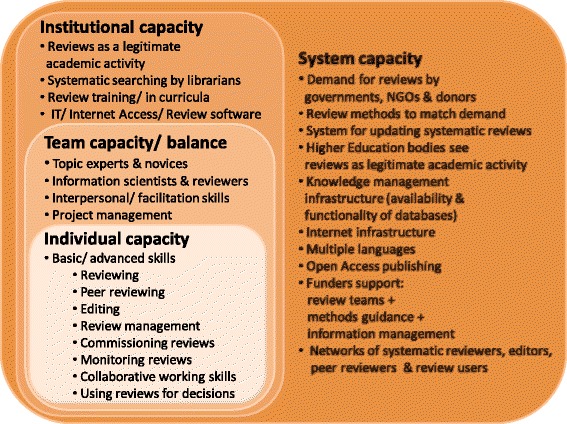
“This relies on the capacity of individuals’ skills, the capacity of teams to work together productively, the capacity of their host organisations to support their work and the capacity of current research methods, tools and guidance to synthesise relevant knowledge (Oliver et al. 2015).”
BackgroundSelf-citationHilkenmeier, F., Stoltenberg, M., & Stierle, C. M. G. (2026) · Systematic Reviews · doi:10.1186/s13643-026-03228-4 · Cited by 8
“…can be established, the proposed workflow may be particularly relevant for review teams working under limited time or personnel resources, because it concentrates human effort on calibration and discordant cases rather than requiring dual human screening of all records ([6, 8, 58] see also [62]).”
Indigenising systematic reviews with a collaborative model of 'training the trainers'.
D'Souza, P., Nayak, B., Tv, B., Dickson, K., & Oliver, S. (2023) · Nurse Researcher · doi:10.7748/nr.2023.e1882 · Cited by 2
Self-citationTrends in evidence synthesis publishing across disciplines in Africa: A bibliometric study
Young, S., Chimwaza, G., Eldermire, E., Ghezzi‐Kopel, K., & Muziringa, M. C. (2023) · Scientific African · doi:10.1016/j.sciaf.2023.e01545 · Cited by 4
Maikuri, A., Shanker, V., & Hopson, R. (2022) · African Evaluation Journal · doi:10.4102/aej.v10i1.625 · Cited by 4
Ho, H., Crandon, T. J., Hines, S., Lambert, M., Dankel, M., Francis, E., & Aromataris, E. (2026) · JBI Evidence Synthesis · doi:10.11124/jbies-26-00120 · Cited by 1
Quality of systematic reviews in African emergency medicine: a cross-sectional methodological study
van Niekerk, J., Fapohunda, T., Rohwer, A. C., & McCaul, M. (2023) · African Journal of Emergency Medicine · doi:10.1016/j.afjem.2023.10.001 · Cited by 1
“The absence of these methodological characteristics points towards the limited capacity for conducting systematic reviews which is prevalent in LMICs [36].”
BackgroundInfluentialOngolo-Zogo, C., El-Khechen, H. A., Morfaw, F., Djiadeu, P., Zani, B., Darzi, A., Wankah, P., Nyambi, A., Youta, A., Zaman, F., et al. (2023) · Health Research Policy and Systems · doi:10.1186/s12961-023-01007-4 · Cited by 2
Job Intensity: Evidence from Low- and Middle-Income Countries
Mutambudzi, M. S., & Vanajan, A. (2020) · Springer eBooks · doi:10.1007/978-3-030-05031-3_9-1 · Cited by 3
Durão, S., Ebrahim, S., Cooper, S., & Kredo, T. (2026) · BMJ evidence-based medicine · doi:10.1136/bmjebm-2025-114410
Pilla, B., Jordan, Z. L., Riddle, D., Klugar, M., Okwen, M. P., Parisod, H., Kachroo, K., & Weeks, S. (2026) · Frontiers in Public Health · doi:10.3389/fpubh.2026.1837626
“Oliver et al. found that international systematic review networks remain dominated by high-income countries with inadequate methods and processes for supporting responses to LMIC systems and policy questions or appropriate mechanisms for building capacity (8, 9).”
Brugulat-Panés, A., Martin-Pintado, C., Guell, C., Unwin, N. C., Iese, V., Augustus, E., & Foley, L. S. (2026) · BMJ Global Health · doi:10.1136/bmjgh-2025-020906 · Cited by 3
“19 Various definitions exist for grey literature due to its diversity.”
Palliative Care in Bolivia: A Scoping Review and Needs Assessment
Frank, H. R., Smith, C., ANTELO, G. P., Conklin, J., & Tilly, A. (2026) · Palliative Medicine Reports · doi:10.1177/26892820261428648 · Cited by 1
“49,50 New guidelines are needed for ways to integrate on-the-ground experiences and context into rigorous review protocols to balance the contributions of both forms of knowledge and experience.”
Khedkar, P., Balasubramanian, H., Pai, A. S., Ananthan, A., Anne, R. P., Mohan, D., Kabra, N. S., Rao, S. C., & Patole, S. (2025) · The Journal of Pediatrics · doi:10.1016/j.jpeds.2025.114871
Data Mining of Systematic Reviews 1934-2023: A Bibliometric Analysis
Al‐Abdallat, H., & Rawashdeh, B. (2023) · High Yield Medical Reviews · doi:10.59707/hymrhuhp8885 · Cited by 3
Cochrane Cameroon: bringing Cochrane to francophone sub-Saharan Africa
Mbuagbaw, L., Wafeu, G. S., Kredo, T., Durão, S., Oliver, J., Wiysonge, C., & Zogo, P. O. (2021) · The Pan African Medical Journal · doi:10.11604/pamj.2021.39.166.30508
Metadata
- Authors
- Oliver, S., Bangpan, M., Stansfield, C., & Stewart, R.
- Affiliations
- University College London (GB)
- University of Johannesburg (ZA)
- Corresponding author
- Oliver, Sandy
- Venue
- Health Research Policy and Systems
- Published
- 2015-04-26
- Volume
- 13
- Issue
- 1
- Pages
- 23-23
- ISSN
- 1478-4505 (ISSN-L)
- PMC
- PMC4443541
- OpenAlex
- W2114178586
- Cited by
- 59
- References
- 37
- Citations by year
- 2026: 7 · 2025: 3 · 2024: 1 · 2023: 10 · 2022: 4 · 2021: 8 · 2020: 4 · 2019: 2 · 2018: 12 · 2017: 3 · 2016: 3 · 2015: 2
- FWCI
- 1.10
- Type
- journal article
- Language
- en
- Open access
- gold
- doi.org
- Locations
- Health Research Policy and Systems (publishedVersion, cc-by)
- Europe PMC (PubMed Central) (publishedVersion, cc-by)
- PubMed Central (publishedVersion, cc-by)
- PubMed (publishedVersion)
- UCL Discovery (University College London) (submittedVersion)
- Funders
- International Development Research Centre
- Canadian Institutes of Health Research
- Topics
- Social Sciences › Decision Sciences › Statistics, Probability and Uncertainty › Meta-analysis and systematic reviews
- Health Sciences › Medicine › Public Health, Environmental and Occupational Health › Global Health and Surgery
- Health Sciences › Health Professions › General Health Professions › Health Policy Implementation Science
- Keywords
- systematic reviews, research capacity, low- and middle-income countries, capacity building, Cochrane Collaboration, skills training, language barriers, knowledge management, research workforce, evidence-based decision making
- MeSH terms
- Developing Countries, Research, Review Literature as Topic, Access to Information
About these checks
Registry, retraction, Cites and statistics results are computed, not judged, with one exception: a printed reference that no index lists is read once by a model before it counts as a citation error. Claims are extracted by a model and kept only when their quote appears verbatim in the text; each cited source is then checked, with a model’s help, for whether it says what the claim relies on. Those verdicts can be wrong — read the claim’s quote and the cited source before relying on one.
Statistics and arithmetic are recomputed, not judged.
Confidence bands are shown only for fields calibrated on our annotated test set. None is calibrated yet, so no band is shown.
What counts as a claim ›How we measure confidence ›How we check this ›
Are you an author, or do you see a problem with this page? Request a review
Data sources
Bibliographic data: Semantic Scholar, OpenAlex, Crossref.
Contains information from the Semantic Scholar Academic Graph Datasets, made available under the ODC Attribution License (ODC-BY 1.0).
Semantic Scholar’s data is described in: Kinney, R., et al. (2023). The Semantic Scholar Open Data Platform. arXiv:2301.10140.
