

Exploring the theory, barriers and enablers for patient and public involvement across health, social care and patient safety: a systematic review of reviews
Open accessThe DOI matches its Crossref record; 71 of the 72 references it cites were found in a registry or an index.
Abstract
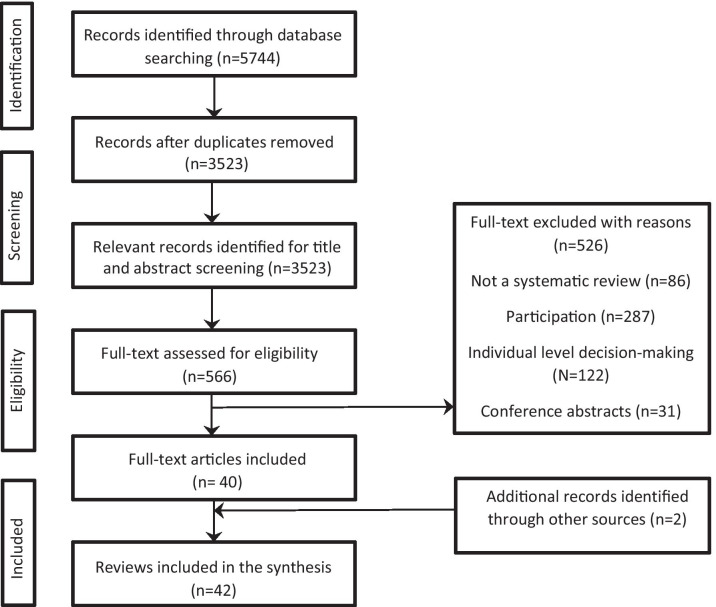
Background: The emergence of patient and public involvement (PPI) in healthcare in the UK can be traced as far back as the 1970s. More recently, campaigns by harmed patients have led to a renewed focus on strengthening PPI. There is a growing awareness of the benefits of PPI in research as well as a need to address power inequities and a lack of diversity and inclusion. This review was undertaken to look at evidence for theories, barriers and enablers in PPI across health, social care and patient safety that could be used to strengthen PPI and address a perceived knowledge and theory gap with PPI in patient safety. Methods: We searched MEDLINE, EMBASE and PsycINFO from inception to August 2018, using both MeSH and free-text terms to identify published empirical literature. Protocols in PROSPERO were also searched to identify any systematic reviews in progress. The extracted information was analysed using a narrative approach, which synthesises data using a descriptive method. Results: Forty-two reviews were identified and grouped by key outcomes. Twenty-two papers mentioned theory in some form, 31 mentioned equality and diversity (although with no theory mentioned in this area), and only 19 cited equality and diversity as a barrier or enabler. Thirty-four reviews identified barriers and enablers at different organisational levels: personal/individual; attitudes; health professional; roles and expectations; knowledge, information and communication; financing and resourcing; training; general support; recruitment and representation, PPI methods and working with communities and addressing power dynamics. Conclusions: The review findings suggest that a commitment to PPI and partnership working is dependent on taking a whole system approach. This needs to consider the complex individual and organisational enablers and constraints to this process and address imbalances of power experienced by different groups. Addressing equality and diversity and use of a theory-driven approach to guide PPI are neglected areas. The long tradition of involvement across health and social care can provide considerable expertise in thinking about ways to strengthen approaches to PPI. This is especially important in patient safety, with a much newer tradition of developing PPI than other areas of healthcare.
Overview
The claims and statistics of this paper haven’t been checked yet.
Free: it reads the open-access text and checks the first 5 claims that cite a source we can check. Create a free account to check every claim.
Integrity signals
Registry
Cites
Statistics
Figures
Verification
Claims the paper makes
The claims and statistics of this paper haven’t been checked yet.
Free: it reads the open-access text and checks the first 5 claims that cite a source we can check. Create a free account to check every claim.
Claims other papers make about this one
Each is checked against this paper’s own text: does it say what the citing paper says it does?
The cited source says what the claim attributes to it.
In the citing paper
“Despite widespread recognition of the moral imperative [13, 20] and added value of meaningful PPIE in health research [21, 22], a gap remains between the ideal of co-production, positioned at the top of Arnstein’s ladder [19], and the realities of implementing this ideal within complex, often rigid research settings [11, 23].”
From Layering perspectives: a structured approach to meaningful patient and public involvement and engagement in the RETURN dental trial (2026) · cites this paper as [23]
The cited source says what the claim attributes to it.
In the citing paper
“For instance, professionals might have negative attitudes about patient contributions and academics may have doubts about the benefits of user input (Ocloo et al., 2021).”
From Using Personas in the development of eHealth interventions for chronic pain: A scoping review and narrative synthesis (2023) · cites this paper as Ocloo et al., 2021
The cited source says what the claim attributes to it.
In the citing paper
“Furthermore, researchers might experience uncertainty about how to conduct PPI, in terms of representativeness and diversity of the target population, high workload or time constraints of clinical staff, patient consent, or ethical issues (Ocloo et al., 2021).”
From Using Personas in the development of eHealth interventions for chronic pain: A scoping review and narrative synthesis (2023) · cites this paper as Ocloo et al., 2021
Self-check
Percentages, sums and reported differences re-computed from the paper’s own numbers.
The self-check needs the paper’s full text.
Citations
Cites
To Err Is Human: Building a Safer Health System
(2000) · National Academies Press eBooks · doi:10.17226/9728 · Cited by 14,044
Shea, B. J., Reeves, B. C., Wells, G., Thuku, M., Hamel, C., Moran, J., Moher, D., Tugwell, P., Welch, V., Kristjansson, E., et al. (2017) · BMJ · doi:10.1136/bmj.j4008 · Cited by 10,636
To Err is Human: Building a Safer Health System
Hendee, W. R. (2001) · Journal of Vascular and Interventional Radiology · doi:10.1016/s1051-0443(01)70072-3 · Cited by 10,103
To Err Is Human : Building A Safer Health System
Kohn, L. T., Corrigan, J. M., & Donaldson, M. S. (2000) · Cited by 2,830
Patient engagement in research: a systematic review
Domecq, J. P., Prutsky, G., Elraiyah, T., Wang, Z., Nabhan, M., Shippee, N., Brito, J. P., Boehmer, K., Hasan, R., Firwana, B., et al. (2014) · BMC Health Services Research · doi:10.1186/1472-6963-14-89 · Cited by 1,773 · cited 10×
“, representation, demographics) in different studies varied [60]; only a few reviews reported PPI contributor characteristics [80] and the characteristics of those who influenced participation decisions in research [75]; participant [outcomes] reported were limited and primarily to do with English-speaking, literate a…”
BackgroundResultInfluentialCarman, K. L., Dardess, P., Maurer, M., Sofaer, S., Adams, K., Bechtel, C., & Sweeney, J. (2013) · Health Affairs · doi:10.1377/hlthaff.2012.1133 · Cited by 1,765
National Institute for Health Research
Evans, R. (2014) · Nursing Standard · doi:10.7748/ns.28.49.32.s37 · Cited by 1,350
Teasdale, G. M. (2002) · British Journal of Neurosurgery · doi:10.1080/02688690220148815 · Cited by 1,063
From tokenism to empowerment: progressing patient and public involvement in healthcare improvement
Ocloo, J., & Matthews, R. (2016) · BMJ Quality & Safety · doi:10.1136/bmjqs-2015-004839 · Cited by 998
Self-citationSystematic review of involving patients in the planning and development of health care
Crawford, M. J., Rutter, D., Manley, C., Weaver, T., Bhui, K., Fulop, N., & Tyrer, P. (2002) · BMJ · doi:10.1136/bmj.325.7375.1263 · Cited by 983
Modernising Governance: New Labour, Policy and Society
Newman, J. (2001) · SAGE Publications Ltd eBooks · doi:10.4135/9781446220511 · Cited by 843
Brett, J., Staniszewska, S., Mockford, C., Herron-Marx, S., Hughes, J., Tysall, C., & Suleman, R. (2014) · The Patient - Patient-Centered Outcomes Research · doi:10.1007/s40271-014-0065-0 · Cited by 839 · cited 9×
“Terms used to describe public involvement and types of involvement were similar to other studies [40, 41].”
BackgroundResultInfluentialModernizing Governance: New Labour, Policy and Society
Newman, J. (2001) · Open Research Online - ORO (The Open University) · Cited by 737
Patient and service user engagement in research: a systematic review and synthesized framework
Shippee, N. D., Domecq Garces, J. P., Prutsky Lopez, G. J., Wang, Z., Elraiyah, T. A., Nabhan, M., Brito, J. P., Boehmer, K., Hasan, R., Firwana, B., et al. (2015) · Health Expectations · doi:10.1111/hex.12090 · Cited by 628
The impact of patient and public involvement on UK NHS health care: a systematic review
Mockford, C., Staniszewska, S., Griffiths, F., & Herron-Marx, S. (2012) · International Journal for Quality in Health Care · doi:10.1093/intqhc/mzr066 · Cited by 570
Patient Satisfaction and Quality of Surgical Care in US Hospitals
Tsai, T. C., Orav, E. J., & Jha, A. K. (2015) · Annals of Surgery · doi:10.1097/sla.0000000000000765 · Cited by 395
Lost in the shadows: reflections on the dark side of co-production
Williams, O., Sarre, S., Papoulias, S. C., Knowles, S., Robert, G., Beresford, P., Rose, D., Carr, S., Kaur, M., & Palmer, V. J. (2020) · Health Research Policy and Systems · doi:10.1186/s12961-020-00558-0 · Cited by 362 · cited 1×
“These drivers have led to the development of theory, methods and approaches, particularly within mental health, that have been used to develop wider models and methods of involving patients and the public, based upon co-production and partnership [34].”
BackgroundInvolving users in the delivery and evaluation of mental health services: systematic review
Simpson, E. L., & House, A. O. (2002) · BMJ · doi:10.1136/bmj.325.7375.1265 · Cited by 349
Lay Participation in Health Care Decision Making: A Conceptual Framework
Charles, C., & DeMaio, S. (1993) · Journal of Health Politics, Policy and Law · doi:10.1215/03616878-18-4-881 · Cited by 322
Social movements in health: an introduction
Brown, P., & Zavestoski, S. (2004) · Sociology of Health & Illness · doi:10.1111/j.0141-9889.2004.00413.x · Cited by 308
Tritter, J. Q. (2009) · Health Expectations · doi:10.1111/j.1369-7625.2009.00564.x · Cited by 299
Review: Engaging Patients as Vigilant Partners in Safety: A Systematic Review
Schwappach, D. L. B. (2010) · Medical Care Research and Review · doi:10.1177/1077558709342254 · Cited by 291
Repper, J., & Breeze, J. (2007) · International Journal of Nursing Studies · doi:10.1016/j.ijnurstu.2006.05.013 · Cited by 255
Citizen Participation in Health Decision-Making: Past Experience and Future Prospects
Church, J., Saunders, D., Wanke, M., Pong, R., Spooner, C., & Dorgan, M. (2002) · Journal of Public Health Policy · doi:10.2307/3343116 · Cited by 243
Jha, V., Quinton, N. D., Bekker, H. L., & Roberts, T. E. (2009) · Medical Education · doi:10.1111/j.1365-2923.2008.03244.x · Cited by 242
Boote, J., Baird, W., & Beecroft, C. (2010) · Health Policy · doi:10.1016/j.healthpol.2009.11.007 · Cited by 234
Brunton, G., Thomas, J., O’Mara-Eves, A., Jamal, F., Oliver, S., & Kavanagh, J. (2017) · BMC Public Health · doi:10.1186/s12889-017-4958-4 · Cited by 232
Theoretical directions for an emancipatory concept of patient and public involvement
Gibson, A., Britten, N., & Lynch, J. (2012) · Health: An Interdisciplinary Journal for the Social Study of Health, Illness and Medicine · doi:10.1177/1363459312438563 · Cited by 231
Next steps on the NHS five year forward view
Ham, C. (2017) · BMJ · doi:10.1136/bmj.j1678 · Cited by 223
Boote, J., Wong, R., & Booth, A. (2015) · Health Expectations · doi:10.1111/hex.12007 · Cited by 216
Public involvement in health care
Florin, D., & Dixon, J. (2004) · BMJ · doi:10.1136/bmj.328.7432.159 · Cited by 212
Berger, Z., Flickinger, T. E., Pfoh, E., Martinez, K. A., & Dy, S. M. (2014) · BMJ Quality & Safety · doi:10.1136/bmjqs-2012-001769 · Cited by 195
Patient Preference and Adherence
Tóth-Czifra, E. (2017) · doi:10.14293/s2199-1006.1.sor-med.clkj7uk.v1 · Cited by 192
Conklin, A., Morris, Z., & Nolte, E. (2015) · Health Expectations · doi:10.1111/hex.12038 · Cited by 184
Happell, B., Byrne, L., McAllister, M., Lampshire, D., Roper, C., Gaskin, C. J., Martin, G., Wynaden, D., McKenna, B., Lakeman, R., et al. (2014) · International Journal of Mental Health Nursing · doi:10.1111/inm.12021 · Cited by 183
Representativeness, legitimacy and power in public involvement in health-service management
Martin, G. P. (2008) · Social Science & Medicine · doi:10.1016/j.socscimed.2008.09.024 · Cited by 176
Gagnon, M.-P., Desmartis, M., Lepage-Savary, D., Gagnon, J., St-Pierre, M., Rhainds, M., Lemieux, R., Gauvin, F.-P., Pollender, H., & Légaré, F. (2011) · International Journal of Technology Assessment in Health Care · doi:10.1017/s0266462310001315 · Cited by 173
Patient participation in patient safety and nursing input – a systematic review
Vaismoradi, M., Jordan, S. E., & Kangasniemi, M. K. (2014) · Journal of Clinical Nursing · doi:10.1111/jocn.12664 · Cited by 171
Doherty, C., & Stavropoulou, C. (2012) · Social Science & Medicine · doi:10.1016/j.socscimed.2012.02.056 · Cited by 170
Morgan, A., & Jones, D. (2009) · Medical Teacher · doi:10.1080/01421590802526946 · Cited by 165
Légaré, F., Boivin, A., van der Weijden, T., Pakenham, C., Burgers, J., Légaré, J., St-Jacques, S., & Gagnon, S. (2011) · Medical Decision Making · doi:10.1177/0272989x11424401 · Cited by 163
When Things Go Wrong: How Health Care Organizations Deal With Major Failures
Walshe, K., & Shortell, S. M. (2004) · Health Affairs · doi:10.1377/hlthaff.23.3.103 · Cited by 160
Nilsen, P., Aalto, M., Bendtsen, P., & Seppä, K. (2006) · Scandinavian Journal of Primary Health Care · doi:10.1080/02813430500475282 · Cited by 148
Vaughn, L. M., Whetstone, C. M., Boards, A., Busch, M. D., Magnusson, M., & Määttä, S. (2018) · Health & Social Care in the Community · doi:10.1111/hsc.12562 · Cited by 138
Burns, K. K., Bellows, M., Eigenseher, C., & Gallivan, J. (2014) · BMC Health Services Research · doi:10.1186/1472-6963-14-175 · Cited by 136
Partnering with patients – a concept ready for action
Hook, M. L. (2006) · Journal of Advanced Nursing · doi:10.1111/j.1365-2648.2006.03993.x · Cited by 131
Hall, J., Peat, M., Birks, Y., Golder, S., on behalf of the PIPS Group, Entwistle, V., Gilbody, S., Mansell, P., McCaughan, D., Sheldon, T., et al. (2010) · BMJ Quality & Safety · doi:10.1136/qshc.2009.032748 · Cited by 131
Patients’ roles and rights in research
Wicks, P., Richards, T., Denegri, S., & Godlee, F. (2018) · BMJ · doi:10.1136/bmj.k3193 · Cited by 131
Black and minority ethnic group involvement in health and social care research: A systematic review
Dawson, S., Campbell, S. M., Giles, S. J., Morris, R. L., & Cheraghi‐Sohi, S. (2018) · Health Expectations · doi:10.1111/hex.12597 · Cited by 128
Self-citationReconsidering Patient Participation in Guideline Development
van de Bovenkamp, H. M., & Trappenburg, M. J. (2009) · Health Care Analysis · doi:10.1007/s10728-008-0099-3 · Cited by 122
Baines, R. L., & Regan de Bere, S. (2018) · Health Expectations · doi:10.1111/hex.12618 · Cited by 116
Smith, E., Ross, F., Donovan, S., Manthorpe, J., Brearley, S., Sitzia, J., & Beresford, P. (2008) · International Journal of Nursing Studies · doi:10.1016/j.ijnurstu.2006.09.010 · Cited by 113
Hubbard, G., Kidd, L., Donaghy, E., McDonald, C., & Kearney, N. (2006) · Patient Education and Counseling · doi:10.1016/j.pec.2006.02.009 · Cited by 107
Albutt, A., O'Hara, J. K., Conner, M. T., Fletcher, S. J., & Lawton, R. (2016) · Health Expectations · doi:10.1111/hex.12496 · Cited by 96
Ocloo, J. E. (2010) · Social Science & Medicine · doi:10.1016/j.socscimed.2010.03.050 · Cited by 95
Self-citationPeat, M., Entwistle, V., Hall, J., Birks, Y., & Golder, S. (2010) · Journal of Health Services Research & Policy · doi:10.1258/jhsrp.2009.009040 · Cited by 91
Service user involvement in preregistration general nurse education: a systematic review
Scammell, J. M. E., Heaslip, V., & Crowley, E. (2015) · Journal of Clinical Nursing · doi:10.1111/jocn.13068 · Cited by 87
Patient involvement in teaching and assessing intimate examination skills: a systematic review
Jha, V., Setna, Z., Al‐Hity, A., Quinton, N. D., & Roberts, T. E. (2010) · Medical Education · doi:10.1111/j.1365-2923.2009.03608.x · Cited by 87 · cited 3×
“In education various training strategies included: classroom-based homework using manuals or videos, moving learning from the classroom into patients’ homes and scheduling teaching to take place in the evening [55, 56].”
BackgroundPatient, Family, and Community Advisory Councils in Health Care and Research: a Systematic Review
Oldfield, B. J., Harrison, M. A., Genao, I., Greene, A. T., Pappas, M. E., Glover, J. G., & Rosenthal, M. S. (2018) · Journal of General Internal Medicine · doi:10.1007/s11606-018-4565-9 · Cited by 86
Perry, J., Watkins, M., Gilbert, A., & Rawlinson, J. (2012) · Journal of Psychiatric and Mental Health Nursing · doi:10.1111/j.1365-2850.2012.01955.x · Cited by 79
Quality of Reporting on Patient and Public Involvement Within Surgical Research: A Systematic Review
Jones, E. L., Williams-Yesson, B. A., Hackett, R. C., Staniszewska, S. H., Evans, D., & Francis, N. K. (2015) · Annals of Surgery · doi:10.1097/sla.0000000000000768 · Cited by 71
Chuah, F. L. H., Srivastava, A., Singh, S. R., Haldane, V. E., Koh, G. C., Seng, C. K., McCoy, D., & Legido‐Quigley, H. (2018) · Social Science & Medicine · doi:10.1016/j.socscimed.2018.07.019 · Cited by 70
Ocloo, J. E., & Fulop, N. J. (2012) · Health Expectations · doi:10.1111/j.1369-7625.2011.00695.x · Cited by 65
Self-citationTerry, J. (2012) · Journal of Psychiatric and Mental Health Nursing · doi:10.1111/j.1365-2850.2011.01858.x · Cited by 61
Rogers, M., Bethel, A., & Boddy, K. (2017) · Health Information & Libraries Journal · doi:10.1111/hir.12157 · Cited by 56
Involving patients in quality indicator development – a systematic review
Blozik, E., Kötter, T., Schäfer, & Scherer, M. (2013) · Patient Preference and Adherence · doi:10.2147/ppa.s39803 · Cited by 49
Ocloo, J. E., Garfield, S., Dawson, S., & Franklin, B. D. (2017) · BMJ Open · doi:10.1136/bmjopen-2017-018426 · Cited by 39
Self-citationLangton, H., Barnes, M., Haslehurst, S., Rimmer, J. H., & Turton, P. (2003) · European Journal of Oncology Nursing · doi:10.1016/s1462-3889(03)00033-4 · Cited by 32
Evans, D., Bird, E. L., Gibson, A., Grier, S., Chin, T. L., Stoddart, M., MacGowan, A. P., & Panel, T. N. B. M. P. (2017) · Health Expectations · doi:10.1111/hex.12587 · Cited by 28
Supporting public involvement in interview and other panels: a systematic review
Baxter, S. K., Clowes, M., Muir, D., Baird, W. O., Broadway‐Parkinson, A., & Bennett, C. (2016) · Health Expectations · doi:10.1111/hex.12491 · Cited by 27
Mazzone, P. J. (2012) · Journal of Thoracic Oncology · doi:10.1097/jto.0b013e3182691425 · Cited by 24
Research works printed but not linked: 6
- Coulter A. Engaging Patients in Healthcare. New York: McGraw Hill Professional; 2013.
- Francis R. Report of the Mid Staffordshire NHS Foundation Trust Public Inquiry. London: Stationery Office; 2013.
- Care Quality Commission. Guidance about compliance: Essential standards of quality and safety. London; 2010:9.
- Darzi A. High Quality Care For All: NHS Next Stage Review. London; 2009.
- Sharpe VA. Medical Harm. Cambridge: Cambridge University Press; 2001.
- Care Quality Commission. Learning, candour and accountability: A review of the way NHS trusts review and investigate the deaths of patients in England. London; 2016.
Cited by
Transforming mental health systems globally: principles and policy recommendations
Patel, V., Saxena, S., Lund, C., Kohrt, B., Kieling, C., Sunkel, C., Kola, L., Chang, O., Charlson, F., O’Neill, K., et al. (2023) · The Lancet · doi:10.1016/s0140-6736(23)00918-2 · Cited by 209
Robert, G., Locock, L., Williams, O., Cornwell, J., Donetto, S., & Goodrich, J. (2022) · doi:10.1017/9781009237024 · Cited by 92
Hardie, P., Darley, A., Langan, L., Lafferty, A., Jarvis, S., & Redmond, C. (2022) · Nurse Education in Practice · doi:10.1016/j.nepr.2022.103482 · Cited by 94
Lauzon-Schnittka, J., Audette-Chapdelaine, S., Boutin, D., Wilhelmy, C., Auger, A.-M., & Brodeur, M. (2022) · Research Involvement and Engagement · doi:10.1186/s40900-022-00388-0 · Cited by 90
Jones, J., Cowe, M., Marks, S. A., McAllister, T., Mendoza, A., Ponniah, C., Wythe, H., & Mathie, E. (2021) · Research Involvement and Engagement · doi:10.1186/s40900-021-00295-w · Cited by 88
Metadata
- Authors
- Ocloo, J., Garfield, S., Franklin, B. D., & Dawson, S.
- Affiliations
- King's College London (GB)
- Imperial College Healthcare NHS Trust (GB)
- University of Bristol (GB)
- Corresponding author
- Ocloo, Josephine
- Venue
- Health Research Policy and Systems
- Published
- 2021-01-20
- Volume
- 19
- Issue
- 1
- Pages
- 8-8
- ISSN
- 1478-4505 (ISSN-L)
- PMC
- PMC7816359
- OpenAlex
- W3093610909
- Cited by
- 460
- References
- 72
- Citations by year
- 2026: 88 · 2025: 111 · 2024: 110 · 2023: 77 · 2022: 48 · 2021: 26
- FWCI
- 13.49
- Type
- journal article
- Language
- en
- Open access
- gold
- doi.org
- Licence
- cc-by
- creativecommons.org/licenses/by/4.0/ (tdm)
- creativecommons.org/licenses/by/4.0/ (vor)
- Locations
- Health Research Policy and Systems (publishedVersion, cc-by)
- PubMed Central (publishedVersion, cc-by)
- PubMed (publishedVersion)
- Bristol Research (University of Bristol) (acceptedVersion, cc-by)
- DOAJ (DOAJ: Directory of Open Access Journals) (submittedVersion, cc-by-sa)
- UCL Discovery (University College London) (submittedVersion)
- Research Portal (King's College London) (submittedVersion, cc-by)
- Funders
- Health Foundation
- National Institute for Health Research
- Topics
- Health Sciences › Health Professions › General Health Professions › Mental Health and Patient Involvement
- Health Sciences › Medicine › Public Health, Environmental and Occupational Health › Community Health and Development
- Health Sciences › Health Professions › General Health Professions › Health Policy Implementation Science
- Keywords
- patient and public involvement, barriers and facilitators, power relations, equality and diversity, social care, patient safety, health research, partnership working, whole systems approach
- MeSH terms
- United Kingdom, Humans, Patient Participation, Social Support, Patient Safety
About these checks
Registry, retraction, Cites and statistics results are computed, not judged, with one exception: a printed reference that no index lists is read once by a model before it counts as a citation error. Claims are extracted by a model and kept only when their quote appears verbatim in the text; each cited source is then checked, with a model’s help, for whether it says what the claim relies on. Those verdicts can be wrong — read the claim’s quote and the cited source before relying on one.
Statistics and arithmetic are recomputed, not judged.
Confidence bands are shown only for fields calibrated on our annotated test set. None is calibrated yet, so no band is shown.
What counts as a claim ›How we measure confidence ›How we check this ›
Are you an author, or do you see a problem with this page? Request a review
Data sources
Bibliographic data: Semantic Scholar, OpenAlex, Crossref.
Contains information from the Semantic Scholar Academic Graph Datasets, made available under the ODC Attribution License (ODC-BY 1.0).
Semantic Scholar’s data is described in: Kinney, R., et al. (2023). The Semantic Scholar Open Data Platform. arXiv:2301.10140.
