

The DOI matches its Crossref record; the references it cites are not checked yet.
Developing a toolkit for implementing evidence-based guidelines to manage hypertension and diabetes in Cambodia: a descriptive case study
Open accessAbstract
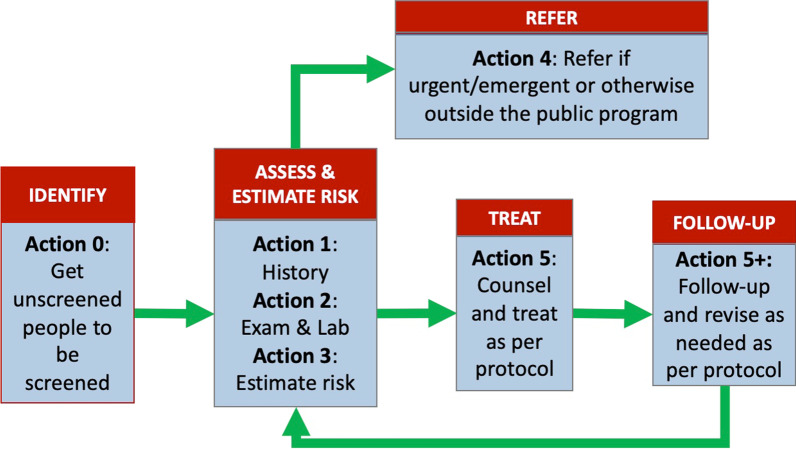
Background: In Cambodia, economic development accompanied by health reforms has led to a rapidly ageing population and an increasing incidence and prevalence of noncommunicable diseases. National strategic plans recognize primary care health centres as the focal points of care for treating and managing chronic conditions, particularly hypertension and type 2 diabetes. However, health centres have limited experience in providing such services. This case study describes the process of developing a toolkit to facilitate the use of evidence-based guidelines to manage hypertension and type 2 diabetes at the health-centre level. Methods: We developed and revised a preliminary toolkit based on the feedback received from key stakeholders. We gathered feedback through an iterative process of group and one-to-one consultations with representatives of the Ministry of Health, provincial health department, health centres and nongovernmental organizations between April 2019 and March 2021. Results: A toolkit was developed and organized according to the core tasks required to treat and manage hypertension and type 2 diabetes patients. The main tools included patient identification and treatment cards, risk screening forms, a treatment flowchart, referral forms, and patient education material on risk factors and lifestyle recommendations on diet, exercise, and smoking cessation. The toolkit supplements existing guidelines by incorporating context-specific features, including drug availability and the types of medication and dosage guidelines recommended by the Ministry of Health. Referral forms can be extended to incorporate engagement with community health workers and patient education material adapted to the local context. All tools were translated into Khmer and can be modified as needed based on available resources and arrangements with other institutions. Conclusions: Our study demonstrates how a toolkit can be developed through iterative engagement with relevant stakeholders individually and in groups to support the implementation of evidence-based guidelines. Such toolkits can help strengthen the function and capacity of the primary care system to provide care for noncommunicable diseases, serving as the first step towards developing a more comprehensive and sustainable health system in the context of population ageing and caring for patients with chronic diseases.
Overview
The claims and statistics of this paper haven’t been checked yet.
Run the check — free, no account needed. It reads the open-access text and checks the sources it cites.
Integrity signals
Registry
Cites
Statistics
Figures
Verification
Claims the paper makes
The claims and statistics of this paper haven’t been checked yet.
Run the check — free, no account needed. It reads the open-access text and checks the sources it cites.
Claims other papers make about this one
Each is checked against this paper’s own text: does it say what the citing paper says it does?
The source backs part of the claim, not all of it — or backs it for a different population, condition or comparison.
In the citing paper
“Structured peer support programmes and context-adapted printed health educational materials function as two core enablers for positive belief restructuring among rural low-resource patients with type 2 diabetes (24, 118).”
From Implementation and translation of evidence-based dietary strategies for type 2 diabetes in resource-limited settings: a scoping review based on the CFIR framework (2026) · cites this paper as [24]
Experimental — accuracy not yet measuredThe source backs part of the claim, not all of it — or backs it for a different population, condition or comparison.
In the citing paper
“Distorted health perceptions and inadequate health awareness constitute core attitudinal and cognitive biases, serving as key individual-level barriers to stable diabetes self-management among low- and middle-income populations and Indigenous ethnic groups (23–25).”
From Implementation and translation of evidence-based dietary strategies for type 2 diabetes in resource-limited settings: a scoping review based on the CFIR framework (2026) · cites this paper as [24]
Experimental — accuracy not yet measuredThe source backs part of the claim, not all of it — or backs it for a different population, condition or comparison.
In the citing paper
“Collectively, knowledge deficits and culturally rooted perceptual biases weaken the efficacy of routine nutritional counselling and hinder patient compliance with standard diabetes self-management guidelines (23–25).”
From Implementation and translation of evidence-based dietary strategies for type 2 diabetes in resource-limited settings: a scoping review based on the CFIR framework (2026) · cites this paper as [24]
Experimental — accuracy not yet measuredThe source backs part of the claim, not all of it — or backs it for a different population, condition or comparison.
In the citing paper
“In Cambodia’s primary care system, the lack of Khmer-language tailored patient educational materials results in prevalent public misunderstanding of evidence-based glycaemic control dietary advice, forming biased perceptions that impede long-term adherence to healthy lifestyle interventions (24).”
From Implementation and translation of evidence-based dietary strategies for type 2 diabetes in resource-limited settings: a scoping review based on the CFIR framework (2026) · cites this paper as [24]
Experimental — accuracy not yet measuredThe source backs part of the claim, not all of it — or backs it for a different population, condition or comparison.
In the citing paper
“When combined with culturally tailored clinical educational toolkits, peer support frameworks work synergistically to resolve health misconceptions, elevate patient health self-efficacy, and accomplish the transition from biased negative perceptions to evidence-based positive health beliefs (24, 118).”
From Implementation and translation of evidence-based dietary strategies for type 2 diabetes in resource-limited settings: a scoping review based on the CFIR framework (2026) · cites this paper as [24]
Experimental — accuracy not yet measured
7 more claims about this paper
Create a free account to see every claim other papers make about this one.
Self-check
Percentages, sums and reported differences re-computed from the paper’s own numbers.
The self-check needs the paper’s full text.
Citations
The citation lists are queued
They are fetched later and appear here then.
References 8 · Cited by 5
Research works printed but not linked: 4
- World Health Organization. Global health estimates 2020: deaths by cause, age, sex, by country and by region, 2000–2019, in health: risk factors. Geneva: World Health Organization; 2020.
- World Health Organization. WHO package of essential noncommunicable (PEN) disease interventions for primary health care. Geneva: World Health Organization; 2020.
- World Health Organization. HEARTS Technical package for cardiovascular disease management in primary health care: implementation guide. Geneva: WHO; 2018.
- World Health Organization. Package of essential noncommunicable (PEN) disease interventions for primary health care in low-resource settings. Geneva: World Health Organization; 2010.
Metadata
- Authors
- Sivapragasam, N., Matchar, D. B., Chhoun, P., Kol, H., Loun, C., Islam, A. M., Ansah, J., & Yi, S.
- Affiliations
- Duke-NUS Medical School (SG)
- Duke University (US)
- Ministry of Health (KH)
- National University of Singapore (SG)
- Corresponding author
- Sivapragasam, Nirmali
- Venue
- Health Research Policy and Systems
- Published
- 2022-11-29
- Volume
- 20
- Issue
- S1
- Pages
- 109-109
- ISSN
- 1478-4505 (ISSN-L)
- PMC
- PMC9706829
- OpenAlex
- W4310588810
- Cited by
- 5
- References
- 8
- Citations by year
- 2026: 2 · 2025: 2 · 2022: 1
- FWCI
- 0.66
- Type
- journal article
- Language
- en
- Open access
- gold
- doi.org
- Licence
- cc-by
- creativecommons.org/licenses/by/4.0 (tdm)
- creativecommons.org/licenses/by/4.0 (vor)
- Locations
- Health Research Policy and Systems (publishedVersion, cc-by)
- PubMed Central (publishedVersion, cc-by)
- PubMed (publishedVersion)
- National University of Singapore (submittedVersion)
- Touro Scholar (Touro College) (submittedVersion)
- DOAJ (DOAJ: Directory of Open Access Journals) (submittedVersion, cc-by-sa)
- Funders
- World Health Organization Centre for Health Development (K18018)
- Topics
- Health Sciences › Medicine › Public Health, Environmental and Occupational Health › Clinical practice guidelines implementation
- Health Sciences › Health Professions › General Health Professions › Health Policy Implementation Science
- Health Sciences › Health Professions › General Health Professions › Health Sciences Research and Education
- Keywords
- antihypertensive therapy, type 2 diabetes management, evidence-based recommendations, implementation toolkit, non-communicable diseases, guideline implementation, patient education materials, referral forms, community health workers, stakeholder engagement, Cambodia
- MeSH terms
- Noncommunicable Diseases, Cambodia, Diabetes Mellitus, Type 2, Health Facilities, Humans, Hypertension
About these checks
Registry, retraction, Cites and statistics results are computed, not judged, with one exception: a printed reference that no index lists is read once by a model before it counts as a citation error. Claims are extracted by a model and kept only when their quote appears verbatim in the text; each cited source is then checked, with a model’s help, for whether it says what the claim relies on. Those verdicts can be wrong — read the claim’s quote and the cited source before relying on one.
Statistics and arithmetic are recomputed, not judged.
Confidence bands are shown only for fields calibrated on our annotated test set. None is calibrated yet, so no band is shown.
What counts as a claim ›How we measure confidence ›How we check this ›
Are you an author, or do you see a problem with this page? Request a review
How to cite
Cite CoChat for the checks on this page, and the paper for its own findings.
- This page
- CoChat. (2026). Citation check: Developing a toolkit for implementing evidence-based guidelines to manage hypertension and diabetes in Cambodia: a descriptive case study. https://app.cochat.ai/papers/10.1186/s12961-022-00912-4
- The paper
- Sivapragasam, N., Matchar, D. B., Chhoun, P., Kol, H., Loun, C., Islam, A. M., Ansah, J., & Yi, S. (2022). Developing a toolkit for implementing evidence-based guidelines to manage hypertension and diabetes in Cambodia: a descriptive case study. Health Research Policy and Systems. https://doi.org/10.1186/s12961-022-00912-4
Data sources
Bibliographic data: Semantic Scholar, OpenAlex, Crossref.
Contains information from the Semantic Scholar Academic Graph Datasets, made available under the ODC Attribution License (ODC-BY 1.0).
Semantic Scholar’s data is described in: Kinney, R., et al. (2023). The Semantic Scholar Open Data Platform. arXiv:2301.10140.
