

Identification of susceptibility loci for cardiovascular disease in adults with hypertension, diabetes, and dyslipidemia
Open accessThe DOI matches its Crossref record; 59 of the 59 references it cites were found in a registry or an index.
Abstract
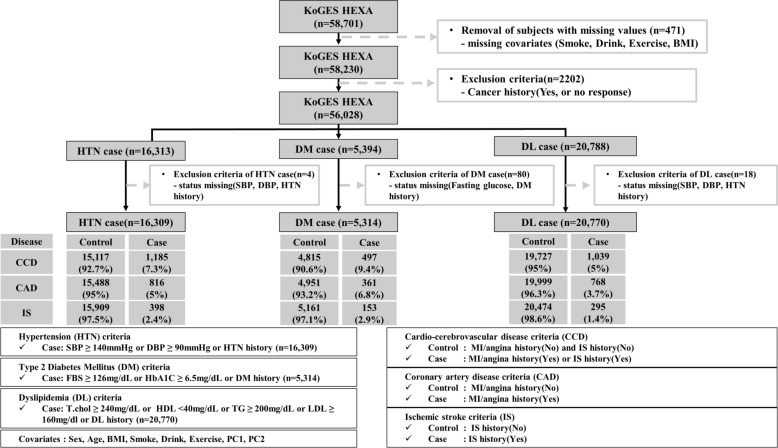
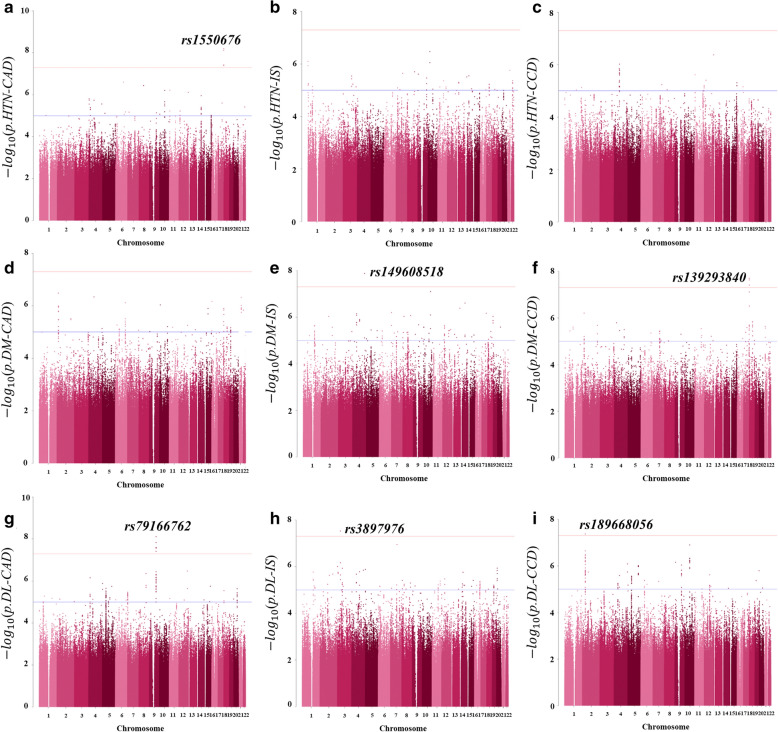
Background: Hypertension (HTN), diabetes mellitus (DM), and dyslipidemia (DL) are well-known risk factors of cardiovascular disease (CVD), but not all patients develop CVDs. Studies have been limited investigating genetic risk of CVDs specific to individuals with metabolic diseases. This study aimed to identify disease-specific and/or common genetic loci associated with CVD susceptibility in chronic metabolic disease patients. Methods: We conducted a genome-wide association study (GWAS) of a multiple case–control design with data from the City Cohort within Health EXAminees subcohort of the Korean Genome and Epidemiology Study (KoGES_HEXA). KoGES_HEXA is a population-based prospective cohort of 173,357 urban Korean adults that had health examinations at medical centers. 42,393 participants (16,309 HTN; 5,314 DM; 20,770 DL) were analyzed, and each metabolic disease group was divided into three CVD case-controls: coronary artery disease (CAD), ischemic stroke (IS), and cardio-cerebrovascular disease (CCD). GWASs were conducted for each case–control group with 7,975,321 imputed single nucleotide polymorphisms using the Phase 3 Asian panel from 1000 Genomes Project, by logistic regression and controlled for confounding variables. Genome-wide significant levels were implemented to identify important susceptibility loci. Results: Totaling 42,393 individuals, this study included 16,309 HTN (mean age [SD], 57.28 [7.45]; 816 CAD, 398 IS, and 1,185 CCD cases), 5,314 DM (57.79 [7.39]; 361 CAD, 153 IS, and 497 CCD cases), and 20,770 DL patients (55.34 [7.63]; 768 CAD, 295 IS, and 1,039 CCD cases). Six genome-wide significant CVD risk loci were identified, with relatively large effect sizes: 1 locus in HTN (HTN-CAD: 17q25.3/ CBX8-CBX4 [OR, 2.607; P = 6.37 × 10 −9 ]), 2 in DM (DM-IS: 4q32.3/ MARCH1-LINC01207 [OR, 5.587; P = 1.34 × 10 −8 ], and DM-CCD: 17q25.3/ RPTOR [OR, 3.511; P = 1.99 × 10 −8 ]), and 3 in DL (DL-CAD: 9q22.2/ UNQ6494-LOC101927847 [OR, 2.282; P = 7.78 × 10 −9 ], DL-IS: 3p22.1/ ULK4 [OR, 2.162; P = 2.97 × 10 −8 ], and DL-CCD: 2p22.2/ CYP1B1-CYP1B1-AS1 [OR, 2.027; P = 4.24 × 10 −8 ]). Conclusions: This study identified 6 susceptibility loci and positional candidate genes for CVDs in HTN, DM, and DL patients using an unprecedented study design. 1 locus (17q25.3) was commonly associated with CAD. These associations warrant validation in additional studies for potential therapeutic applications.
Overview
The claims and statistics of this paper haven’t been checked yet.
Free: it reads the open-access text and checks the first 5 claims that cite a source we can check. Create a free account to check every claim.
Integrity signals
Registry
Cites
Statistics
Figures
Verification
Claims the paper makes
The claims and statistics of this paper haven’t been checked yet.
Free: it reads the open-access text and checks the first 5 claims that cite a source we can check. Create a free account to check every claim.
Claims other papers make about this one
Each is checked against this paper’s own text: does it say what the citing paper says it does?
The source backs part of the claim, not all of it — or backs it for a different population, condition or comparison.
In the citing paper
“Recent genome-wide association studies (GWAS) have highlighted genetic loci, notably CDKN2B-AS1 on chromosome 9p21 and 7q22, as overlapping risk factors for both endometriosis and CVD.”
From Endometriosis and Cardiovascular Disease: Exploring Pathophysiological Interconnections and Risk Mechanisms (2025) · cites this paper as [17]
Experimental — accuracy not yet measuredThe source backs part of the claim, not all of it — or backs it for a different population, condition or comparison.
In the citing paper
“These genetic overlaps suggest a common susceptibility to chronic inflammation, a key feature in both CVD and endometriosis.”
From Endometriosis and Cardiovascular Disease: Exploring Pathophysiological Interconnections and Risk Mechanisms (2025) · cites this paper as [17]
Experimental — accuracy not yet measuredThe check wasn’t confident either way, so it gives no verdict — never disputed.
In the citing paper
“The CDKN2B-AS1 locus is notably associated with conditions like abdominal aortic aneurysm and ischemic stroke, suggesting its crucial role in vascular health by affecting inflammatory and cell-proliferation pathways common to both CVD and endometriosis [17].”
From Endometriosis and Cardiovascular Disease: Exploring Pathophysiological Interconnections and Risk Mechanisms (2025) · cites this paper as [17]
Experimental — accuracy not yet measured
Self-check
Percentages, sums and reported differences re-computed from the paper’s own numbers.
The self-check needs the paper’s full text.
Citations
Cites
Second-generation PLINK: rising to the challenge of larger and richer datasets
Chang, C. C., Chow, C. C., Tellier, L. C., Vattikuti, S., Purcell, S. M., & Lee, J. J. (2015) · Gigascience · doi:10.1186/s13742-015-0047-8 · Cited by 12,709
Self-citationInflammation and Atherosclerosis
Libby, P., Ridker, P. M., & Maseri, A. (2002) · Circulation · doi:10.1161/hc0902.104353 · Cited by 7,724
Ettehad, D., Emdin, C. A., Kiran, A., Anderson, S. G., Callender, T., Emberson, J., Chalmers, J., Rodgers, A., & Rahimi, K. (2016) · The Lancet · doi:10.1016/s0140-6736(15)01225-8 · Cited by 3,755
LocusZoom: regional visualization of genome-wide association scan results
Pruim, R. J., Welch, R. P., Sanna, S., Teslovich, T. M., Chines, P. S., Gliedt, T. P., Boehnke, M., Abecasis, G. R., & Willer, C. J. (2010) · Bioinformatics · doi:10.1093/bioinformatics/btq419 · Cited by 2,707
Einarson, T. R., Acs, A., Ludwig, C., & Panton, U. H. (2018) · Cardiovascular Diabetology · doi:10.1186/s12933-018-0728-6 · Cited by 2,312
Borén, J., Chapman, M. J., Krauss, R. M., Packard, C. J., Bentzon, J. F., Binder, C. J., Daemen, M. J., Demer, L. L., Hegele, R. A., Nicholls, S. J., et al. (2020) · European Heart Journal · doi:10.1093/eurheartj/ehz962 · Cited by 1,601
Cohort Profile: The Korean Genome and Epidemiology Study (KoGES) Consortium
Kim, Y., Han, B.-G., & the KoGES group (2017) · International Journal of Epidemiology · doi:10.1093/ije/dyv316 · Cited by 1,017
Lloyd-Jones, D. M., Nam, B.-H., D'Agostino, Sr., Levy, D., Murabito, J. M., Wang, T. J., Wilson, P. W. F., & O'Donnell, C. J. (2004) · JAMA · doi:10.1001/jama.291.18.2204 · Cited by 807
New Insights Into the Role of mTOR Signaling in the Cardiovascular System
Sciarretta, S., Forte, M., Frati, G., & Sadoshima, J. (2018) · Circulation Research · doi:10.1161/circresaha.117.311147 · Cited by 491
Thrainsdottir, I. S., Aspelund, T., Thorgeirsson, G., Gudnason, V., Hardarson, T., Malmberg, K., Sigurdsson, G., & Rydén, L. (2005) · Diabetes Care · doi:10.2337/diacare.28.3.612 · Cited by 374
Cited by
Li, Z., Gao, Z., Sun, T., Zhang, S., Yang, S., Zheng, M., & Shen, H. (2023) · Frontiers in Immunology · doi:10.3389/fimmu.2023.1098570 · Cited by 93
“3 was a susceptibility locus of cardiovascular disease (5), psoriasis (6), and atopic dermatitis (7), where its fragment deletion could result in cardiovascular deficiencies or cardiac phenotype changes.”
BackgroundMagnetic Particle Imaging: From Tracer Design to Biomedical Applications in Vasculature Abnormality
Xie, X., Zhai, J., Zhou, X., Guo, Z., Lo, P., Zhu, G., Chan, K. W. Y., & Yang, M. (2023) · Advanced Materials · doi:10.1002/adma.202306450 · Cited by 63
Hanscombe, K. B., Persyn, E., Traylor, M., Glanville, K. P., Hamer, M., Coleman, J. R. I., & Lewis, C. M. (2021) · Genome Medicine · doi:10.1186/s13073-021-00994-9 · Cited by 58
“2 (L3MBTL2) with a high probability of the same variant driving PA association and expression in the adipose, brain, heart, lung and muscle; have previously been associated with disease (Parkinson’s disease [70], hypertrophic cardio myopathy [71], ischaemic stroke, diabetes mellitus and coronary artery disease [72]) a…”
BackgroundAghagolzadeh, P., Plaisance, I., Bernasconi, R., Treibel, T. A., Pulido-Quetglas, C., Wyss, T., Wigger, L., Nemir, M., Sarre, A., Chouvardas, P., et al. (2023) · Circulation · doi:10.1161/circulationaha.122.062601 · Cited by 46
Surakka, I. L., Wu, K.-H., Hornsby, W., Wolford, B. N., Shen, F. Y., Zhou, W., Huffman, J. E., Pandit, A., Hu, Y., Brumpton, B. M., et al. (2023) · Cell Genomics · doi:10.1016/j.xgen.2023.100345 · Cited by 39
Selegiline ameliorated dyslipidemia and hepatic steatosis in high-fat diet mice
Tian, Z., Wang, X., Han, T., & Sun, C. (2023) · International Immunopharmacology · doi:10.1016/j.intimp.2023.109901 · Cited by 21
Lu, Y., Li, G., Viallon, V., Ferrari, P., Freisling, H., Qiao, Y., Shao, L., Wu, L., Ding, Y., & Ke, C. (2024) · American Journal of Epidemiology · doi:10.1093/aje/kwae167 · Cited by 19
Dyslipidaemia—Genotype Interactions with Nutrient Intake and Cerebro-Cardiovascular Disease
Lee, S., Choi, J., Park, B., Cha, M.-Y., Hong, K., & Jung, D. (2022) · Biomedicines · doi:10.3390/biomedicines10071615 · Cited by 15
“The detailed cohort information is described in our previous report [18].”
BackgroundSelf-citationGrilo, L. F., Zimmerman, K. D., Puppala, S., Chan, J., Huber, H. F., Li, G., Jadhav, A. Y. L., Wang, B., Li, C., Clarke, G. D., et al. (2024) · Advanced Science · doi:10.1002/advs.202309211 · Cited by 14
Long, P., Si, J., Zhu, Z., Jiang, Y., Wang, Y., Jiang, Q., Li, W., Xu, X., You, Y., Qu, M., et al. (2024) · Nature Communications · doi:10.1038/s41467-024-51751-6 · Cited by 16
“Among the 26 validated loci, EHBP1L1 (cg16749093), PRKCZ (cg00660626), and PRDM16 (cg24395386) have been reported to associate with cardiovascular disease by previous GWAS 20,21,23,24 .”
BackgroundSzpila, G., Szczotka, J., Suchodolski, A., & Szulik, M. (2025) · Diagnostics · doi:10.3390/diagnostics15121458 · Cited by 7
“The genetic markers are thought to influence shared mechanisms like immune response, cellular adhesion, and angiogenesis, pathways that can exacerbate both cardiovascular conditions and endometriotic tissue proliferation [17,18].”
RNA Therapies in Cardio-Kidney-Metabolic Syndrome: Advancing Disease Management
Mohammadi, A., Karimian, A., Shokri, K., Mohammadi, A., Karzar, N. H., Bahar, R., Radfar, A., Pakyari, M., & Tehrani, B. N. (2025) · Journal of Cardiovascular Translational Research · doi:10.1007/s12265-025-10603-4 · Cited by 8
“For instance, the identification of specific genetic variants associated with dyslipidemia, hypertension, or insulin resistance could enable the design of patient-specific ASOs or siRNAs [143].”
The Role of Somatic Mutations in Ischemic Stroke: CHIP’s Impact on Vascular Health
Kinzhebay, A., & Salybekov, A. A. (2025) · Neurology International · doi:10.3390/neurolint17020019 · Cited by 8
Hanscombe, K. B., Persyn, E., Traylor, M., Glanville, K. P., Hamer, M., Coleman, J. R. I., & Lewis, C. M. (2020) · medRxiv · doi:10.1101/2020.12.08.20243337 · Cited by 6
Transcriptional profiles associated with coronary artery disease in type 2 diabetes mellitus
Nevado, J. B., la Paz, E. M. C. C., Paz-Pacheco, E. T., Jasul, G., Aman, A. Y. C. L., Deguit, C. D. T., Pedro, J. V. B. S., & Francisco, M. D. G. (2024) · Frontiers in Endocrinology · doi:10.3389/fendo.2024.1323168 · Cited by 8
Gupta, M. K., Gouda, G., & Vadde, R. (2024) · Functional & Integrative Genomics · doi:10.1007/s10142-024-01451-7 · Cited by 4
“…(Rhee et al. 2013), fasting insulin (Chen et al. 2021), male-pattern baldness (Yap et al. 2018), vertigo (Skuladottir et al. 2021), ischemic stroke in diabetes mellitus (Song et al. 2021), prostate cancer (Conti et al. 2021), lung cancer (Sakaue et al. 2021), and COVID-19 (Kousathanas et al. 2022).”
Potential Regulatory Role of lncRNA-miRNA-mRNA in Coronary Artery Disease (CAD)
Zhu, L., Zhao, S., & Wang, Z. (2021) · International Heart Journal · doi:10.1536/ihj.21-156 · Cited by 5
Genetic modifiers of synucleinopathies—lessons from experimental models
Lee, R. M. Q., & Koh, T. (2023) · Oxford Open Neuroscience · doi:10.1093/oons/kvad001 · Cited by 6
“Common variants close to genome-wide significance in association with coronary artery disease in diabetes [327]; rare variants associated with congenital heart disease [ 328] Regulates insulin signaling in flies [128] No data”
BackgroundDeng, X., Yang, Z., Yu, Q., Wu, X., Sun, Z., Yang, L., & Yuan, G. (2026) · Therapeutic Advances in Endocrinology and Metabolism · doi:10.1177/20420188261419199 · Cited by 3
Chitcharoen, S., Phokaew, C., Mauleekoonphairoj, J., Khongphatthanayothin, A., Sutjaporn, B., Wandee, P., Poovorawan, Y., Nademanee, K., & Payungporn, S. (2022) · Genomics & Informatics · doi:10.5808/gi.22047 · Cited by 3
“Most of the HERV-K breakpoints in the gene region were the NBPF genes, which were implicated in several developmental and neurogenetic diseases and congenital heart disease [17,68].”
BackgroundZhang, F., Fu, C., Deng, Y., Zhang, M., Peng, H., Li, W., Zhong, J., Zhou, Q., Huang, L., Xiao, S., et al. (2023) · Cerebrovascular Diseases · doi:10.1159/000526918 · Cited by 3
Mendelian randomization studies on ischemic stroke: a field synopsis and systematic review
Yang, J., Han, C., Zhang, Y., Tan, S., Wu, Q., Ma, Y., Duan, Y., Wang, Y., Wang, J., Liu, B., et al. (2025) · Journal of Translational Medicine · doi:10.1186/s12967-025-06992-4 · Cited by 4
“Moreover, a recent GWAS involving 42,393 Korean participants identified shared genetic susceptibility loci between diabetes and dyslipidemia and IS, suggesting a common genetic architecture underlying these diseases [243].”
Li, Z., Li, M., & Li, Y. (2026) · Cytokine · doi:10.1016/j.cyto.2026.157125 · Cited by 3
A cross-organ single-cell analysis of hypertension
Qiu, Q., Liu, Y., Xue, H., Pandey, R., Liu, J., He, L., Liu, P., Therani, B., Kumar, V. D., Huang, J., et al. (2026) · Science · doi:10.1126/science.aea6187 · Cited by 4
Semler, E. M., Michell, D. L., Kingsley, P. J., Ramirez, M. A., Massick, C., Castleberry, M., Doran, A. C., Carr, J. J., Marnett, L. J., Sheng, Q., et al. (2025) · Atherosclerosis · doi:10.1016/j.atherosclerosis.2025.120584 · Cited by 4
Jung, M., Ahn, Y., Chang, S. J., Kim, C.-B., Jeong, K. S., Koh, S. B., & Gim, J. (2022) · Genes · doi:10.3390/genes13020172 · Cited by 2
“i estigated the genetic and epigenetic risk factors of CVDs [27].”
BackgroundKanhar, S., & Sahoo, A. K. (2021) · Biocatalysis and Agricultural Biotechnology · doi:10.1016/j.bcab.2021.102173 · Cited by 1
Yan, Y., Dong, M., Tian, L., Zhu, C., & Zhao, X. (2025) · Medical Gas Research · doi:10.4103/mgr.medgasres-d-24-00117 · Cited by 1
“6,21 However, the precise function of the gene OXLD1, which is located in the terminal region of 17q25.”
Machine learning and SHAP values for predicting coronary artery disease risk in Xinjiang, China
Maimaitituersun, G., Abulimiti, F., Shao, Q., Zhou, Y., Jureti, S., Fan, L., Liu, R., Wei, M., Liu, Z., & Zhenyan, F. (2026) · European journal of medical research · doi:10.1186/s40001-025-03763-1 · Cited by 1
“With over 1.25 million Kazakh residents in Xinjiang, previous research has demon - strated that this population has the highest hypertension prevalence among all Chinese ethnic minorities [29].”
InfluentialZhang, H., Feng, J., Shi, W., Niu, G., Zheng, Y., Zhao, Z., Wang, M., Zhou, Z., Li, Z., & Wu, Y. (2026) · Cardiovascular Therapeutics · doi:10.1155/cdr/4594769 · Cited by 1
Identification of Novel Genetic Risk Variants Associated With Early-Onset Ischemic Stroke in Taiwan
Wang, Y.-C., Liu, K.-M., Gan, Y., Chi, N., Lu, L.-S., Chou, C.-Y., Wang, L.-Y., Chang, L.-H., Hou, M., Fu, Y., et al. (2026) · Neurology · doi:10.1212/wnl.0000000000218126 · Cited by 1
Lee, H., Lee, D., & Jun, S. (2025) · Biological Research For Nursing · doi:10.1177/10998004251361807 · Cited by 1
“For example, SNPs such as rs762551 and rs6785930 have been associated with CVD in Central Asian populations (Taizhanova et al., 2023), while Korean studies have implicated variants in MMP2-AS1 , CBX8 – CBX4 , and MARCH1 – LINC01207 among individuals with chronic diseases (Song et al., 2021).”
Nemes-Nagy, E., Fogarasi, E., Croitoru, M., Preg, Z., Pál, S., Nyulas, K., Pál, T., Tripon, R., Tilinca, M., & German-sallo, M. (2022) · Romanian Journal of Laboratory Medicine · doi:10.2478/rrlm-2022-0025 · Cited by 1
Memon, F. R., Kazi, N., Memon, A. R., Laghari, M. J., Memon5, R. A., & Memon, J. U. Q. (2021) · JMMC · doi:10.62118/jmmc.v11i2.164
Genetic and epigenetic factors affecting carotid intima-media thickness in monozygotic twins
Mori, S., Arakawa, Y., Hasegawa, M., Kato, S., Hashimoto, H., Yoshioka, S., Ueda, H., & Watanabe, M. (2024) · Gene · doi:10.1016/j.gene.2024.149093
Rashid, S. A., Prasad, M., Madar, I. H., Dhanabalan, K., Balasubramanian, R., & Maideen, N. M. P. (2025) · Current Drug Research Reviews · doi:10.2174/0125899775382225250811111859 · Cited by 1
Goswami, C., Juang, J. J., Lu, T., Yang, J., Chattopadhyay, A. S., & Chuang, E. Y.-Y. (2025) · Bioinformatics and Biology Insights · doi:10.1177/11779322251385926
“53 The significant case-enriched duplication region (chr11:534197-535098), mapped to the HRAS gene ( P = 5.05e-07), has not been reported in previous studies on BrS.”
Hanscombe, K. B., Persyn, E., Traylor, M., Glanville, K. P., Hamer, M., Coleman, J. R. I., & Lewis, C. M. (2021) · Figshare · doi:10.6084/m9.figshare.16969232
Bonab, L. N. H., Moazzam‐Jazi, M., Khalili, D., Mahdavi, M., Khalili, M., & DANESHPOUR, M. S. (2026) · BMC Cardiovascular Disorders · doi:10.1186/s12872-026-06049-4
“…genetic variation may influence disease risk through multiple biological pathways, many of which are reflected in established metabolic and cardiovascular risk factors such as blood pressure [46], dyslipidemia, and cholesterol [47, 48], consistent with findings from several prior studies [49].”
Goncharova, I. A., Зарубин, А. А., Markov, A., Shipulina, S. А., Бабушкина, Н. П., Koroleva, I. A., Sleptcov, A. A., & Nazarenko, M. S. (2026) · Vavilov Journal of Genetics and Breeding · doi:10.18699/vjgb-26-94
Validation of targets linked to weight gain in C57BL/6 mice and translational aspects in humans
Wu, Y.-G., Rudolf, A. M., Wang, L., Zhang, Z.-J., Niu, C.-Q., Xia, F., Li, M., Wang, A., Mitchell, S., Zhang, H.-R., et al. (2026) · Proceedings of the National Academy of Sciences of the United States of America · doi:10.1073/pnas.2613776123
Metadata
- Authors
- Song, Y., Choi, J.-E., Kwon, Y.-J., Chang, H.-J., Kim, J. O., Park, D.-H., Park, J.-M., Kim, S.-J., Lee, J. W., & Hong, K.-W.
- Affiliations
- Yonsei University (KR)
- Theragen (KR)
- Corresponding author
- Lee, Ji Won
- Hong, Kyung-Won
- ORCID
- Venue
- Journal of Translational Medicine
- Published
- 2021-02-25
- Volume
- 19
- Issue
- 1
- Pages
- 85-85
- ISSN
- 1479-5876 (ISSN-L)
- PMC
- PMC7905883
- OpenAlex
- W3133250665
- Cited by
- 41
- References
- 59
- Citations by year
- 2026: 9 · 2025: 9 · 2024: 6 · 2023: 7 · 2022: 4 · 2021: 5
- FWCI
- 3.11
- Type
- journal article
- Language
- en
- Open access
- gold
- doi.org
- Licence
- cc-by
- creativecommons.org/licenses/by/4.0/ (tdm)
- creativecommons.org/licenses/by/4.0/ (vor)
- Locations
- Journal of Translational Medicine (publishedVersion, cc-by)
- PubMed Central (publishedVersion, cc-by)
- PubMed (publishedVersion)
- DOAJ (DOAJ: Directory of Open Access Journals) (submittedVersion, cc-by-sa)
- YUHSpace (Yonsei University Medical Library) (submittedVersion, cc-by-nc-nd)
- Funders
- Ministry of Science, ICT and Future Planning (NRF2018R1D1A1B07049223)
- Ministry of Trade, Industry and Energy (20002781)
- Topics
- Life Sciences › Biochemistry, Genetics and Molecular Biology › Genetics › Genetic Associations and Epidemiology
- Health Sciences › Medicine › Cardiology and Cardiovascular Medicine › Cardiovascular Health and Risk Factors
- Health Sciences › Medicine › Endocrinology, Diabetes and Metabolism › Diabetes, Cardiovascular Risks, and Lipoproteins
- Keywords
- cardiovascular disease susceptibility, hypertension, diabetes mellitus, dyslipidemia, coronary artery disease, ischemic stroke, cardio-cerebrovascular disease, genetic susceptibility loci, CCL23, CCL22
- MeSH terms
- Adult, Cardiovascular Diseases, Coronary Artery Disease, Diabetes Mellitus, Humans, Hypertension, Ligases, Prospective Studies, Risk Factors, Protein Serine-Threonine Kinases, Dyslipidemias, Genome-Wide Association Study, Polycomb-Group Proteins, Polycomb Repressive Complex 1
About these checks
Registry, retraction, Cites and statistics results are computed, not judged, with one exception: a printed reference that no index lists is read once by a model before it counts as a citation error. Claims are extracted by a model and kept only when their quote appears verbatim in the text; each cited source is then checked, with a model’s help, for whether it says what the claim relies on. Those verdicts can be wrong — read the claim’s quote and the cited source before relying on one.
Statistics and arithmetic are recomputed, not judged.
Confidence bands are shown only for fields calibrated on our annotated test set. None is calibrated yet, so no band is shown.
What counts as a claim ›How we measure confidence ›How we check this ›
Are you an author, or do you see a problem with this page? Request a review
Data sources
Bibliographic data: Semantic Scholar, OpenAlex, Crossref.
Contains information from the Semantic Scholar Academic Graph Datasets, made available under the ODC Attribution License (ODC-BY 1.0).
Semantic Scholar’s data is described in: Kinney, R., et al. (2023). The Semantic Scholar Open Data Platform. arXiv:2301.10140.
