

Life expectations in early adolescence and the timing of first sex and marriage: evidence from a longitudinal survey in Ethiopia
Open accessThe DOI matches its Crossref record; 52 of the 53 references it cites were found in a registry or an index; 8 of the 59 sources its claims cite were checked for support.
Abstract
Raising the median age at first sexual intercourse and first marriage among females is a policy goal of the Ethiopian government. ... Discrete-time logistic hazard regression models were applied ... Male and female adolescents who had high career expectations at young ages were at a significantly lower risk of first sex during adolescence and early adulthood ... Among female adolescents, delaying first sex, schooling, and high career expectations are associated with a lower risk of first marriage.
Overview
CoChat Summary
## TL;DR
This longitudinal study from southwestern Ethiopia found that high educational and occupational expectations formed in early adolescence were linked to delayed first sex for both boys and girls, and to delayed marriage for girls. Schooling was also protective, but its effect on delaying first sex weakened with age, whereas the effect of high career expectations persisted.
## Key findings
- Among male youth, high career expectations were associated with a significantly lower hazard of first sex; being in school also lowered the hazard, but the protective effect of school wore off with age.
- Among female youth, the effect of high career expectations on first sex was more than twice as large as for males; the paper reports that girls with career expectations 1 standard deviation above the mean had a hazard of first sex that was 30% lower than girls with average expectations, compared with 13% lower for boys.
- For female marriage, having had first sex in a prior year increased the hazard of marriage by a factor of close to 16 (e2.764), and being in school was associated with a significantly lower hazard of marriage at all ages.
- Female youth who believed their parents wanted them to marry at older ages were at a lower risk of early marriage; in the sample, the correlation between perceived parents’ career expectations and youth’s own career expectations was 0.71 for males and 0.68 for females.
## Methods
- Longitudinal analysis using multiple waves of the Jimma Longitudinal Family Survey of Youth (JLFSY) in southwestern Ethiopia; baseline household survey in 2005–2006, adolescent waves in 2006–2007 and 2009–2010.
- Sample for the analysis included 870 males and 651 females who completed at least the first and third wave surveys; youth were 13–17 at baseline and 17–21 at wave 3.
- Main analysis used discrete-time logistic hazard regression on a person-year file to model time to first sex for males and females separately, and first marriage for females; models used sample weights and robust standard errors adjusted for community clustering.
## Limitations
- The paper states that sample attrition is a shortcoming of the JLFSY data; it notes that attrition may bias estimates because lost-to-follow-up youth differed on some baseline characteristics.
- The authors note that decisions about timing of first sex and first marriage are not always entirely under adolescents’ control; they cite evidence from a nearby survey that approximately 8% of young people ages 13–24 who had ever had sex were raped at first sex. (stated in the paper)
- Evidence on first marriage among males is not analyzed because of low prevalence of first marriage among adolescent males in the study area.
Model-written summary. Check it against the paper before relying on it.
Integrity signals
Registry
Cites
Statistics
Figures
Verification
Claims the paper makes
6 Valid · 1 Not valid · 27 Not checked · 63 Own results and interpretations
The cited sources support only part of this claim — read each source’s verdict below.
In the paper
“Prior studies provide strong evidence of a close connection between the initiation of sexual activity and entry into marriage in Ethiopia [6, 30, 31], especially for females.”
§ Life expectations in early adolescence and the timing of first sex and marriage: evidence from a longitudinal survey in Ethiopia > Methods > Measures
What the sources say
- Not matchedcites [6] Lindstrom DP Kiros GE Hogan DP Transition into first intercourse, marriage, and childbearing among Ethiopian women Genus 2009 LXV 2 45 77 PMC4060638 24948839
Its entry has no title and year that we can search by.
- Supportedcites [30] Erulkar A, Mekbid T, Simie N, Gulema T. The experiences of adolescence in rural Amhara region, Ethiopia. Accra: Population Council; 2004. source
Section X (Sexual Activity & Marriage, p. 10) states that adolescent sexual activity occurred within the context of marriage, that 99% of sexually active adolescent girls were married and nearly all had first sex with their husband or fiancé, and that 'within this rural population, marriage largely drove the timing of first sex' — a result the authors note is 'consistent with other studies of Ethiopian youth.' The Executive Summary repeats that for 99% of girls and 86% of boys first sex occurred within marriage, and that the timing of marriage drives the timing of sexual initiation, with the girl-focused data (median/early marriage ages, 39% married by 15) supporting the 'especially for females' qualifier. The claim's 'close connection' is if anything weaker than the source's own framing, so nothing attributed here is unsupported. (LLM, conf=0.90)
- Supportedcites [31] Gurmu E Etana D Age at first marriage and first birth interval in Ethiopia: analysis of the roles of social and demographic factors Afr Popul Stud 2014 28 3 1332 1344 10.11564/0-0-625 source
The 'Age at first marriage, intercourse, and birth' section (p. 4) states that median age at first marriage 'exactly coincided with age at first sexual intercourse in all regions' and that 'sexual debut before marriage was negligible in Ethiopia', which is precisely the close connection between sexual initiation and marital entry the claim attributes to this study. The evidence is female-specific by design: the Data and methods section (p. 3) shows the analysis used 10,240 ever-married women aged 15-49 from the 2005 EDHS, matching the 'especially for females' qualifier. Premarital conception/birth being rare (p. 3) further reinforces the linkage. (LLM, conf=0.88)
boostedstates an association- Asserted: passes — The authors put it forward as true.
- Checkable: passes — It can be checked against evidence.
- Load-bearing: unclear — It is unclear whether the paper’s conclusions depend on it.
- Based: passes — The paper gives a reason why it holds.
- Not matched
A result the paper states — it cites no source for it, so there is none to check. The quote shows it is in the paper.
In the paper
“Adolescents’ perceptions of parents’ expectations for them are strongly associated with their own expectations and behavior.”
§ Life expectations in early adolescence and the timing of first sex and marriage: evidence from a longitudinal survey in Ethiopia > Abstract > Conclusions
boostedstates an association- Asserted: passes — The authors put it forward as true.
- Checkable: passes — It can be checked against evidence.
- Load-bearing: passes — The paper’s conclusions depend on it.
- Based: passes — The paper gives a reason why it holds.
A result the paper reports from its own data — it cites no other source for it, so there is none to check. The quote shows it is in the paper.
In the paper
“Male and female adolescents who had high career expectations at young ages were at a significantly lower risk of first sex during adolescence and early adulthood.”
§ Life expectations in early adolescence and the timing of first sex and marriage: evidence from a longitudinal survey in Ethiopia > Abstract > Results
plainstates an association- Asserted: passes — The authors put it forward as true.
- Checkable: passes — It can be checked against evidence.
- Load-bearing: passes — The paper’s conclusions depend on it.
- Based: passes — The paper gives a reason why it holds.
A result the paper reports from its own data — it cites no other source for it, so there is none to check. The quote shows it is in the paper.
In the paper
“We provide evidence that youth who had higher career expectations at young ages tended to delay first sex and marriage, even after taking into account the protective effects of being in school.”
§ Life expectations in early adolescence and the timing of first sex and marriage: evidence from a longitudinal survey in Ethiopia > Background Ethiopia is a young nation with close to 40% of the estimated population of 115 million between the ages of 10 and 24 [1]. Although women’s age at marriage has risen among recent cohorts, it remains relatively low. Among women ages 25–49, the median age at first marriage is 17.1 years and the median age at first heterosexual intercourse, or first sex, is 16.6 years [2]. The recent National Adolescent and Youth Health Strategy 2016–2020 of the Ethiopian government identifies raising the median age at first sex and first marriage among females to 18 years or above as one of its outcome targets [3]. Education—including primary and secondary schools; higher education; and out-of-school interventions such as youth centers, peer clubs, and youth associations—figures prominently in the government’s plans for achieving its goals. The emphasis on early-life interventions is in line with the government’s identification of the life-course approach as one of the guiding principles in its strategic framework [3]. The life-course approach emphasizes the important influence of early events, experiences, and contexts on choices, behaviors, and life chances at older ages. Most studies on age at first sex and first marriage use retrospective data from cross-sectional surveys that make it difficult to establish a causal relationship between early life experiences, expectations, and later behaviors. In this study, we use longitudinal survey data collected from a cohort of youth in southwestern Ethiopia to assess the influence of life expectations, experiences, and family context measured in early adolescence on the risk of first sex and first marriage during the adolescent and early adult years. We provide evidence that youth who had higher career expectations at young ages tended to delay first sex and marriage, even after taking into account the protective effects of being in school. School is a highly influential institutional setting that shapes the life course of youth. A positive relationship between years of schooling and age at first sex and first marriage is well documented in the demographic literature [4–8]. Part of the effect of education on delaying sexual initiation and marriage results from being a student. The role incompatibility hypothesis argues that the sequencing of age-appropriate roles in the early life course is strongly regulated by social norms and institutional rules and regulations [9]. In most societies, schooling, especially at the primary and secondary levels, is viewed as preparing children and youth for adult roles and responsibilities. Being a student is often considered incompatible with being married and taking on marital and parental roles. Indeed, in many African countries, girls who become pregnant are required to leave school [10]. Keeping adolescents in school longer, however, is not always equally effective in delaying sexual initiation for male and female youth, especially at older adolescent ages. Meekers and Ahmed [11] for example, found in a study of urban youth in Botswana that being in school reduced the risk of being sexually active among female adolescents ages 13–18 but had no effect on males. Schooling exposes youth, and especially girls, to an expanded range of life opportunities and choices as alternatives to early marriage and traditional gender roles [12]. Pursuing professional occupations and jobs in the modern sector of the economy requires higher levels of education and hence that youth remain in school at ages when marriage traditionally occurs. The opportunity cost perspective focuses on the incompatibility between meeting the time demands of attaining higher levels of schooling and early work experience and the demands of marriage and parenthood [13]. Implicit in the approach is the importance of aspirations as a motivation for staying in school. Youth with high educational and occupational aspirations recognize that early marriage reduces the chances of school progression and ultimately the attainment of higher status occupations. Research on adolescents in the United States has explored the impact of early career and family plans on age at marriage. Vesely et al. [14] found that youth with higher future aspirations were less likely to have had first sex, and Lauritsen [15] found that high educational aspirations were associated with lower levels of sexual activity among White youth but not among Black youth. Hockaday et al. [16] found that adolescent girls with high educational expectations and life aspirations were at a lower risk of pregnancy. Vernon et al. [17] found that adolescent girls with lower expectations about future jobs were at a higher risk of early pregnancy. Other studies found that high educational expectations among female youth were associated with postponement of childbearing [16, 18], as were higher educational and occupational aspirations [19]. Research on the influence of early educational and occupational aspirations and expectations on the initiation of sexual activity and entry into marriage provides compelling evidence that youth who develop high aspirations and future life plans tend to transition into sexual activity and marriage at older ages. However, this research is based primarily on the U.S. experience. Very little is known about the influence of early career aspirations and expectations on age at first sex and marriage in the African context, where the expansion of educational opportunities beyond the primary level is relatively new and occupational opportunities in the modern sector are more limited. In addition to the constraints on educational and job opportunities that boys face, many girls face low expectations at home and gender discrimination at school and in the labor market, all of which raise doubts about the influence of early expectations on outcomes at older ages.
plainstates an association- Asserted: passes — The authors put it forward as true.
- Checkable: passes — It can be checked against evidence.
- Load-bearing: passes — The paper’s conclusions depend on it.
- Based: passes — The paper gives a reason why it holds.
A result the paper reports from its own data — it cites no other source for it, so there is none to check. The quote shows it is in the paper.
In the paper
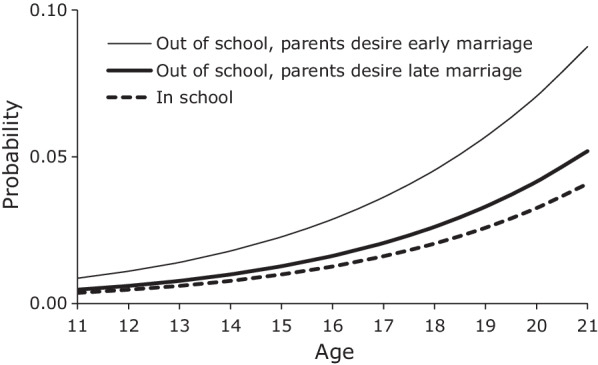
“Having parents who desired an older age at marriage (1 standard deviation above the mean) lowered the probability of marriage among out-of-school females close to the probability of marriage for in school youth.”
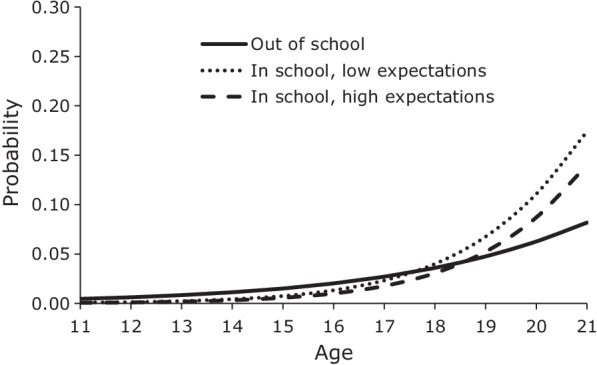
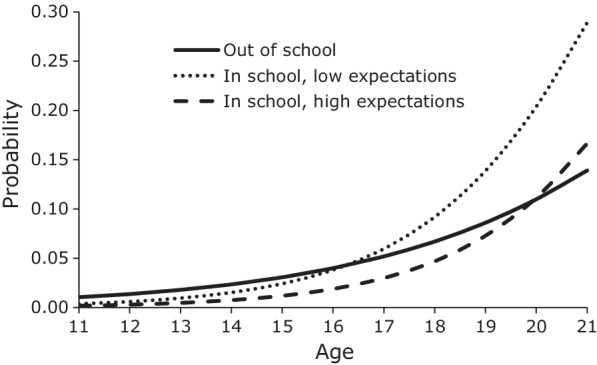
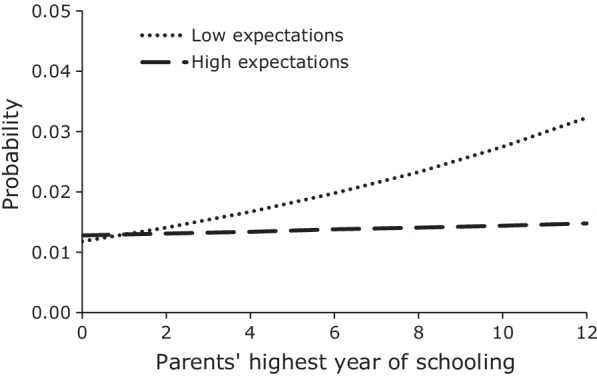
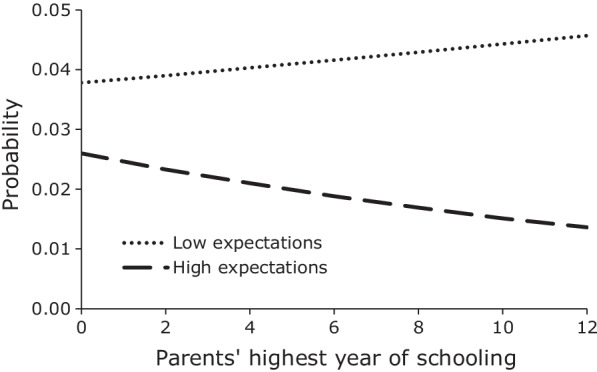
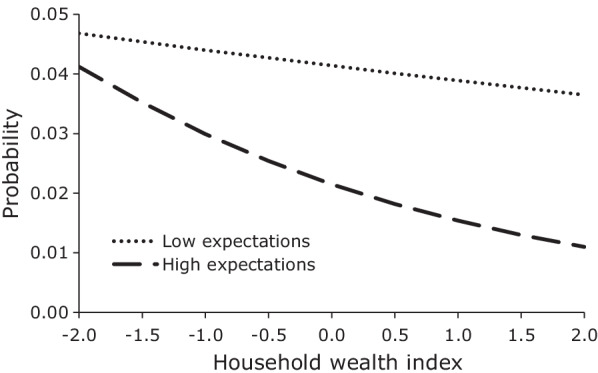
§ Life expectations in early adolescence and the timing of first sex and marriage: evidence from a longitudinal survey in Ethiopia > Results We turn now to the results from the discrete-time logistic hazard regression models predicting first sexual intercourse and first marriage. In the first sex models and the first marriage model, we tested for interactions between age (time-varying) and in school status. The interactions tested whether the predicted negative effect of being in school on the hazard of first sex and first marriage wore off with age. We found significant age and in school interactions in the first sex models but not in the first marriage model. We report in Table 5 the results from the male and female first sex models with the interaction term and the results for the first marriage model without the interaction term. Among male youth, high career expectations were associated with a significantly lower hazard of first sex. Being in school also significantly lowered the hazard, but the significant positive effects of age and the age–in school interaction indicate that the protective effect of in school status wore off as youth got older. Parents’ highest year of schooling, female headed household, and living in an urban area were all associated with a significantly higher hazard of first sex. Parents with higher levels of education may have been more permissive than other parents with their sons and provided them with greater freedoms. We suspect male youth in female headed households tended to have less parental supervision than youth in two-parent households. Youth in urban areas also have more opportunities than youth in rural communities to avoid the supervision of parents, all of which place them at a higher risk of first sex. The basic pattern of results for female youth was very similar to that of male youth. Higher career expectations and being in school at younger ages were associated with a lower hazard of first sex, and living in an urban area was associated with a higher risk. In comparison to males, the magnitude of the effect of career expectations for females was more than twice as large. In contrast to males, parents’ education and living in a female headed household had no effect on the hazard of first sex for females. This last result is consistent with the greater supervision and more restricted freedom of movement that unmarried girls experience in Ethiopia [6]. In summary, consistent with our predictions career expectations formed at younger ages influenced the timing of first sex at older ages. Not only did being in school at younger ages lower the hazard of early sexual initiation, higher educational and occupational expectations lowered the hazard as well. In addition to testing for an interaction between age and in school status, we also tested for an interaction between career expectations and age to test whether the delaying effect of high career expectations on age at first sex also wore off with time. We found no evidence of interaction effects in the male and female models. Unlike the effect of being a student, which changed from placing youth at a lower hazard of first sex to eventually a higher hazard of first sex, high career expectations were consistently protective of early sexual initiation throughout the adolescent years. We graphed the predicted probabilities from the discrete-time logistic hazard regression models to show the relative impact of in-school status and adolescents’ career expectations on the risk of fist sex. Figure 1 presents the mean age-specific probabilities of first sex for males if they are out of school and if they are in school with low career expectations or high career expectations. Low expectations have a value of − 1 (1 standard deviation below the mean) and high expectations have a value of 1 (1 standard deviation above the mean). All other covariates are as observed. The graph shows that up to around ages 17–18 males who were in school had a lower probability of first sex than males who were out of school. However, after ages 17–18, the probability of first sex for males who were still in school rapidly surpassed that of out-of-school males. Having high career expectations prolonged the protective effects of student status for males, but only modestly. In the case of females, the delaying effect of high career expectations was much larger than for males, and it extended by more than one year the age at which the probability of first sex for females in school was below that of out-of-school females (Fig. 2). Our results provide clear evidence that high career expectations are associated with delayed first sex for adolescents in Ethiopia. These results are consistent with a large body of research from other countries that connects aspirations in early adolescence to a wide range of later life outcomes, including educational [29] and occupational attainment [27, 46], as well as the initiation of sexual experience [14]. Theory and evidence, however, also suggest that family background has potentially significant moderating effects on the influence of early life aspirations and expectations on subsequent behavior [47, 48]. Youth expectations and behavior are influenced not only by individual traits but also by family context, which provides the resources needed to realize life plans and aspirations [49]. Family cultural and financial resources play a critical role in academic achievement and can either reinforce youth aspirations and expectations or dampen them [26, 27]. In accord with our findings and the research literature, we pursued our analysis of age at first sex one step further and tested for the moderating effects of family cultural and financial capital, measured by parents’ highest year of schooling and household wealth. Parents with higher levels of education understand the role and value of education in future occupational attainment and are more aware of behaviors that lead to educational success than parents with little or no school experience. They also serve as models for their children. We reestimated the first sex models for males and females with interactions between career expectations and parents’ schooling and career expectations and household wealth added separately. The parents’ education interaction was statistically significant in both the male and female samples, and the wealth interaction was significant only in the female sample. Figures 3, 4 graph the mean predicted probabilities of first sex among male and female youth for low and high career expectations across the range of parents’ highest year of schooling, and Fig. 5 graphs the mean predicted probabilities of first sex among female youth by low and high career expectations for different values of the household wealth index. In the case of males, the interaction model reveals that the positive relationship between parents’ schooling and the hazard of first sex only existed among youth with low career expectations. Among male youth with high career expectations, parents’ education had no apparent effect. The result is still consistent with our earlier conjecture that more educated parents provide greater freedom to their sons than less educated parents do, but it suggests that either this greater freedom is only given to sons who demonstrate low educational and occupational expectations or that it is only taken advantage of by such sons. Regardless, the result from the interaction model provides clear evidence of the significant effect of high career expectations on lowering the hazard of early sexual initiation. In the case of female youth, the relative effect of career expectations also increases with increases in parents’ education. However, in contrast to male youth, the delaying effect of high career expectations becomes increasingly large with increases in parents’ education. Interestingly, a slight positive slope in the probability of first sex for female youth with low career expectations suggests that the leniency or reduced supervision that we observed among male youth with low career expectations and more educated parents also seems to apply to female youth with low career expectations. Figure 5 graphs the mean predicted probabilities of first sex among female youth with low and high career expectations by level of household wealth. As was the case with parents’ education, the relative effect of career expectations increases with increases in household wealth. However, in contrast to parents’ education, the probability of first sex declines with increases in household wealth for all levels of career expectations, but it declines the most for females with high career expectations. We now turn to the hazard of first marriage among female youth. The final column in Table 5 presents the results from the model predicting the hazard of first marriage among female youth. Because of the very close relationship in Ethiopia between the timing of first sex and first marriage, we included in the model a time-varying indicator variable of ever had first sex lagged by one year. We also added to the model expected age at first marriage and the parents’ desired age at first marriage. We did not include career expectations in the model of first marriage because it was correlated with ever had first sex and expected age at marriage. Having had first sex in a prior year increased the hazard that a female youth married by a factor of close to 16 (e2.764). In contrast, being in school was associated with a significantly lower hazard of marriage. Unlike with age at first sex, we found no evidence that the protective effect of being a student wore off during adolescence for the risk of marriage. Contrary to our predictions, we found no evidence that expected age at marriage had any effect on the risk of marriage during adolescence. However, we did find that female youth’s perception of parents’ desired age at marriage did have a very significant effect. Female youth who believed their parents wanted them to marry at older ages were at a lower risk of early marriage than other female youth. We also found that female youth in female headed households were at a significantly lower risk of early marriage. This finding stands in stark contrast to first sex among male youth in similar households. One possible explanation for the delaying effect of female headship on marriage is that female household heads needed the labor and/or earnings of an adolescent daughter and therefore had an interest in delaying their marriage. We present in Fig. 6 the mean predicted probabilities of first marriage among female youth by student status and perceived parental preferences regarding age at marriage. Being in school was associated with a lower probability of marriage for females at all ages, not just younger ages. The graph also highlights the comparatively large effect that parents’ desires for age at marriage had on the timing of daughters’ marriage. Having parents who desired an older age at marriage (1 standard deviation above the mean) lowered the probability of marriage among out-of-school females close to the probability of marriage for in school youth. Having parents who desired a younger age at marriage (1 standard deviation below the mean) approximately doubled the probability of marriage compared to in school youth.
plainstates a cause- Asserted: passes — The authors put it forward as true.
- Checkable: passes — It can be checked against evidence.
- Load-bearing: passes — The paper’s conclusions depend on it.
- Based: passes — The paper gives a reason why it holds.
36 more claims
Create a free account to see all 97 claims and to verify the 10 references still open.
- Probably not a substantial claim. 41
- It may state two separate claims as one. 29
Citations
Cites
Toward a Unifying Social Cognitive Theory of Career and Academic Interest, Choice, and Performance.
Lent, R. W., Brown, S. D., & Hackett, G. (1994) · Journal of Vocational Behavior · doi:10.1006/jvbe.1994.1027 · Cited by 7,715
Ethiopia demographic and health survey, 2000
Central Statistical Agency, & Ethiopia (2017) · Cited by 3,873
Ganzeboom, H. B. G., & Treiman, D. J. (1996) · Social Science Research · doi:10.1006/ssre.1996.0010 · Cited by 1,858
Children of the Great Depression: Social Change in Life Experience.
Coles, R., & Elder, G. H. (1975) · Social Forces · doi:10.2307/2576115 · Cited by 840
Feldman, A. F., & Matjasko, J. L. (2005) · Review of Educational Research · doi:10.3102/00346543075002159 · Cited by 815 · cited 1×
“Studies also found that participation in sports and other school-based extracurricular activities was associated with higher educational aspirations [36] and other positive developmental outcomes [37, 38].”
BackgroundTeenage Aspirations for Future Careers and Occupational Outcomes
Schoon, I., & Parsons, S. (2002) · Journal of Vocational Behavior · doi:10.1006/jvbe.2001.1867 · Cited by 532
Women’s Education, Autonomy, and Reproductive Behaviour: Experience from Developing Countries
Jejeebhoy, S. J. (1995) · doi:10.1093/oso/9780198290339.001.0001 · Cited by 481
School Athletic Participation: Mostly Gain with Little Pain
Marsh, H. W., & Kleitman, S. (2003) · Journal of Sport and Exercise Psychology · doi:10.1123/jsep.25.2.205 · Cited by 348 · cited 1×
“Studies also found that participation in sports and other school-based extracurricular activities was associated with higher educational aspirations [36] and other positive developmental outcomes [37, 38].”
BackgroundAshby, J. S., & Schoon, I. (2010) · Journal of Vocational Behavior · doi:10.1016/j.jvb.2010.06.006 · Cited by 312 · cited 3×
“Family cultural and financial resources play a critical role in academic achievement and can either reinforce youth aspirations and expectations or dampen them [26, 27].”
BackgroundResultLloyd, C. B., & Mensch, B. S. (2008) · Population Studies · doi:10.1080/00324720701810840 · Cited by 276
The Role of Parental Influences on Young Adolescents' Career Development
Keller, B. K., & Whiston, S. C. (2008) · Journal of Career Assessment · doi:10.1177/1069072707313206 · Cited by 264 · cited 1×
“The strong positive association between parents’ and children’s aspirations and expectations is one of the most consistent findings in the research literature on adolescent development and achievement [27, 47, 59].”
BackgroundThe Timing of Sexual Intercourse among Adolescents: Family, Peer, and Other Antecedents
MILLER, B. C., NORTON, M. C., CURTIS, T., HILL, E. J., SCHVANEVELDT, P., & YOUNG, M. H. (1997) · Youth & Society · doi:10.1177/0044118x97029001003 · Cited by 225
Crockett, L. J., Raymond Bingham, C., Chopak, J. S., & Vicary, J. R. (1996) · Journal of Youth and Adolescence · doi:10.1007/bf01537382 · Cited by 203
The Effects of Attitudes on Teenage Premarital Pregnancy and its Resolution
Plotnick, R. D. (1992) · American Sociological Review · doi:10.2307/2096124 · Cited by 187
The influence of parental resources on the timing of the transition to marriage
Axinn, W. G., & Thornton, A. (1992) · Social Science Research · doi:10.1016/0049-089x(92)90008-5 · Cited by 183 · cited 2×
“Axinn WG, Thornton A.”
BackgroundProfiles and portfolios of adolescent school‐based extracurricular activity participation
Feldman, A. F., & Matjasko, J. L. (2007) · Journal of Adolescence · doi:10.1016/j.adolescence.2006.03.004 · Cited by 178
Athletic Participation and Sexual Behavior in Adolescents: The Different Worlds of Boys and Girls
Miller, K. E., Sabo, D. F., Farrell, M. P., Barnes, G. M., & Melnick, M. J. (1998) · Journal of Health and Social Behavior · doi:10.2307/2676394 · Cited by 174 · cited 1×
“Studies of youth in the United States found that participation in after school sports was associated with later age at first sex among females [34, 35], and earlier age at first sex among males.”
BackgroundReproductive Health Risk and Protective Factors among Unmarried Youth in Ghana
Karim, A. M., Magnani, R. J., Morgan, G. T., & Bond, K. C. (2003) · International Family Planning Perspectives · doi:10.2307/3180997 · Cited by 173
The potential protective effects of youth assets from adolescent sexual risk behaviors
VESELY, S., WYATT, V, OMAN, R., ASPY, C., KEGLER, M., RODINE, D., MARSHALL, L., & MCLEROY, K. (2004) · Journal of Adolescent Health · doi:10.1016/s1054-139x(03)00333-1 · Cited by 162 · cited 2×
“[14] found that youth with higher future aspirations were less likely to have had first sex, and Lauritsen [15] found that high educational aspirations were associated with lower levels of sexual activity among White youth but not among Black youth.”
BackgroundResultCompromises in Adolescents' Occupational Aspirations and Expectations from Grades 8 to 10
Armstrong, P. I., & Crombie, G. (2000) · Journal of Vocational Behavior · doi:10.1006/jvbe.1999.1709 · Cited by 152 · cited 1×
“Indeed, research finds that expectations tend to be lower than aspirations [51, 57, 58] and that over time aspirations move closer to expectations [54].”
BackgroundLongitudinal Analysis of Select Influences on Adolescents' Occupational Aspirations
Rojewski, J. W., & Yang, B. (1997) · Journal of Vocational Behavior · doi:10.1006/jvbe.1996.1561 · Cited by 148 · cited 5×
“1 The use of a composite index based on educational and occupational expectations to measure career expectations follows Rojewski and Yang [26] and evidence from prior studies of the close interrelatedness of the two concepts [27–29].”
BackgroundInfluentialThe effect of education on the timing of marriage in Kenya
Ikamari, L. (2005) · Demographic Research · doi:10.4054/demres.2005.12.1 · Cited by 134 · cited 1×
“Schooling exposes youth, and especially girls, to an expanded range of life opportunities and choices as alternatives to early marriage and traditional gender roles [12].”
BackgroundCareer Choice Patterns and Behavior of Work-Bound Youth During Early Adolescence
Rojewski, J. W., & Kim, H. (2003) · Journal of Career Development · doi:10.1177/089484530303000201 · Cited by 127 · cited 1×
“Research demonstrates that adolescent aspirations and expectations are relatively stable across the adolescent years [52, 53] and that earlier aspirations and expectations are strongly predictive of aspirations and expectations at older ages [26].”
BackgroundIndividual, familial, friends‐related and contextual predictors of early sexual intercourse
Boislard P., M., & Poulin, F. (2011) · Journal of Adolescence · doi:10.1016/j.adolescence.2010.05.002 · Cited by 122
Sexual Initiation and Premarital Childbearing in Sub-Saharan Africa
Meekers, D. (1994) · Population Studies · doi:10.1080/0032472031000147466 · Cited by 122
The Variable Effects of Family Background on the Timing of First Marriage: United States, 1969–1993
South, S. J. (2001) · Social Science Research · doi:10.1006/ssre.2001.0714 · Cited by 115 · cited 1×
“Multiple studies in the United States have also found that living in a single parent household was associated with lower age at first sex [39, 41–43], earlier age at first birth [19], and earlier age at marriage [44].”
BackgroundExplaining Race and Gender Differences in Adolescent Sexual Behavior
Lauritsen, J. L. (1994) · Social Forces · doi:10.2307/2579784 · Cited by 115
Explaining Race and Gender Differences in Adolescent Sexual Behavior
Lauritsen, J. L. (1994) · Social Forces · doi:10.1093/sf/72.3.859 · Cited by 115
Hill, N. E., Ramirez, C., & Dumka, L. E. (2003) · Journal of Family Issues · doi:10.1177/0192513x03254517 · Cited by 97 · cited 1×
“Youth expectations and behavior are influenced not only by individual traits but also by family context, which provides the resources needed to realize life plans and aspirations [49].”
BackgroundThe Role of Responsibility and Knowledge in Reducing Teenage Out-of-Wedlock Childbearing
Hanson, S. L., Myers, D. E., & Ginsburg, A. L. (1987) · Journal of Marriage and the Family · doi:10.2307/352297 · Cited by 90 · cited 1×
“Other studies found that high educational expectations among female youth were associated with postponement of childbearing [16, 18], as were higher educational and occupational aspirations [19].”
Adolescent expectations and desires about marriage and parenthood
Plotnick, R. D. (2007) · Journal of Adolescence · doi:10.1016/j.adolescence.2007.01.003 · Cited by 83 · cited 1×
“The opportunity cost perspective focuses on the incompatibility between meeting the time demands of attaining higher levels of schooling and early work experience and the demands of marriage and parenthood [13].”
BackgroundMiller, K. E., Farrell, M. P., Sabo, D. F., Barnes, G. M., & Melnick, M. J. (1999) · Sociology of Sport Journal · doi:10.1123/ssj.16.4.366 · Cited by 81 · cited 1×
“Studies of youth in the United States found that participation in after school sports was associated with later age at first sex among females [34, 35], and earlier age at first sex among males.”
BackgroundSawitri, D. R., Creed, P. A., & Zimmer‐Gembeck, M. J. (2015) · Journal of Research on Adolescence · doi:10.1111/jora.12145 · Cited by 78 · cited 2×
“Theory and evidence, however, also suggest that family background has potentially significant moderating effects on the influence of early life aspirations and expectations on subsequent behavior [47, 48].”
BackgroundSawitri, D. R., & Creed, P. A. (2016) · Journal of Career Development · doi:10.1177/0894845316668576 · Cited by 78
A prospective study of adolescent pregnancy
HOCKADAY, C., CRASE, S. J., SHELLEY, M. C., & STOCKDALE, D. F. (2000) · Journal of Adolescence · doi:10.1006/jado.2000.0329 · Cited by 74 · cited 2×
“[16] found that adolescent girls with high educational expectations and life aspirations were at a lower risk of pregnancy.”
BackgroundAdolescent Life Events and their Association with the Onset of Sexual Intercourse
DORIUS, G. L., HEATON, T. B., & STEFFEN, P. (1993) · Youth & Society · doi:10.1177/0044118x93025001001 · Cited by 68
Swiss Adolescents’ Career Aspirations: Influence of Context, Age, and Career Adaptability
Hirschi, A. (2010) · Journal of Career Development · doi:10.1177/0894845309345844 · Cited by 66 · cited 1×
“Research demonstrates that adolescent aspirations and expectations are relatively stable across the adolescent years [52, 53] and that earlier aspirations and expectations are strongly predictive of aspirations and expectations at older ages [26].”
BackgroundCONTEMPORARY PATTERNS OF ADOLESCENT SEXUALITY IN URBAN BOTSWANA
MEEKERS, D., & AHMED, G. (2000) · Journal of Biosocial Science · doi:10.1017/s0021932000004673 · Cited by 59 · cited 2×
“Meekers D, Ahmed G. Contemporary patterns of adolescent sexuality in urban Botswana.”
BackgroundTeenage Pregnancy: A Prospective Study of Self-Esteem and Other Sociodemographic Factors
Vernon, M. E. L., Green, J. A., & Frothingham, T. E. (1983) · Pediatrics · doi:10.1542/peds.72.5.632 · Cited by 58 · cited 1×
“[17] found that adolescent girls with lower expectations about future jobs were at a higher risk of early pregnancy.”
BackgroundCareer expectations and aspirations of adolescents
McNulty, W. B., & Borgen, W. A. (1988) · Journal of Vocational Behavior · doi:10.1016/0001-8791(88)90057-7 · Cited by 51 · cited 1×
“Indeed, research finds that expectations tend to be lower than aspirations [51, 57, 58] and that over time aspirations move closer to expectations [54].”
BackgroundOccupational Aspirations and Expectations of Australian Adolescents
Patton, W., & Creed, P. (2007) · Australian Journal of Career Development · doi:10.1177/103841620701600108 · Cited by 50 · cited 2×
“Indeed, research finds that expectations tend to be lower than aspirations [51, 57, 58] and that over time aspirations move closer to expectations [54].”
BackgroundChavira, G., Cooper, C. R., & Vasquez-Salgado, Y. (2016) · Journal of Latinos and Education · doi:10.1080/15348431.2015.1131693 · Cited by 48
The experience of adolescence in rural Amhara Region, Ethiopia
Erulkar, A., Mekbib, T.-A., Simie, N., & Gulema, T. (2004) · doi:10.31899/pgy1.1002 · Cited by 46
Ashby, J. S., & Schoon, I. (2012) · Developmental Psychology · doi:10.1037/a0027297 · Cited by 38
Life Plans and Marriage Age: An Application of Path Analysis
Bayer, A. E. (1969) · Journal of Marriage and the Family · doi:10.2307/349780 · Cited by 38
Gurmu, E., & Etana, D. (2014) · African Population Studies · doi:10.11564/0-0-625 · Cited by 36 · cited 1×
“Prior studies provide strong evidence of a close connection between the initiation of sexual activity and entry into marriage in Ethiopia [6, 30, 31], especially for females.”
BackgroundLindstrom, D. P., & Paz, C. B. (2001) · Biodemography and Social Biology · doi:10.1080/19485565.2001.9989039 · Cited by 34
Self-citationLindstrom, D. P., Belachew, T., Hadley, C., Hattori, M. K., Hogan, D., & Tessema, F. (2010) · Studies in Family Planning · doi:10.1111/j.1728-4465.2010.00251.x · Cited by 27 · cited 1×
“The cards were designed to address concerns about social desirability bias and privacy and were field tested in a survey of youth in an area adjacent to the JLFSY study area [21, 22].”
MethodSelf-citation(2009) · PubMed · Cited by 19
Self-citationRecent trends in the timing of first sex and marriage among young women in Ethiopia
Reda, A. A., & Lindstrom, D. (2014) · African Population Studies · doi:10.11564/28-0-564 · Cited by 19 · cited 1×
“The connection between first sex and first marriage is very high in Ethiopia and has remained fairly stable over recent decades [6, 60].”
BackgroundSelf-citationLifting the Curtain on the Conditions of Sexual Initiation Among Youth in Ethiopia
Lindstrom, D. P., Hattori, M. K., Belachew, T., & Tessema, F. (2012) · Journal of Adolescent Health · doi:10.1016/j.jadohealth.2011.10.253 · Cited by 16 · cited 2×
“The cards were designed to address concerns about social desirability bias and privacy and were field tested in a survey of youth in an area adjacent to the JLFSY study area [21, 22].”
BackgroundMethodSelf-citationOccupational prestige, status, and social change in modern Ethiopia
Shack, W. A. (1976) · Africa · doi:10.2307/1158759 · Cited by 1 · cited 1×
“The last two published efforts to develop occupational prestige rankings for Ethiopia were based on small samples of primary and secondary students interviewed in 1958 by Schack [24] and university students interviewed in the late 1960s by Brown [25].”
Background
Research works printed but not linked: 5
- NRC/IOM (National Research Council and Institute of Medicine). Growing up global: the changing transitions to adulthood in developing countries. Panel on transitions to adulthood in developing countries, Lloyd CB (ed.). Washington: National Academies Press; 2005.
- Stewart J The mommy track: the consequences of gender ideology and aspirations at first motherhood J Sociol Soc Welfare. 2003 XXX 2 3 30
- Brown RL Occupational prestige and the Ethiopian student J Couns Dev 1969 48 3 222 228
- Rojewski JW Brown SD Lent RW Career aspirations Career development and counselling. Putting theory and research to work 2005 New Jersey John Wiley 131 154
- Davey FH The occupational aspirations and expectations of senior high school students Guidance Couns 1993 8 5 16 28
Cited by
Sexual and reproductive health in Ethiopia: gains and reflections over the past two decades
DeMaria, L., Smith, K. V., & Berhane, Y. (2022) · Reproductive Health · doi:10.1186/s12978-022-01464-0 · Cited by 23
“provide evidence on how these changing norms impact the ages of first marriage and first sex [13, 14].”
BackgroundWondmeneh, T. G. (2026) · Contraception and Reproductive Medicine · doi:10.1186/s40834-026-00448-w · Cited by 2
Kim, S., Kelly, T.-A., Icard, L. D., Zhang, J., Jemmott, L. S., & Jemmott, J. B. (2025) · Journal of Racial and Ethnic Health Disparities · doi:10.1007/s40615-025-02446-1 · Cited by 1
“Research highlights that parental and peer approval of sexual behavior are significant predictors of adolescents’ sexual risk behaviors, and reactions from sexual partners also affect adolescent sexual behaviors [41, 42].”
Materu, J., Konje, E. T., Boerma, T., Urassa, M., Marston, M., Slaymaker, E., & Todd, J. (2026) · Archives of Sexual Behavior · doi:10.1007/s10508-025-03282-4
“Studies from various regions, including sub-Saharan Africa, have documented similar trends, reinforcing the protective role of education in delaying these milestones (Hargreaves et al., 2012; Ikamari, 2005; Lindstrom et al., 2022; Marphatia et al., 2020; Reda & Lindstrom, 2014).”
Vakili, F., Masoumi, M., Valiey, F., Asadi, F., Nasiri, M., Jahanfar, S., Hamzehgardeshi, Z., & Alamolhoda, S. H. (2026) · Scientific Reports · doi:10.1038/s41598-026-41367-9
Metadata
- Authors
- Lindstrom, D. P., Sahlu, I., Belachew, T., & Gerbaba, M.
- Affiliations
- Brown University (US)
- Jimma University (ET)
- Corresponding author
- Lindstrom, David P.
- Venue
- Reproductive Health
- Published
- 2022-06-13
- Volume
- 19
- Issue
- S1
- Pages
- 196-196
- ISSN
- 1742-4755 (ISSN-L)
- PMC
- PMC9195193
- OpenAlex
- W4282588923
- Semantic Scholar
- 3d42d84b1bdec90e79768f5bae3bd5f0910ffd72
- Cited by
- 5
- References
- 53
- Citations by year
- 2026: 3 · 2025: 1 · 2022: 1
- FWCI
- 0.57
- Type
- journal article
- Language
- en
- Open access
- gold
- doi.org
- Licence
- cc-by
- creativecommons.org/licenses/by/4.0 (tdm)
- creativecommons.org/licenses/by/4.0 (vor)
- Locations
- Reproductive Health (publishedVersion, cc-by)
- PubMed Central (publishedVersion, cc-by)
- PubMed (publishedVersion)
- DOAJ (DOAJ: Directory of Open Access Journals) (submittedVersion)
- Funders
- David and Lucile Packard Foundation (Grant #2013-39493)
- Topics
- Health Sciences › Medicine › Public Health, Environmental and Occupational Health › Adolescent Sexual and Reproductive Health
- Social Sciences › Sociology and Political Science › Marriage and Family Dynamics
- Social Sciences › Demography › Family Dynamics and Relationships
- Keywords
- life expectations, career expectations, educational expectations, occupational expectations, age at first sexual intercourse, age at marriage, early adolescence, coming of age, parental expectations, school attendance, youth sexual behavior, Ethiopia
- MeSH terms
- Adolescent, Adolescent Behavior, Adult, Aged, Ethiopia, Female, Humans, Longitudinal Studies, Male, Motivation, Surveys and Questionnaires, Sexual Behavior
About these checks
Registry, retraction, Cites and statistics results are computed, not judged, with one exception: a printed reference that no index lists is read once by a model before it counts as a citation error. Claims are extracted by a model and kept only when their quote appears verbatim in the text; each cited source is then checked, with a model’s help, for whether it says what the claim relies on. Those verdicts can be wrong — read the claim’s quote and the cited source before relying on one.
The claim verdicts this report counts are experimental: their accuracy is not yet measured.
A language model drew the claims from the paper on 2026-10-10, under version 3 of the claim definition (model deepseek-v4.1-flash, prompt extract-v3).
A second model labelled each claim on 2026-10-10 (model jev-1.13-20260917, definition revision gold-guideline-v0.2).
Cited sources are checked with a language model’s help (qwen3.8-omni-flash).
Statistics and arithmetic are recomputed, not judged.
Confidence bands are shown only for fields calibrated on our annotated test set. None is calibrated yet, so no band is shown.
What counts as a claim ›How we measure confidence ›How we check this ›
Are you an author, or do you see a problem with this page? Request a review
Data sources
Bibliographic data: Semantic Scholar, OpenAlex, Crossref.
Contains information from the Semantic Scholar Academic Graph Datasets, made available under the ODC Attribution License (ODC-BY 1.0).
Semantic Scholar’s data is described in: Kinney, R., et al. (2023). The Semantic Scholar Open Data Platform. arXiv:2301.10140.
