

Assessing the relationship between reproductive autonomy and contraceptive use in rural Malawi
Open accessThe DOI matches its Crossref record; 55 of the 55 references it cites were found in a registry or an index; none of the 37 sources its claims cite is checked for support yet.
Abstract
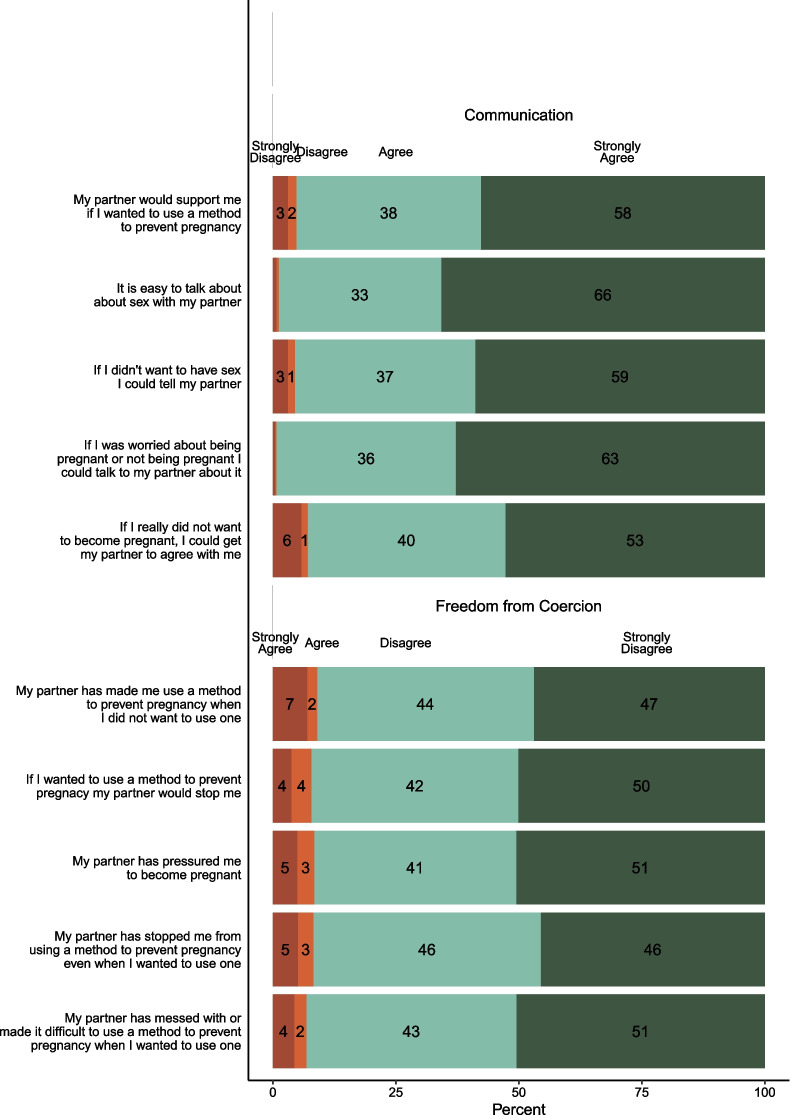
Reproductive autonomy, or the extent to which people control matters related to their own sexual and reproductive decisions, may help explain why some people who do not intend to become pregnant nevertheless do not use contraception. Using cross-sectional survey data from 695 women aged 16 to 47 enrolled in the Umoyo Wa Thanzi (UTHA) study in Malawi in 2019, we conducted confirmatory factor analysis, descriptive analyses, and multivariable logistic regression to assess the freedom from coercion and communication subscales of the Reproductive Autonomy Scale and to examine relationships between these components of reproductive autonomy and current contraceptive use. The freedom from coercion and communication subscales were valid within this population of partnered women; results from a correlated two-factor confirmatory factor analysis model resulted in good model fit. Women with higher scores on the freedom from coercion subscale had greater odds of current contraceptive use (aOR 1.13, 95% CI: 1.03–1.23) after adjustment for pregnancy intentions, relationship type, parity, education, employment for wages, and household wealth. Scores on the communication subscale were predictive of contraceptive use in some, but not all, models. These findings demonstrate the utility of the Reproductive Autonomy Scale in more holistically understanding contractive use and non-use in a lower-income setting, yet also highlight the need to further explore the multidimensionality of women’s reproductive autonomy and its effects on achieving desired fertility.
Overview
CoChat Summary
TL;DR
In a cross-sectional sample of 695 partnered women aged 16–47 in rural Malawi, the freedom from coercion and communication subscales of the Reproductive Autonomy Scale showed construct validity, and higher freedom from coercion was associated with greater odds of current contraceptive use. Communication was associated with contraceptive use in some but not all models.
Key findings
- The two-factor correlated Reproductive Autonomy Scale model had good fit (CFI 0.98, TLI 0.98, RMSEA 0.09, SRMR 0.03), and internal consistency was Cronbach’s alpha 0.82 for freedom from coercion and 0.73 for communication.
- Higher freedom from coercion was associated with current contraceptive use: unadjusted OR 1.15 (95% CI 1.05–1.26); adjusted for sociodemographic and partnership characteristics OR 1.16 (95% CI 1.07–1.26); fully adjusted with pregnancy intention aOR 1.13 (95% CI 1.03–1.23). The paper reports that each additional point on the freedom from coercion subscale increased odds of using contraception by 16% (95% CI 7–26%) in the sociodemographic/partnership-adjusted model.
- Higher communication was associated with contraceptive use in unadjusted (OR 1.14, 95% CI 1.02–1.28) and sociodemographic/partnership-adjusted models (OR 1.16, 95% CI 1.02–1.30), but not in the fully adjusted model with pregnancy intention (OR 1.10, 95% CI 0.97–1.25).
- Most women reported current contraceptive use (91%); 29% used long-acting methods, 44% short-acting methods, and 18% were sterilized. Contraceptive use was 71% among women intending to get pregnant in the next 12 months versus 94% among those not intending to get pregnant (p < 0.001).
Methods
- Cross-sectional survey data from the Umoyo Wa Thanzi (UTHA) study, Wave 5, conducted May–September 2019 in rural Lilongwe District, Malawi. The analytic sample was 695 women aged 16–47; exclusions included single women (n = 111), currently pregnant women (n = 70), menopausal women (n = 4), and women over age 49 (n = 9). Regression models in Table 3 had n = 688.
- Measures included the Reproductive Autonomy Scale freedom from coercion (5 items) and communication (5 items) subscales; the decision-making subscale was not fielded based on local team input because abortion was illegal in Malawi and adoption uncommon. Contraceptive use was assessed by asking whether the respondent was currently using any method to avoid pregnancy in her relationship.
- Analysis included confirmatory factor analysis (two-factor correlated and uncorrelated models, robust diagonally weighted least squares), Cronbach’s alpha, descriptive and bivariate analyses, and multivariable logistic regression with village-clustered standard errors. Interactions between reproductive autonomy subscales and pregnancy intention were tested with likelihood ratio tests; sensitivity analyses excluded sterilized women and used pregnancy happiness as an alternative pregnancy intention measure.
Limitations
- Stated: the cross-sectional design limits conclusions about temporality; the decision-making subscale was omitted, hindering comparisons to other settings; cross-cultural differences may affect responses; social desirability and survey modality may influence reports of coercion, pregnancy intention, and contraceptive use; women most vulnerable to abuse may not have participated, creating ceiling effects; no measures of power differentials or other dimensions of agency were included; the small number of contraceptive non-users limited power; and high contraceptive use may reflect measurement error, social desirability, a Hawthorne effect, or free methods available in the area.
- Stated: contraceptive use was extremely high (91%), and the authors note possible misclassification of “current” use and reporting bias; sensitivity analyses excluding sterilized women and using pregnancy happiness were largely unchanged (results not shown).
- Evident from the text: the sample is restricted to partnered, ever-sex women aged 16–47, so findings do not speak to unpartnered women or men; only two of the three Reproductive Autonomy Scale subscales were fielded; and the outcome is self-reported current contraceptive use.
Model-written summary. Check it against the paper before relying on it.
Integrity signals
Registry
Cites
Statistics
Figures
Verification
Claims the paper makes
0 Valid · 0 Not valid · 22 Not checked · 38 Own results and interpretations
A result the paper reports from its own data — it cites no other source for it, so there is none to check. The quote shows it is in the paper.
In the paper
“Fit statistics from the models suggested that the two-factor correlated model was significantly better than the uncorrelated model (Table 2).”
§ Assessing the relationship between reproductive autonomy and contraceptive use in rural Malawi > Results > Construct validity of the Reproductive Autonomy Scale
hedged- Asserted: passes — The authors put it forward as true.
- Checkable: passes — It can be checked against evidence.
- Load-bearing: passes — The paper’s conclusions depend on it.
- Based: passes — The paper gives a reason why it holds.
A result the paper reports from its own data — it cites no other source for it, so there is none to check. The quote shows it is in the paper.
In the paper
“Results were unchanged for both the communication and freedom from coercion models when excluding women who were sterilized (results not shown).”
§ Assessing the relationship between reproductive autonomy and contraceptive use in rural Malawi > Results > Associations between the Reproductive Autonomy Scale and contraceptive use
plain- Asserted: passes — The authors put it forward as true.
- Checkable: passes — It can be checked against evidence.
- Load-bearing: unclear — It is unclear whether the paper’s conclusions depend on it.
- Based: passes — The paper gives a reason why it holds.
A result the paper reports from its own data — it cites no other source for it, so there is none to check. The quote shows it is in the paper.
In the paper
“results were largely unchanged when sociodemographic and partnership characteristics were included in the model (Table 3)”
- Also stated in: § Associations between the Reproductive Autonomy Scale and contraceptive use · plain
“RA Communication subscale | 1.14*1.02–1.28 | 1.16*1.02–1.30 | 1.100.97–1.25”
§ Assessing the relationship between reproductive autonomy and contraceptive use in rural Malawi > Results > Associations between the Reproductive Autonomy Scale and contraceptive use
plainstates an associationn = 688- Asserted: passes — The authors put it forward as true.
- Checkable: passes — It can be checked against evidence.
- Load-bearing: unclear — It is unclear whether the paper’s conclusions depend on it.
- Based: passes — The paper gives a reason why it holds.
- Also stated in: § Associations between the Reproductive Autonomy Scale and contraceptive use · plain
A result the paper reports from its own data — it cites no other source for it, so there is none to check. The quote shows it is in the paper.
In the paper
“results from a correlated two-factor confirmatory factor analysis model resulted in good model fit.”
§ Assessing the relationship between reproductive autonomy and contraceptive use in rural Malawi > Abstract
plainn = 695- Asserted: passes — The authors put it forward as true.
- Checkable: passes — It can be checked against evidence.
- Load-bearing: passes — The paper’s conclusions depend on it.
- Based: passes — The paper gives a reason why it holds.
A result the paper reports from its own data — it cites no other source for it, so there is none to check. The quote shows it is in the paper.
In the paper
“The freedom from coercion and communication subscales were valid within this population of partnered women; results from a correlated two-factor confirmatory factor analysis model resulted in good model fit.”
§ Assessing the relationship between reproductive autonomy and contraceptive use in rural Malawi > Abstract
plainn = 695- Asserted: passes — The authors put it forward as true.
- Checkable: passes — It can be checked against evidence.
- Load-bearing: passes — The paper’s conclusions depend on it.
- Based: passes — The paper gives a reason why it holds.
31 more claims
Create a free account to see all 60 claims and to verify the 36 references still open.
- It may state two separate claims as one. 7
- Probably not a substantial claim. 19
Self-check
Percentages, sums and reported differences re-computed from the paper’s own numbers.
Each contradiction between two passages listed here was confirmed by an independent check.
Rated minor: it would not touch a result — a value no result rests on, a p-value that stays on the same side of the significance level, or a conflict that is clerical, resolved elsewhere in the paper, or outside its own findings.
In the paper
§ Assessing the relationship between reproductive autonomy and contraceptive use in rural Malawi > Results > Construct validity of the Reproductive Autonomy Scale
“| Two factor—oblique factors | 10 | 5341.9* | 35 | 0.41 | 0.25 | 0.47 | 0.36 |”
§ Assessing the relationship between reproductive autonomy and contraceptive use in rural Malawi > Methods > Analysis
“we tested a two-factor model with both correlated and uncorrelated factors”
Rated minor: it would not touch a result — a value no result rests on, a p-value that stays on the same side of the significance level, or a conflict that is clerical, resolved elsewhere in the paper, or outside its own findings.
In the paper
“| Age (n = 529) | | | | | | | | | < 20 | 27 (4.1%) | 16.7 | Ref. | 17.3 | Ref. | 85 | Ref. | | 20–24 | 145 (22.1%) | 17.0 | 0.67 | 17.7 | 0.48 | 90 | 0.42 | | 25–29 | 172 (26.2%) | 16.7 | 0.96 | 17.5 | 0.65 | 91 | 0.25 | | 30–34 | 126 (19.2%) | 16.7 | 1.0 | 17.5 | 0.67 | 89 | 0.59 | | 35 + | 186 (28.4%)”
§ Assessing the relationship between reproductive autonomy and contraceptive use in rural Malawi > Results > Characteristics of the sample
Reported 529 · recomputed 656
Citations
Cites
lavaan : An R Package for Structural Equation Modeling
Rosseel, Y. (2012) · Journal of Statistical Software · doi:10.18637/jss.v048.i02 · Cited by 27,955
Reporting Structural Equation Modeling and Confirmatory Factor Analysis Results: A Review
Schreiber, J. B., Nora, A., Stage, F. K., Barlow, E. A., & King, J. (2006) · The Journal of Educational Research · doi:10.3200/joer.99.6.323-338 · Cited by 6,937 · cited 2×
“Degrees of Freedom (Df), confirmatory factor index (CFI), Tucker Lewis Index (TLI) and root mean square error of approximation (RMSEA), standardized root mean square residual (SRMR)”
MethodConstructing socio-economic status indices: how to use principal components analysis
Vyas, S., & Kumaranayake, L. (2006) · Health Policy and Planning · doi:10.1093/heapol/czl029 · Cited by 3,280 · cited 1×
“We measured respondent household wealth by conducting a principal components analysis on measures of asset ownership (e.g., bicycle, mattress) and retained the first component based on plotting eigenvalues on a scree plot [36].”
MethodMcCambridge, J., Witton, J., & Elbourne, D. R. (2014) · Journal of Clinical Epidemiology · doi:10.1016/j.jclinepi.2013.08.015 · Cited by 2,748 · cited 1×
“, Hawthorne Effect) or because the health facility in the area provided a range of free contraceptive methods [56].”
BackgroundIntended and Unintended Pregnancies Worldwide in 2012 and Recent Trends
Sedgh, G., Singh, S., & Hussain, R. (2014) · Studies in Family Planning · doi:10.1111/j.1728-4465.2014.00393.x · Cited by 1,040 · cited 1×
“, mistimed or unwanted) every year, representing 40% of all pregnancies [1].”
BackgroundGipson, J. D., Koenig, M. A., & Hindin, M. J. (2008) · Studies in Family Planning · doi:10.1111/j.1728-4465.2008.00148.x · Cited by 994 · cited 1×
“Unintended pregnancies are associated with a range of negative health and social impacts on women and their families [2].”
BackgroundSelf-citationPregnancy coercion, intimate partner violence and unintended pregnancy
Miller, E., Decker, M. R., McCauley, H. L., Tancredi, D. J., Levenson, R. R., Waldman, J., Schoenwald, P., & Silverman, J. G. (2010) · Contraception · doi:10.1016/j.contraception.2009.12.004 · Cited by 638 · cited 1×
“Reproductive coercion is a deliberate action or an attempt to influence or control a person’s reproductive choices or interfere with their reproductive autonomy [14, 40, 41].”
BackgroundWomen's empowerment and fertility: A review of the literature
Upadhyay, U. D., Gipson, J. D., Withers, M., Lewis, S., Ciaraldi, E. J., Fraser, A., Huchko, M. J., & Prata, N. (2014) · Social Science & Medicine · doi:10.1016/j.socscimed.2014.06.014 · Cited by 542
Self-citationAdding It Up: The Costs and Benefits of Investing In Family Planning and Maternal and Newborn Health
Singh, S. D., Darroch, J. E., Ashford, L. S., & Vlassoff, M. (2009) · Cited by 426
Pallitto, C. C., García‐Moreno, C., Jansen, H. A. F. M., Heise, L., Ellsberg, M., Watts, C., & Violence, W. M. S. O. W. H. A. D. (2013) · International Journal of Gynecology & Obstetrics · doi:10.1016/j.ijgo.2012.07.003 · Cited by 419 · cited 1×
“Intimate partner violence-including sexual violence (i.e., sexual abuse) has been linked to higher levels of unintended pregnancy [12–16].”
Background
Cited by
Prevalence and factors associated with unintended pregnancy among women in Ghana
Osborne, A., Wongnaah, F. G., Adeleye, K. K., Bangura, C., Aboagye, R. G., & Ahinkorah, B. O. (2025) · BMC Pregnancy and Childbirth · doi:10.1186/s12884-025-07749-z · Cited by 10
Reproductive Autonomy in Fertility Research in Sub‐Saharan Africa: A Scoping Review
de Haas, B., Kabagenyi, A., & Diennabila, S. (2025) · Studies in Family Planning · doi:10.1111/sifp.70012 · Cited by 9
Inequities in safe abortion: women’s care trajectories in Abuja and Lagos, Nigeria
Roemer, M., Ushie, B. A., Akiode, A., Onuoha, O., Idoko, O., & Taiwo, A. (2025) · BMC Public Health · doi:10.1186/s12889-025-23889-5 · Cited by 7
“Contraceptive use is associated with increased reproductive autonomy, enabling individuals to make informed decisions about their reproductive health [29].”
Community pharmacists improving equitable access to contraceptive methods: a commentary
Ali, Z. Z., Assifi, A. R., Skouteris, H., Pirotta, S., & Hussainy, S. Y. (2025) · International Journal of Clinical Pharmacy · doi:10.1007/s11096-025-01870-x · Cited by 6
“Contraception provides women with the choice and autonomy to control their reproductive health, and allows them to play an important role in their family planning journey [7]; making access vitally important.”
Kunesh, J., Hémono, R., Gatare, E., Kayitesi, L., Packel, L. J., Hope, R., & McCoy, S. I. (2024) · SSM - Population Health · doi:10.1016/j.ssmph.2024.101617 · Cited by 6
“Although previous research indicates that ADR at first sex is frequent among women, to our knowledge, there have been no recent studies on ADR and first sex conducted in SSA, and none have investigated the association between reproductive autonomy within ADR in the AGYW population.”
ResultInfluential
Metadata
- Authors
- Wollum, A., Bornstein, M., Mopiwa, G., Norris, A., & Gipson, J. D.
- Affiliations
- University of California, Los Angeles (US)
- University of South Carolina (US)
- The Ohio State University (US)
- Corresponding author
- Wollum, Alexandra
- Venue
- Reproductive Health
- Published
- 2023-09-22
- Volume
- 20
- Issue
- 1
- Pages
- 142-142
- ISSN
- 1742-4755 (ISSN-L)
- PMC
- PMC10515069
- OpenAlex
- W4386944372
- Cited by
- 27
- References
- 55
- Citations by year
- 2026: 12 · 2025: 12 · 2024: 3
- FWCI
- 4.70
- Type
- journal article
- Language
- en
- Open access
- gold
- doi.org
- Licence
- cc-by
- creativecommons.org/licenses/by/4.0 (tdm)
- creativecommons.org/licenses/by/4.0 (vor)
- Locations
- Reproductive Health (publishedVersion, cc-by)
- PubMed Central (publishedVersion, cc-by)
- PubMed (publishedVersion)
- DOAJ (DOAJ: Directory of Open Access Journals) (submittedVersion)
- Funders
- Ohio State University (P2CHD058484)
- National Institutes of Health
- California Center for Population Research, University of California, Los Angeles (T32HD007545, P2C- HD041022)
- Eunice Kennedy Shriver National Institute of Child Health and Human Development (R24HD041022, P2CHD058484, T32HD007545, P2CHD041022)
- Topics
- Health Sciences › Medicine › Public Health, Environmental and Occupational Health › Reproductive Health and Contraception
- Social Sciences › Gender Studies › Demographic Trends and Gender Preferences
- Health Sciences › Medicine › Infectious Diseases › HIV/AIDS Research and Interventions
- Keywords
- reproductive autonomy, contraceptive use, unintended pregnancy, pregnancy intention, married women, rural Malawi, desired fertility, scale validation
- MeSH terms
- Contraceptive Agents, Contraceptive Devices, Cross-Sectional Studies, Female, Humans, Malawi, Pregnancy, Reproduction
About these checks
Registry, retraction, Cites and statistics results are computed, not judged, with one exception: a printed reference that no index lists is read once by a model before it counts as a citation error. Claims are extracted by a model and kept only when their quote appears verbatim in the text; each cited source is then checked, with a model’s help, for whether it says what the claim relies on. Those verdicts can be wrong — read the claim’s quote and the cited source before relying on one.
A language model drew the claims from the paper on 2026-11-29, under version 3 of the claim definition (model deepseek-v4.1-flash, prompt extract-v3).
A second model labelled each claim on 2026-11-29 (model jev-1.13-20260917, definition revision gold-guideline-v0.2).
Statistics and arithmetic are recomputed, not judged.
Confidence bands are shown only for fields calibrated on our annotated test set. None is calibrated yet, so no band is shown.
What counts as a claim ›How we measure confidence ›How we check this ›
Are you an author, or do you see a problem with this page? Request a review
Data sources
Bibliographic data: Semantic Scholar, OpenAlex, Crossref.
Contains information from the Semantic Scholar Academic Graph Datasets, made available under the ODC Attribution License (ODC-BY 1.0).
Semantic Scholar’s data is described in: Kinney, R., et al. (2023). The Semantic Scholar Open Data Platform. arXiv:2301.10140.
