

The DOI matches its Crossref record; 29 of the 29 references it cites were found in a registry or an index.
Leap motion controlled video game-based therapy for upper limb rehabilitation in patients with Parkinson’s disease: a feasibility study
Open accessAbstract
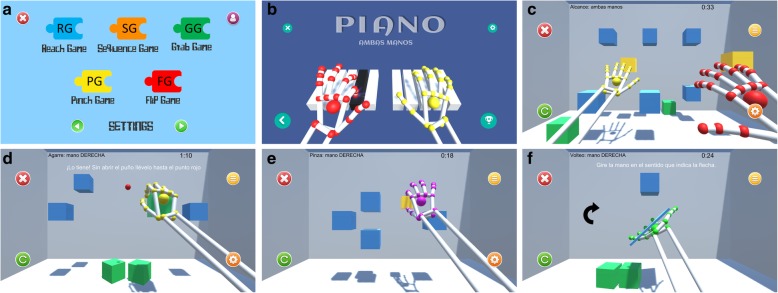
BACKGROUND: Non-immersive video games are currently being used as technological rehabilitation tools for individuals with Parkinson's disease (PD). The aim of this feasibility study was to evaluate the effectiveness of the Leap Motion Controller® (LMC) system used with serious games designed for the upper limb (UL), as well as the levels of satisfaction and compliance among patients in mild-to-moderate stages of the disease. METHODS: A non-probabilistic sampling of non-consecutive cases was performed. 23 PD patients, in stages II-IV of the Hoehn & Yahr scale, were randomized into two groups: an experimental group (n = 12) who received treatment based on serious games designed by the research team using the LMC system for the UL, and a control group (n = 11) who received a specific intervention for the UL. Grip muscle strength, coordination, speed of movements, fine and gross UL dexterity, as well as satisfaction and compliance, were assessed in both groups pre-treatment and post-treatment. RESULTS: Within the experimental group, significant improvements were observed in all post-treatment assessments, except for Box and Blocks test for the less affected side. Clinical improvements were observed for all assessments in the control group. Statistical intergroup analysis showed significant improvements in coordination, speed of movements and fine motor dexterity scores on the more affected side of patients in the experimental group. CONCLUSIONS: The LMC system and the serious games designed may be a feasible rehabilitation tool for the improvement of coordination, speed of movements and fine UL dexterity in PD patients. Further studies are needed to confirm these preliminary findings.
Overview
The claims and statistics of this paper haven’t been checked yet.
Run the check — free, no account needed. It reads the open-access text and checks the sources it cites.
Integrity signals
Registry
Cites
Statistics
Figures
Verification
Claims the paper makes
The claims and statistics of this paper haven’t been checked yet.
Run the check — free, no account needed. It reads the open-access text and checks the sources it cites.
Claims other papers make about this one
Each is checked against this paper’s own text: does it say what the citing paper says it does?
The source backs part of the claim, not all of it — or backs it for a different population, condition or comparison.
In the citing paper
“LMC is a good alternative for serious games for the improvement of coordination, speed of movements, and fine upper-limb dexterity [43].”
From Serious Game for Fine Motor Control Rehabilitation for Children With Epileptic Encephalopathy: Development and Usability Study (2023) · cites this paper as [43]
Experimental — accuracy not yet measured
Self-check
Percentages, sums and reported differences re-computed from the paper’s own numbers.
The self-check needs the paper’s full text.
Citations
Cites
Assessment of client/patient satisfaction: development of a general scale
Larsen, D. L., Attkisson, C. C., Hargreaves, W. A., & Nguyen, T. D. (1979) · Evaluation and Program Planning · doi:10.1016/0149-7189(79)90094-6 · Cited by 2,887
Adult Norms for the Box and Block Test of Manual Dexterity
Mathiowetz, V., Volland, G., Kashman, N., & Weber, K. (1985) · The American Journal of Occupational Therapy · doi:10.5014/ajot.39.6.386 · Cited by 2,105
Desrosiers, J., Bravo, G., Hébert, R., Dutil, É., & Mercier, L. (1994) · Archives of Physical Medicine and Rehabilitation · doi:10.1016/0003-9993(94)90130-9 · Cited by 522
Physiotherapy versus placebo or no intervention in Parkinson's disease
Tomlinson, C. L., Patel, S., Meek, C., Herd, C. P., Clarke, C. E., Stowe, R., Shah, L., Sackley, C. M., Deane, K. H., Wheatley, K., et al. (2013) · Cochrane Database of Systematic Reviews · doi:10.1002/14651858.cd002817.pub4 · Cited by 441
van Kuijk, A. A., Bakker, C. D., Hendriks, J. C., Geurts, A. C., Stegeman, D. F., & Pasman, J. W. (2014) · Journal of NeuroEngineering and Rehabilitation · doi:10.1186/1743-0003-11-1 · Cited by 373
Pompeu, J. E., Mendes, F. A. D. S., Silva, K. G. D., Lobo, A. M., Oliveira, T. D. P., Zomignani, A. P., & Piemonte, M. E. P. (2012) · Physiotherapy · doi:10.1016/j.physio.2012.06.004 · Cited by 354
Physiotherapy intervention in Parkinson's disease: systematic review and meta-analysis
Tomlinson, C. L., Patel, S., Meek, C., Herd, C. P., Clarke, C. E., Stowe, R., Shah, L., Sackley, C., Deane, K. H. O., Wheatley, K., et al. (2012) · BMJ · doi:10.1136/bmj.e5004 · Cited by 341
The role of exergaming in Parkinson’s disease rehabilitation: a systematic review of the evidence
Barry, G., Galna, B., & Rochester, L. (2014) · Journal of NeuroEngineering and Rehabilitation · doi:10.1186/1743-0003-11-33 · Cited by 313
Motor Control Abnormalities in Parkinson's Disease
Mazzoni, P., Shabbott, B., & Cortes, J. C. (2012) · Cold Spring Harbor Perspectives in Medicine · doi:10.1101/cshperspect.a009282 · Cited by 295
Physiotherapy versus placebo or no intervention in Parkinson's disease
Tomlinson, C. L., Patel, S., Meek, C., Clarke, C. E., Stowe, R. L., Shah, L., Sackley, C. M., Deane, K. H., Wheatley, K., & Ives, N. J. (2001) · Cochrane Database of Systematic Reviews · doi:10.1002/14651858.cd002817 · Cited by 198
Research works printed but not linked: 1
- Hironobu K, Masashi S. A noncontact tremor measurement system using leap motion. IEEA `17 proceeding of the 6th international conference on informatics, Enviroment, energy and applications; 2017. p. 76–9.
Cited by
Items 101–125 of 125
Rehabilitation of hand through leap motion control on burn injury patients
Jobanputtra, Y., & Telang, P. (2022) · Journal of Pharmaceutical Negative Results · doi:10.47750/pnr.2022.13.s06.405
Using video games for stroke rehabilitation at home
(2023) · Journal of Science and Technology - HaUI · doi:10.57001/huih5804.2023.077
Jogo de realidade virtual para reabilitação da mão
Corrêa, A. G. D., Kintschner, N. R., Campos, V. Z., & Blascovi‐Assis, S. M. (2023) · OBSERVATÓRIO DE LA ECONOMÍA LATINOAMERICANA · doi:10.55905/oelv21n6-012
Contreras, E., Silva, M. O., Hidalgo, M. G., Gutiérrez, J. A., & Gutiérrez, F. J. (2024) · Lecture notes in computer science · doi:10.1007/978-3-031-60695-3_2
Bouatrous, A. (2024) · theses.fr (ABES) · doi:10.70675/43cf680az6f90z410azb56dz7c2499a1dfeb
A Digital Therapeutic Approach in Neurology
(2024) · Neurological Sciences and Neurosurgery · doi:10.47275/2692-093x-138
Rethinking VR Input: Co-design with Gamers with Upper Limb Motor Impairments and VR Designers
Kakkar, M. (2024) · Carleton University's Institutional Repository (MacOdrum Library, Carleton University) · doi:10.22215/etd/2024-16315
Real-Time Supervision and Guidance for Rehabilitation Exercises via Computer Vision
Amrani, M. Z.-E.-A., Borst, C. W., & Achour, N. (2025) · IEEE Transactions on Human-Machine Systems · doi:10.1109/thms.2025.3566248
Zhao, R., Wu, L., & Yang, Y. (2025) · Lecture notes in computer science · doi:10.1007/978-3-031-93508-4_9
Corrêa, P. S., Thomazi, C. P. D. F., Lahude, A. B., Cemim, J. A., Witt, S., Cabeleira, M. E. P., Barroso, G. D. C., & Cechetti, F. (2025) · doi:10.22541/au.175868659.95498312/v1
Pei, Z. (2023) · TSpace (University of Toronto)
Ramanauskaitė, I. (2025) · Lithuanian University of Health Sciences
Mendes, L. C. (2024) · theses.fr (ABES) · doi:10.70675/df45c874zdf56z491ezbc58z5550d26c7494
Development of a new methodology for quantitative analysis of rigidity in Parkinson’s disease
Alves, C. M. (2024) · theses.fr (ABES) · doi:10.70675/c7e3e326ze315z49e1z80e1z327c04d421ea
Hashemizadeh, F., Rasti, J., & Alamdarifar, S. (2026) · Research Square · doi:10.21203/rs.3.rs-9701312/v1
Bel-Lacoma, J., Rubio, Á. A., & Cano‐de‐la‐Cuerda, R. (2026) · Neurology International · doi:10.3390/neurolint18080142
Self-citationPapamichael, E., Michailidou, C., & Giannaki, C. D. (2026) · Digital Health · doi:10.1177/20552076261473784
Kelly, C. Y. Y., Xinyue, W., & Wai, A. A. P. (2026) · Proceedings in Technology Transfer · doi:10.1007/978-981-95-9630-0_8
Cela, A., Oña, E. D., & Jardón, A. (2026) · doi:10.2196/preprints.112406
Liu, T., Choi, H., Swaminathan, S., & Jeong, H. (2025) · JMIR Rehabilitation and Assistive Technologies · doi:10.2196/89727
Preliminary Evaluation of eJamar Game Controller as Hand Range of Motion Measurement Tool
Oña, E. D., Yépez-Figueroa, J. J., Cela, A., & Jardón, A. (2026) · Biosystems & biorobotics · doi:10.1007/978-3-032-18746-8_20
Bu-yu, L., Zhuang, Y.-X., Zhuang, C., & Ruan, H. (2026) · Frontiers in Neurology · doi:10.3389/fneur.2026.1964034
Metadata
- Authors
- Fernández-González, P., Carratalá-Tejada, M., Monge-Pereira, E., Collado-Vázquez, S., Sánchez-Herrera Baeza, P., Cuesta-Gómez, A., Oña-Simbaña, E. D., Jardón-Huete, A., Molina-Rueda, F., Balaguer-Bernaldo de Quirós, C., Miangolarra-Page, J. C., & Cano-de la Cuerda, R.
- Affiliations
- Universidad Rey Juan Carlos (ES)
- Venue
- Journal of NeuroEngineering and Rehabilitation
- Published
- 2019-11-06
- Volume
- 16
- Issue
- 1
- Pages
- 133-133
- ISSN
- 1743-0003 (ISSN-L)
- PMC
- PMC6836460
- OpenAlex
- W2989279296
- Cited by
- 116
- References
- 29
- Citations by year
- 2026: 11 · 2025: 15 · 2024: 13 · 2023: 22 · 2022: 24 · 2021: 17 · 2020: 14
- FWCI
- 9.60
- Type
- journal article
- Language
- en
- Open access
- gold
- doi.org
- Licence
- cc-by
- creativecommons.org/licenses/by/4.0/ (tdm)
- creativecommons.org/licenses/by/4.0/ (vor)
- Locations
- Journal of NeuroEngineering and Rehabilitation (publishedVersion, cc-by)
- Europe PMC (PubMed Central) (publishedVersion, cc-by)
- PubMed Central (publishedVersion, cc-by)
- PubMed (publishedVersion)
- BURJC Digital (King Juan Carlos University) (submittedVersion, cc-by)
- LA Referencia (Red Federada de Repositorios Institucionales de Publicaciones Científicas) (submittedVersion, cc-by)
- DOAJ (DOAJ: Directory of Open Access Journals) (submittedVersion, cc-by-sa)
- e-Archivo (Carlos III University of Madrid) (submittedVersion, cc-by)
- Hispana (submittedVersion, cc-by)
- NORA - Norwegian Open Research Archives (submittedVersion, cc-by)
- Funders
- Ministerio de Economía y Competitividad (DPI2013-47944-C4-1-R)
- Topics
- Health Sciences › Medicine › Rehabilitation › Stroke Rehabilitation and Recovery
- Life Sciences › Neuroscience › Cognitive Neuroscience › Motor Control and Adaptation
- Health Sciences › Medicine › Clinical Neurology › Deep Brain Stimulation and Movement Disorders
- Keywords
- Parkinson's disease, upper limb rehabilitation, serious games, video game-based therapy, Leap Motion, motor coordination, movement speed, fine motor dexterity, grip strength, patient satisfaction, medication adherence, feasibility
- MeSH terms
- Aged, Feasibility Studies, Female, Humans, Leg, Male, Middle Aged, Motion, Parkinson Disease, Patient Compliance, Psychomotor Performance, Treatment Outcome, Patient Satisfaction, Hand Strength, Video Games, Upper Extremity, Muscle Strength, Muscle Strength Dynamometer
About these checks
Registry, retraction, Cites and statistics results are computed, not judged, with one exception: a printed reference that no index lists is read once by a model before it counts as a citation error. Claims are extracted by a model and kept only when their quote appears verbatim in the text; each cited source is then checked, with a model’s help, for whether it says what the claim relies on. Those verdicts can be wrong — read the claim’s quote and the cited source before relying on one.
Statistics and arithmetic are recomputed, not judged.
Confidence bands are shown only for fields calibrated on our annotated test set. None is calibrated yet, so no band is shown.
What counts as a claim ›How we measure confidence ›How we check this ›
Are you an author, or do you see a problem with this page? Request a review
Data sources
Bibliographic data: Semantic Scholar, OpenAlex, Crossref.
Contains information from the Semantic Scholar Academic Graph Datasets, made available under the ODC Attribution License (ODC-BY 1.0).
Semantic Scholar’s data is described in: Kinney, R., et al. (2023). The Semantic Scholar Open Data Platform. arXiv:2301.10140.
