

Effects of intermittent theta-burst stimulation on cognition and glymphatic system activity in mild cognitive impairment and very mild Alzheimer’s disease: a randomized controlled trial
Open accessThe DOI matches its Crossref record; 72 of the 72 references it cites were found in a registry or an index; none of the 48 sources its claims cite is checked for support yet.
Abstract
Background: Repetitive transcranial magnetic stimulation (rTMS) has demonstrated efficacy in alleviating cognitive symptoms in Alzheimer’s disease (AD) and mild cognitive impairment (MCI). Although animal studies suggest rTMS may enhance glymphatic system efficiency and reduce amyloid deposits, its impact on human glymphatic activity remains uncertain. Methods: This double-blind, randomized, sham-controlled trial investigated the effects of intermittent theta-burst stimulation (iTBS), a novel rTMS technique, on cognitive function and glymphatic system activity using diffusion tensor image analysis along the perivascular space (DTI-ALPS) in 52 participants with amnestic MCI or very mild AD. Participants underwent 10 sessions of iTBS targeting the left dorsolateral prefrontal cortex over two weeks. Cognitive and glymphatic assessments were conducted at baseline, week 2, and week 6. Of the 52 participants, 28 received active iTBS, while 24 received sham stimulation. After the first two weeks, the sham group transitioned to active iTBS. Results: Significant cognitive improvements were observed at week 6 in the iTBS group, indicating delayed cognitive enhancement, though no immediate changes in cognition or glymphatic system activity (measured by the ALPS index) were observed. No adverse events were reported. Conclusions: These findings suggest that iTBS can produce delayed cognitive enhancement in individuals with amnestic MCI and very mild AD, while the impact on the glymphatic system remains uncertain and requires further investigation. Trial registration: Clinicaltrials.gov (NCT04555941).
Overview
CoChat Summary
TL;DR
In this double-blind, sham-controlled RCT, 10 sessions of intermittent theta-burst stimulation (iTBS) to the left DLPFC did not immediately improve cognition or glymphatic activity in amnestic MCI/very mild AD. The active iTBS group showed delayed MMSE improvement at week 6, but no significant change in the ALPS index.
Key findings
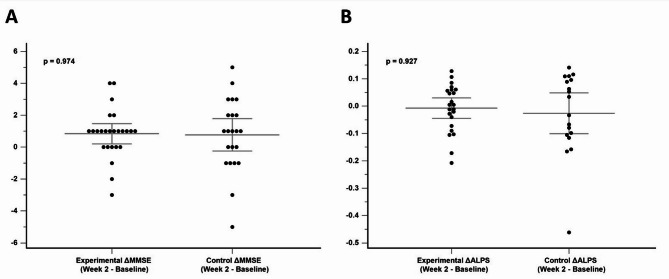
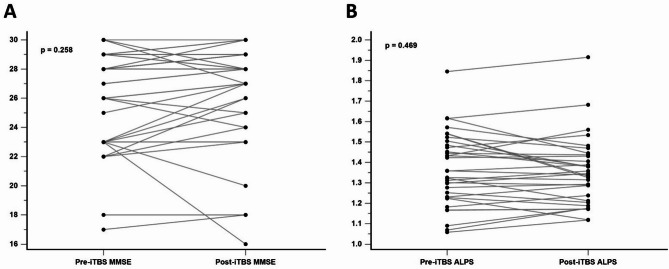
- No immediate effects at week 2: between-group MMSE change P = .974 and ALPS index change P = .927. Combining active iTBS periods, MMSE changed from 26.26 to 26.63 (P = .258) and ALPS from 1.37 to 1.35 (P = .469).
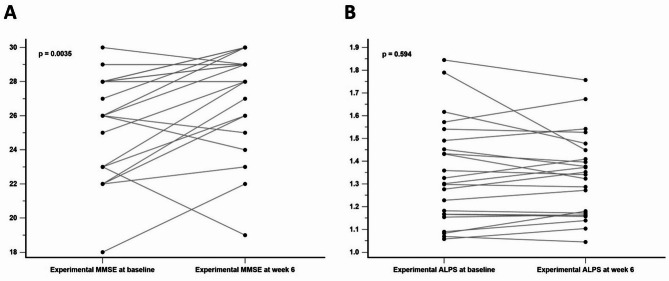
- Delayed cognitive improvement: experimental group baseline MMSE 25.78 to 27.35 at week 6 (P = .0035); control group baseline-to-week-6 mean MMSE change was −0.14 (P = .751). No significant ALPS index change from baseline to week 6 in the experimental group (P = .594).
- Blinding was effective: 88% of active and 88.5% of sham participants believed they received real stimulation (χ²[1, N = 51] = 0.147, p = .701).
- No iTBS-related adverse events were reported; one participant withdrew due to suicidal ideation after the first sham session.
Methods
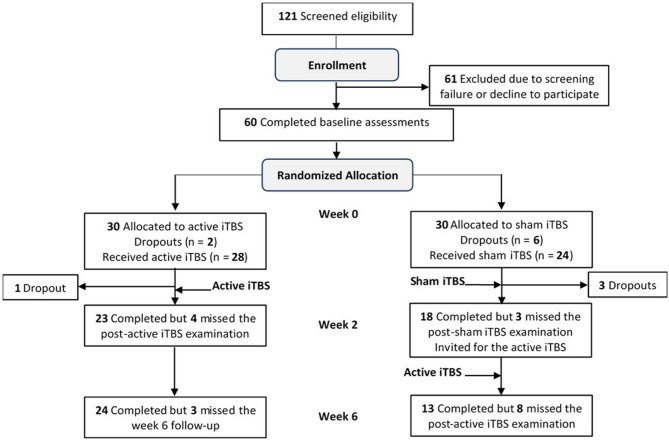
- Double-blind, randomized, sham-controlled trial: 121 screened, 60 enrolled and randomized 30 active/30 sham; 52 had pre-intervention MRI (28 active, 24 sham). Assessments occurred at baseline, week 2, and week 6; the sham group was offered active iTBS during weeks 4–5.
- iTBS targeted the left DLPFC with neuronavigation at 80% resting motor threshold: 10 sessions over 2 consecutive weeks (Monday–Friday), 3 runs of 600 pulses per session (1800 pulses over 20 min), with a placebo coil for sham.
- Primary outcome was MMSE; secondary outcome was the DTI-ALPS index. Analyses used Mann–Whitney, independent t tests, paired t tests, and Wilcoxon tests in MedCalc, with two-sided α = .05.
Limitations
- Stated: larger multicenter studies are needed; COVID-19 interruptions caused dropouts and missed follow-ups; reliance on symptomatic clinical diagnosis rather than biomarkers may limit internal validity; optimal iTBS parameters remain unestablished.
- Stated: the ALPS index may not fully capture glymphatic changes because it is derived from a specific ROI, may have limited sensitivity in cognitively preserved individuals, and may primarily reflect radial Brownian motion at the lateral ventricular body.
- Evident: attrition and unequal follow-up (24 experimental vs 13 control at week 6) may bias the delayed-effect comparison; the control group received active iTBS in weeks 4–5, so week-6 control data are not a pure sham comparator.
Model-written summary. Check it against the paper before relying on it.
Integrity signals
Registry
Cites
Statistics
Figures
Verification
Claims the paper makes
0 Valid · 0 Not valid · 23 Not checked · 38 Own results and interpretations
A result the paper reports from its own data — it cites no other source for it, so there is none to check. The quote shows it is in the paper.
In the paper
“When combining the data from the active stimulation of the experimental group (week 2 - week 0) and the control group (week 6 - week 2), no significant differences were observed in MMSE scores (mean pre-iTBS MMSE score = 26.26; mean post-iTBS MMSE score = 26.63; P =.258) or ALPS indices (mean pre-iTBS ALPS value = 1.37; mean post-iTBS ALPS value = 1.35; P =.469) before and after 2 weeks of real iT”
§ Effects of intermittent theta-burst stimulation on cognition and glymphatic system activity in mild cognitive impairment and very mild Alzheimer’s disease: a randomized controlled trial > Results > iTBS efficacy
plain- Asserted: passes — The authors put it forward as true.
- Checkable: passes — It can be checked against evidence.
- Load-bearing: passes — The paper’s conclusions depend on it.
- Based: passes — The paper gives a reason why it holds.
A result the paper reports from its own data — it cites no other source for it, so there is none to check. The quote shows it is in the paper.
In the paper
“At the end of week 2, neither group showed changes in MMSE scores (P =.974) nor changes in ALPS indices (P =.927)”
§ Effects of intermittent theta-burst stimulation on cognition and glymphatic system activity in mild cognitive impairment and very mild Alzheimer’s disease: a randomized controlled trial > Results > iTBS efficacy
plain- Asserted: passes — The authors put it forward as true.
- Checkable: passes — It can be checked against evidence.
- Load-bearing: passes — The paper’s conclusions depend on it.
- Based: passes — The paper gives a reason why it holds.
A result the paper reports from its own data — it cites no other source for it, so there is none to check. The quote shows it is in the paper.
In the paper
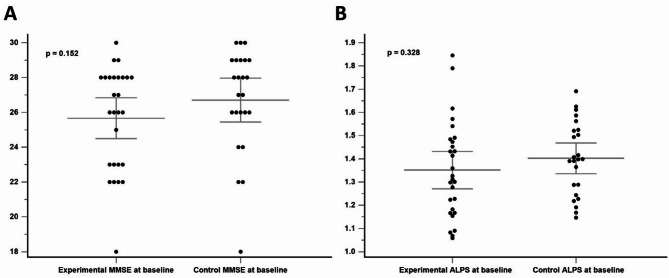
“No significant group differences were found in baseline MMSE scores (P =.152) or ALPS indices (P =.328) for the two groups (Fig. 2).”
§ Effects of intermittent theta-burst stimulation on cognition and glymphatic system activity in mild cognitive impairment and very mild Alzheimer’s disease: a randomized controlled trial > Results > iTBS efficacy
plain- Asserted: passes — The authors put it forward as true.
- Checkable: passes — It can be checked against evidence.
- Load-bearing: unclear — It is unclear whether the paper’s conclusions depend on it.
- Based: passes — The paper gives a reason why it holds.
A result the paper reports from its own data — it cites no other source for it, so there is none to check. The quote shows it is in the paper.
In the paper
“When combining the data from the active stimulation of the experimental group (week 2 - week 0) and the control group (week 6 - week 2), no significant differences were observed in MMSE scores (mean pre-iTBS MMSE score = 26.26; mean post-iTBS MMSE score = 26.63; P =.258) or ALPS indices (mean pre-iTBS ALPS value = 1.37; mean post-iTBS ALPS value = 1.35; P =.469) before and after 2 weeks of real iT”
§ Effects of intermittent theta-burst stimulation on cognition and glymphatic system activity in mild cognitive impairment and very mild Alzheimer’s disease: a randomized controlled trial > Results > iTBS efficacy
plain- Asserted: passes — The authors put it forward as true.
- Checkable: passes — It can be checked against evidence.
- Load-bearing: passes — The paper’s conclusions depend on it.
- Based: passes — The paper gives a reason why it holds.
A result the paper reports from its own data — it cites no other source for it, so there is none to check. The quote shows it is in the paper.
In the paper
“No adverse events related to iTBS were reported.”
§ Effects of intermittent theta-burst stimulation on cognition and glymphatic system activity in mild cognitive impairment and very mild Alzheimer’s disease: a randomized controlled trial > Results > Adverse events
plain- Asserted: passes — The authors put it forward as true.
- Checkable: passes — It can be checked against evidence.
- Load-bearing: unclear — It is unclear whether the paper’s conclusions depend on it.
- Based: passes — The paper gives a reason why it holds.
28 more claims
Create a free account to see all 61 claims and to verify the 48 references still open.
- Probably not a substantial claim. 15
- It may state two separate claims as one. 17
Self-check
Percentages, sums and reported differences re-computed from the paper’s own numbers.
Each contradiction between two passages listed here was confirmed by an independent check.
Rated minor: it would not touch a result — a value no result rests on, a p-value that stays on the same side of the significance level, or a conflict that is clerical, resolved elsewhere in the paper, or outside its own findings.
In the paper
§ Effects of intermittent theta-burst stimulation on cognition and glymphatic system activity in mild cognitive impairment and very mild Alzheimer’s disease: a randomized controlled trial > Results > iTBS efficacy
“When combining the data from the active stimulation of the experimental group (week 2 - week 0) and the control group (week 6 - week 2), no significant differences were observed”
§ Effects of intermittent theta-burst stimulation on cognition and glymphatic system activity in mild cognitive impairment and very mild Alzheimer’s disease: a randomized controlled trial > Results > iTBS efficacy
“Figure: Fig. 4 MMSE scores (A) and ALPS indices (B) before and after 2 weeks of active iTBS in the experimental group”
Citations
Cites
Folstein, M. F., Folstein, S. E., & McHugh, P. R. (1975) · Journal of Psychiatric Research · doi:10.1016/0022-3956(75)90026-6 · Cited by 88,282 · cited 1×
“Traditionally, rTMS’s effects on cognition have been captured through tools like the Mini-Mental State Examination (MMSE) [27] and Montreal Cognitive Assessment (MoCA) [28].”
Faul, F., Erdfelder, E., Lang, A.-G., & Buchner, A. (2007) · Behavior Research Methods · doi:10.3758/bf03193146 · Cited by 65,971 · cited 1×
“Sample size estimation was performed using G*Power software version 3.1 [35].”
InfluentialThe Montreal Cognitive Assessment, MoCA: a brief screening tool for mild cognitive impairment
Nasreddine, Z. S., Phillips, N. A., Bédirian, V., Charbonneau, S., Whitehead, V., Collin, I., Cummings, J. L., & Chertkow, H. (2005) · Journal of the American Geriatrics Society · doi:10.1111/j.1532-5415.2005.53221.x · Cited by 25,553 · cited 1×
“Traditionally, rTMS’s effects on cognition have been captured through tools like the Mini-Mental State Examination (MMSE) [27] and Montreal Cognitive Assessment (MoCA) [28].”
Kok, J. S., Berg, I. J., & Scherder, E. J. A. (2013) · Dementia and Geriatric Cognitive Disorders Extra · doi:10.1159/000353441 · Cited by 20,589
NIA‐AA Research Framework: Toward a biological definition of Alzheimer's disease
Jack, C. R., Bennett, D. A., Blennow, K., Carrillo, M. C., Dunn, B., Haeberlein, S. B., Holtzman, D. M., Jagust, W., Jessen, F., Karlawish, J., et al. (2018) · Alzheimer's & Dementia · doi:10.1016/j.jalz.2018.02.018 · Cited by 10,537 · cited 1×
“Third, while advances in biomarkers for AD diagnosis have been significant [69], our reliance on symptomatic clinical approaches may limit the internal validity of the study [70].”
Albert, M. S., DeKosky, S. T., Dickson, D., Dubois, B., Feldman, H. H., Fox, N. C., Gamst, A., Holtzman, D. M., Jagust, W. J., Petersen, R. C., et al. (2011) · Alzheimer's & Dementia · doi:10.1016/j.jalz.2011.03.008 · Cited by 10,152 · cited 1×
“…edition of the Diagnostic and Statistical Manual of Mental Disorders (DSM-5), diagnosed with MCI or very mild dementia due to AD by neurologists based on the criteria proposed by National Institute on Aging and the Alzheimer’s Association (NIA-AA) [33], with a clinical dementia rating (CDR) of 0.5.”
InfluentialIliff, J. J., Wang, M., Liao, Y., Plogg, B. A., Peng, W., Gundersen, G. A., Benveniste, H., Vates, G. E., Deane, R., Goldman, S. A., et al. (2012) · Science Translational Medicine · doi:10.1126/scitranslmed.3003748 · Cited by 5,824
Theta Burst Stimulation of the Human Motor Cortex
Huang, Y.-Z., Edwards, M. J., Rounis, E., Bhatia, K. P., & Rothwell, J. C. (2005) · Neuron · doi:10.1016/j.neuron.2004.12.033 · Cited by 4,158
Knopman, D. S., Amieva, H., Petersen, R. C., Chételat, G., Holtzman, D. M., Hyman, B. T., Nixon, R. A., & Jones, D. T. (2021) · Nature Reviews Disease Primers · doi:10.1038/s41572-021-00269-y · Cited by 2,606 · cited 3×
“While current pharmacological treatments offer symptomatic relief, they may be limited by side effects and their challenges in slowing disease progression, particularly given the accelerated cognitive decline observed in people with dementia after the COVID-19 pandemic [1, 6, 7].”
InfluentialTranscranial Magnetic Stimulation: A Primer
Hallett, M. (2007) · Neuron · doi:10.1016/j.neuron.2007.06.026 · Cited by 1,891 · cited 1×
“This region is also vulnerable to AD-related changes, making it an ideal target for interventions aimed at enhancing synaptic plasticity and improving cognitive function [14, 40, 65].”
Cited by
Wang, H., Wang, X., Liu, N., Wang, H., & Feng, C. (2026) · Frontiers in Immunology · doi:10.3389/fimmu.2026.1828809 · Cited by 3
Zheng, W., Zhou, Y., Xia, Y., & Wang, Y. (2026) · The Journal of Prevention of Alzheimer s Disease · doi:10.1016/j.tjpad.2026.100597 · Cited by 2
Wang, C., Ni, H., & Yue, J. (2026) · Frontiers in Medicine · doi:10.3389/fmed.2026.1756881 · Cited by 2
Yao, Q., Han, X., Cui, T., Li, D., Shan, A., Wang, X. G., Li, S., Luan, H., Zhu, Y., Wen, B., et al. (2026) · Journal of Neurology · doi:10.1007/s00415-026-13997-6 · Cited by 1
Wang, Y., Feng, H., Dai, J., & Wang, Q. (2025) · Topics in Stroke Rehabilitation · doi:10.1080/10749357.2025.2605295 · Cited by 1
“35,36 Tonic stimulation with 100 pulses produces fewer LTP effects than burst patterns with only 20 pulses.”
Metadata
- Authors
- Yang, C.-C., Huang, K.-Y., Hsu, J.-L., Hu, C.-J., Lu, Y.-H., & Kuan, Y.-C.
- Affiliations
- Fu Jen Catholic University (TW)
- Taipei Medical University-Shuang Ho Hospital (TW)
- Chang Gung University (TW)
- National Taiwan University (TW)
- Corresponding author
- Kuan, Yi-Chun
- Venue
- Journal of NeuroEngineering and Rehabilitation
- Published
- 2025-09-26
- Volume
- 22
- Issue
- 1
- Pages
- 195-195
- ISSN
- 1743-0003 (ISSN-L)
- PMC
- PMC12465570
- OpenAlex
- W4414556423
- Cited by
- 15
- References
- 70
- Citations by year
- 2026: 14 · 2025: 1
- FWCI
- 4.22
- Type
- journal article
- Language
- en
- Open access
- gold
- doi.org
- Licence
- cc-by
- creativecommons.org/licenses/by/4.0 (tdm)
- creativecommons.org/licenses/by/4.0 (vor)
- Locations
- Journal of NeuroEngineering and Rehabilitation (publishedVersion, cc-by)
- Europe PMC (PubMed Central) (publishedVersion, cc-by)
- PubMed Central (publishedVersion, cc-by)
- PubMed (publishedVersion)
- DOAJ (DOAJ: Directory of Open Access Journals) (submittedVersion)
- Funders
- Ministry of Science and Technology, Taiwan (MOST 109-2410-H-038-011)
- Taipei Medical University (TMU112-AE1-B19)
- Topics
- Life Sciences › Neuroscience › Neurology › Transcranial Magnetic Stimulation Studies
- Health Sciences › Medicine › Psychiatry and Mental health › Dementia and Cognitive Impairment Research
- Health Sciences › Medicine › Clinical Neurology › Traumatic Brain Injury Research
- Keywords
- intermittent theta burst stimulation, repetitive transcranial magnetic stimulation, glymphatic system, mild cognitive impairment, amnestic MCI, dorsolateral prefrontal cortex, perivascular spaces, cognitive enhancement, diffusion tensor imaging, amyloid
- MeSH terms
- Glymphatic System, Aged, Aged, 80 and over, Alzheimer Disease, Cognition, Double-Blind Method, Female, Humans, Male, Middle Aged, Theta Rhythm, Treatment Outcome, Transcranial Magnetic Stimulation, Diffusion Tensor Imaging, Cognitive Dysfunction
About these checks
Registry, retraction, Cites and statistics results are computed, not judged, with one exception: a printed reference that no index lists is read once by a model before it counts as a citation error. Claims are extracted by a model and kept only when their quote appears verbatim in the text; each cited source is then checked, with a model’s help, for whether it says what the claim relies on. Those verdicts can be wrong — read the claim’s quote and the cited source before relying on one.
A language model drew the claims from the paper on 2026-11-27, under version 3 of the claim definition (model deepseek-v4.1-flash, prompt extract-v3).
A second model labelled each claim on 2026-11-27 (model jev-1.13-20260917, definition revision gold-guideline-v0.2).
Statistics and arithmetic are recomputed, not judged.
Confidence bands are shown only for fields calibrated on our annotated test set. None is calibrated yet, so no band is shown.
What counts as a claim ›How we measure confidence ›How we check this ›
Are you an author, or do you see a problem with this page? Request a review
Data sources
Bibliographic data: Semantic Scholar, OpenAlex, Crossref.
Contains information from the Semantic Scholar Academic Graph Datasets, made available under the ODC Attribution License (ODC-BY 1.0).
Semantic Scholar’s data is described in: Kinney, R., et al. (2023). The Semantic Scholar Open Data Platform. arXiv:2301.10140.
