

The DOI matches its Crossref record; 117 of the 117 references it cites were found in a registry or an index.
Mixed-method study of a conceptual model of evidence-based intervention sustainment across multiple public-sector service settings
Open accessAbstract
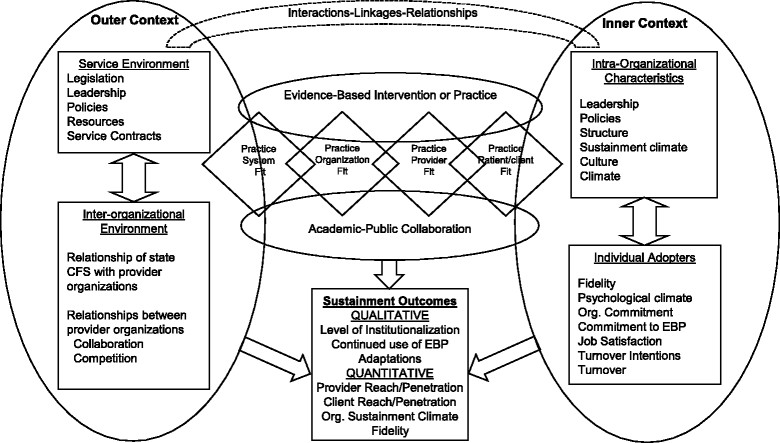
BACKGROUND: This study examines sustainment of an EBI implemented in 11 United States service systems across two states, and delivered in 87 counties. The aims are to 1) determine the impact of state and county policies and contracting on EBI provision and sustainment; 2) investigate the role of public, private, and academic relationships and collaboration in long-term EBI sustainment; 3) assess organizational and provider factors that affect EBI reach/penetration, fidelity, and organizational sustainment climate; and 4) integrate findings through a collaborative process involving the investigative team, consultants, and system and community-based organization (CBO) stakeholders in order to further develop and refine a conceptual model of sustainment to guide future research and provide a resource for service systems to prepare for sustainment as the ultimate goal of the implementation process. METHODS: A mixed-method prospective and retrospective design will be used. Semi-structured individual and group interviews will be used to collect information regarding influences on EBI sustainment including policies, attitudes, and practices; organizational factors and external policies affecting model implementation; involvement of or collaboration with other stakeholders; and outer- and inner-contextual supports that facilitate ongoing EBI sustainment. Document review (e.g., legislation, executive orders, regulations, monitoring data, annual reports, agendas and meeting minutes) will be used to examine the roles of state, county, and local policies in EBI sustainment. Quantitative measures will be collected via administrative data and web surveys to assess EBI reach/penetration, staff turnover, EBI model fidelity, organizational culture and climate, work attitudes, implementation leadership, sustainment climate, attitudes toward EBIs, program sustainment, and level of institutionalization. Hierarchical linear modeling will be used for quantitative analyses. Qualitative analyses will be tailored to each of the qualitative methods (e.g., document review, interviews). Qualitative and quantitative approaches will be integrated through an inclusive process that values stakeholder perspectives. DISCUSSION: The study of sustainment is critical to capitalizing on and benefiting from the time and fiscal investments in EBI implementation. Sustainment is also critical to realizing broad public health impact of EBI implementation. The present study takes a comprehensive mixed-method approach to understanding sustainment and refining a conceptual model of sustainment.
Overview
The claims and statistics of this paper haven’t been checked yet.
Run the check — free, no account needed. It reads the open-access text and checks the sources it cites.
Integrity signals
Registry
Cites
Statistics
Figures
Verification
Claims the paper makes
The claims and statistics of this paper haven’t been checked yet.
Run the check — free, no account needed. It reads the open-access text and checks the sources it cites.
Claims other papers make about this one
Each is checked against this paper’s own text: does it say what the citing paper says it does?
In the citing paper
“Sustainment is also critical because the ultimate public health impact of EBPs is dependent on long-term use [73].”
From Translating economic evaluations into financing strategies for implementing evidence-based practices (2021) · cites this paper as [73]
Self-check
Percentages, sums and reported differences re-computed from the paper’s own numbers.
The self-check needs the paper’s full text.
Citations
Cites
Qualitative Data Analysis: An Expanded Sourcebook
(1994) · Journal of Environmental Psychology · doi:10.1016/s0272-4944(05)80231-2 · Cited by 48,420
Qualitative research and evaluation methods
Patton, M. Q. (1980) · Cited by 35,637
Designing and Conducting Mixed Methods Research
Robinson, P. M. (2007) · Australian and New Zealand Journal of Public Health · doi:10.1111/j.1753-6405.2007.00096.x · Cited by 23,362
Hierarchical Linear Models: Applications and Data Analysis Methods.
Longford, N. T., Bryk, A. S., & Raudenbush, S. W. (1993) · Contemporary Sociology A Journal of Reviews · doi:10.2307/2075823 · Cited by 18,773
Hierarchical Linear Models: Applications and Data Analysis Methods
Davidian, M. (2003) · Journal of the American Statistical Association · doi:10.1198/jasa.2003.s288 · Cited by 13,820
Applied Longitudinal Data Analysis: Modeling Change and Event Occurrence
Singer, J. D., & Willett, J. B. (2003) · doi:10.1093/acprof:oso/9780195152968.001.0001 · Cited by 10,647
Proctor, E., Silmere, H., Raghavan, R., Hovmand, P., Aarons, G., Bunger, A., Griffey, R., & Hensley, M. (2011) · Administration and Policy in Mental Health and Mental Health Services Research · doi:10.1007/s10488-010-0319-7 · Cited by 8,721
Self-citationDiffusion of Innovations in Service Organizations: Systematic Review and Recommendations
GREENHALGH, T., ROBERT, G., MACFARLANE, F., BATE, P., & KYRIAKIDOU, O. (2004) · The Milbank Quarterly · doi:10.1111/j.0887-378x.2004.00325.x · Cited by 7,448
SAGE Handbook of Mixed Methods in Social & Behavioral Research
Tashakkori, A., & Teddlie, C. (2010) · doi:10.4135/9781506335193 · Cited by 6,215
Writing Ethnographic Fieldnotes.
Joffe, C. E., Emerson, R. M., Fretz, R. I., & Shaw, L. L. (1996) · Contemporary Sociology A Journal of Reviews · doi:10.2307/2077613 · Cited by 5,152
Research works printed but not linked: 3
- U.S. Department of Health and Human Services, Administration for Children and Families, Administration on Children, Youth and Families: Child Maltreatment. 2010, Children’s Bureau, Washington, DC
- Whitaker DJ, Lutzker JR, Self-Brown S, Edwards AE: Implementing an evidence-based program for the prevention of child maltreatment: the SafeCare® program. Report on Emotional & Behavioral Disorders in Youth. 2008, 8: 55-62.
- Fraser D: QSR NVivo Reference Guide. 2000, QSR International, Melbourne
Cited by
Sorted by citations
Items 101–106 of 106
Meza, R. D., Triplett, N. S., Woodard, G. S., Martin, P., Khairuzzaman, A. N., Jamora, G., & Dorsey, S. (2021) · Figshare · doi:10.6084/m9.figshare.14920968
Dopp, A. R., Hunter, S. B., Godley, M. D., González, I., Bongard, M., Han, B., Cantor, J., Hindmarch, G., Lindquist, K. M., Wright, B., et al. (2024) · Figshare · doi:10.6084/m9.figshare.26626363
Self-citationWoodward, E. N., Singh, R. S., Ndebele‐Ngwenya, P., Melgar Castillo, A., Dickson, K. S., & Kirchner, J. E. (2021) · Figshare · doi:10.6084/m9.figshare.14738859
Lyon, A. R., Pullmann, M. D., Dorsey, S., Levin, C., Gaias, L. M., Brewer, S. K., Larson, M. F., Corbin, C. M., Davis, C. J., Muse, I., et al. (2021) · Figshare · doi:10.6084/m9.figshare.13545220
Cost-effectiveness study: design, measures, and classic example
Vangsness, K. L., Sam, A.-P., & Carré, A. L. (2026) · Elsevier eBooks · doi:10.1016/b978-0-323-91168-9.00091-0
Ruud, T., Drake, R. E., Selle, M. L., Hartveit, M., Drivenes, K., Heiervang, K., Høifødt, T. S., Haaland, V. Ø., Joa, I., Johannessen, J., et al. (2026) · Administration and Policy in Mental Health and Mental Health Services Research · doi:10.1007/s10488-026-01493-y
Metadata
- Authors
- Aarons, G. A., Green, A. E., Willging, C. E., Ehrhart, M. G., Roesch, S. C., Hecht, D. B., & Chaffin, M. J.
- Affiliations
- University of California San Diego (US)
- Pacific Institute For Research and Evaluation (US)
- San Diego State University (US)
- University of Oklahoma Health Sciences Center (US)
- Georgia State University (US)
- Corresponding author
- Aarons, Gregory A
- Venue
- Implementation Science
- Published
- 2014-12
- Volume
- 9
- Issue
- 1
- Pages
- 183-183
- ISSN
- 1748-5908 (ISSN-L)
- PMC
- PMC4272775
- OpenAlex
- W2115239664
- Cited by
- 107
- References
- 116
- Citations by year
- 2026: 2 · 2025: 4 · 2024: 15 · 2023: 5 · 2022: 4 · 2021: 31 · 2020: 12 · 2019: 11 · 2018: 5 · 2017: 9 · 2016: 7 · 2015: 2
- FWCI
- 10.83
- Type
- journal article
- Language
- en
- Open access
- gold
- doi.org
- Locations
- Implementation Science (publishedVersion, cc-by)
- Europe PMC (PubMed Central) (publishedVersion, cc-by)
- PubMed Central (publishedVersion, cc-by)
- PubMed (publishedVersion)
- eScholarship (California Digital Library) (submittedVersion)
- eScholarship (California Digital Library) (submittedVersion, cc-by)
- Funders
- National Institute of Mental Health (R01MH072961)
- Topics
- Health Sciences › Health Professions › General Health Professions › Health Policy Implementation Science
- Social Sciences › Public Administration › Evaluation and Performance Assessment
- Health Sciences › Health Professions › General Health Professions › Health Sciences Research and Education
- Keywords
- implementation sustainability, contracting, stakeholder collaboration, organizational climate, fidelity, employee turnover, implementation leadership, community organizations, institutionalization
- MeSH terms
- Attitude of Health Personnel, Behavior Therapy, Child, Child Abuse, Cooperative Behavior, Delivery of Health Care, Health Policy, Home Care Services, Humans, Interprofessional Relations, Leadership, Prospective Studies, Retrospective Studies, United States, Organizational Culture, Program Evaluation, Organizational Policy, Private Sector, Public Sector, Evidence-Based Medicine
About these checks
Registry, retraction, Cites and statistics results are computed, not judged, with one exception: a printed reference that no index lists is read once by a model before it counts as a citation error. Claims are extracted by a model and kept only when their quote appears verbatim in the text; each cited source is then checked, with a model’s help, for whether it says what the claim relies on. Those verdicts can be wrong — read the claim’s quote and the cited source before relying on one.
Statistics and arithmetic are recomputed, not judged.
Confidence bands are shown only for fields calibrated on our annotated test set. None is calibrated yet, so no band is shown.
What counts as a claim ›How we measure confidence ›How we check this ›
Are you an author, or do you see a problem with this page? Request a review
