

The DOI matches its Crossref record; 44 of the 44 references it cites were found in a registry or an index.
Narrative review of models and success factors for scaling up public health interventions
Open accessAbstract
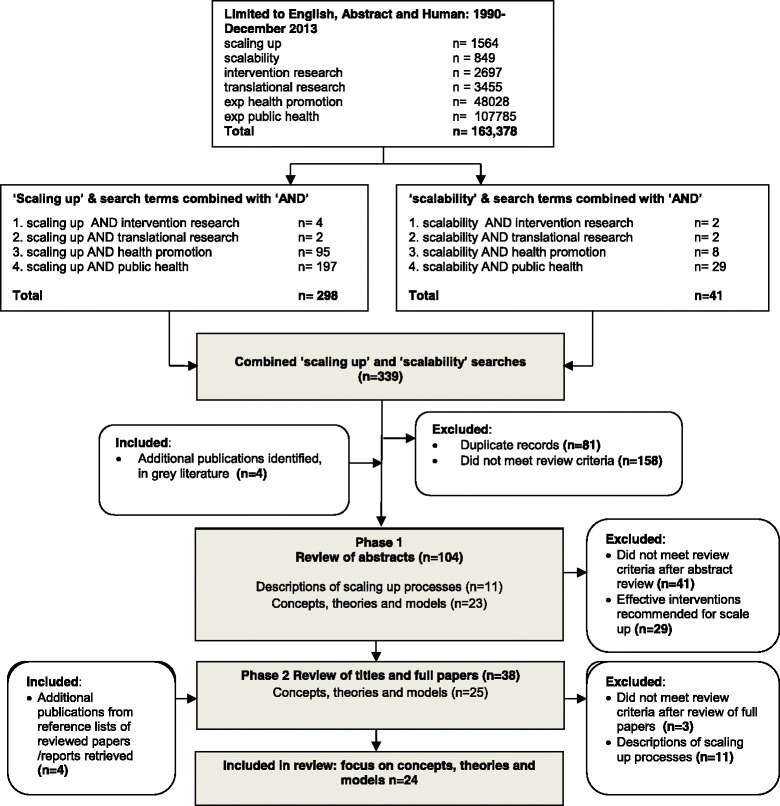
BACKGROUND: To maximise the impact of public health research, research interventions found to be effective in improving health need to be scaled up and delivered on a population-wide basis. Theoretical frameworks and approaches are useful for describing and understanding how effective interventions are scaled up from small trials into broader policy and practice and can be used as a tool to facilitate effective scale-up. The purpose of this literature review was to synthesise evidence on scaling up public health interventions into population-wide policy and practice, with a focus on the defining and describing frameworks, processes and methods of scaling up public health initiatives. METHODS: The review involved keyword searches of electronic databases including MEDLINE, CINAHL, PsycINFO, EBM Reviews and Google Scholar between August and December 2013. Keywords included 'scaling up' and 'scalability', while the search terms 'intervention research', 'translational research', 'research dissemination', 'health promotion' and 'public health' were used to focus the search on public health approaches. Studies included in the review were published in English from January 1990 to December 2013 and described processes, theories or frameworks associated with scaling up public health and health promotion interventions. RESULTS: There is a growing body of literature describing frameworks for scaling health interventions, with the review identifying eight frameworks, the majority of which have an explicit focus on scaling up health action in low and middle income country contexts. Key success factors for scaling up included the importance of establishing monitoring and evaluation systems, costing and economic modelling of intervention approaches, active engagement of a range of implementers and the target community, tailoring the scaled-up approach to the local context, the use of participatory approaches, the systematic use of evidence, infrastructure to support implementation, strong leadership and champions, political will, well defined scale-up strategy and strong advocacy. CONCLUSIONS: Effective scaling up requires the systematic use of evidence, and it is essential that data from implementation monitoring is linked to decision making throughout the scaling up process. Conceptual frameworks can assist both policy makers and researchers to determine the type of research that is most useful at different stages of scaling up processes.
Overview
The claims and statistics of this paper haven’t been checked yet.
Run the check — free, no account needed. It reads the open-access text and checks the sources it cites.
Integrity signals
Registry
Cites
Statistics
Figures
Verification
Claims the paper makes
The claims and statistics of this paper haven’t been checked yet.
Run the check — free, no account needed. It reads the open-access text and checks the sources it cites.
Claims other papers make about this one
Each is checked against this paper’s own text: does it say what the citing paper says it does?
In the citing paper
“Examples of scale-up strategies include train-the-trainer initiatives, infrastructure development (supply chains, data systems), quality improvement collaboratives, benchmarking, policy advocacy, and recognition systems [42, 43].”
From Beyond “implementation strategies”: classifying the full range of strategies used in implementation science and practice (2017) · cites this paper as [42]
In the citing paper
“Targets level of individual, inner setting, and outer setting”
From Beyond “implementation strategies”: classifying the full range of strategies used in implementation science and practice (2017) · cites this paper as [42]
In the citing paper
“Motivation and capacity to integrate a specific EBI into practice”
From Beyond “implementation strategies”: classifying the full range of strategies used in implementation science and practice (2017) · cites this paper as [42]
In the citing paper
“Motivation and capacity to implement, and actual implementation of an EBI across multiple settings”
From Beyond “implementation strategies”: classifying the full range of strategies used in implementation science and practice (2017) · cites this paper as [42]
Self-check
Percentages, sums and reported differences re-computed from the paper’s own numbers.
The self-check needs the paper’s full text.
Citations
Cites
Rogers, E. M., Singhal, A., & Quinlan, M. M. (2019) · Routledge eBooks · doi:10.4324/9780203710753-35 · Cited by 37,670
(1998) · Cited by 13,501
Gluesing, J. C. (2012) · Sage eBooks · doi:10.4135/9781412994231.n14 · Cited by 3,264
How Can We Increase Translation of Research into Practice? Types of Evidence Needed
Glasgow, R. E., & Emmons, K. M. (2007) · Annual Review of Public Health · doi:10.1146/annurev.publhealth.28.021406.144145 · Cited by 1,050
Criteria for evaluating evidence on public health interventions
Rychetnik, L., Frommer, M., Hawe, P., & Shiell, A. (2002) · Journal of Epidemiology and Community Health · doi:10.1136/jech.56.2.119 · Cited by 1,042
WHO Health Promotion Glossary: new terms
Smith, B. J., Tang, K. C., & Nutbeam, D. (2006) · Health Promotion International · doi:10.1093/heapro/dal033 · Cited by 598
Milat, A., King, L., Bauman, A. E., & Redman, S. (2012) · Health Promotion International · doi:10.1093/heapro/dar097 · Cited by 439
Self-citationCost effectiveness analysis of strategies to combat malaria in developing countries
Morel, C. M., Lauer, J. A., & EVANS, D. B. (2005) · BMJ · doi:10.1136/bmj.38639.702384.ae · Cited by 308
Scaling up in international health: what are the key issues?
Mangham, L. J., & Hanson, K. (2010) · Health Policy and Planning · doi:10.1093/heapol/czp066 · Cited by 303
Scaling up global health interventions: A proposed framework for success
Yamey, G. (2011) · PLoS Medicine · doi:10.1371/journal.pmed.1001049 · Cited by 295
Research works printed but not linked: 8
- Productivity Commission. Strengthening evidence-based policy in the Australian Federation, volume 2: background paper. Canberra (AUST): Productivity Commission; 2010.
- McKeon R. Strategic review of health and medical research in Australia—better health through research. Canberra: Commonwealth of Australia; 2013.
- World Health Organization. ExpandNet: nine steps for developing a scaling-up strategy. Geneva: WHO; 2010.
- Norton W, Mittman B. Scaling-up health promotion/disease prevention programs in community settings: barriers, facilitators, and initial recommendations, Report Submitted to Patrick and Catherine Weldon Donaghue Medical Research Foundation. 2010.
- Kohl R, Cooley L. Scaling up—a conceptual and operational framework. Washington, DC: Management Systems International; 2003.
- Milat AJ, Newson R, King L. Increasing the scale of population health interventions: a guide. North Sydney: NSW Ministry of Health; 2014.
- Cooley LVR. Scaling Up - From Vision to Large‐Scale Change: A Management Framework for Practitioners. Washington: Management Systems International; 2012.
- Norman R, Haas M. Issues in the costing of large projects in health and healthcare. North Sydney: NSW Department of Health; 2009.
Cited by
Sorted by citations
Reis, R. S., Salvo, D., Ogilvie, D., Lambert, E. V., Goenka, S., & Brownson, R. C. (2016) · The Lancet · doi:10.1016/s0140-6736(16)30728-0 · Cited by 719
Leeman, J., Birken, S. A., Powell, B. J., Rohweder, C., & Shea, C. M. (2017) · Implementation Science · doi:10.1186/s13012-017-0657-x · Cited by 544
Koorts, H., Eakin, E., Estabrooks, P. A., Timperio, A. F., Salmon, J., & Bauman, A. E. (2018) · International Journal of Behavioral Nutrition and Physical Activity · doi:10.1186/s12966-018-0678-0 · Cited by 337
Self-citationIowa Model of Evidence‐Based Practice: Revisions and Validation
Collaborative, I. M., Buckwalter, K. C., Cullen, L., Hanrahan, K., Kleiber, C., McCarthy, A. M., Rakel, B. A., Steelman, V. M., Tripp‐Reimer, T., Tucker, S., et al. (2017) · Worldviews on Evidence-Based Nursing · doi:10.1111/wvn.12223 · Cited by 324
Mishra, M., Sudarsan, D., Santos, C. A. G., Mishra, S. K., Kamal, A. H. M., Goswami, S., Kalumba, A. M., Biswal, R., da Silva, R. M., dos Santos, C. A. C., et al. (2023) · Environment Development and Sustainability · doi:10.1007/s10668-023-03225-w · Cited by 416
Metadata
- Authors
- Milat, A. J., Bauman, A., & Redman, S.
- Affiliations
- The University of Sydney (AU)
- Sax Institute (AU)
- Corresponding author
- Milat, Andrew J.
- Venue
- Implementation Science
- Published
- 2015-08-12
- Volume
- 10
- Issue
- 1
- Pages
- 113-113
- ISSN
- 1748-5908 (ISSN-L)
- PMC
- PMC4533941
- OpenAlex
- W2160180972
- Cited by
- 366
- References
- 44
- Citations by year
- 2026: 26 · 2025: 32 · 2024: 28 · 2023: 48 · 2022: 45 · 2021: 58 · 2020: 39 · 2019: 36 · 2018: 29 · 2017: 14 · 2016: 10 · 2015: 1
- FWCI
- 3.26
- Type
- journal article
- Language
- en
- Open access
- gold
- doi.org
- Licence
- Locations
- Implementation Science (publishedVersion, cc-by)
- Europe PMC (PubMed Central) (publishedVersion, cc-by)
- PubMed Central (publishedVersion, cc-by)
- PubMed (publishedVersion)
- Topics
- Health Sciences › Health Professions › General Health Professions › Health Policy Implementation Science
- Health Sciences › Medicine › Public Health, Environmental and Occupational Health › Public Health Policies and Education
- Social Sciences › Public Administration › Evaluation and Performance Assessment
- Keywords
- scale-up, public health interventions, success factors, health promotion, translational research, research dissemination, implementation monitoring and evaluation, participatory approach, political will, advocacy, leadership, low- and middle-income countries, evidence-based decision making
- MeSH terms
- Humans, Public Health Administration, Program Evaluation, Program Development, Models, Organizational, Capacity Building
About these checks
Registry, retraction, Cites and statistics results are computed, not judged, with one exception: a printed reference that no index lists is read once by a model before it counts as a citation error. Claims are extracted by a model and kept only when their quote appears verbatim in the text; each cited source is then checked, with a model’s help, for whether it says what the claim relies on. Those verdicts can be wrong — read the claim’s quote and the cited source before relying on one.
Statistics and arithmetic are recomputed, not judged.
Confidence bands are shown only for fields calibrated on our annotated test set. None is calibrated yet, so no band is shown.
What counts as a claim ›How we measure confidence ›How we check this ›
Are you an author, or do you see a problem with this page? Request a review
