

Behavior change interventions and policies influencing primary healthcare professionals’ practice—an overview of reviews
Open accessThe DOI matches its Crossref record; 161 of the 165 references it cites were found in a registry or an index.
Abstract
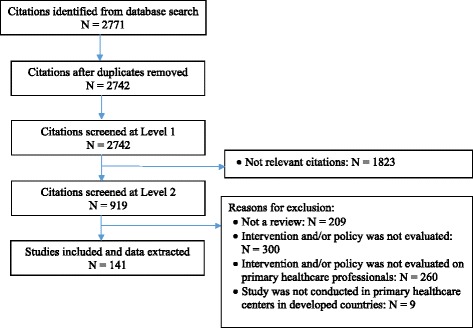
BACKGROUND: There is a plethora of interventions and policies aimed at changing practice habits of primary healthcare professionals, but it is unclear which are the most appropriate, sustainable, and effective. We aimed to evaluate the evidence on behavior change interventions and policies directed at healthcare professionals working in primary healthcare centers. METHODS: Study design: overview of reviews. DATA SOURCE: MEDLINE (Ovid), Embase (Ovid), The Cochrane Library (Wiley), CINAHL (EbscoHost), and grey literature (January 2005 to July 2015). STUDY SELECTION: two reviewers independently, and in duplicate, identified systematic reviews, overviews of reviews, scoping reviews, rapid reviews, and relevant health technology reports published in full-text in the English language. DATA EXTRACTION AND SYNTHESIS: two reviewers extracted data pertaining to the types of reviews, study designs, number of studies, demographics of the professionals enrolled, interventions, outcomes, and authors' conclusions for the included studies. We evaluated the methodological quality of the included studies using the AMSTAR scale. For the comparative evaluation, we classified interventions according to the behavior change wheel (Michie et al.). RESULTS: Of 2771 citations retrieved, we included 138 reviews representing 3502 individual studies. The majority of systematic reviews (91%) investigated behavior and practice changes among family physicians. Interactive and multifaceted continuous medical education programs, training with audit and feedback, and clinical decision support systems were found to be beneficial in improving knowledge, optimizing screening rate and prescriptions, enhancing patient outcomes, and reducing adverse events. Collaborative team-based policies involving primarily family physicians, nurses, and pharmacists were found to be most effective. Available evidence on environmental restructuring and modeling was found to be effective in improving collaboration and adherence to treatment guidelines. Limited evidence on nurse-led care approaches were found to be as effective as general practitioners in patient satisfaction in settings like asthma, cardiovascular, and diabetes clinics, although this needs further evaluation. Evidence does not support the use of financial incentives to family physicians, especially for long-term behavior change. CONCLUSIONS: Behavior change interventions including education, training, and enablement in the context of collaborative team-based approaches are effective to change practice of primary healthcare professionals. Environmental restructuring approaches including nurse-led care and modeling need further evaluation. Financial incentives to family physicians do not influence long-term practice change.
Overview
The claims and statistics of this paper haven’t been checked yet.
Free: it reads the open-access text and checks the first 5 claims that cite a source we can check. Create a free account to check every claim.
Integrity signals
Registry
Cites
Statistics
Figures
Verification
Claims the paper makes
The claims and statistics of this paper haven’t been checked yet.
Free: it reads the open-access text and checks the first 5 claims that cite a source we can check. Create a free account to check every claim.
Claims other papers make about this one
Each is checked against this paper’s own text: does it say what the citing paper says it does?
The source backs part of the claim, not all of it — or backs it for a different population, condition or comparison.
In the citing paper
“Costly pay-for-performance interventions appear to influence short-term GP behaviour change, but not long-term, and do not appear to translate to improved patient outcomes [63,64].”
From General practitioners’ views on managing knee osteoarthritis: a thematic analysis of factors influencing clinical practice guideline implementation in primary care (2018) · cites this paper as [64]
Experimental — accuracy not yet measured
Self-check
Percentages, sums and reported differences re-computed from the paper’s own numbers.
The self-check needs the paper’s full text.
Citations
Cites
1 retracted
Nursing record systems: effects on nursing practice and healthcare outcomes
Urquhart, C., Currell, R., Grant, M. J., & Hardiker, N. R. (2009) · Cochrane Database of Systematic Reviews · doi:10.1002/14651858.cd002099.pub2 · Cited by 243
RetractedMichie, S., van Stralen, M. M., & West, R. (2011) · Implementation Science · doi:10.1186/1748-5908-6-42 · Cited by 13,697
Development of AMSTAR: A measurement tool to assess the methodological quality of systematic reviews
Shea, B. J., Grimshaw, J. M., Wells, G. A., Boers, M., Andersson, N., Hamel, C., Porter, A. C., Tugwell, P., Moher, D., & Bouter, L. M. (2007) · BMC Medical Research Methodology · doi:10.1186/1471-2288-7-10 · Cited by 4,374
(2001) · PubMed · Cited by 1,709
Armijo‐Olivo, S., Stiles, C. R., Hagen, N. A., Biondo, P. D., & Cummings, G. G. (2012) · Journal of Evaluation in Clinical Practice · doi:10.1111/j.1365-2753.2010.01516.x · Cited by 1,539
Interventions for providers to promote a patient-centred approach in clinical consultations
Dwamena, F., Holmes-Rovner, M., Gaulden, C. M., Jorgenson, S., Sadigh, G., Sikorskii, A., Lewin, S., Smith, R. C., Coffey, J., Olomu, A., et al. (2012) · Cochrane Database of Systematic Reviews · doi:10.1002/14651858.cd003267.pub2 · Cited by 1,227
Midwife-led continuity models versus other models of care for childbearing women
Sandall, J., Soltani, H., Gates, S., Shennan, A., & Devane, D. (2013) · Cochrane Database of Systematic Reviews · doi:10.1002/14651858.cd004667.pub3 · Cited by 1,226
Collaborative care for depression and anxiety problems
Archer, J., Bower, P., Gilbody, S., Lovell, K., Richards, D., Gask, L., Dickens, C., & Coventry, P. (2012) · Cochrane Database of Systematic Reviews · doi:10.1002/14651858.cd006525.pub2 · Cited by 1,126
Substitution of doctors by nurses in primary care
Laurant, M., Reeves, D., Hermens, R., Braspenning, J., Grol, R., & Sibbald, B. (2005) · Cochrane Database of Systematic Reviews · doi:10.1002/14651858.cd001271.pub2 · Cited by 935
Interventions for improving the adoption of shared decision making by healthcare professionals
Légaré, F., Ratté, S., Stacey, D., Kryworuchko, J., Gravel, K., Graham, I. D., & Turcotte, S. (2010) · Cochrane Database of Systematic Reviews · doi:10.1002/14651858.cd006732.pub2 · Cited by 823
Research works printed but not linked: 6
- PHAC Public health agency of Canada: chronic disease infobase 2014
- Mirolla M The cost of chronic disease in Canada 2004
- Scholle STP Peikes D Han E Genevro J Engaging patients and families in the medical home (prepared by Mathematica Policy Research under contract no. HHSA290200900019ITO2.) AHRQ Publication no. 10-0083-EF 2010 Rockville Agency for Healthcare Research and Quality
- Institute of Medicine Committee on the Future of Primary C Donaldson M Yordy K Vanselow N Defining Primary Care: An Interim Report 1994 Washington (DC) National Academies Press (US) 25101391
- Vahidi RGM A systematic review of the effect of payment mechanisms on family physicians service provision and referral rate behavior J Pak Med Students 2013 3 54 60
- Jackson GL Powers BJ Chatterjee R Bettger JP Kemper AR Hasselblad V Dolor RJ Irvine RJ Heidenfelder BL Kendrick AS Improving patient care. The patient centered medical home. a systematic review Ann Intern Med 2013 158 169 178 10.7326/0003-4819-158-3-201302050-00579 24779044 · DOI · Paper page
Cited by
Items 201–244 of 244
Brewster, I., Anson, L., Clingan, R., & Wijeratne, A. (2025) · Cureus · doi:10.7759/cureus.97761
“Systematic reviews show that multifaceted interventions (e.g., audit with feedback, digital prompts, and education) are more effective than single-mode interventions [8].”
Esteban-Fabró, R., Coma, E., Marin-Gomez, F. X., Hermosilla, E., Méndez-Boo, L., Guiriguet, C., Facchini, G., Violán, C., Nicodemo, C., & Vidal‐Alaball, J. (2025) · British Journal of General Practice · doi:10.3399/bjgp.2025.0518
“14,23,24,42 More than half of late-incentivised indicators improved during the information-only period, which supports earlier evidence on the sustained benefits of non-financial interventions.”
Zahroh, R. I., Kneale, D., Sutcliffe, K., Corona, M. V., Opiyo, N., Homer, C., Betrán, A. P., & Bohren, M. A. (2023) · Figshare · doi:10.6084/m9.figshare.22603684
Zahroh, R. I., Kneale, D., Sutcliffe, K., Corona, M. V., Opiyo, N., Homer, C., Betrán, A. P., & Bohren, M. A. (2023) · Figshare · doi:10.6084/m9.figshare.22603669
Whittaker, E. M. (2021) · Edge Hill University Research Information Repository (Edge Hill University) · doi:10.13140/rg.2.2.19716.44167 · Cited by 1
van Gestel, L. C., Adriaanse, M. A., Kanis, S. L., Mensink-Bout, S. M., Schoones, J. W., Numans, M. E., Kiefte-de Jong, J. C., & van den Brink, G. (2024) · Figshare · doi:10.6084/m9.figshare.26019608
van Gestel, L. C., Adriaanse, M. A., Kanis, S. L., Mensink-Bout, S. M., Schoones, J. W., Numans, M. E., Kiefte-de Jong, J. C., & van den Brink, G. (2024) · Figshare · doi:10.6084/m9.figshare.26732461
Kanyinga, F. B., Gogovor, A., Dofara, S. G., Gadio, S., Tremblay, M., Daniel, S. J., Rivest, L., & Légaré, F. (2023) · Figshare · doi:10.6084/m9.figshare.24079660
Lo, K. B. N. (2020) · Carolina Digital Repository (University of North Carolina at Chapel Hill) · doi:10.17615/k5r0-v766 · Cited by 1
Disbeschl, S., Surgey, A., Roberts, J. L., Hendry, A., Lewis, R., Goulden, N., Hoare, Z., Williams, N., Anthony, B. F., Edwards, R. T., et al. (2021) · Figshare · doi:10.6084/m9.figshare.14462644
Zahroh, R. I., Kneale, D., Sutcliffe, K., Corona, M. V., Opiyo, N., Homer, C., Betrán, A. P., & Bohren, M. A. (2023) · Figshare · doi:10.6084/m9.figshare.22603681
Disbeschl, S., Surgey, A., Roberts, J. L., Hendry, A., Lewis, R., Goulden, N., Hoare, Z., Williams, N., Anthony, B. F., Edwards, R. T., et al. (2021) · Figshare · doi:10.6084/m9.figshare.14462641
Krstic, S., Dennis, S., Southcombe, F., & Denney‐Wilson, E. (2024) · Figshare · doi:10.6084/m9.figshare.25495212
Disbeschl, S., Surgey, A., Roberts, J. L., Hendry, A., Lewis, R., Goulden, N., Hoare, Z., Williams, N., Anthony, B. F., Edwards, R. T., et al. (2021) · Figshare · doi:10.6084/m9.figshare.14462650
Zahroh, R. I., Kneale, D., Sutcliffe, K., Corona, M. V., Opiyo, N., Homer, C., Betrán, A. P., & Bohren, M. A. (2023) · Figshare · doi:10.6084/m9.figshare.22603675
Kanyinga, F. B., Gogovor, A., Dofara, S. G., Gadio, S., Tremblay, M., Daniel, S. J., Rivest, L., & Légaré, F. (2023) · Figshare · doi:10.6084/m9.figshare.24079648
van Gestel, L. C., Adriaanse, M. A., Kanis, S. L., Mensink-Bout, S. M., Schoones, J. W., Numans, M. E., Kiefte-de Jong, J. C., & van den Brink, G. (2024) · Figshare · doi:10.6084/m9.figshare.26732464
Delivering a Screening Programme for Atrial Fibrillation: a mixed methods investigation
Modi, R. N. (2023) · Apollo (University of Cambridge) · doi:10.17863/cam.97053 · Cited by 2
Zahroh, R. I., Kneale, D., Sutcliffe, K., Corona, M. V., Opiyo, N., Homer, C., Betrán, A. P., & Bohren, M. A. (2023) · Figshare · doi:10.6084/m9.figshare.22603687
Disbeschl, S., Surgey, A., Roberts, J. L., Hendry, A., Lewis, R., Goulden, N., Hoare, Z., Williams, N., Anthony, B. F., Edwards, R. T., et al. (2021) · Figshare · doi:10.6084/m9.figshare.14462647
Kanyinga, F. B., Gogovor, A., Dofara, S. G., Gadio, S., Tremblay, M., Daniel, S. J., Rivest, L., & Légaré, F. (2023) · Figshare · doi:10.6084/m9.figshare.24079654
Zahroh, R. I., Kneale, D., Sutcliffe, K., Corona, M. V., Opiyo, N., Homer, C., Betrán, A. P., & Bohren, M. A. (2023) · Figshare · doi:10.6084/m9.figshare.22603678
van Gestel, L. C., Adriaanse, M. A., Kanis, S. L., Mensink-Bout, S. M., Schoones, J. W., Numans, M. E., Kiefte-de Jong, J. C., & van den Brink, G. (2024) · Figshare · doi:10.6084/m9.figshare.26019713
Kanyinga, F. B., Gogovor, A., Dofara, S. G., Gadio, S., Tremblay, M., Daniel, S. J., Rivest, L., & Légaré, F. (2023) · Figshare · doi:10.6084/m9.figshare.24079657
Exploring the use of self-report behavioural science questionnaires in sub-Saharan African countries
Weir, C. (2023) · Stirling Online Research Repository (University of Stirling) · Cited by 2
Promoting Early Recognition and Management of Valley Fever in Primary Care Settings
Foley, R. R., & Foley, R. R. (2024) · UA Campus Repository (The University of Arizona)
Sustainable solutions for respiratory and airway biomedical devices
Webb, C. (2024) · Brunel University Research Archive (BURA) (Brunel University London) · Cited by 1
Landspítalinn: Þarfagreining. Mannafli, árangurstengingar og framleiðni
Hjartarson, Þ. (2023) · Skemman
Physician behaviour and quality of care in healthcare
Stöcker, A. (2025) · Kölner Universitäts PublikationsServer (Universität zu Köln)
Meerhoff, G. A. (2024) · Radboud Repository (Radboud University)
Lifelong influence of sports and physical activity
(2025) · Frontiers research topics · doi:10.3389/978-2-8325-6371-7
Lambrechts, D., Declercq, A., & Put, J. (2025) · Lirias
Oral Diseases and Prevention in Pregnant Women, Infants and Preschool Children
(2026) · Frontiers research topics · doi:10.3389/978-2-8325-7395-2
Haseldine, C., O’Donoghue, G., Kearney, P. M., Riordan, F., Humphreys, M., Kirby, L., & McHugh, S. (2026) · BMJ Open · doi:10.1136/bmjopen-2025-104300 · Cited by 1
Barzideh, A. (2024) · TSpace (University of Toronto) · Cited by 1
Vuijk, D. A., Krijnen, P., Eggebeen, N. J., Schipper, I. B., van Bodegom‐Vos, L., & Termaat, M. F. (2026) · Journal of Bone and Joint Surgery · doi:10.2106/jbjs.25.01663
Nwaokorie, C., Abdullahi, A. M., Kangkum, N., Amasiatu, V. C., Aigbogun, E., & Igbokwe, U. (2026) · International Journal of Gynecology & Obstetrics · doi:10.1002/ijgo.71218
Mao, Y., Jie, L., Zhang, B., Kang, D., Xiao, J., & Pang, H. (2026) · Risk Management and Healthcare Policy · doi:10.2147/rmhp.s618402
“This result also explains the divergent views on the role of economic incentives in previous studies, 17,42 10 alone cannot offset the negative impact caused by the absence of non-economic incentives.”
Christe, G., Darlow, B., Hartvigsen, J., Stanic, J., Rosa, M., Virdee, J., Martel, M., Lötscher-Stamm, M., Wieser, S., Schaller, D., et al. (2026) · Contemporary Clinical Trials Communications · doi:10.1016/j.conctc.2026.101679
Anand-Kumar, V., Schreier, M., Giné‐Garriga, M., Ortmann, M., Belmokhtar, F.-Z., Grineviciute, S., Quan, T. N.-H., Aluru, L., & Lippke, S. (2026) · JMIR Human Factors · doi:10.2196/87519
“Behavioral science, particularly the Behavior Change Wheel (BCW) framework and the corresponding Capability, Opportunity, Motivation–Behavior (COM-B) model, offer a systematic way to map how digital tools can build patient capabilities, create opportunities, and motivate change [34].”
Russell, G., Jia, L., Stocks, N. P., Nelson, M. R., Edwards, J., Jensen, G., Hunt, E., Gwini, S. M., Akram, M., Morris, H., et al. (2026) · Journal of Human Hypertension · doi:10.1038/s41371-026-01207-9
Liu, R., & Xing, H. (2026) · Research Square · doi:10.21203/rs.3.rs-10590861/v1
Metadata
- Authors
- Chauhan, B. F., Jeyaraman, M., Mann, A. S., Lys, J., Skidmore, B., Sibley, K. M., Abou-Setta, A., & Zarychanksi, R.
- Affiliations
- Children's Hospital Research Institute of Manitoba (CA)
- George & Fay Yee Centre for Healthcare Innovation (CA)
- CancerCare Manitoba (CA)
- Corresponding author
- Chauhan, Bhupendrasinh F.
- Venue
- Implementation Science
- Published
- 2017-01-05
- Volume
- 12
- Issue
- 1
- Pages
- 3-3
- ISSN
- 1748-5908 (ISSN-L)
- PMC
- PMC5216570
- OpenAlex
- W2569344334
- Cited by
- 210
- References
- 165
- Citations by year
- 2026: 9 · 2025: 19 · 2024: 25 · 2023: 32 · 2022: 28 · 2021: 32 · 2020: 21 · 2019: 18 · 2018: 16 · 2017: 10
- FWCI
- 3.13
- Type
- journal article
- Language
- en
- Update notices
- correction (2017-03-17)
- Open access
- gold
- doi.org
- Licence
- cc-by
- Locations
- Implementation Science (publishedVersion, cc-by)
- PubMed Central (publishedVersion, cc-by)
- PubMed (publishedVersion)
- Funders
- Canadian Institutes of Health Research
- Topics
- Health Sciences › Health Professions › General Health Professions › Health Policy Implementation Science
- Health Sciences › Medicine › Public Health, Environmental and Occupational Health › Clinical practice guidelines implementation
- Social Sciences › Education › Innovations in Medical Education
- Keywords
- behaviour change interventions, health policy, primary healthcare professionals, general practitioners, continuing medical education, audit and feedback, clinical decision support systems, team-based care, nurse-led care, financial incentives, environmental restructuring, modeling, Behaviour Change Wheel, guideline adherence
- MeSH terms
- Health Personnel, Health Policy, Humans, Practice Patterns, Physicians', Primary Health Care, Professional Practice
About these checks
Registry, retraction, Cites and statistics results are computed, not judged, with one exception: a printed reference that no index lists is read once by a model before it counts as a citation error. Claims are extracted by a model and kept only when their quote appears verbatim in the text; each cited source is then checked, with a model’s help, for whether it says what the claim relies on. Those verdicts can be wrong — read the claim’s quote and the cited source before relying on one.
Statistics and arithmetic are recomputed, not judged.
Confidence bands are shown only for fields calibrated on our annotated test set. None is calibrated yet, so no band is shown.
What counts as a claim ›How we measure confidence ›How we check this ›
Are you an author, or do you see a problem with this page? Request a review
Data sources
Bibliographic data: Semantic Scholar, OpenAlex, Crossref.
Contains information from the Semantic Scholar Academic Graph Datasets, made available under the ODC Attribution License (ODC-BY 1.0).
Semantic Scholar’s data is described in: Kinney, R., et al. (2023). The Semantic Scholar Open Data Platform. arXiv:2301.10140.
