

Integrating knowledge and action: learnings from an implementation program for food security and food sovereignty with First Nations communities within Canada
Open accessPublished version of a preprint
The DOI matches its Crossref record; 60 of the 60 references it cites were found in a registry or an index.
Abstract
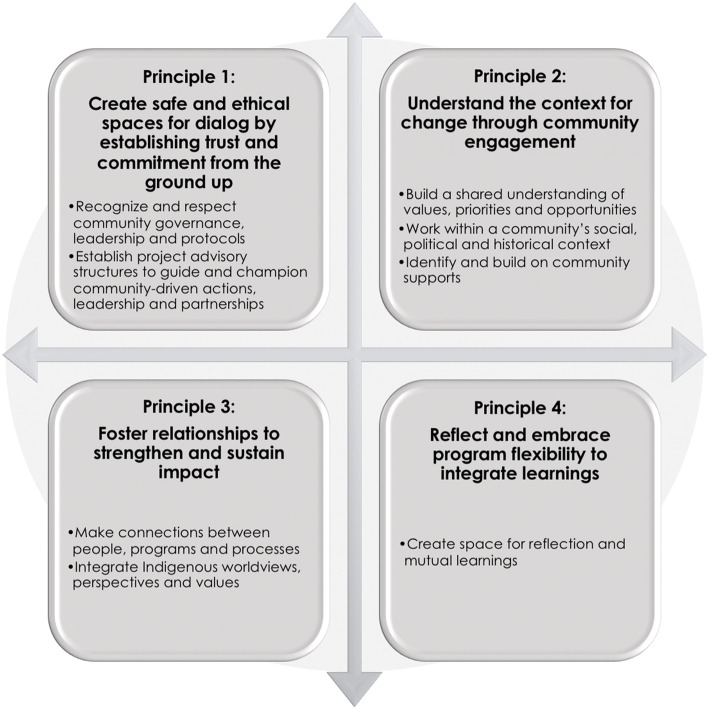
Background: Collaborative approaches to knowledge translation (KT) are important for advancing community-engaged research. However, there is a need for examples of participatory approaches that have effectively supported public health research, program development, and implementation with First Nations communities. To strengthen KT with communities, we proposed a set of guiding principles for participatory planning and action for local food system change. Principles emerged from a cross-community analysis of Learning Circles: Local Healthy Food to School (LC:LHF2S) a participatory program (2015–2019) for Indigenous food system action. The objective was to identify guiding principles for participatory planning and action from key learnings and successes on scaling-up of the Learning Circles (LC) model vertically in Haida Nation, British Columbia (BC), and horizontally in three distinct community contexts: Gitxsan Nation, Hazelton /Upper Skeena, BC; Ministikwan Lake. The application of these principles is discussed in the context of our ongoing partnership with Williams Treaties First Nations to support community planning to enhance food security and sovereignty. Methods: A cross-community thematic analysis was conducted and guided by an implementation science framework, Foster-Fishman and Watson’s (2012) ABLe Change Framework, to identify key learnings and successes from adapting the LC approach. Information gathered from interviews ( n = 55) and meeting reports ( n = 37) was thematically analyzed to inform the development of guiding principles. Community sense-making of findings informed applicability in a new community context embarking on food systems work. Results: Emergent guiding principles for participatory food system planning and action are described within four main areas: (1) create safe and ethical spaces for dialog by establishing trust and commitment from the ground up, (2) understand the context for change through community engagement, (3) foster relationships to strengthen and sustain impact, and (4) reflect and embrace program flexibility to integrate learnings. Conclusions: Emergent principles offer guidance to supporting Indigenous community-led research and mobilization of knowledge into action. Principles are intended to support researchers and health system administrators with taking a collaborative approach that fosters relationships and integration of community leadership, knowledge, and action for food system change. Application of principles with implementation frameworks can strengthen KT in Indigenous contexts by incorporating community protocols and perspectives in support of Indigenous self-determined priorities.
Overview
The claims and statistics of this paper haven’t been checked yet.
Free: it reads the open-access text and checks the first 5 claims that cite a source we can check. Create a free account to check every claim.
Integrity signals
Registry
Cites
Statistics
Figures
Verification
Claims the paper makes
The claims and statistics of this paper haven’t been checked yet.
Free: it reads the open-access text and checks the first 5 claims that cite a source we can check. Create a free account to check every claim.
Claims other papers make about this one
Each is checked against this paper’s own text: does it say what the citing paper says it does?
The source backs part of the claim, not all of it — or backs it for a different population, condition or comparison.
In the citing paper
“While champions proved to be key enablers for program planning, relying on a small number of people in the community also came with challenges [17–21].”
From Scale up of the learning circles: a participatory action approach to support local food systems in four diverse First Nations school communities within Canada (2024) · cites this paper as [21]
Experimental — accuracy not yet measuredThe cited source says what the claim attributes to it.
In the citing paper
“The LC fosters multi-sector relationships, collaboration, and shared decision-making with a broad range of people with interest in locally grown and, as emerged, traditional food [15–21].”
Self-check
Percentages, sums and reported differences re-computed from the paper’s own numbers.
The self-check needs the paper’s full text.
Citations
Cites
Research Design: Qualitative, Quantitative, and Mixed Methods Approaches
Creswell, J. W. (1994) · Cited by 35,484
Braun, V., & Clarke, V. (2012) · APA handbook of research methods in psychology, Vol 2: Research designs: Quantitative, qualitative, neuropsychological, and biological. · doi:10.1037/13620-004 · Cited by 10,299
Action Research and Minority Problems
Lewin, K. (1946) · Journal of Social Issues · doi:10.1111/j.1540-4560.1946.tb02295.x · Cited by 6,554 · cited 2×
“The term “action research” was coined by Lewin [53] who linked community engagement for social planning and action throughout the research process [53].”
BackgroundREVIEW OF COMMUNITY-BASED RESEARCH: Assessing Partnership Approaches to Improve Public Health
Israel, B. A., Schulz, A. J., Parker, E. A., & Becker, A. B. (1998) · Annual Review of Public Health · doi:10.1146/annurev.publhealth.19.1.173 · Cited by 5,893 · cited 2×
“Principles for CBPR by Israel, Shulz, Parker, and Becker (1998) emphasize the importance of prioritizing community needs, building on existing strengths, restoring power and control, and reciprocity [58].”
BackgroundMethodLost in knowledge translation: Time for a map?
Graham, I. D., Logan, J., Harrison, M. B., Straus, S. E., Tetroe, J., Caswell, W., & Robinson, N. (2006) · Journal of Continuing Education in the Health Professions · doi:10.1002/chp.47 · Cited by 4,705 · cited 3×
“When used in conjunction with implementation models or frameworks such as ABLe Change and the KTA cycle [5, 38, 59, 60], opportunities for centering Indigenous voices in iterative planning and strengthening collaborative action can be supported.”
BackgroundMethodWelcome to Implementation Science
Eccles, M. P., & Mittman, B. S. (2006) · Implementation Science · doi:10.1186/1748-5908-1-1 · Cited by 2,254 · cited 2×
“Implementation research is the “scientific study of methods to promote the systematic uptake of clinical research findings and other evidence-based practices into routine practice and, hence, to improve the quality and effectiveness of health care” [11, pg.1].”
BackgroundMethodUsing Community-Based Participatory Research to Address Health Disparities
Wallerstein, N. B., & Duran, B. (2006) · Health Promotion Practice · doi:10.1177/1524839906289376 · Cited by 2,243
Decolonizing Methodologies: Research and Indigenous Peoples
Tuhiwai Smith, L. (2021) · doi:10.5040/9781350225282 · Cited by 2,062
Theme development in qualitative content analysis and thematic analysis
Vaismoradi, M., Jones, J., Turunen, H., & Snelgrove, S. (2016) · Journal of Nursing Education and Practice · doi:10.5430/jnep.v6n5p100 · Cited by 1,994
An introduction to implementation science for the non-specialist
Bauer, M. S., Damschroder, L., Hagedorn, H., Smith, J., & Kilbourne, A. M. (2015) · BMC Psychology · doi:10.1186/s40359-015-0089-9 · Cited by 1,611 · cited 3×
“…to support community-led actions [1, 2, 16–23 , 29 The LC:LHF2S was a participatory initiative (2015– 2019) within four community contexts within Canada: 1 Implementation science emerged as a field to bridge the research-to-prac-tice gap and facilitate the spread of evidence-based practices [7].”
Background
Research works printed but not linked: 1
- Kovach M. Indigenous methodologies: characteristics, conversations, and contexts. Second edition. Toronto: University of Toronto press; 2021.
Cited by
Zuza, E. J., Lambert, K., MacMillan, T., Chiyemura, F., Araya, Y., Bowskill, V., Oluseye, A., Kanui, M. N., Keding, G. B., Butler, G., et al. (2024) · Food and Energy Security · doi:10.1002/fes3.558 · Cited by 66
“…is complex, ranging from the preservation of plant, tree, fungi, and animal species, sustainable management of natural resources, and community resilience practices for coping with natural disasters to improved health and well-being through traditional medicine and nutrition (Domingo et al., 2023).”
Tjilen, A. P., Tambaip, B., Dharmawan, B., Adrianus, A., Riyanto, P., & Ohoiwutun, Y. (2024) · Corporate Governance and Organizational Behavior Review · doi:10.22495/cgobrv8i1p12 · Cited by 36
Rivera, I., de León, D. D., & Pérez-Salazar, M. D. R. (2024) · Frontiers in Sustainable Food Systems · doi:10.3389/fsufs.2024.1450321 · Cited by 20
Melro, C. M., Gilfoyle, M., Ballantyne, C., Augustine, L., Brass, G. M., Rabbitskin, N., Hutt‐MacLeod, D., Iyer, S. N., & Mushquash, C. J. (2025) · Research Involvement and Engagement · doi:10.1186/s40900-025-00721-3 · Cited by 10
“It seeks to understand the context in which health service delivery and research will be implemented and requires partnerships to reflect and embrace flexibility and trust throughout the process [9].”
Glaros, A., & Newell, R. (2025) · Agriculture · doi:10.3390/agriculture15070718 · Cited by 8
Metadata
- Authors
- Domingo, A., Yessis, J., Charles, K.-A., Skinner, K., & Hanning, R. M.
- Affiliations
- University of Waterloo (CA)
- Corresponding author
- Domingo, Ashleigh
- Venue
- Implementation Science
- Published
- 2023-08-12
- Volume
- 18
- Issue
- 1
- Pages
- 34-34
- ISSN
- 1748-5908 (ISSN-L)
- PMC
- PMC10422772
- OpenAlex
- W4385780658
- Cited by
- 16
- References
- 60
- Citations by year
- 2026: 6 · 2025: 5 · 2024: 4 · 2023: 1
- FWCI
- 4.32
- Type
- journal article
- Language
- en
- Open access
- gold
- doi.org
- Licence
- cc-by
- creativecommons.org/licenses/by/4.0 (tdm)
- creativecommons.org/licenses/by/4.0 (vor)
- Locations
- Implementation Science (publishedVersion, cc-by)
- Research Square (acceptedVersion, cc-by)
- PubMed Central (publishedVersion, cc-by)
- PubMed (publishedVersion)
- DOAJ (DOAJ: Directory of Open Access Journals) (submittedVersion, cc-by-sa)
- Funders
- Canadian Institutes of Health Research (137732)
- Topics
- Social Sciences › Health › Indigenous Health, Education, and Rights
- Health Sciences › Health Professions › General Health Professions › Health Policy Implementation Science
- Health Sciences › Medicine › Public Health, Environmental and Occupational Health › Community Health and Development
- Keywords
- knowledge translation, First Nations, Indigenous food sovereignty, food security, local food systems, participatory planning, study circles, school food programs, community participation, guiding principles, Indigenous self-determination, community protocols, scale-up
- MeSH terms
- Food Security, British Columbia, Canada, Humans, Longitudinal Studies, Public Health
About these checks
Registry, retraction, Cites and statistics results are computed, not judged, with one exception: a printed reference that no index lists is read once by a model before it counts as a citation error. Claims are extracted by a model and kept only when their quote appears verbatim in the text; each cited source is then checked, with a model’s help, for whether it says what the claim relies on. Those verdicts can be wrong — read the claim’s quote and the cited source before relying on one.
Statistics and arithmetic are recomputed, not judged.
Confidence bands are shown only for fields calibrated on our annotated test set. None is calibrated yet, so no band is shown.
What counts as a claim ›How we measure confidence ›How we check this ›
Are you an author, or do you see a problem with this page? Request a review
How to cite
Cite CoChat for the checks on this page, and the paper for its own findings.
- This page
- CoChat. (2026). Citation check: Integrating knowledge and action: learnings from an implementation program for food security and food sovereignty with First Nations communities within Canada. https://app.cochat.ai/papers/10.1186/s13012-023-01291-2
- The paper
- Domingo, A., Yessis, J., Charles, K.-A., Skinner, K., & Hanning, R. M. (2023). Integrating knowledge and action: learnings from an implementation program for food security and food sovereignty with First Nations communities within Canada. Implementation Science. https://doi.org/10.1186/s13012-023-01291-2
Data sources
Bibliographic data: Semantic Scholar, OpenAlex, Crossref.
Contains information from the Semantic Scholar Academic Graph Datasets, made available under the ODC Attribution License (ODC-BY 1.0).
Semantic Scholar’s data is described in: Kinney, R., et al. (2023). The Semantic Scholar Open Data Platform. arXiv:2301.10140.
