

Cost-of-illness studies of inherited retinal diseases: a systematic review
Open accessThe DOI matches its Crossref record; 31 of the 31 references it cites were found in a registry or an index.
Abstract
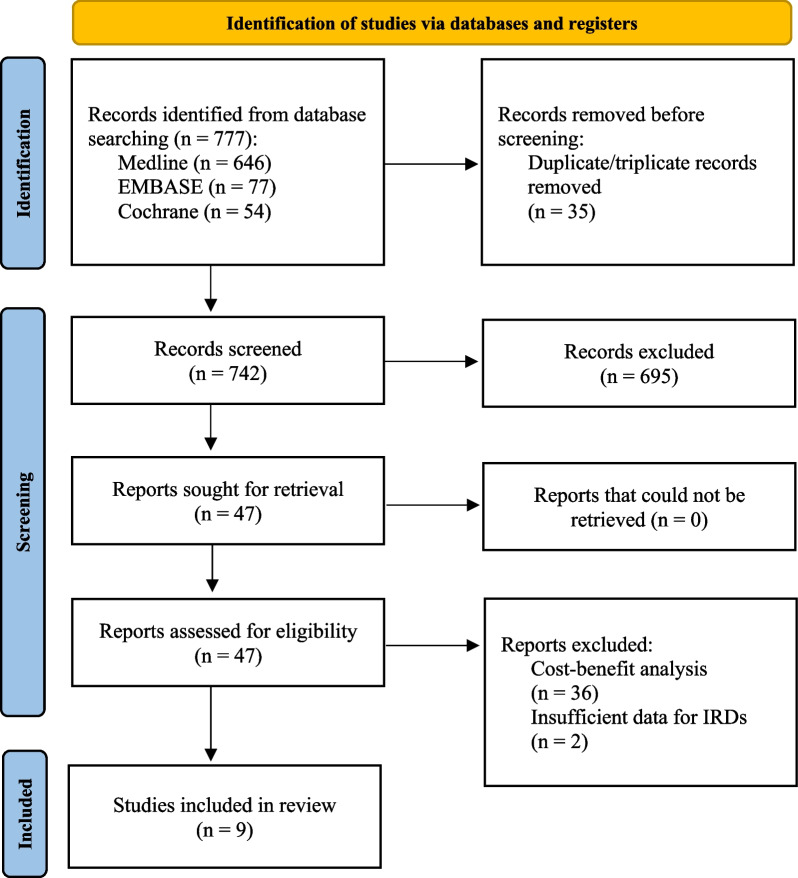
Background: While health care and societal costs are routinely modelled for most diseases, there is a paucity of comprehensive data and cost-of-illness (COI) studies for inherited retinal diseases (IRDs). This lack of data can lead to underfunding or misallocation of resources. A comprehensive understanding of the COI of IRDs would assist governmental and healthcare leaders in determining optimal resource allocation, prioritizing funding for research, treatment, and support services for these patients. Methods: Following PRISMA guidelines, a literature search was conducted using Medline, EMBASE and Cochrane databases, from database inception up to 30 Jun 2023, to identify COI studies related to IRD. Original studies in English, primarily including patients with IRDs, and whose main study objective was the estimation of the costs of IRDs and had sufficiently detailed methodology to assess study quality were eligible for inclusion. To enable comparison across countries and studies, all annual costs were standardized to US dollars, adjusted for inflation to reflect their current value and recalculated on a “per patient” basis wherever possible. The review protocol was registered in PROSPERO (registration number CRD42023452986). Results: A total of nine studies were included in the final stage of systematic review and they consistently demonstrated a significant disease burden associated with IRDs. In Singapore, the mean total cost per patient was roughly US$6926/year. In Japan, the mean total cost per patient was US$20,833/year. In the UK, the mean total cost per patient with IRD ranged from US$21,658 to US$36,549/year. In contrast, in the US, the mean total per-patient costs for IRDs ranged from about US$33,017 to US$186,051 per year. In Canada, these mean total per-patient costs varied between US$16,470 and US$275,045/year. Non-health costs constituted the overwhelming majority of costs as compared to healthcare costs; 87–98% of the total costs were due to non-health costs, which could be attributed to diminished quality of life, poverty, and increased informal caregiving needs for affected individuals. Conclusion: IRDs impose a disproportionate societal burden outside health systems. It is vital for continued funding into IRD research, and governments should incorporate societal costs in the evaluation of cost-effectiveness for forthcoming IRD interventions, including genomic testing and targeted therapies.
Overview
The claims and statistics of this paper haven’t been checked yet.
Free: it reads the open-access text and checks the first 5 claims that cite a source we can check. Create a free account to check every claim.
Integrity signals
Registry
Cites
Statistics
Figures
Verification
Claims the paper makes
The claims and statistics of this paper haven’t been checked yet.
Free: it reads the open-access text and checks the first 5 claims that cite a source we can check. Create a free account to check every claim.
Claims other papers make about this one
Each is checked against this paper’s own text: does it say what the citing paper says it does?
The cited source doesn’t support the claim as written.
In the citing paper
“The review identified 28 studies that varied in terms of disease of interest, sample size, methodology, as well as how costs were reported and valued, thus concurring with previous literature that found a high degree of heterogeneity across these types of studies [17, 21–23].”
From The economic impact of retinal diseases for which gene therapy is emerging: a systematic literature review (2025) · cites this paper as [17]
Checked by a reasoning model — may be wrong.
Experimental — accuracy not yet measuredThe source backs part of the claim, not all of it — or backs it for a different population, condition or comparison.
In the citing paper
“Previous literature reviews analysing costs associated with vision impairment and blindness found a high degree of heterogeneity across these studies in terms of size, methodology, as well as the way in which costs were defined and reported [17, 21–23].”
From The economic impact of retinal diseases for which gene therapy is emerging: a systematic literature review (2025) · cites this paper as [17]
Experimental — accuracy not yet measuredThe source backs part of the claim, not all of it — or backs it for a different population, condition or comparison.
In the citing paper
“With respect to IRDs, the only treatment currently on the market is a gene therapy, Luxturna (voretigene neparvovec), intended to treat RPE65 mediated Leber congenital amaurosis (LCA) and retinitis pigmentosa, and which was marketed at 450 000 USD per eye injection in the United States [17].”
From The economic impact of retinal diseases for which gene therapy is emerging: a systematic literature review (2025) · cites this paper as [17]
Experimental — accuracy not yet measured
Self-check
Percentages, sums and reported differences re-computed from the paper’s own numbers.
The self-check needs the paper’s full text.
Citations
Cites
The PRISMA 2020 statement: An updated guideline for reporting systematic reviews
Page, M. J., McKenzie, J. E., Bossuyt, P. M., Boutron, I., Hoffmann, T. C., Mulrow, C. D., Shamseer, L., Tetzlaff, J. M., Akl, E. A., Brennan, S. E., et al. (2021) · BMJ · doi:10.1136/bmj.n71 · Cited by 108,283
Russell, S., Bennett, J., Wellman, J. A., Chung, D. C., Yu, Z.-F., Tillman, A., Wittes, J., Pappas, J., Elci, O., McCague, S., et al. (2017) · The Lancet · doi:10.1016/s0140-6736(17)31868-8 · Cited by 1,952 · cited 1×
“%) passed multi-luminance mobility testing (MLMT) at the lowest luminance level tested, which measures functional vision at specified light levels, while no control participants did [12].”
BackgroundEvers, S., Goossens, M., de Vet, H., van Tulder, M., & Ament, A. (2005) · International Journal of Technology Assessment in Health Care · doi:10.1017/s0266462305050324 · Cited by 856 · cited 1×
“With reference to the Consensus on Health Economic Criteria (CHEC) list [16], the following inclusion criteria were adopted: (1) original study, (2) published or translated into the English language, (3) primarily including patients with inherited retinal diseases (e.g. retinitis pigmentosa), (4)…”
MethodDisability-adjusted life years: a critical review
Anand, S., & Hanson, K. (1997) · Journal of Health Economics · doi:10.1016/s0167-6296(97)00005-2 · Cited by 814 · cited 1×
“In two studies [6, 7], wellbeing costs were estimated using the World Health Organization (WHO) burden of disease methodology, which quantified the impact of pain, suffering, and premature mortality by measuring disability-adjusted life years (DALYs) [26].”
MethodCanada's universal health-care system: achieving its potential
Martin, D., Miller, A. P., Quesnel-Vallée, A., Caron, N. R., Vissandjée, B., & Marchildon, G. P. (2018) · The Lancet · doi:10.1016/s0140-6736(18)30181-8 · Cited by 559
Cost-of-illness studies of depression
Luppa, M., Heinrich, S., Angermeyer, M. C., König, H.-H., & Riedel-Heller, S. G. (2007) · Journal of Affective Disorders · doi:10.1016/j.jad.2006.07.017 · Cited by 353 · cited 2×
“In the area of health economics, although most researchers acknowledge the importance of incorporating productivity loss as a component of societal cost [4, 5, 29], opinions may differ when it comes to including wellbeing costs in these studies.”
BackgroundGlobal economic productivity losses from vision impairment and blindness
Marques, A. P., Ramke, J., Cairns, J., Butt, T., Zhang, J. H., Muirhead, D., Jones, I., Tong, B. A. M. A., Swenor, B. K., Faal, H., et al. (2021) · EClinicalMedicine · doi:10.1016/j.eclinm.2021.100852 · Cited by 236 · cited 1×
“…risk of poverty, diminished quality of life, limited employment prospects and increased financial burdens associated with informal caregiving [27, 28], although the unexpected finding of lower costs associated with injuries in the visually impaired cohort in the study by Kessel et al. [23]…”
BackgroundHeath Jeffery, R. C., Mukhtar, S. A., McAllister, I. L., Morgan, W. H., Mackey, D. A., & Chen, F. K. (2021) · Ophthalmic Genetics · doi:10.1080/13816810.2021.1913610 · Cited by 198 · cited 3×
“IRDs are caused by mutations in one of more than 317 mapped genes, affecting around 5 to 6 million people worldwide [3] and are a leading cause of blindness among working adults [1].”
BackgroundDurability of Voretigene Neparvovec for Biallelic RPE65-Mediated Inherited Retinal Disease
Maguire, A. M., Russell, S., Chung, D. C., Yu, Z.-F., Tillman, A., Drack, A. V., Simonelli, F., Leroy, B. P., Reape, K. Z., High, K. A., et al. (2021) · Ophthalmology · doi:10.1016/j.ophtha.2021.03.031 · Cited by 194 · cited 1×
“These improvements in functional vision and visual function were sustained in majority of the participants even after 3 and 4 years [13].”
BackgroundClinical Perspective: Treating RPE65-Associated Retinal Dystrophy
Maguire, A. M., Bennett, J., Aleman, E. M., Leroy, B. P., & Aleman, T. S. (2021) · Molecular Therapy · doi:10.1016/j.ymthe.2020.11.029 · Cited by 184 · cited 2×
“With the advent of novel gene therapies, current health systems are also not well-configured for large, one-time payments, which is the case of Luxturna (voretigene neparvovec-rzyl) [11].”
Background
Cited by
Ng, Q. X., Ong, C., Chan, K. E., Ong, T. S. K., Lim, I. J. X., Tang, A. S. P., Chan, H. W., & Koh, G. C. (2024) · Health Economics Review · doi:10.1186/s13561-024-00519-1 · Cited by 27
“Previously, many of these rare diseases had only symp-tom-relieving treatments [5]; today, with the advent of gene therapy, large strides have been made with novel treatments that significantly improve one’s quality of life [6].”
BackgroundSelf-citationBakir, M., Robertson, E. G., Chen, R. T., Nguyen, B. N., McFadyen, B., Makrai, E., Boyd, L., Boyd, R., Karandrews, S., Ayton, L. N., et al. (2025) · Disability and health journal · doi:10.1016/j.dhjo.2025.101820 · Cited by 12
Ng, Q. X., Chan, H. W., Lim, R. B. T., & Koh, G. C. (2025) · Disability and health journal · doi:10.1016/j.dhjo.2025.101819 · Cited by 10
Self-citationNg, Q. X., Tang, A. S. P., Chan, K. E., Chan, H. W., Howard, N., & Koh, G. C. (2025) · Disability and health journal · doi:10.1016/j.dhjo.2025.101826 · Cited by 11
Self-citationReal-World Research on Retinal Diseases Using Health Claims Database: A Narrative Review
Ahn, S. J. (2024) · Diagnostics · doi:10.3390/diagnostics14141568 · Cited by 9
“For example, inherited retinal diseases impose a significant societal burden in many countries due to the long-term effects of vision loss, reduced productivity, and the costs of treatments, such as gene therapy and retinal prostheses [110].”
BackgroundNg, Q. X., Chan, H. W., & Koh, G. C. (2025) · Journal of Community Genetics · doi:10.1007/s12687-025-00796-1 · Cited by 2
“This gap is significant given the extensive direct and indirect costs associated with the condition (Ng et al. 2024 ).”
Self-citationRPGR-Related Retinal Dystrophy in Latin America—A Collaborative Study
Varela, M. D., Moya, R., Luna, J. D., Ciccioli, M., Inga, M. E., Gras, J., Nuova, P. J., Capalbo, L., Antacle, A., Echandi, L. V., et al. (2025) · American Journal of Ophthalmology · doi:10.1016/j.ajo.2025.05.025 · Cited by 2
Using deep learning to identify inherited retinal diseases based on wide-field retinal imaging data
Joskowicz, L., Buchbinder, T., Chodorov, E., Hoogi, A., Matos, K., Rivera, A., Sharon, D., Banin, E., & Levy, J. (2026) · PLoS ONE · doi:10.1371/journal.pone.0348866 · Cited by 2
The socioeconomic impact of inherited retinal dystrophies (IRDs) in Belgium: A cost-of-illness study
Vandersmissen, I., Geers, J., Denee, T. R., Oinasmaa, S. P., Hoeben, D., Zhang, X., Aydin, B., Cheung, S., Billiet, L., Joniau, I., et al. (2026) · PLoS ONE · doi:10.1371/journal.pone.0339332 · Cited by 1
Gao, J., Liu, C., Wang, X., Cai, H., & Tang, Y. (2026) · Frontiers in Public Health · doi:10.3389/fpubh.2026.1864284 · Cited by 1
“The costs are also over-whelmingly indirect/non-health in nature (6).”
Willmington, C., Kirby, A., & Murphy, A. (2025) · Health Economics Review · doi:10.1186/s13561-025-00707-7
“The review identified 28 studies that varied in terms of disease of interest, sample size, methodology, as well as how costs were reported and valued, thus concurring with previous literature that found a high degree of heterogeneity across these types of studies [17, 21–23].”
A shared journey and a call for action for persons living with inherited retinal diseases
Ng, Q. X., Chan, H. W., & Koh, G. C. (2025) · Disability and health journal · doi:10.1016/j.dhjo.2025.101921
Self-citationHerce-Hagiwara, B., McKenna, A., Makam, A. N., Richardson, M., Lee, W., Phillips, M., Rind, D. M., & Agboola, F. O. (2025) · Journal of Managed Care & Specialty Pharmacy · doi:10.18553/jmcp.2025.31.8.835 · Cited by 2
Survey of genetic testing, community involvement, and vision care in Albinism
Prokhoda, P., & Carroll, J. (2025) · The Journal of Medicine Access · doi:10.1177/27550834251371501
“26”
Terapia génica y cribado basado en IA en el futuro de la oftalmología
Díaz, L. P. O., Zambrano, R. X. C., Casillas, M. C., Muñoz, L. C. G., Gómez, J. R., Meza, J. D. P., Borjas, J. Á. L., & Hernández, I. M. J. (2025) · Multidisciplinary Journal of Sciences Discoveries and Society · doi:10.71068/syxmtd58
Terapia génica y cribado basado en IA en el futuro de la oftalmología
Díaz, L. P. O., Zambrano, R. X. C., Casillas, M. C., Muño, L. C. G., Gómez, J. R., Meza, J. D. P., Borjas, J. Á. L., & Hernández, I. M. J. (2025) · Multidisciplinary Journal of Sciences Discoveries and Society · doi:10.71068/4xj7dh79
Felfeli, T., Fang, H., Gauthier‐Loiselle, M., Jiang, F., & Mandelcorn, E. D. (2025) · Canadian Journal of Ophthalmology · doi:10.1016/j.jcjo.2025.11.002
Ng, Q. X., Ong, C., Chan, K. E., Ong, T. S. K., Lim, I. J. X., Tang, A. S. P., Chan, H. W., & Koh, G. C. H. (2024) · Figshare · doi:10.6084/m9.figshare.26736306
Self-citationAlEissa, M. M., Abedalthagafi, M., & Edward, D. (2026) · Frontiers in Ophthalmology · doi:10.3389/fopht.2025.1660483 · Cited by 1
Grewal, B. K., Britten‐Jones, A. C., Metha, A. B., Bedggood, P. A., & Ayton, L. N. (2026) · Expert Review of Ophthalmology · doi:10.1080/17469899.2026.2645147
Gawai, M., Kröll‐Hermi, A., Hiersche, M., Decker, C., Birtel, J., Yang-Seeger, D., Lentzsch, A. M., Friedburg, C., Preising, M. N., Betz, C., et al. (2026) · Human Mutation · doi:10.1155/humu/4677747
Kebede, B., Tefera, B. B., & Tafere, C. (2026) · PharmacoEconomics - Open · doi:10.1007/s41669-026-00657-8
“Cost-of-illness (COI) studies provide an important framework for quantifying the economic burden of diseases by estimating direct costs, indirect costs such as productivity losses, and sometimes intangible costs related to pain, suffering, or reduced quality of life [9, 10].”
Precision Medicine in Inherited Retinal Disease: Advances, Challenges, and Future Directions
Dhivagaran, T., Butt, F. R., Grover, K., Devgan, K., Sachdeva, K. S., Dhivagaran, V., Abid, F., Tao, B. K.-L., Balas, M., Dimopoulos, I. S., et al. (2026) · Journal of Personalized Medicine · doi:10.3390/jpm16060292
“Thus, financial inaccessibility encompasses not only the high price of treatment but also the broader economic vulnerability experienced by individuals living with IRDs [48].”
Gu, V. Y., Guo, J., Zhang, X., Zhang, W., Liu, H., Xiao, H., Jiao, D., Yin, J., Tian, T., & Zhao, P. (2026) · Frontiers in Medicine · doi:10.3389/fmed.2026.1848302
“Yet the decision The economic consequences of an IRD diagnosis for affected families are well documented, including lost income, costs associated with early age of onset, and the long-term expenses of treatment and follow-up (12, 15).”
Jaju, S., Sivagnanam, J., Menon, P., R, E. N. G., Shanmugam, P., Jose, A., Morris, R., Ramasamy, K., Venkatapathy, N., Pandian, J., et al. (2026) · Ophthalmology Science · doi:10.1016/j.xops.2026.101341
Cost‐of‐Illness of Irritable Bowel Syndrome: A Systematic Review
Neo, K. M. L., How, A. L., Ang, A. Y. H., Pang, G. Y., Patil, S. R., Tan, H. W., Zhou, K. X., Siah, K. T. H., & Ng, Q. X. (2026) · Journal of Gastroenterology and Hepatology · doi:10.1111/jgh.70618
Self-citationEthical and regulatory aspects of gene therapy in neurodegenerative disorders
Shoari, A. (2026) · Elsevier eBooks · doi:10.1016/b978-0-443-40467-2.00007-5
Metadata
- Authors
- Ng, Q. X., Ong, C., Yaow, C. Y. L., Chan, H. W., Thumboo, J., Wang, Y., & Koh, G. C. H.
- Affiliations
- National University of Singapore (SG)
- Corresponding author
- Ng, Qin Xiang
- ORCID
- Venue
- Orphanet Journal of Rare Diseases
- Published
- 2024-02-29
- Volume
- 19
- Issue
- 1
- Pages
- 93-93
- ISSN
- 1750-1172 (ISSN-L)
- PMC
- PMC10905859
- OpenAlex
- W4392296331
- Cited by
- 27
- References
- 31
- Citations by year
- 2026: 12 · 2025: 12 · 2024: 3
- FWCI
- 2.98
- Type
- journal article
- Language
- en
- Open access
- gold
- doi.org
- Licence
- cc-by
- creativecommons.org/licenses/by/4.0 (tdm)
- creativecommons.org/licenses/by/4.0 (vor)
- Locations
- Orphanet Journal of Rare Diseases (publishedVersion, cc-by)
- PubMed Central (publishedVersion, cc-by)
- PubMed (publishedVersion)
- National University of Singapore (submittedVersion)
- DOAJ (DOAJ: Directory of Open Access Journals) (submittedVersion, cc-by-sa)
- Topics
- Social Sciences › Economics, Econometrics and Finance › Economics and Econometrics › Health Systems, Economic Evaluations, Quality of Life
- Health Sciences › Medicine › Ophthalmology › Retinal Development and Disorders
- Health Sciences › Medicine › Ophthalmology › Retinal Diseases and Treatments
- Keywords
- inherited retinal disease, economic burden, social costs, informal care, quality of life, health care costs, resource allocation, cost-effectiveness, retinal degeneration, rare diseases, Singapore, Japan, Canada, South America, Europe, Middle East
- MeSH terms
- Delivery of Health Care, Humans, Quality of Life, Retinal Diseases, Health Care Costs, Cost of Illness
About these checks
Registry, retraction, Cites and statistics results are computed, not judged, with one exception: a printed reference that no index lists is read once by a model before it counts as a citation error. Claims are extracted by a model and kept only when their quote appears verbatim in the text; each cited source is then checked, with a model’s help, for whether it says what the claim relies on. Those verdicts can be wrong — read the claim’s quote and the cited source before relying on one.
Statistics and arithmetic are recomputed, not judged.
Confidence bands are shown only for fields calibrated on our annotated test set. None is calibrated yet, so no band is shown.
What counts as a claim ›How we measure confidence ›How we check this ›
Are you an author, or do you see a problem with this page? Request a review
Data sources
Bibliographic data: Semantic Scholar, OpenAlex, Crossref.
Contains information from the Semantic Scholar Academic Graph Datasets, made available under the ODC Attribution License (ODC-BY 1.0).
Semantic Scholar’s data is described in: Kinney, R., et al. (2023). The Semantic Scholar Open Data Platform. arXiv:2301.10140.
