

The ratio of serum free triiodothyronine to free thyroxine in children: a retrospective database survey of healthy short individuals and patients with severe thyroid hypoplasia or central hypothyroidism
Open accessThe DOI matches its Crossref record; 24 of the 24 references it cites were found in a registry or an index.
Abstract
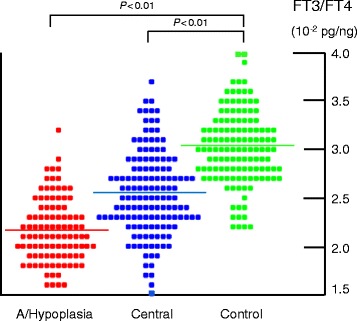
BACKGROUND: The ratio of serum free triiodothyronine (FT3) to free thyroxine (FT4) has been shown to be constant in healthy adults. However, this ratio has been found to be decreased in athyreotic adult patients on levothyroxine (L-T4) supplementation. In order to better evaluate thyroid-related pathologies in children as well as to establish a reference range, we investigated the FT3/FT4 ratio in a pediatric population. Furthermore, we evaluated this ratio in children with congenital hypothyroidism as well as those with central hypothyroidism. METHODS: A reference range for the FT3/FT4 ratio was obtained from 129 Japanese children (3-17 y) with idiopathic short stature who were designated as the 'Control' group. Patients with congenital hypothyroidism due to athyreosis or severe thyroid hypoplasia (designated as 'A/Hypoplasia'), as well as patients with central hypothyroidism ('Central'), were recruited from the institutional database. For each group, the mean FT3/FT4 ratio was obtained. RESULTS: In the Control group, the FT3/FT4 ratio was 3.03 ± 0.38 10(-2) pg/ng (mean ± standard deviation) with no age or gender differences. A/Hypoplasia patients showed a significantly decreased mean FT3/FT4 ratio (2.17 ± 0.33, P < 0.001) compared to Control patients, with decreased FT3 and elevated FT4 levels. The Central group also showed a significantly decreased FT3/FT4 ratio (2.55 ± 0.45, P < 0.001) compared to the Control group, with decreased FT3 and equivalent FT4 levels. CONCLUSIONS: The FT3/FT4 ratio appears to be constant between the ages of 3-17 y. Children on L-T4 due to congenital thyroid a/hypoplasia or central hypothyroidism have a decreased FT3/FT4 ratio compared to short normal children.
Overview
The claims and statistics of this paper haven’t been checked yet.
Free: it reads the open-access text and checks the first 5 claims that cite a source we can check. Create a free account to check every claim.
Integrity signals
Registry
Cites
Statistics
Figures
Verification
Claims the paper makes
The claims and statistics of this paper haven’t been checked yet.
Free: it reads the open-access text and checks the first 5 claims that cite a source we can check. Create a free account to check every claim.
Self-check
Percentages, sums and reported differences re-computed from the paper’s own numbers.
The self-check needs the paper’s full text.
Citations
Cites
Mechanisms of thyroid hormone action
Brent, G. A. (2012) · Journal of Clinical Investigation · doi:10.1172/jci60047 · Cited by 1,244 · cited 1×
“In contrast, T4 is produced exclusively in the thyroid gland [1, 2].”
BackgroundSaravanan, P., Chau, W. ‐., Roberts, N., Vedhara, K., Greenwood, R., & Dayan, C. M. (2002) · Clinical Endocrinology · doi:10.1046/j.1365-2265.2002.01654.x · Cited by 514 · cited 1×
“It has been reported that 5–10 % of hypothyroid patients treated with L-T4 therapy suffered from symptoms indicative of persistent hypothyroidism such as impaired well-being, diminished cognitive functions, anxiety, and depression despite adequate TSH suppression [17–19].”
BackgroundA Mutation in the Thyroid Hormone Receptor Alpha Gene
Bochukova, E., Schoenmakers, N., Agostini, M., Schoenmakers, E., Rajanayagam, O., Keogh, J. M., Henning, E., Reinemund, J., Gevers, E., Sarri, M., et al. (2012) · New England Journal of Medicine · doi:10.1056/nejmoa1110296 · Cited by 379 · cited 2×
“The consistency of the FT3/FT4 ratio during childhood is useful for the screening of several genetic disorders related to peripheral thyroid hormone metabolism, including Allan-Herndon-Dudley syndrome (MCT8 deficiency) [4], selenocysteine insertion sequence binding protein 2 deficiency [5], thyroid hormone resistance…”
BackgroundAllan-Herndon-Dudley Syndrome and the Monocarboxylate Transporter 8 (MCT8) Gene
Schwartz, C. E., May, M. M., Carpenter, N. J., Rogers, R. C., Martin, J., Bialer, M. G., Ward, J., Sanabria, J., Marsa, S., Lewis, J. A., et al. (2005) · The American Journal of Human Genetics · doi:10.1086/431313 · Cited by 378
A Mutation in the Thyroid Hormone Receptor Alpha Gene
Bochukova, E. G., Schoenmakers, N. A., Agostini, M., Schoenmakers, E., Rajanayagam, O., Keogh, J. M., Henning, E., Reinemund, J., Gevers, E. F., Sarri, M., et al. (2012) · UCL Discovery (University College London) · Cited by 327
Levothyroxine Monotherapy Cannot Guarantee Euthyroidism in All Athyreotic Patients
Gullo, D., Latina, A., Frasca, F., Le Moli, R., Pellegriti, G., & Vigneri, R. (2011) · PLoS ONE · doi:10.1371/journal.pone.0022552 · Cited by 307 · cited 6×
“Whereas FT3/FT4 ratio has been reported to be constant in healthy adult individuals [3], the consistency of this ratio has not yet been clearly determined in the pediatric population.”
BackgroundInfluentialWekking, E. M., Appelhof, B. C., Fliers, E., Schene, A. H., Huyser, J., Tijssen, J. G. P., & Wiersinga, W. M. (2005) · European Journal of Endocrinology · doi:10.1530/eje.1.02025 · Cited by 299 · cited 1×
“It has been reported that 5–10 % of hypothyroid patients treated with L-T4 therapy suffered from symptoms indicative of persistent hypothyroidism such as impaired well-being, diminished cognitive functions, anxiety, and depression despite adequate TSH suppression [17–19].”
BackgroundGrozinsky-Glasberg, S., Fraser, A., Nahshoni, E., Weizman, A., & Leibovici, L. (2006) · The Journal of Clinical Endocrinology & Metabolism · doi:10.1210/jc.2006-0448 · Cited by 296 · cited 1×
“In clinical trials, L-T4 and L-T3 combination therapy was found to be beneficial in terms of quality-of-life and the severity of depression, and was also found to ameliorate tissue hypothyroidism [20, 21].”
BackgroundCentral Hypothyroidism: Pathogenic, Diagnostic, and Therapeutic Challenges
Persani, L. (2012) · The Journal of Clinical Endocrinology & Metabolism · doi:10.1210/jc.2012-1616 · Cited by 295
Silva, J. E., & Larsen, P. R. (1978) · Journal of Clinical Investigation · doi:10.1172/jci109041 · Cited by 209 · cited 1×
“Third, referring to a classical study [15], it was shown that the proportion of the latter T3 is increased in hypothyroid patients on L-T4.”
Background
Cited by
Dietrich, J. W., Landgrafe-Mende, G., Wiora, E., Chatzitomaris, A., Klein, H. H., Midgley, J. E. M., & Hoermann, R. (2016) · Frontiers in Endocrinology · doi:10.3389/fendo.2016.00057 · Cited by 164
“They found it to be increased in iodine deficiency (41) and other settings of hyperdeiodination (42–44) – possibly accompanied by intrathyroidal hypoiodination and representing an iodine recovery mechanism – and to be decreased in NTIS (45, 46), central hypothyroidism ensuing from thyrotropic insufficiency (47, 48), c…”
ResultPhthalates and thyroid function in preschool age children: sex specific associations
Morgenstern, R., Whyatt, R. M., Insel, B. J., Calafat, A. M., Liu, X., Rauh, V. A., Herbstman, J., Bradwin, G., & Factor-Litvak, P. (2017) · Environment International · doi:10.1016/j.envint.2017.05.007 · Cited by 95
“Although we lacked information on whether any of the study children were diagnosed with thyroid disease, their FT4 and TSH levels were within normal limits (Kapelari et al. 2008; Oto et al. 2015).”
BackgroundCentral hypothyroidism and its role for cardiovascular risk factors in hypopituitary patients
Feldt-Rasmussen, U., & Klose, M. (2016) · Endocrine · doi:10.1007/s12020-016-1047-x · Cited by 43
Thyroid Glands: Physiology and Structure
Al-Suhaimi, E. A., & Khan, F. A. (2022) · Springer eBooks · doi:10.1007/978-981-16-9016-7_5 · Cited by 57
Kong, S. H., Kim, J. H., Park, Y. J., Lee, J. H., Hong, A. R., Shin, C. S., & Cho, N. H. (2020) · Osteoporosis International · doi:10.1007/s00198-019-05137-w · Cited by 28
Metadata
- Authors
- Oto, Y., Muroya, K., Hanakawa, J., Asakura, Y., & Adachi, M.
- Affiliations
- Kanagawa Children's Medical Center (JP)
- Corresponding author
- Adachi, Masanori
- Venue
- Thyroid Research
- Published
- 2015-07-08
- Volume
- 8
- Issue
- 1
- Pages
- 10-10
- ISSN
- 1756-6614 (ISSN-L)
- PMC
- PMC4495644
- OpenAlex
- W2098652280
- Cited by
- 16
- References
- 24
- Citations by year
- 2026: 2 · 2025: 1 · 2024: 1 · 2022: 5 · 2020: 1 · 2019: 2 · 2017: 1 · 2016: 3
- FWCI
- 1.16
- Type
- journal article
- Language
- en
- Open access
- gold
- doi.org
- Locations
- Thyroid Research (publishedVersion, cc-by)
- PubMed Central (publishedVersion, cc-by)
- PubMed (publishedVersion)
- Topics
- Health Sciences › Medicine › Endocrinology, Diabetes and Metabolism › Thyroid Disorders and Treatments
- Health Sciences › Medicine › Endocrinology, Diabetes and Metabolism › Growth Hormone and Insulin-like Growth Factors
- Health Sciences › Medicine › Endocrinology, Diabetes and Metabolism › Thyroid Cancer Diagnosis and Treatment
- Keywords
- FT3/FT4 ratio, congenital hypothyroidism, central hypothyroidism, thyroid hypoplasia, athyreosis, levothyroxine, idiopathic short stature, reference values, children
About these checks
Registry, retraction, Cites and statistics results are computed, not judged, with one exception: a printed reference that no index lists is read once by a model before it counts as a citation error. Claims are extracted by a model and kept only when their quote appears verbatim in the text; each cited source is then checked, with a model’s help, for whether it says what the claim relies on. Those verdicts can be wrong — read the claim’s quote and the cited source before relying on one.
Statistics and arithmetic are recomputed, not judged.
Confidence bands are shown only for fields calibrated on our annotated test set. None is calibrated yet, so no band is shown.
What counts as a claim ›How we measure confidence ›How we check this ›
Are you an author, or do you see a problem with this page? Request a review
How to cite
Cite CoChat for the checks on this page, and the paper for its own findings.
- This page
- CoChat. (2026). Citation check: The ratio of serum free triiodothyronine to free thyroxine in children: a retrospective database survey of healthy short individuals and patients with severe thyroid hypoplasia or central hypothyroidism. https://app.cochat.ai/papers/10.1186/s13044-015-0023-5
- The paper
- Oto, Y., Muroya, K., Hanakawa, J., Asakura, Y., & Adachi, M. (2015). The ratio of serum free triiodothyronine to free thyroxine in children: a retrospective database survey of healthy short individuals and patients with severe thyroid hypoplasia or central hypothyroidism. Thyroid Research. https://doi.org/10.1186/s13044-015-0023-5
Data sources
Bibliographic data: Semantic Scholar, OpenAlex, Crossref.
Contains information from the Semantic Scholar Academic Graph Datasets, made available under the ODC Attribution License (ODC-BY 1.0).
Semantic Scholar’s data is described in: Kinney, R., et al. (2023). The Semantic Scholar Open Data Platform. arXiv:2301.10140.
