

The DOI matches its Crossref record; 55 of the 55 references it cites were found in a registry or an index.
Emergency surgery in the elderly: the balance between function, frailty, fatality and futility
Open accessAbstract
Becoming old is considered a privilege and results from the socioeconomic progress and improvements in health care systems worldwide. However, morbidity and mortality increases with age, and even more so in acute onset disease. With the current prospects of longevity, a considerable number of elderly patients will continue to live with good function and excellent quality of life after emergency surgical care. However, mortality in emergency surgery may be reported at 15-30%, doubled if associated with complications, and notably higher in patients over 75 years. A number of risks associated with death are reported, and a number of scores proposed for prediction of risk. Frailty, a decline in the physiological reserves that may make the person vulnerable to even the most minor of stressful event, appears to be a valid indicator and predictor of risk and poor outcome, but how to best address and measure frailty in the emergency setting is not clear. Futility may sometimes be clearly defined, but most often becomes a borderline decision between ethics, clinical predictions and patient communication for which no solid evidence currently exists. The number and severity of other underlying condition(s), as well as the treatment alternatives and their consequences, is a complex picture to interpret. Add in the onset of the acute surgical disease as a further potential detrimental factor on function and quality of life - and you have a perfect storm to handle. In this brief review, some of the challenging aspects related to emergency surgery in the elderly will be discussed. More research, including registries and trials, are needed for improved knowledge to a growing health care challenge.
Overview
The claims and statistics of this paper haven’t been checked yet.
Run the check — free, no account needed. It reads the open-access text and checks the sources it cites.
Integrity signals
Registry
Cites
Statistics
Figures
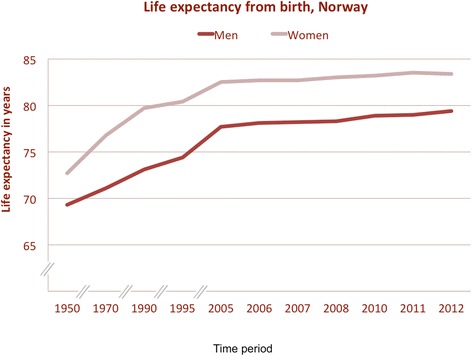
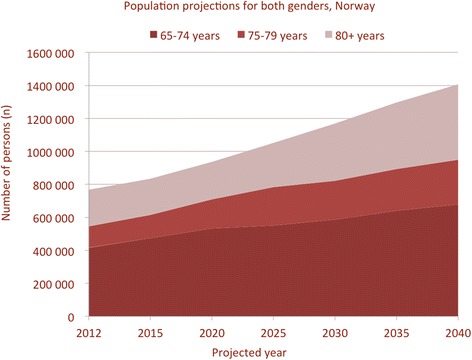
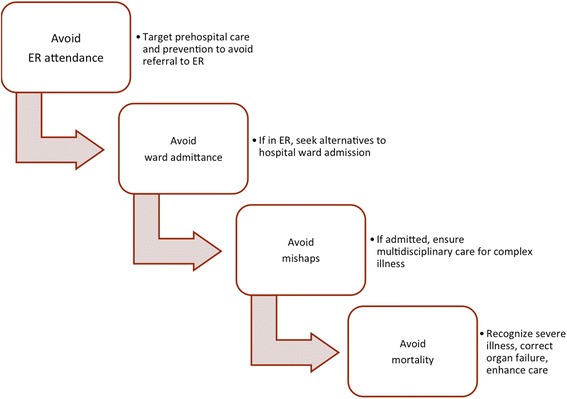
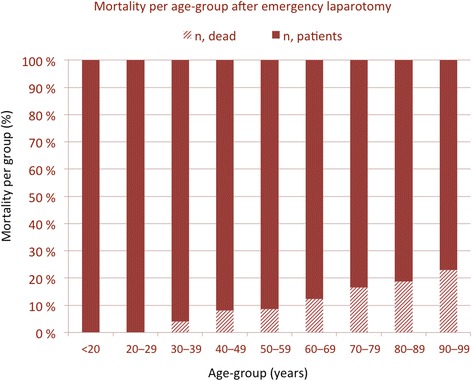
Verification
Claims the paper makes
The claims and statistics of this paper haven’t been checked yet.
Run the check — free, no account needed. It reads the open-access text and checks the sources it cites.
Claims other papers make about this one
Each is checked against this paper’s own text: does it say what the citing paper says it does?
The source backs part of the claim, not all of it — or backs it for a different population, condition or comparison.
In the citing paper
“Elderly, frail, and very co-morbid patients may not be surgical candidates, nor candidates for active intervention.”
From Acute mesenteric ischaemia (2023) · cites this paper as [19]
Experimental — accuracy not yet measured
Self-check
Percentages, sums and reported differences re-computed from the paper’s own numbers.
The self-check needs the paper’s full text.
Citations
Cites
Clegg, A., Young, J., Iliffe, S., Rikkert, M. O., & Rockwood, K. (2013) · The Lancet · doi:10.1016/s0140-6736(12)62167-9 · Cited by 9,503
Liang, G., Wen, T., Mi, K., Li, C., Wang, C., Li, K., Li, C., & Tang, Y. (2011) · Hepatogastroenterology · doi:10.5754/hge11554 · Cited by 684
Global disease burden of conditions requiring emergency surgery
Stewart, B., Khanduri, P., McCord, C., Ohene-Yeboah, M., Uranues, S., Vega Rivera, F., & Mock, C. (2014) · Journal of British Surgery · doi:10.1002/bjs.9329 · Cited by 550
Farhat, J. S., Velanovich, V., Falvo, A. J., Horst, H. M., Swartz, A., Patton, J. H., & Rubinfeld, I. S. (2012) · The Journal of Trauma: Injury, Infection, and Critical Care · doi:10.1097/ta.0b013e3182542fab · Cited by 536
Saunders, D., Murray, D., Pichel, A. C., Varley, S., & Peden, C. J. (2012) · British Journal of Anaesthesia · doi:10.1093/bja/aes165 · Cited by 405
Thorsen, K. (2013) · World Journal of Gastroenterology · doi:10.3748/wjg.v19.i3.347 · Cited by 271
Jacobs, D. G., Plaisier, B., Barie, P. S., Hammond, J., Holevar, M. R., Sinclair, K. E., Scalea, T. M., & Wahl, W. L. (2003) · The Journal of Trauma: Injury, Infection, and Critical Care · doi:10.1097/01.ta.0000042015.54022.be · Cited by 261
Al-Temimi, M. H., Griffee, M., Enniss, T. M., Preston, R. J., Vargo, D. J., Overton, S., Kimball, E. J., Barton, R. G., & Nirula, R. (2012) · Journal of the American College of Surgeons · doi:10.1016/j.jamcollsurg.2012.06.004 · Cited by 225
Boddaert, J., Cohen‐Bittan, J., Khiami, F., Manach, Y. L., Raux, M., Beinis, J., Verny, M., & Riou, B. (2014) · PLoS ONE · doi:10.1371/journal.pone.0083795 · Cited by 215
Deschodt, M., Flamaing, J., Haentjens, P., Boonen, S., & Milisen, K. (2013) · BMC Medicine · doi:10.1186/1741-7015-11-48 · Cited by 214
Cited by
Sorted by citations
Søreide, K., Thorsen, K., Harrison, E. M., Bingener, J., Møller, M. H., Ohene‐Yeboah, M., & Søreide, J. A. (2015) · The Lancet · doi:10.1016/s0140-6736(15)00276-7 · Cited by 515
Self-citationEmergency general surgery in the geriatric patient
Desserud, K. F., Veen, T., & Søreide, K. (2016) · Journal of British Surgery · doi:10.1002/bjs.10044 · Cited by 176
Self-citationPape, H., Halvachizadeh, S., Leenen, L. P. H., Velmahos, G. C., Buckley, R., & Giannoudis, P. V. (2019) · Injury · doi:10.1016/j.injury.2019.09.021 · Cited by 134
Management of intra-abdominal infections: recommendations by the WSES 2016 consensus conference
Sartelli, M., Catena, F., Abu‐Zidan, F. M., Ansaloni, L., Biffl, W. L., Boermeester, M. A., Ceresoli, M., Chiara, O., Coccolini, F., Waele, J. J. D., et al. (2017) · World Journal of Emergency Surgery · doi:10.1186/s13017-017-0132-7 · Cited by 222
Self-citationEmergency surgery in the elderly: challenges and solutions
Griffiths, E. A., Torrance, A. D. W., & Powell, S. (2015) · Open Access Emergency Medicine · doi:10.2147/oaem.s68324 · Cited by 85
Metadata
- Authors
- Søreide, K., & Desserud, K. F.
- Affiliations
- Stavanger University Hospital (NO)
- Corresponding author
- Søreide, Kjetil
- ORCID
- Søreide, Kjetil
- Venue
- Scandinavian Journal of Trauma, Resuscitation and Emergency Medicine
- Published
- 2015-02-03
- Volume
- 23
- Issue
- 1
- Pages
- 10-10
- ISSN
- 1757-7241 (ISSN-L)
- PMC
- PMC4320594
- OpenAlex
- W2109776710
- Cited by
- 103
- References
- 55
- Citations by year
- 2026: 6 · 2025: 6 · 2024: 5 · 2023: 8 · 2022: 7 · 2021: 10 · 2020: 9 · 2019: 11 · 2018: 8 · 2017: 17 · 2016: 11 · 2015: 5
- FWCI
- 6.84
- Type
- journal article
- Language
- en
- Open access
- gold
- doi.org
- Locations
- Scandinavian Journal of Trauma Resuscitation and Emergency Medicine (publishedVersion, cc-by)
- Europe PMC (PubMed Central) (publishedVersion, cc-by)
- PubMed Central (publishedVersion, cc-by)
- PubMed (publishedVersion)
- NORA - Norwegian Open Research Archives (submittedVersion, cc-by)
- Topics
- Health Sciences › Medicine › Geriatrics and Gerontology › Frailty in Older Adults
- Health Sciences › Medicine › Cardiology and Cardiovascular Medicine › Cardiac, Anesthesia and Surgical Outcomes
- Health Sciences › Medicine › Emergency Medicine › Trauma and Emergency Care Studies
- Keywords
- emergency surgery, elderly patients, frailty, postoperative mortality, risk scoring, futility, quality of life, geriatric surgery, patient communication, acute surgical diseases
- MeSH terms
- Aged, Female, Humans, Male, Postoperative Complications, Quality of Life, Risk Factors, Surgical Procedures, Operative, Geriatric Assessment, Frail Elderly, Hospital Mortality, Medical Futility, Recovery of Function, Quality Improvement
About these checks
Registry, retraction, Cites and statistics results are computed, not judged, with one exception: a printed reference that no index lists is read once by a model before it counts as a citation error. Claims are extracted by a model and kept only when their quote appears verbatim in the text; each cited source is then checked, with a model’s help, for whether it says what the claim relies on. Those verdicts can be wrong — read the claim’s quote and the cited source before relying on one.
Statistics and arithmetic are recomputed, not judged.
Confidence bands are shown only for fields calibrated on our annotated test set. None is calibrated yet, so no band is shown.
What counts as a claim ›How we measure confidence ›How we check this ›
Are you an author, or do you see a problem with this page? Request a review
