

The DOI matches its Crossref record; 64 of the 64 references it cites were found in a registry or an index.
Serum substance P levels are associated with severity and mortality in patients with severe traumatic brain injury
Abstract
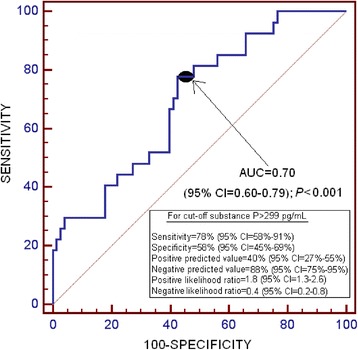
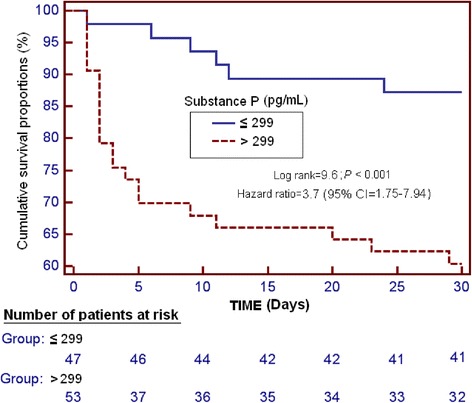
Introduction: Substance P (SP) is a member of the tachykinin family of neuropeptides, which are widely distributed throughout the central nervous system (CNS) and actively involved in inflammatory processes. SP is released early following acute injury to the CNS, promoting a neurogenic inflammatory response characterized by an increase in the permeability of the blood–brain barrier and the development of vasogenic edema. High levels of SP could lead to an exacerbated inflammatory response that could be fatal for patients with traumatic brain injury (TBI). Thus, the main goal of the present study was to determine whether serum SP levels are associated with injury severity and mortality in patients with severe TBI. Methods: This multicenter, observational, prospective study was carried out in six Spanish intensive care units and included patients with Glasgow Coma Scale (GCS) scores ≤8. Patients with an Injury Severity Score ≥10 in non-cranial aspects were excluded. Blood samples were collected on day 1 of TBI to measure serum SP levels. The endpoint was 30-day mortality. Results: We found higher serum SP levels (P=0.002) in non-surviving patients (n =27) than in surviving patients (n =73). The area under the curve for serum SP levels with regard to predicting 30-day mortality was 0.70 (95% confidence interval (CI), 0.60 to 0.79;P<0.001). Survival analysis showed that patients with serum SP levels >299 pg/ml had higher 30-day mortality than patients with lower levels (hazard ratio =3.7; 95% CI, 1.75 to 7.94;P<0.001). Multiple binomial logistic regression analysis showed that serum SP levels >299 pg/ml were associated with 30-day mortality when we controlled for APACHE II score and Marshall computed tomography lesion classification (odds ratio (OR) =5.97; 95% CI, 1.432 to 24.851;P=0.01) and for GCS score and age (OR =5.71; 95% CI, 1.461 to 22.280;P=0.01). We found a negative association between serum SP levels and GCS score (Spearman’s ρ = −0.22;P=0.03). Conclusions: We report, for the first time to our knowledge, that serum SP levels were associated with injury severity and mortality in patients with severe TBI. These results open the possibility that SP antagonists may be useful in the treatment of patients with severe TBI.
Overview
The claims and statistics of this paper haven’t been checked yet.
Run the check — free, no account needed. It reads the open-access text and checks the sources it cites.
Integrity signals
Registry
Cites
Statistics
Figures
Verification
Claims the paper makes
The claims and statistics of this paper haven’t been checked yet.
Run the check — free, no account needed. It reads the open-access text and checks the sources it cites.
Claims other papers make about this one
Each is checked against this paper’s own text: does it say what the citing paper says it does?
The cited source says what the claim attributes to it.
In the citing paper
“Substances P plays role in inflammation through astrocyte and leukocyte activation at the site of injury (Lorente et al., 2015).”
From Lysosomal Cathepsin A Plays a Significant Role in the Processing of Endogenous Bioactive Peptides (2016) · cites this paper as Lorente et al., 2015
Self-check
Percentages, sums and reported differences re-computed from the paper’s own numbers.
The self-check needs the paper’s full text.
Citations
Cites
APACHE II: A severity of disease classification system
KNAUS, W. A., DRAPER, E. A., WAGNER, D. P., & ZIMMERMAN, J. E. (1985) · Critical Care Medicine · doi:10.1097/00003246-198510000-00009 · Cited by 13,664
APACHE II-A Severity of Disease Classification System: Reply
Knaus, W. A., Draper, E. A., Wagner, D. P., & Zimmerman, J. E. (1986) · Critical Care Medicine · doi:10.1097/00003246-198608000-00028 · Cited by 13,376
ASSESSMENT OF COMA AND IMPAIRED CONSCIOUSNESS
Teasdale, G., & Jennett, B. (1974) · The Lancet · doi:10.1016/s0140-6736(74)91639-0 · Cited by 13,215
Applied Regression Analysis and Other Multivariable Methods
Walker, E., Kleinbaum, D. G., Kupper, L. L., & Muller, K. E. (1989) · Technometrics · doi:10.2307/1270375 · Cited by 8,538
Baker, S. P., O’Neill, B., Haddon, W. F., & Long, W. B. (1974) · PubMed · Cited by 7,946
Baker, S. P., O’Neill, B., Haddon, W. F., & Long, W. B. (1974) · The Journal of Trauma: Injury, Infection, and Critical Care · doi:10.1097/00005373-197403000-00001 · Cited by 7,326
APACHE II: a severity of disease classification system.
Knaus, W. A., Draper, E. S., Wagner, D. P., & Zimmerman, J. E. (1985) · PubMed · Cited by 6,034
Family history of subarachnoid haemorrhage: supplemental value of scrutinizing all relatives.
Greebe, P., Bromberg, J. E. C., Rinkel, G. J. E., Algra, A., & van Gijn, J. (1997) · Journal of Neurology Neurosurgery & Psychiatry · doi:10.1136/jnnp.62.3.273 · Cited by 4,137
Guidelines for the Management of Severe Traumatic Brain Injury, Fourth Edition
Carney, N., Totten, A., O'Reilly, C., Ullman, J., Hawryluk, G., Bell, M., Bratton, S., Chesnut, R., Harris, O., Kissoon, N., et al. (2016) · Neurosurgery · doi:10.1227/neu.0000000000001432 · Cited by 3,403
Inflammatory Blockade Restores Adult Hippocampal Neurogenesis
Monje, M. L., Toda, H., & Palmer, T. D. (2003) · Science · doi:10.1126/science.1088417 · Cited by 2,426
Research works printed but not linked: 1
- Palma C, Minghetti L, Astolfi M, Ambrosini E, Silberstein FC, Manzini S, et al. Functional characterization of substance P receptors on cultured human spinal cord astrocytes: synergism of substance P with cytokines in inducing interleukin-6 and prostaglandin E2 production. Glia. 1997;21:183–93. · DOI
Cited by
Lysosomal Cathepsin A Plays a Significant Role in the Processing of Endogenous Bioactive Peptides
Timur, Z. K., Akyildiz Demir, S., & Seyrantepe, V. (2016) · Frontiers in Molecular Biosciences · doi:10.3389/fmolb.2016.00068 · Cited by 38
Metadata
- Authors
- Lorente, L., Martín, M. M., Almeida, T., Hernández, M., Ramos, L., Argueso, M., Cáceres, J. J., Solé-Violán, J., & Jiménez, A.
- Venue
- Critical Care
- Published
- 2015-12
- Volume
- 19
- Issue
- 1
- ISSN
- 1364-8535
- PMC
- PMC4424826
- Cited by
- 47
- References
- 64
- Language
- en
- Licence
- creativecommons.org/licenses/by/4.0 (tdm)
- creativecommons.org/licenses/by/4.0 (vor)
About these checks
Registry, retraction, Cites and statistics results are computed, not judged, with one exception: a printed reference that no index lists is read once by a model before it counts as a citation error. Claims are extracted by a model and kept only when their quote appears verbatim in the text; each cited source is then checked, with a model’s help, for whether it says what the claim relies on. Those verdicts can be wrong — read the claim’s quote and the cited source before relying on one.
Statistics and arithmetic are recomputed, not judged.
Confidence bands are shown only for fields calibrated on our annotated test set. None is calibrated yet, so no band is shown.
What counts as a claim ›How we measure confidence ›How we check this ›
Are you an author, or do you see a problem with this page? Request a review
Data sources
Bibliographic data: Semantic Scholar, OpenAlex, Crossref.
Contains information from the Semantic Scholar Academic Graph Datasets, made available under the ODC Attribution License (ODC-BY 1.0).
Semantic Scholar’s data is described in: Kinney, R., et al. (2023). The Semantic Scholar Open Data Platform. arXiv:2301.10140.
