

The DOI matches its Crossref record; 31 of the 31 references it cites were found in a registry or an index.
Efficacy of ultrasound-guided technique for radial artery catheterization in pediatric populations: a systematic review and meta-analysis of randomized controlled trials
Open accessAbstract
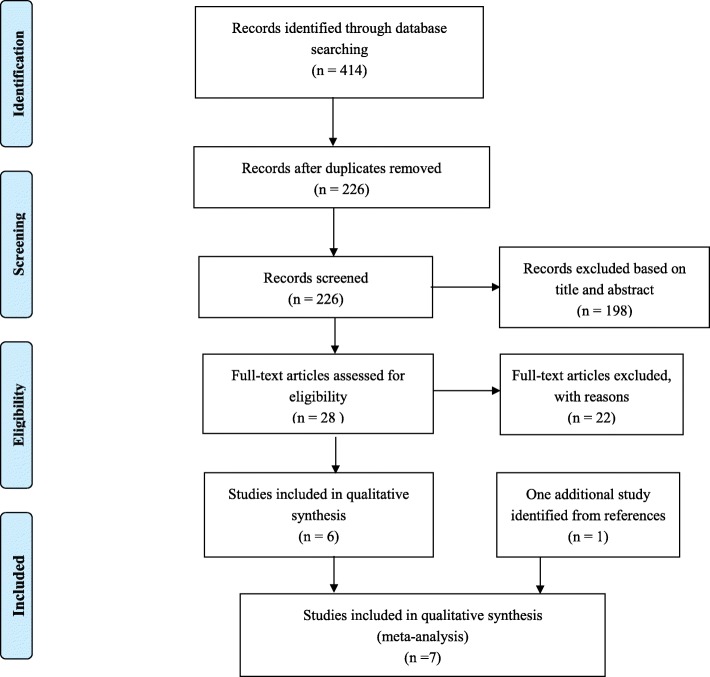
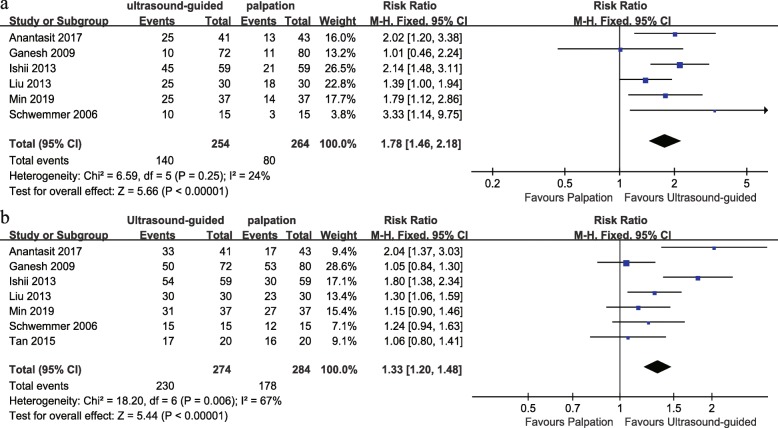
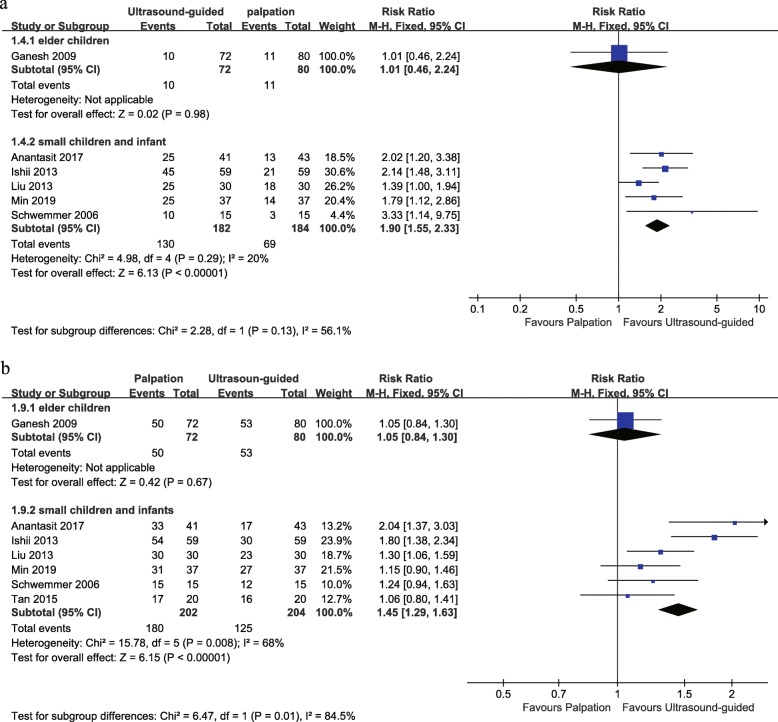
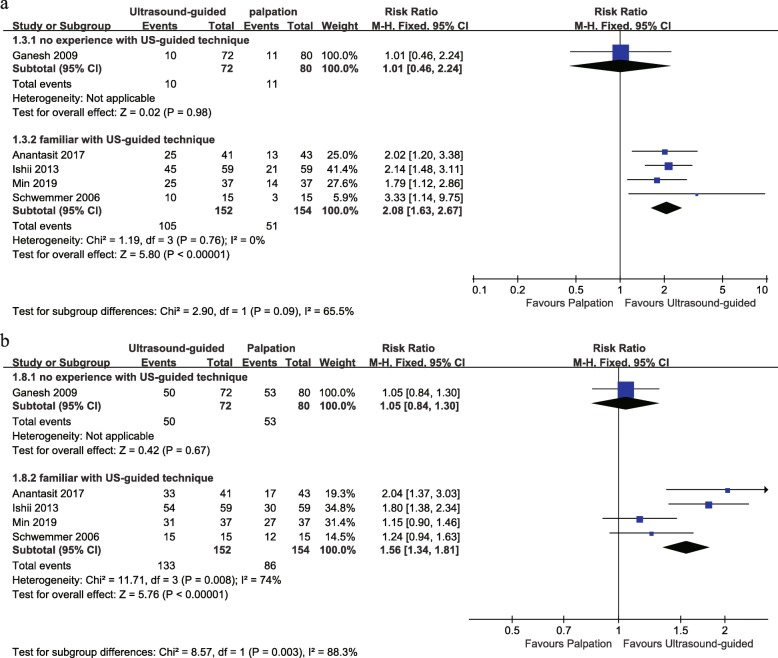
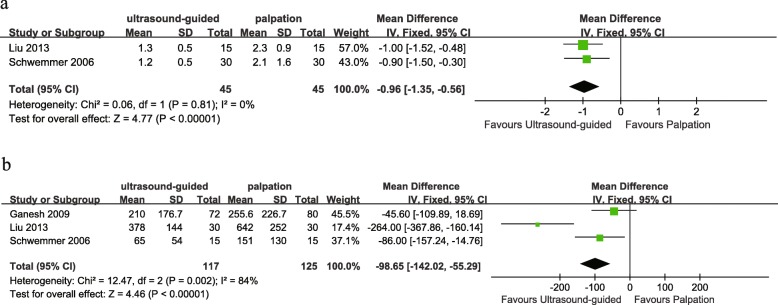
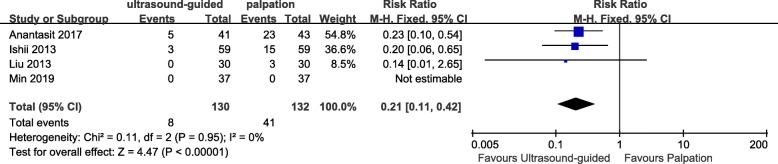
Background: The use of an ultrasound-guided technique for radial arterial catheterization has not been well established in pediatric patients. We conducted a systematic review and meta-analysis to evaluate the efficacy of the ultrasound-guided technique for radial artery catheterization in pediatric populations. Method: A systematic review of PubMed, Medline, Embase, and the Cochrane library was performed from their date of inception to December 2019. In this meta-analysis, we conducted online searches using the search terms “ultrasonography,” “ultrasonics,” “ultrasound-guided,” “ultrasound,” “radial artery,” “radial arterial,” “catheter,” “cannula,” and “catheterization.” The rate of the first-attempt and total success, mean attempts to success, mean time to success, and incidence of complications (hematomas) were extracted. Data analysis was performed with RevMan 5.3.5. Results: From 7 relevant studies, 558 radial artery catheterizations were enrolled, including 274 ultrasound-guided and 284 palpation catheterizations. The ultrasound-guided technique could significantly improve the rate of first-attempt and total success (RR 1.78, 95% CI 1.46 to 2.18, P < 0.00001; RR 1.33; 95% CI 1.20 to 1.48; P < 0.00001). However, there was significant heterogeneity for the total success rate among the included studies (I2 = 67%). The ultrasound-guided radial artery catheterization was also associated with less mean attempts and mean time to success (WMD − 1.13, 95% CI − 1.58 to − 0.69; WMD − 72.97 s, 95% CI − 134.41 to − 11.52) and lower incidence of the hematomas (RR 0.17, 95% CI 0.07 to 0.41). Conclusions: The use of the ultrasound-guided technique could improve the success rate of radial arterial catheterization and reduce the incidence of hematomas in pediatric patients. However, the results should be interpreted cautiously due to the heterogeneity among the studies.
Overview
The claims and statistics of this paper haven’t been checked yet.
Run the check — free, no account needed. It reads the open-access text and checks the sources it cites.
Integrity signals
Registry
Cites
Statistics
Figures
Verification
Claims the paper makes
The claims and statistics of this paper haven’t been checked yet.
Run the check — free, no account needed. It reads the open-access text and checks the sources it cites.
Claims other papers make about this one
Each is checked against this paper’s own text: does it say what the citing paper says it does?
The source backs part of the claim, not all of it — or backs it for a different population, condition or comparison.
In the citing paper
“In pediatrics, both meta-analyses and RCTs have shown higher success rates and fewer complications for US-guided arterial cannulation (typically radial artery) compared to palpation or Doppler guidance [ 3 , 5 ].”
From Ultrasound vessel sizing before cannulation: a measurement-first approach for anesthesiologists (2026) · cites this paper as [3]
Experimental — accuracy not yet measuredThe source backs part of the claim, not all of it — or backs it for a different population, condition or comparison.
In the citing paper
“The evidence compiled in this review indicates higher first-pass success rates, fewer attempts, faster placement times, and reduced complication rates when ultrasound pre-measurement and real-time guidance are used compared to traditional landmark techniques [ 2 – 5 , 13 ].”
From Ultrasound vessel sizing before cannulation: a measurement-first approach for anesthesiologists (2026) · cites this paper as [3]
Experimental — accuracy not yet measuredThe cited source says what the claim attributes to it.
In the citing paper
“Furthermore, US guidance improves outcomes for peripheral IV (PIV) placement and radial arterial cannulation – including in pediatric patients – compared to landmark techniques [ 2 – 5 ].”
From Ultrasound vessel sizing before cannulation: a measurement-first approach for anesthesiologists (2026) · cites this paper as [3]
The check wasn’t confident either way, so it gives no verdict — never disputed.
In the citing paper
“Furthermore, US guidance improves outcomes for peripheral IV (PIV) placement and radial arterial cannulation – including in pediatric patients – compared to landmark techniques [ 2 – 5 ].”
From Ultrasound vessel sizing before cannulation: a measurement-first approach for anesthesiologists (2026) · cites this paper as [3]
Experimental — accuracy not yet measuredThe check wasn’t confident either way, so it gives no verdict — never disputed.
In the citing paper
“To minimize the risk of arterial spasm or occlusion, we apply the “one-third rule” for catheter size in arteries: limiting the catheter’s outer diameter to approximately one-third of the arterial inner diameter may help reduce the risk of vasospasm and occlusion (equivalently, catheter cross-sectional area ≤ 1/3 of the lumen area, which is OD/ID ≤ 0.577) [ 3 , 6 , 7 ].”
From Ultrasound vessel sizing before cannulation: a measurement-first approach for anesthesiologists (2026) · cites this paper as [3]
Experimental — accuracy not yet measured
Self-check
Percentages, sums and reported differences re-computed from the paper’s own numbers.
The self-check needs the paper’s full text.
Citations
Cites
Guidelines for Performing Ultrasound Guided Vascular Cannulation
Troianos, C. A., Hartman, G. S., Glas, K. E., Skubas, N. J., Eberhardt, R. T., Walker, J. D., & Reeves, S. T. (2011) · Anesthesia & Analgesia · doi:10.1213/ane.0b013e3182407cd8 · Cited by 325
Ultrasound-guided arterial cannulation in infants improves success rate
Schwemmer, U., Arzet, H. A., Trautner, H., Rauch, S., Roewer, N., & Greim, C. A. (2006) · European Journal of Anaesthesiology · doi:10.1017/s0265021506000275 · Cited by 154
Ultrasound-guided arterial cannulation for paediatrics
Aouad-Maroun, M., Raphael, C. K., Sayyid, S. K., Farah, F., & Akl, E. A. (2016) · Cochrane Database of Systematic Reviews · doi:10.1002/14651858.cd011364.pub2 · Cited by 147
White, L., Halpin, A., Turner, M., & Wallace, L. (2016) · British Journal of Anaesthesia · doi:10.1093/bja/aew097 · Cited by 142
Catheterization of the radial or brachial artery in neonates and infants
Schindler, E., KOWALD, B., Suess, H., NIEHAUS‐BORQUEZ, B., Tausch, B., & Brecher, A. M. (2005) · Pediatric Anesthesia · doi:10.1111/j.1460-9592.2004.01522.x · Cited by 111
Ultrasound Guidance Facilitates Radial Artery Catheterization
Gu, W.-J., Wu, X.-D., Wang, F., Ma, Z.-L., & Gu, X.-P. (2016) · Chest · doi:10.1378/chest.15-1784 · Cited by 109
Pacha, H. M., Alahdab, F., Al-khadra, Y., Idris, A., Rabbat, F., Darmoch, F., Soud, M., Zaitoun, A., Kaki, A., Rao, S. V., et al. (2018) · American Heart Journal · doi:10.1016/j.ahj.2018.06.007 · Cited by 105
Evaluation of ultrasound-guided radial artery cannulation in children
Ganesh, A., Kaye, R. D., Cahill, A. M., Stern, W., Pachikara, R., Gallagher, P. R., & Watcha, M. F. (2009) · Pediatric Critical Care Medicine · doi:10.1097/pcc.0b013e31819368ca · Cited by 104
Gu, W., Tie, H., Liu, J., & Zeng, X. (2014) · Critical Care · doi:10.1186/cc13862 · Cited by 101
Berk, D., Gürkan, Y., Kuş, A., Ulugöl, H., Solak, M., & Toker, K. (2013) · Journal of Clinical Monitoring and Computing · doi:10.1007/s10877-013-9437-6 · Cited by 96
Research works printed but not linked: 1
- Liu GL, Zheng TH, Lv H. The value of ultrasound guided technique for radial artery catheterization in small children and infants. Chin J Anesthesiol. 2013;33(10):2.
Cited by
Vegas, A., Wells, B. J., Braum, P. F., Denault, A. Y., Miller‐Hance, W. C., Kaufman, C. S., Patel, M. B., & Salvatori, M. (2025) · Journal of the American Society of Echocardiography · doi:10.1016/j.echo.2024.12.004 · Cited by 83
Martha, J. W., Pranata, R., Wibowo, A., & Lim, M. A. (2021) · International Journal of Infectious Diseases · doi:10.1016/j.ijid.2021.02.029 · Cited by 51
Smart Glasses for Radial Arterial Catheterization in Pediatric Patients: A Randomized Clinical Trial
Jang, Y., Cho, S., Ji, S., Kim, E., Lee, J., Kim, H., & Kim, J. (2021) · Anesthesiology · doi:10.1097/aln.0000000000003914 · Cited by 44
Schults, J. A., Young, E., Marsh, N. M., Larsen, E. N., Corley, A., Ware, R. S., Murgo, M., Alexandrou, E., McGrail, M. R., Gowardman, J. R., et al. (2024) · Journal of Intensive Care · doi:10.1186/s40560-024-00719-1 · Cited by 32
Ultrasound-guided peripheral vascular catheterization in pediatric patients: a narrative review
Nakayama, Y., Takeshita, J., Nakajima, Y., & Shime, N. (2020) · Critical Care · doi:10.1186/s13054-020-03305-7 · Cited by 29
Metadata
- Authors
- Zhang, W., Li, K., Xu, H., Luo, D., Ji, C., Yang, K., & Zhao, Q.
- Affiliations
- Liaocheng People's Hospital (CN)
- Corresponding author
- Xu, Hui
- ORCID
- Venue
- Critical Care
- Published
- 2020-05-06
- Volume
- 24
- Issue
- 1
- Pages
- 197-197
- ISSN
- 1364-8535 (ISSN-L)
- PMC
- PMC7201726
- OpenAlex
- W3022139252
- Cited by
- 34
- References
- 31
- Citations by year
- 2026: 5 · 2025: 4 · 2024: 9 · 2023: 4 · 2022: 7 · 2021: 4 · 2020: 1
- FWCI
- 0.56
- Type
- journal article
- Language
- en
- Open access
- gold
- doi.org
- Licence
- cc-by
- creativecommons.org/licenses/by/4.0/ (tdm)
- creativecommons.org/licenses/by/4.0/ (vor)
- Locations
- Critical Care (publishedVersion, cc-by)
- PubMed Central (publishedVersion, cc-by)
- PubMed (publishedVersion)
- DOAJ (DOAJ: Directory of Open Access Journals) (submittedVersion, cc-by-sa)
- Funders
- Natural Science Foundation of Shandong Province (ZR2017MH112)
- Topics
- Health Sciences › Medicine › Pulmonary and Respiratory Medicine › Vascular Procedures and Complications
- Health Sciences › Medicine › Critical Care and Intensive Care Medicine › Central Venous Catheters and Hemodialysis
- Health Sciences › Medicine › Critical Care and Intensive Care Medicine › Ultrasound in Clinical Applications
- Keywords
- ultrasound-guided catheterization, radial artery catheterization, pediatric patients, central venous catheterization, catheterization success rate, vascular access complications
- MeSH terms
- Catheterization, Peripheral, Humans, Pediatrics, Randomized Controlled Trials as Topic, Radial Artery, Ultrasonography, Interventional, Vascular Access Devices
About these checks
Registry, retraction, Cites and statistics results are computed, not judged, with one exception: a printed reference that no index lists is read once by a model before it counts as a citation error. Claims are extracted by a model and kept only when their quote appears verbatim in the text; each cited source is then checked, with a model’s help, for whether it says what the claim relies on. Those verdicts can be wrong — read the claim’s quote and the cited source before relying on one.
Statistics and arithmetic are recomputed, not judged.
Confidence bands are shown only for fields calibrated on our annotated test set. None is calibrated yet, so no band is shown.
What counts as a claim ›How we measure confidence ›How we check this ›
Are you an author, or do you see a problem with this page? Request a review
How to cite
Cite CoChat for the checks on this page, and the paper for its own findings.
- This page
- CoChat. (2026). Citation check: Efficacy of ultrasound-guided technique for radial artery catheterization in pediatric populations: a systematic review and meta-analysis of randomized controlled trials. https://app.cochat.ai/papers/10.1186/s13054-020-02920-8
- The paper
- Zhang, W., Li, K., Xu, H., Luo, D., Ji, C., Yang, K., & Zhao, Q. (2020). Efficacy of ultrasound-guided technique for radial artery catheterization in pediatric populations: a systematic review and meta-analysis of randomized controlled trials. Critical Care. https://doi.org/10.1186/s13054-020-02920-8
Data sources
Bibliographic data: Semantic Scholar, OpenAlex, Crossref.
Contains information from the Semantic Scholar Academic Graph Datasets, made available under the ODC Attribution License (ODC-BY 1.0).
Semantic Scholar’s data is described in: Kinney, R., et al. (2023). The Semantic Scholar Open Data Platform. arXiv:2301.10140.
