

The DOI matches its Crossref record; 3 of the 3 references it cites were found in a registry or an index.
Artificial intelligence hallucinations
Open accessAbstract
SCOPUS: le.j
Overview
The claims and statistics of this paper haven’t been checked yet.
Run the check — free, no account needed. It reads the open-access text and checks the sources it cites.
Integrity signals
Registry
Cites
Statistics
Figures
Verification
Claims the paper makes
The claims and statistics of this paper haven’t been checked yet.
Run the check — free, no account needed. It reads the open-access text and checks the sources it cites.
Claims other papers make about this one
Each is checked against this paper’s own text: does it say what the citing paper says it does?
The cited source says what the claim attributes to it.
In the citing paper
“LLMs may generate fictional “facts” presented as true “real-world facts,” which is referred to as hallucination [19,23].”
From Evaluation of Large Language Model Performance and Reliability for Citations and References in Scholarly Writing: Cross-Disciplinary Study (2024) · cites this paper as [19]
In the citing paper
“We also considered that during the writing process writers frequently struggle with cognitive overload [61] and that even small demands on working memory can lead to decreased fluency [77].”
From ABScribe: Rapid Exploration & Organization of Multiple Writing Variations in Human-AI Co-Writing Tasks using Large Language Models (2024) · cites this paper as [77]
Self-check
Percentages, sums and reported differences re-computed from the paper’s own numbers.
The self-check needs the paper’s full text.
Citations
Cites
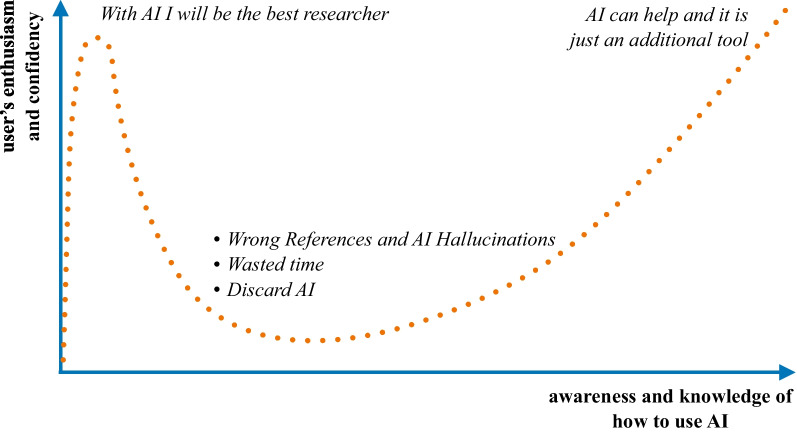
Kruger, J., & Dunning, D. (1999) · Journal of Personality and Social Psychology · doi:10.1037/0022-3514.77.6.1121 · Cited by 7,731
Large language models and the perils of their hallucinations
Azamfirei, R., Kudchadkar, S. R., & Fackler, J. (2023) · Critical Care · doi:10.1186/s13054-023-04393-x · Cited by 323
Correction to: Can artificial intelligence help for scientific writing?
Salvagno, M., Taccone, F. S., & Gerli, A. G. (2023) · Critical Care · doi:10.1186/s13054-023-04390-0 · Cited by 46
Self-citation
Cited by
Li, Y., Li, Z., Zhang, K., Dan, R., Jiang, S., & Zhang, Y. (2023) · Cureus · doi:10.7759/cureus.40895 · Cited by 505
Li, Y., Li, Z., Zhang, K., Dan, R., Jiang, S., & Zhang, Y. (2023) · arXiv · doi:10.48550/arxiv.2303.14070 · Cited by 512
A Culturally Sensitive Test to Evaluate Nuanced GPT Hallucination
McIntosh, T. R., Liu, T., Susnjak, T., Watters, P., Ng, A., & Halgamuge, M. N. (2024) · IEEE Transactions on Artificial Intelligence · doi:10.1109/tai.2023.3332837 · Cited by 145
Enhancing emergency decision-making with knowledge graphs and large language models
Chen, M., Tao, Z., Tang, W., Qin, T., Yang, R. C., & Zhu, C. (2024) · International Journal of Disaster Risk Reduction · doi:10.1016/j.ijdrr.2024.104804 · Cited by 119
Artificial Intelligence and Healthcare Simulation: The Shifting Landscape of Medical Education
Hamilton, A. J. (2024) · Cureus · doi:10.7759/cureus.59747 · Cited by 126
Metadata
- Authors
- Salvagno, M., Taccone, F. S., & Gerli, A. G.
- Affiliations
- Université Libre de Bruxelles (BE)
- University of Milan (IT)
- Corresponding author
- Salvagno, Michele
- Venue
- Critical Care
- Published
- 2023-05-10
- Volume
- 27
- Issue
- 1
- Pages
- 180-180
- ISSN
- 1364-8535 (ISSN-L)
- PMC
- PMC10170715
- OpenAlex
- W4376133468
- Cited by
- 136
- References
- 3
- Citations by year
- 2026: 32 · 2025: 56 · 2024: 38 · 2023: 10
- Type
- journal article
- Language
- en
- Open access
- gold
- doi.org
- Licence
- cc-by
- creativecommons.org/licenses/by/4.0 (tdm)
- creativecommons.org/licenses/by/4.0 (vor)
- Locations
- Critical Care (publishedVersion, cc-by)
- PubMed Central (publishedVersion, cc-by)
- PubMed (publishedVersion)
- Dépôt institutionnel de l'Université libre de Bruxelles (Université Libre de Bruxelles) (submittedVersion, other-oa)
- DOAJ (DOAJ: Directory of Open Access Journals) (submittedVersion, cc-by-sa)
- Topics
- Health Sciences › Medicine › Health Informatics › Artificial Intelligence in Healthcare and Education
- Life Sciences › Neuroscience › Cognitive Neuroscience › Hallucinations in medical conditions
- Health Sciences › Medicine › Family Practice › Clinical Reasoning and Diagnostic Skills
- Keywords
- large language models, artificial intelligence in healthcare, clinical decision support
- MeSH terms
- Artificial Intelligence, Hallucinations, Humans
About these checks
Registry, retraction, Cites and statistics results are computed, not judged, with one exception: a printed reference that no index lists is read once by a model before it counts as a citation error. Claims are extracted by a model and kept only when their quote appears verbatim in the text; each cited source is then checked, with a model’s help, for whether it says what the claim relies on. Those verdicts can be wrong — read the claim’s quote and the cited source before relying on one.
Statistics and arithmetic are recomputed, not judged.
Confidence bands are shown only for fields calibrated on our annotated test set. None is calibrated yet, so no band is shown.
What counts as a claim ›How we measure confidence ›How we check this ›
Are you an author, or do you see a problem with this page? Request a review
How to cite
Cite CoChat for the checks on this page, and the paper for its own findings.
- This page
- CoChat. (2026). Citation check: Artificial intelligence hallucinations. https://app.cochat.ai/papers/10.1186/s13054-023-04473-y
- The paper
- Salvagno, M., Taccone, F. S., & Gerli, A. G. (2023). Artificial intelligence hallucinations. Critical Care. https://doi.org/10.1186/s13054-023-04473-y
Data sources
Bibliographic data: Semantic Scholar, OpenAlex, Crossref.
Contains information from the Semantic Scholar Academic Graph Datasets, made available under the ODC Attribution License (ODC-BY 1.0).
Semantic Scholar’s data is described in: Kinney, R., et al. (2023). The Semantic Scholar Open Data Platform. arXiv:2301.10140.
