

Gene name errors are widespread in the scientific literature
Open accessThe DOI matches its Crossref record; 3 of the 3 references it cites were found in a registry or an index; 2 of the 2 sources its claims cite were checked for support.
Abstract
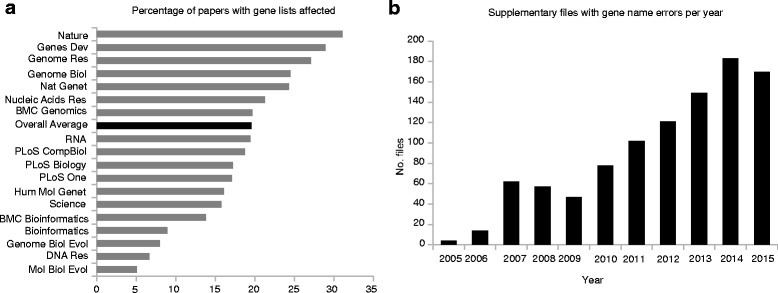
The spreadsheet software Microsoft Excel, when used with default settings, is known to convert gene names to dates and floating-point numbers. A programmatic scan of leading genomics journals reveals that approximately one-fifth of papers with supplementary Excel gene lists contain erroneous gene name conversions.
Overview
CoChat Summary
TL;DR
A programmatic screen of supplementary Excel files from 18 genomics journals and NCBI GEO found that Excel’s default conversion of gene symbols to dates and floating-point numbers remains widespread, affecting 19.6% of papers with Excel gene lists in the journal screen and 39.7% of GEO files with gene lists. The authors call for vigilance and screening by researchers, reviewers, editorial staff, and database curators.
Key findings
- In 35,175 supplementary Excel files from 18 journals (2005–2015), 7,467 gene lists were found in 3,597 papers; gene name errors were confirmed in 987 supplementary files from 704 published articles, with 23,861 gene names converted. The proportion of published articles with Excel gene lists affected was 19.6%.
- Journal-level prevalence varied: the lowest proportion (<10%) occurred in Molecular Biology and Evolution, Bioinformatics, DNA Research, and Genome Biology and Evolution; the highest (>20%) occurred in Nucleic Acids Research, Genome Biology, Nature Genetics, Genome Research, Genes and Development, and Nature. BMC Bioinformatics had errors in 13.8% of papers with Excel gene lists.
- There was a positive correlation between 2015 journal impact factor and the proportion of supplementary gene lists affected (Spearman rho = 0.52, two-sided p = 0.03). Linear-regression estimates showed gene name errors increased at an annual rate of 15% over the past five years, outpacing the increase in published papers (3.8% per year).
- In NCBI GEO, 4,321 Excel files were screened; 574 contained gene lists, and 228 (39.7%) of these contained gene name errors. Of the 987 affected supplementary files, 166 lacked other identifying information such as accession numbers or genomic coordinates that could be used to infer the original gene names.
Methods
- Design: programmatic screen of supplementary Excel files from 18 journals published between 2005 and 2015, plus Excel files deposited in NCBI GEO released 2005–2015; all suspected files were verified manually by downloading and checking them.
- Processing: .xls and .xlsx files were converted to tab-separated files with ssconvert (v1.12.9), with each sheet converted separately. A column was suspected to be a gene list if the first 20 rows contained five or more gene symbols; a regular-expression search of the entire column then identified gene symbol errors, using official Ensembl version 82 symbols (accessed November 2015) for 10 organisms and a regex similar to Zeeberg et al. with added date formats. For Science, Nature, and PLoS One, articles were limited to those with the keyword “genome” in the title or abstract.
- Analysis: counts and proportions of affected files/papers, Spearman correlation with 2015 journal impact factor, and linear regression for annual increase. Scripts were run on Ubuntu v14.04 LTS with GNU bash v4.3.11 and are available at SourceForge.
Limitations
- Stated: the scripts focused on screening vertical lists of genes, so instances in horizontal gene lists might have been missed; many more instances likely exist in journals outside the 18 screened; pay-walled supplementary files could not be programmatically accessed; and ten false-positive cases were identified and removed.
- Evident from the text: the screen was restricted to 18 journals and to programmatically accessible Excel files, and for Science, Nature, and PLoS One to articles containing “genome” in the title or abstract; reliance on official Ensembl symbols for 10 organisms may not capture all species or non-official gene-naming conventions (the latter is not explicitly stated by the authors).
Model-written summary. Check it against the paper before relying on it.
Integrity signals
Registry
Cites
Statistics
Figures
Verification
Claims the paper makes
2 Valid · 0 Not valid · 0 Not checked · 19 Own results and interpretations
Every source the paper cites for this claim was checked and supports it.
In the paper
“The spreadsheet software Microsoft Excel, when used with default settings, is known to convert gene names to dates and floating-point numbers.”
- Also stated in: § Electronic supplementary material · plain
“The problem of Excel software (Microsoft Corp., Redmond, WA, USA) inadvertently converting gene symbols to dates and floating-point numbers was originally described in 2004 [1].”
§ Gene name errors are widespread in the scientific literature > Abstract
What the sources say
- Supportedcites [1] Zeeberg BR Riss J Kane DW Bussey KJ Uchio E Linehan WM Mistaken identifiers: gene name errors can be introduced inadvertently when using Excel in bioinformatics BMC Bioinformatics 2004 5 80 10.1186/1471-2105-5-80 15214961 PMC459209 source
The Abstract Results attribute gene-name errors to Excel’s default date and floating-point format conversions. The Text gives examples of a gene name converted to a date and a RIKEN identifier converted to a floating-point number. (LLM, conf=0.95)
boostedstates a cause- Asserted: passes — The authors put it forward as true.
- Checkable: passes — It can be checked against evidence.
- Load-bearing: passes — The paper’s conclusions depend on it.
- Based: passes — The paper gives a reason why it holds.
- Also stated in: § Electronic supplementary material · plain
A result the paper reports from its own data — it cites no other source for it, so there is none to check. The quote shows it is in the paper.
In the paper
“In the 987 supplementary files containing gene name errors identified here, 166 files did not contain any other identifying information such as accession numbers or genomic coordinates that could be used to infer the original gene names.”
§ Gene name errors are widespread in the scientific literature > Abstract > Electronic supplementary material
plain- Asserted: passes — The authors put it forward as true.
- Checkable: passes — It can be checked against evidence.
- Load-bearing: unclear — It is unclear whether the paper’s conclusions depend on it.
- Based: passes — The paper gives a reason why it holds.
A result the paper reports from its own data — it cites no other source for it, so there is none to check. The quote shows it is in the paper.
In the paper
“A programmatic scan of leading genomics journals reveals that approximately one-fifth of papers with supplementary Excel gene lists contain erroneous gene name conversions.”
- Also stated in: § Electronic supplementary material · plain
“Of the selected journals, the proportion of published articles with Excel files containing gene lists that are affected by gene name errors is 19.6 %.”
§ Gene name errors are widespread in the scientific literature > Abstract
plain- Asserted: passes — The authors put it forward as true.
- Checkable: passes — It can be checked against evidence.
- Load-bearing: passes — The paper’s conclusions depend on it.
- Based: passes — The paper gives a reason why it holds.
- Also stated in: § Electronic supplementary material · plain
A result the paper reports from its own data — it cites no other source for it, so there is none to check. The quote shows it is in the paper.
In the paper
“Since that report, we have uncovered further instances where gene symbols were converted to dates in supplementary data of recently published papers (e.g. ‘SEPT2’ converted to ‘2006/09/02’).”
§ Gene name errors are widespread in the scientific literature > Abstract > Electronic supplementary material
plain- Asserted: passes — The authors put it forward as true.
- Checkable: passes — It can be checked against evidence.
- Load-bearing: unclear — It is unclear whether the paper’s conclusions depend on it.
- Based: passes — The paper gives a reason why it holds.
A result the paper reports from its own data — it cites no other source for it, so there is none to check. The quote shows it is in the paper.
In the paper
“Journals that had the highest proportion of papers with affected supplementary files were Nucleic Acids Research, Genome Biology, Nature Genetics, Genome Research, Genes and Development and Nature (>20 %).”
§ Gene name errors are widespread in the scientific literature > Abstract > Electronic supplementary material
plain- Asserted: passes — The authors put it forward as true.
- Checkable: passes — It can be checked against evidence.
- Load-bearing: unclear — It is unclear whether the paper’s conclusions depend on it.
- Based: passes — The paper gives a reason why it holds.
4 more claims
Create a free account to see all 21 claims and every source verdict.
- Probably not a substantial claim. 8
- It may state two separate claims as one. 5
- The quote only partly states this claim. 1
Claims other papers make about this one
Each is checked against this paper’s own text: does it say what the citing paper says it does?
The cited source doesn’t support the claim as written.
In the citing paper
“The proportion of publications with Excel gene lists that contain errors was 30.9%; substantially higher than previously reported [2].”
From Gene name errors: Lessons not learned (2021) · cites this paper as [2]
Checked by a reasoning model — may be wrong.
Experimental — accuracy not yet measuredThe source backs part of the claim, not all of it — or backs it for a different population, condition or comparison.
In the citing paper
“For example, when importing text files of transcriptome data into a spreadsheet program, gene symbols may be wrongly imported as dates (Zeeberg, 2004; Ziemann, 2016), which can lead to erroneous conclusions about the affected genes.”
From Guidance document on Good cell and tissue culture practice 2.0 (GCCP 2.0) (2021) · cites this paper as Ziemann, 2016
Experimental — accuracy not yet measuredThe cited source says what the claim attributes to it.
In the citing paper
“Previous work shows that gene name errors are made while researchers analyse and prepare supplementary files for publication [2].”
From Gene name errors: Lessons not learned (2021) · cites this paper as [2]
The cited source says what the claim attributes to it.
In the citing paper
“A screen of 18 journals found that one fifth of publications with supplementary Excel gene lists contained errors (704/3597).”
From Gene name errors: Lessons not learned (2021) · cites this paper as [2]
The cited source says what the claim attributes to it.
In the citing paper
“This may seem counterintuitive, but is consistent with previous analysis [2].”
From Gene name errors: Lessons not learned (2021) · cites this paper as [2]
1 more claim about this paper
Create a free account to see every claim other papers make about this one.
Self-check
Percentages, sums and reported differences re-computed from the paper’s own numbers.
Rated minor: it would not touch a result — a value no result rests on, a p-value that stays on the same side of the significance level, or a conflict that is clerical, resolved elsewhere in the paper, or outside its own findings.
In the paper
“from accession ‘2310009E13’ to ‘2.31E+13’”
§ Gene name errors are widespread in the scientific literature > Abstract > Electronic supplementary material
Reported 23100000000000 · recomputed 23100090000000000000
Citations
Cites
NCBI GEO: archive for functional genomics data sets—update
Barrett, T., Wilhite, S. E., Ledoux, P., Evangelista, C., Kim, I. F., Tomashevsky, M., Marshall, K. A., Phillippy, K. H., Sherman, P. M., Holko, M., et al. (2012) · Nucleic Acids Research · doi:10.1093/nar/gks1193 · Cited by 10,418 · cited 5×
“xlsx) deposited in NCBI Gene Expression Omnibus (GEO) [3] were also screened in the same way (files released 2005–2015).”
InfluentialThe BioMart community portal: an innovative alternative to large, centralized data repositories
Smedley, D., Haider, S., Durinck, S., Pandini, L., Provero, P., Allen, J., Arnaiz, O., Awedh, M. H., Baldock, R., Barbiera, G., et al. (2015) · Nucleic Acids Research · doi:10.1093/nar/gkv350 · Cited by 755 · cited 1×
“Arabidopsis thaliana, Caenorhabditis elegans, Drosophila melanogaster, Danio rerio, Escherichia coli, Gallus gallus, Homo sapiens, Mus musculus, Oryza sativa and Saccharomyces cerevisiae [2].”
BackgroundZeeberg, B. R., Riss, J., Kane, D. W., Bussey, K. J., Uchio, E., Linehan, W. M., Barrett, J. C., & Weinstein, J. N. (2004) · BMC Bioinformatics · doi:10.1186/1471-2105-5-80 · Cited by 110 · cited 4×
“The description of this problem and workarounds were first highlighted over a decade ago [1]—nevertheless, we find that these errors continue to pervade supplementary files in the scientific literature.”
BackgroundMethodInfluential
Cited by
Estimation of immune cell content in tumour tissue using single-cell RNA-seq data
Schelker, M., Feau, S., Du, J., Ranu, N., Klipp, E., MacBeath, G., Schoeberl, B., & Raue, A. (2017) · Nature Communications · doi:10.1038/s41467-017-02289-3 · Cited by 285
A Benchmark for Data Imputation Methods
Jäger, S., Allhorn, A., & Bießmann, F. (2021) · Frontiers in Big Data · doi:10.3389/fdata.2021.693674 · Cited by 231
Prestigious Science Journals Struggle to Reach Even Average Reliability
Brembs, B. (2018) · Frontiers in Human Neuroscience · doi:10.3389/fnhum.2018.00037 · Cited by 213
“These errors are widespread in the literature and the journals with above average error-rate are more highly ranked than journals with below-average error rate (Figure 5, modified from Ziemann et al., 2016).”
BackgroundMethodResultAI-based language models powering drug discovery and development
Liu, Z., Roberts, R. A., Lal-Nag, M., Chen, X., Huang, R., & Tong, W. (2021) · Drug Discovery Today · doi:10.1016/j.drudis.2021.06.009 · Cited by 167
McMurry, J. A., Juty, N., Blomberg, N., Burdett, T., Conlin, T., Conte, N., Courtot, M., Deck, J., Dumontier, M., Fellows, D. K., et al. (2017) · PLOS Biology · doi:10.1371/journal.pbio.2001414 · Cited by 139
“Such issues in gene names alone have been shown to impact 19% of life sciences papers [22].”
BackgroundData Organization in Spreadsheets
Broman, K. W., & Woo, K. (2018) · The American Statistician · doi:10.1080/00031305.2017.1375989 · Cited by 243
Biocuration: Distilling data into knowledge
International Society for Biocuration (2018) · PLOS Biology · doi:10.1371/journal.pbio.2002846 · Cited by 118
Guidance document on Good cell and tissue culture practice 2.0 (GCCP 2.0)
Pamies, D. (2021) · ALTEX · doi:10.14573/altex.2111011 · Cited by 100
MITI minimum information guidelines for highly multiplexed tissue images
Schapiro, D., Yapp, C., Sokolov, A., Reynolds, S. M., Chen, Y.-A., Sudar, D., Xie, Y., Muhlich, J. L., Arias-Camison, R., Arena, S., et al. (2022) · Nature Methods · doi:10.1038/s41592-022-01415-4 · Cited by 88
iDEP Web Application for RNA-Seq Data Analysis
Ge, X. (2021) · Methods in molecular biology · doi:10.1007/978-1-0716-1307-8_22 · Cited by 102
Where Are the Self-Correcting Mechanisms in Science?
Vazire, S., & Holcombe, A. O. (2022) · Review of General Psychology · doi:10.1177/10892680211033912 · Cited by 81
“Similarly, in an analysis of genetics articles published between 2005 and 2015, a team of researchers found that about 1 in 5 articles hadMicrosoft Excel files with gene lists that are affected by gene name errors (e.g., gene names that Excel automatically converts to dates; Ziemann et al., 2016).”
BackgroundThe five pillars of computational reproducibility: bioinformatics and beyond
Ziemann, M., Poulain, P., & Bora, A. (2023) · Briefings in Bioinformatics · doi:10.1093/bib/bbad375 · Cited by 124
Self-citationSharing biological data: why, when, and how
Wilson, S. L., Way, G. P., Bittremieux, W., Armache, J., Haendel, M. A., & Hoffman, M. M. (2021) · FEBS Letters · doi:10.1002/1873-3468.14067 · Cited by 70
Ten simple rules for biologists learning to program
Carey, M. A., & Papin, J. A. (2018) · PLoS Computational Biology · doi:10.1371/journal.pcbi.1005871 · Cited by 66
Designing Drug‐Response Experiments and Quantifying their Results
Hafner, M., Niepel, M., Subramanian, K., & Sorger, P. K. (2017) · Current Protocols in Chemical Biology · doi:10.1002/cpch.19 · Cited by 38
“These operations are not trackable and are susceptible to fragmentation, loss of metadata, and errors arising from forced formatting (which change numerical values and gene names into dates, for example; Zeeberg et al., 2004; Ziemann et al., 2016).”
BackgroundKim, J., Wang, K., Weng, C., & Liu, C. (2024) · The American Journal of Human Genetics · doi:10.1016/j.ajhg.2024.08.010 · Cited by 53
Ciw: An open-source discrete event simulation library
Palmer, G., Knight, V., Harper, P., & Hawa, A. L. (2018) · Journal of Simulation · doi:10.1080/17477778.2018.1473909 · Cited by 56
“This in turn leads to low confidence in results, a well reported phenomenon [50] with the use of spreadsheets.”
BackgroundLaurinavichyute, A., Yadav, H., & Vasishth, S. (2022) · Journal of Memory and Language · doi:10.1016/j.jml.2022.104332 · Cited by 88
A comprehensive database for integrated analysis of omics data in autoimmune diseases
Martorell‐Marugán, J., López-Domínguez, R., García-Moreno, A., Toro‐Domínguez, D., Villatoro-García, J. A., Barturen, G., Martín-Gómez, A., Troulé, K., Goméz-López, G., Al‐Shahrour, F., et al. (2021) · BMC Bioinformatics · doi:10.1186/s12859-021-04268-4 · Cited by 51
FAIR: A Call to Make Published Data More Findable, Accessible, Interoperable, and Reusable
Reiser, L., Harper, L. C., Freeling, M., Han, B., & Luan, S. (2018) · Molecular Plant · doi:10.1016/j.molp.2018.07.005 · Cited by 49
“Editorial should be carefully checked to ensure data are not corrupted (Ziemann et al., 2016).”
BackgroundHGNChelper: identification and correction of invalid gene symbols for human and mouse
Oh, S., Abdelnabi, J., Al-Dulaimi, R., Aggarwal, A., Ramos, M., Davis, S. R., Riester, M., & Waldron, L. (2020) · F1000Research · doi:10.12688/f1000research.28033.1 · Cited by 72
What did we learn from multiple omics studies in asthma?
Ivanova, O., Richards, L. B., Vijverberg, S. J. H., Neerincx, A. H., Sinha, A., Sterk, P. J., & der Zee, A. H. M. (2019) · Allergy · doi:10.1111/all.13833 · Cited by 48
Uni-Detect: A Unified Approach to Automated Error Detection in Tables
Wang, P., & He, Y. (2019) · ACM SIGMOD International Conference on Management of Data (SIGMOD) · doi:10.1145/3299869.3319855 · Cited by 66
“Studies suggest that 24% of professionally-produced spreadsheets (by firms like KPMG) have errors [39, 70], and approximately 20% of spreadsheets accompanying scientific publications have quality issues [64].”
BackgroundBrauner, P., Philipsen, R., Valdez, A. S. C., & Ziefle, M. (2019) · Behaviour and Information Technology · doi:10.1080/0144929x.2019.1581258 · Cited by 53
“…misuse and obedience of such support systems can lead to lower performance, errors and disastrous e ff ects in terms of economic loss, e ffi ciency, supply chain viability or viability of companies (Lee and See 2004; Muir and Moray 1996; Ziemann, Eren, and El-Osta 2016; Mosier and Skitka 1996).”
BackgroundReliable novelty: New should not trump true
Brembs, B. (2019) · PLoS Biology · doi:10.1371/journal.pbio.3000117 · Cited by 44
Gene name errors: Lessons not learned
Abeysooriya, M., Soria, M., Kasu, M. S., & Ziemann, M. (2021) · PLOS Computational Biology · doi:10.1371/journal.pcbi.1008984 · Cited by 39
Self-citationFrictionless Data: Making Research Data Quality Visible
Fowler, D., Barratt, J., & Walsh, P. (2018) · International Journal of Digital Curation · doi:10.2218/ijdc.v12i2.577 · Cited by 52
Investigating Software Usage in the Social Sciences: A Knowledge Graph Approach
Schindler, D., Zapilko, B., & Krüger, F. (2020) · Lecture Notes in Computer Science · doi:10.1007/978-3-030-49461-2_16 · Cited by 24
“This is of particular interest, as software might contain issues that can affect the scientific results, as for instance reported by [4,30,31].”
BackgroundIn’nami, Y., Mizumoto, A., Plonsky, L., & Koizumi, R. (2022) · Research Methods in Applied Linguistics · doi:10.1016/j.rmal.2022.100030 · Cited by 30
Bolibaugh, C., Vanek, N., & Marsden, E. J. (2021) · Bilingualism Language and Cognition · doi:10.1017/s1366728921000535 · Cited by 32
Estimation of immune cell content in tumour tissue using single-cell RNA-seq dataPreprint
Schelker, M., Feau, S., Du, J., et al. (2017) · bioRxiv (Cold Spring Harbor Laboratory) · doi:10.1101/127001 · Cited by 30
Dempsey, W. P., Foster, I. T., Fraser, S. E., & Kesselman, C. (2022) · Harvard Data Science Review · doi:10.1162/99608f92.44d21b86 · Cited by 33
“One consequence, as discussed earlier, is the potential for a proliferation of erroneous data (Abeysooriya et al., 2021; Ziemann et al., 2016).”
Metadata integrity in bioinformatics: Bridging the gap between data and knowledge
Caliskan, A., Dangwal, S., & Dandekar, T. (2023) · Computational and Structural Biotechnology Journal · doi:10.1016/j.csbj.2023.10.006 · Cited by 32
“In response to this issue, a 2016 publication by Ziemann et al. raised awareness and prompted the Human Gene Name Consortium (HGNC) to rename genes with names less prone to autocorrect [67,68].”
BackgroundExperience Report: Study of Vulnerabilities of Enterprise Operating Systems
Gorbenko, A., Romanovsky, A. B., Tarasyuk, O., & Biloborodov, O. (2017) · Proceedings/Proceedings - International Symposium on Software Reliability Engineering · doi:10.1109/issre.2017.20 · Cited by 30
“In particular, the authors of [31] found out that more than 700 research papers reporting on various strands of the genomic research over the 10-year period are riddled with errors due to an erroneous conversation of some gene symbols (e.”
BackgroundDuke, R., Bhat, V., & Risko, C. M. (2022) · Chemical Science · doi:10.1039/d2sc05142g · Cited by 28
“23,24 27 Database management systems (DBMS) provide solutions to many of these problems.”
BackgroundGammie, S. C. (2021) · Scientific Reports · doi:10.1038/s41598-021-83348-0 · Cited by 26
Blum, B. C., & Emili, A. (2021) · Bioinformatics Advances · doi:10.1093/bioadv/vbab024 · Cited by 22
Forero, D. A., Curioso, W. H., & Patrinos, G. P. (2021) · BMC Research Notes · doi:10.1186/s13104-021-05817-z · Cited by 29
“In this context, it has been shown that the use of some commercial file formats, such as.xls files, has led to issues in data storage, such as changing gene symbols to dates [23].”
Backgroundvan Es, K. F., Schäfer, M. T., & Wieringa, M. (2021) · Medien & Kommunikationswissenschaft · doi:10.5771/1615-634x-2021-1-46 · Cited by 42
“…IDI medical research institute in Melbourne estimated that the automatic conversion of gene names into dates (e.g. SEP2 to September 2) via Microsoft’s Excel spreadsheet software plagued about one-fifth of publications containing supplementary gene lists in genomic journals (Ziemann et al. 2016).”
MethodNguyen, S. L., Greenberg, J. W., Wang, H., Collaer, B. W., Wang, J., & Petroff, M. G. (2019) · PLoS ONE · doi:10.1371/journal.pone.0218270 · Cited by 20
“Studies in women have suggested that placental EVs contribute to critical processes in pregnancy, including vascular development of the maternal-fetal interface and establishment of maternal immune tolerance to the antigenically foreign fetus [1,13].”
BackgroundDo Shifts in Late-Counted Votes Signal Fraud? Evidence from Bolivia
Idrobo, N., Kronick, D., & Rodríguez, F. R. (2022) · The Journal of Politics · doi:10.1086/719639 · Cited by 34
Pfeiffer, C. T., Wang, J., Paulo, J. A., Jiang, X., Gygi, S. P., & Rockman, H. A. (2021) · Journal of Proteome Research · doi:10.1021/acs.jproteome.1c00080 · Cited by 24
Complex mixtures by NMR and complex NMR for mixtures: experimental and publication challenges
Wist, J. (2016) · Magnetic Resonance in Chemistry · doi:10.1002/mrc.4533 · Cited by 21
Shirazi, R., & Zweibel, S. (2020) · College & Research Libraries · doi:10.5860/crl.81.7.1123 · Cited by 20
Xu, X., He, Q., Chen, C., & Zhang, C. (2016) · PLoS ONE · doi:10.1371/journal.pone.0163368 · Cited by 20
Data Without Software Are Just Numbers
Davenport, J. H., Grant, J., & Jones, C. M. (2020) · Data Science Journal · doi:10.5334/dsj-2020-003 · Cited by 30
Sharing and Preserving Computational Analyses for Posterity with encapsulator
Pasquier, T., Lau, M. K., Han, X., Fong, E., Lerner, B. S., Boose, E. R., Crosas, M., Ellison, A. M., & Seltzer, M. (2018) · Computing in Science & Engineering · doi:10.1109/mcse.2018.042781334 · Cited by 23
“do not cover that space, as it has inherent barriers to transparency and identification of the source of errors [9, 10].”
BackgroundPereira, K. S., Gibson, L., Biggs, D., et al. (2022) · Frontiers in Ecology and Evolution · doi:10.3389/fevo.2022.866403 · Cited by 19
Error tight: Exercises for lab groups to prevent research mistakes.
Strand, J. F. (2025) · Psychological Methods · doi:10.1037/met0000547 · Cited by 22
Omics approaches to study gene regulatory networks for development in echinoderms
Lowe, E. K., Cuomo, C., & Arnone, M. I. (2017) · Briefings in Functional Genomics · doi:10.1093/bfgp/elx012 · Cited by 15
Phenobook: an open source software for phenotypic data collection
Crescente, J. M., Guidobaldi, F., Demichelis, M., Formica, M. B., Helguera, M., & Vanzetti, L. S. (2017) · GigaScience · doi:10.1093/gigascience/giw019 · Cited by 15
“According to a programmatic validation done by Ziemann et al. [6], approximately one-fifth of papers with supplementary Excel gene lists contain erroneous gene name conversions.”
Pogner, C., Antunes, C. M., Apangu, G., Bruffaerts, N., Çelenk, S., Cristofori, A., Roldán, N. G., Grinn‐Gofroń, A., Lara, B., Lika, M., et al. (2024) · The Science of The Total Environment · doi:10.1016/j.scitotenv.2024.177439 · Cited by 25
Bouzékri, E., Martinie, C., Palanque, P. A., Atwood, K., & Gris, C. (2021) · Lecture notes in computer science · doi:10.1007/978-3-030-85610-6_24 · Cited by 15
A practical guide to data management and sharing for biomedical laboratory researchers
Fouad, K., Vavrek, R., Surles-Zeigler, M. C., Huie, J. R., Radabaugh, H. L., Gurkoff, G. G., Visser, U., Grethe, J. S., Martone, M. E., Ferguson, A. R., et al. (2024) · Experimental Neurology · doi:10.1016/j.expneurol.2024.114815 · Cited by 15
Do Shifts in Late-Counted Votes Signal Fraud? Evidence From BoliviaPreprint
Idrobo, N., Kronick, D., & Rodríguez, F. R. (2020) · SSRN Electronic Journal · doi:10.2139/ssrn.3621475 · Cited by 13
Asokan, V. A., Yarime, M., & Onuki, M. (2019) · Sustainability Science · doi:10.1007/s11625-019-00759-9 · Cited by 20
Jenkins, J., Chang, L., Hutchinson, E. B., et al. (2016) · doi:10.1109/bigdata.2016.7841086 · Cited by 13
Opinionated Practices for Teaching Reproducibility: Motivation, Guided Instruction and Practice
Östblom, J., & Timbers, T. (2022) · Journal of Statistics and Data Science Education · doi:10.1080/26939169.2022.2074922 · Cited by 16
“…COVID case records in the UK (Kelion 2020) Automatic formatting in Excel Important genes disregarded in scientific studies (Zeeberg et al. 2004; Ziemann, Eren, and El-Osta 2016) Deletion of a cell caused rows to shift Mix-up of which patient group received the treatment (Wallensteen et al.…”
MethodTen quick tips for sharing open genomic data
Brown, A. V., Campbell, J. D., Assefa, T., Grant, D., Nelson, R. T., Weeks, N. T., & Cannon, S. B. (2018) · PLoS Computational Biology · doi:10.1371/journal.pcbi.1006472 · Cited by 12
Gene Updater: a web tool that autocorrects and updates for Excel misidentified gene names
Koh, C. W., Ooi, J. S. G., Joly, G. L. C., & Chan, K. R. (2022) · Scientific Reports · doi:10.1038/s41598-022-17104-3 · Cited by 11
Accountability by design in technology research
Wagner, B. (2020) · Computer law & security review · doi:10.1016/j.clsr.2020.105398 · Cited by 19
Openness and Computational Reproducibility in Plant Pathology: Where We Stand and a Way Forward
Sparks, A., Ponte, E. M. D., Alves, K. S., Foster, Z., & Grünwald, N. J. (2023) · Phytopathology · doi:10.1094/phyto-10-21-0430-per · Cited by 11
Laurinavichyute, A., Yadav, H., & Vasishth, S. (2021) · doi:10.31234/osf.io/hf297 · Cited by 10
Autocorrect errors in Excel still creating genomics headache
Lewis, D. (2021) · Nature · doi:10.1038/d41586-021-02211-4 · Cited by 13
NuRsing Research in the 21st Century: R You Ready?
Wright, M. L., Higgins, M. K., Taylor, J. Y., & Hertzberg, V. (2018) · Biological Research For Nursing · doi:10.1177/1099800418810514 · Cited by 12
Best practices in statistical computing
Sanchez, R., Griffin, B. A., Pane, J., & McCaffrey, D. F. (2021) · Statistics in Medicine · doi:10.1002/sim.9169 · Cited by 10
“does (here shows summary statistics for the inputted variables), (2) the needed input variables (here a particular data set and the column name for the variable to be summarized), and (3) the output that will be produced (basic summary statistics and plots of the inputted variable).”
BackgroundError Tight: Exercises for Lab Groups to Prevent Research MistakesPreprint
Strand, J. F. (2021) · doi:10.31234/osf.io/rsn5y · Cited by 9
O’Shea, E., Khan, R., Breathnach, C., & Margaria, T. (2020) · IEEE International Conference on Big Data (BigData) · doi:10.1109/bigdata50022.2020.9378148 · Cited by 13
“It is well known that Excel is inadequate to deal with scientific data [29], and this is an additional reason to resort to more robust data storage technologies.”
BackgroundFunctional Bioinformatics Analyses of the Matrisome and Integrin Adhesome
Horton, E. R. (2020) · Methods in molecular biology · doi:10.1007/978-1-0716-0962-0_16 · Cited by 10
No half-measures: A study of manual and tool-assisted end-user programming tasks in Excel
Pandita, R., Parnin, C., Hermans, F., & Murphy-Hill, E. R. (2018) · IEEE Symposium on Visual Languages and Human-Centric Computing (VL/HCC) · doi:10.1109/vlhcc.2018.8506540 · Cited by 10
“For instance, unintended formatting of gene data in Excel has lead to widespread error in many scientific publications [36].”
BackgroundDas, G., Das, S., Dutta, S., & Ghosh, I. (2017) · Genomics · doi:10.1016/j.ygeno.2017.08.002 · Cited by 9
Truke, a web tool to check for and handle excel misidentified gene symbols
Mallona, I., & Peinado, M. A. (2017) · BMC Genomics · doi:10.1186/s12864-017-3631-8 · Cited by 8
“%) of corrupted gene symbols in Additional file 1 contained in genomics papers published in leading journals [2, 3].”
InfluentialWiegand, F., Laehnemann, D., Mölder, F., Uzuner, H., Prinz, A. D., Schramm, A. R., & Köster, J. (2025) · PLoS ONE · doi:10.1371/journal.pone.0323079 · Cited by 8
Mahdi, A. F., Nolan, J., O’Connor, R. Í., Lowery, A., Allardyce, J. M., Kiely, P. A., & McGourty, K. (2023) · Frontiers in Oncology · doi:10.3389/fonc.2023.1270436 · Cited by 8
“Each protein was assigned its corresponding HGNC gene id to avoid any duplicates, protein aliases or Microsoft Excel errors being included (58).”
BackgroundEscape Excel: A tool for preventing gene symbol and accession conversion errors
Welsh, E. A., Stewart, P. A., Kuenzi, B. M., & Eschrich, J. A. (2017) · PLoS ONE · doi:10.1371/journal.pone.0185207 · Cited by 11
“A recent programmatic scan of literature revealed that nearly a thousand supplementary files are affected by gene symbol to date auto-conversions [2].”
BackgroundA how-to guide for code sharing in biology
Abdill, R. J., Talarico, E., & Grieneisen, L. (2024) · PLoS Biology · doi:10.1371/journal.pbio.3002815 · Cited by 17
“Such quick fixes can be tempting, but they also add risk: A researcher could easily add a typo, corrupt a file in unexpected ways [28], or forget the step altogether.”
BackgroundIn’nami, Y., Mizumoto, A., Plonsky, L., et al. (2022) · doi:10.31219/osf.io/drw8s · Cited by 7
Using The Cancer Genome Atlas as an Inquiry Tool in the Undergraduate Classroom
Hankey, W., Zanghi, N., Crow, M. M., Dow, W., KRATZ, A. T., Robinson, A. M., Robinson, M. R., & Segarra, V. A. (2020) · Frontiers in Genetics · doi:10.3389/fgene.2020.573992 · Cited by 7
Ten quick tips for getting the most scientific value out of numerical data
Schwen, L. O., & Rueschenbaum, S. (2018) · PLoS Computational Biology · doi:10.1371/journal.pcbi.1006141 · Cited by 6
ISDB: a database toolkit for storing and analyzing viral integration site data
Sibley, T. R., Silberman, E. J., & Mullins, J. I. (2018) · Bioinformatics · doi:10.1093/bioinformatics/bty712 · Cited by 6
Integrity, standards, and QC-related issues with big data in pre-clinical drug discovery
Brothers, J. F., Ung, M. H., Escalante-Chong, R., Ross, J., Zhang, J., Cha, Y., Lysaght, A. C., Funt, J. M., & Kusko, R. L. (2018) · Biochemical Pharmacology · doi:10.1016/j.bcp.2018.03.014 · Cited by 8
McMurry, J. A., Juty, N., Blomberg, N., et al. (2017) · bioRxiv (Cold Spring Harbor Laboratory) · doi:10.1101/117812 · Cited by 7
Ménard, H., Akinpelu, O., Fiakpui, N. A., He, R. (., Huxter, S., Jordan, C. R., Judge, L., King, A., Miller, B., Moggs, S. E., et al. (2021) · Wiley Interdisciplinary Reviews Forensic Science · doi:10.1002/wfs2.1447 · Cited by 9
Schutz, S., Monod-Broca, C., Bourneuf, L., Marijon, P., & Montier, T. (2021) · Bioinformatics Advances · doi:10.1093/bioadv/vbab028 · Cited by 8
Reproducible manuscript preparation with RMarkdown application to JMSACL and other Elsevier Journals
Holmes, D. T., Mobini, M., & McCudden, C. R. (2021) · Journal of Mass Spectrometry and Advances in the Clinical Lab · doi:10.1016/j.jmsacl.2021.09.002 · Cited by 6
Guidelines for reliable and reproducible functional enrichment analysisPreprint
Wijesooriya, K., Jadaan, S. A., Perera, K. L., Kaur, T., & Ziemann, M. (2021) · bioRxiv (Cold Spring Harbor Laboratory) · doi:10.1101/2021.09.06.459114 · Cited by 6
“Excel spreadsheets are not recommended for genomics work [11].”
BackgroundSelf-citationGene name errors: lessons not learnedPreprint
Abeysooriya, M., Soria, M., Kasu, M. S., et al. (2021) · bioRxiv (Cold Spring Harbor Laboratory) · doi:10.1101/2021.03.30.437702 · Cited by 6
Self-citationHow Cognitive Biases Influence the Data Verification of Safety Indicators: A Case Study in Rail
Burggraaf, J., Groeneweg, J., Sillem, S., & van Gelder, P. H. A. J. M. (2019) · Safety · doi:10.3390/safety5040069 · Cited by 8
“one-fifth of papers with supplementary Excel gene lists contain erroneous gene name conversions” [1] and “we found that the most common software packages for fMRI analysis (SPM, FSL, AFNI) can result in false-positive rates of up to 70%” [2].”
BackgroundEleven quick tips for properly handling tabular data
Hertz, M. I., & McNeill, A. S. (2024) · PLoS Computational Biology · doi:10.1371/journal.pcbi.1012604 · Cited by 6
Shaw, F., Minotto, A., McTaggart, S. J., et al. (2023) · Wellcome Open Research · doi:10.12688/wellcomeopenres.18499.2 · Cited by 5
Integration of Metabolomic and Proteomic Data to Uncover Actionable Metabolic Pathways
Heckendorf, C. F., Blum, B. C., Lin, W., Lawton, M. L., & Emili, A. (2023) · Methods in molecular biology · doi:10.1007/978-1-0716-3163-8_10 · Cited by 8
Jundzill, M., Spott, R., Lohde, M., Hölzer, M., Viehweger, A., & Brandt, C. (2023) · Database · doi:10.1093/database/baad071 · Cited by 3
The importance of being the HGNC
Bruford, E. A., Braschi, B., Haim-Vilmovsky, L., Jones, T. E. M., Seal, R. L., & Tweedie, S. (2022) · Human Genomics · doi:10.1186/s40246-022-00432-w · Cited by 6
“The prevalence of this erroneous “correction” from a gene symbol to a date was such that one study found roughly twenty percent of datasets in the literature contained these errors [22].”
BackgroundOchs, A. R., Mehrabi, M., Becker, D., Asad, M. N., Zhao, J. J., Zaragoza, M. V., & Grosberg, A. (2019) · Journal of Visualized Experiments · doi:10.3791/60038 · Cited by 6
“One study reported that around 20% of genomic journal papers with supplemental files had gene names that were erroneously converted to dates 35 .”
BackgroundTwo Decades of Biological Pathway Databases: Results and Challenges
Rahmati, S., Pastrello, C., Rossos, A. E. M., & Jurišica, I. (2018) · Elsevier eBooks · doi:10.1016/b978-0-12-809633-8.20496-2 · Cited by 5
Escape Excel: a tool for preventing gene symbol and accession conversion errorsPreprint
Welsh, E. A., Stewart, P. A., & Kuenzi, B. M. (2017) · bioRxiv (Cold Spring Harbor Laboratory) · doi:10.1101/103820 · Cited by 5
Wyatt, S. (2022) · Philosophy of engineering and technology · doi:10.1007/978-3-031-07877-4_7 · Cited by 6
Berčič, K., Kohlhase, M., & Rabe, F. (2020) · it - Information Technology · doi:10.1515/itit-2019-0028 · Cited by 4
López-Fernández, H., Araújo, J. E., Jorge, S., Glez‐Peña, D., Reboiro‐Jato, M., Santos, H. M., Fdez‐Riverola, F., & Capelo, J. L. (2017) · Computer Methods and Programs in Biomedicine · doi:10.1016/j.cmpb.2017.11.024 · Cited by 4
Metadata
- Authors
- Ziemann, M., Eren, Y., & El-Osta, A.
- Affiliations
- Baker Heart and Diabetes Institute (AU)
- ORCID
- Ziemann, Mark
- Venue
- Genome Biology
- Published
- 2016-08-23
- Volume
- 17
- Issue
- 1
- Pages
- 177-177
- ISSN
- 1465-6906 (ISSN-L)
- 1474-760X
- PMC
- PMC4994289
- OpenAlex
- W2510799396
- Cited by
- 167
- References
- 3
- Citations by year
- 2026: 16 · 2025: 10 · 2024: 8 · 2023: 16 · 2022: 18 · 2021: 27 · 2020: 18 · 2019: 12 · 2018: 20 · 2017: 17 · 2016: 5
- FWCI
- 8.44
- Type
- journal article
- Language
- en
- Open access
- gold
- doi.org
- Licence
- cc-by
- Locations
- Genome biology (publishedVersion, cc-by)
- Europe PMC (PubMed Central) (publishedVersion, cc-by)
- PubMed Central (publishedVersion, cc-by)
- PubMed (publishedVersion)
- Minerva Access (University of Melbourne) (submittedVersion, cc-by)
- Figshare (submittedVersion, cc-by)
- Funders
- Juvenile Diabetes Research Foundation International
- National Health and Medical Research Council
- National Heart Foundation of Australia
- Topics
- Health Sciences › Medicine › Health Informatics › Biomedical Text Mining and Ontologies
- Physical Sciences › Computer Science › Information Systems › Research Data Management Practices
- Social Sciences › Library and Information Sciences › Academic Writing and Publishing
- Keywords
- Microsoft Excel, gene list, data entry errors, gene nomenclature
- MeSH terms
- Genes, Humans, Terminology as Topic, Publications, Software
About these checks
Registry, retraction, Cites and statistics results are computed, not judged, with one exception: a printed reference that no index lists is read once by a model before it counts as a citation error. Claims are extracted by a model and kept only when their quote appears verbatim in the text; each cited source is then checked, with a model’s help, for whether it says what the claim relies on. Those verdicts can be wrong — read the claim’s quote and the cited source before relying on one.
A language model drew the claims from the paper on 2026-10-01, under version 3 of the claim definition (model deepseek-v4.1-flash, prompt extract-v3).
A second model labelled each claim on 2026-10-01 (model jev-1.13-20260917, definition revision gold-guideline-v0.2).
Cited sources are checked with a language model’s help (gpt-6-sol).
Statistics and arithmetic are recomputed, not judged.
Confidence bands are shown only for fields calibrated on our annotated test set. None is calibrated yet, so no band is shown.
What counts as a claim ›How we measure confidence ›How we check this ›
Are you an author, or do you see a problem with this page? Request a review
Data sources
Bibliographic data: Semantic Scholar, OpenAlex, Crossref.
Contains information from the Semantic Scholar Academic Graph Datasets, made available under the ODC Attribution License (ODC-BY 1.0).
Semantic Scholar’s data is described in: Kinney, R., et al. (2023). The Semantic Scholar Open Data Platform. arXiv:2301.10140.
