

OrthoFinder: phylogenetic orthology inference for comparative genomics
Open accessPublished version of a preprint
The DOI matches its Crossref record; 51 of the 51 references it cites were found in a registry or an index; 39 of the 42 sources its claims cite were checked for support.
Abstract
Here, we present a major advance of the OrthoFinder method. This extends OrthoFinder’s high accuracy orthogroup inference to provide phylogenetic inference of orthologs, rooted gene trees, gene duplication events, the rooted species tree, and comparative genomics statistics. Each output is benchmarked on appropriate real or simulated datasets, and where comparable methods exist, OrthoFinder is equivalent to or outperforms these methods. Furthermore, OrthoFinder is the most accurate ortholog inference method on the Quest for Orthologs benchmark test. Finally, OrthoFinder’s comprehensive phylogenetic analysis is achieved with equivalent speed and scalability to the fastest, score-based heuristic methods. OrthoFinder is available at https://github.com/davidemms/OrthoFinder .
Overview
CoChat Summary
TL;DR
OrthoFinder is updated to perform fully phylogenetic orthology inference from protein sequences, inferring orthogroups, rooted gene trees, a rooted species tree, gene duplication events, orthologs, and comparative genomics statistics. It reports the highest ortholog inference accuracy on Quest for Orthologs benchmarks while remaining fast and scalable, with some accuracy–speed trade-offs and rooting limitations.
Key findings
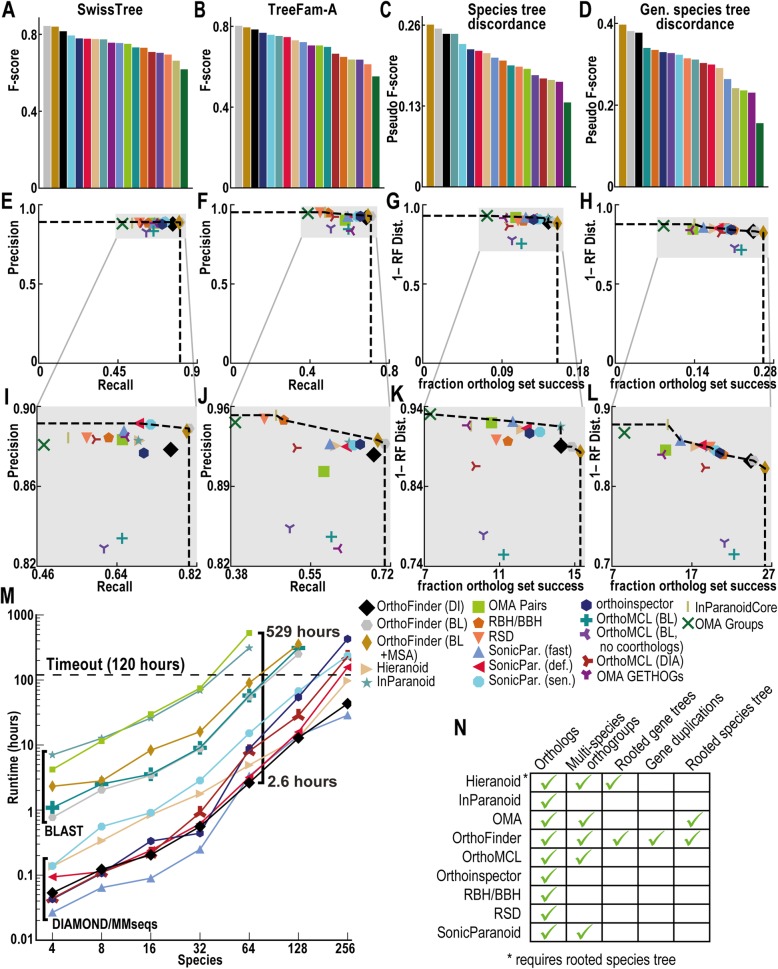
- On Quest for Orthologs 2011_04, the default fastest OrthoFinder was 3–24% more accurate on SwissTree and 2–30% more accurate on TreeFam-A than any other method; other OrthoFinder configurations were a further 1–3% more accurate.
- On the Species Tree Discordance Tests, all OrthoFinder versions had equal or higher pseudo-F-score than all other methods; the default version scored 0–45% higher on STDT and 10–59% higher on GSTDT.
- Default OrthoFinder ran in 192 s on 4 fungal species and 1.8 days on 256 species with 16 threads, making it the second quickest method; SonicParanoid was fastest at 1.2 days on 256 species.
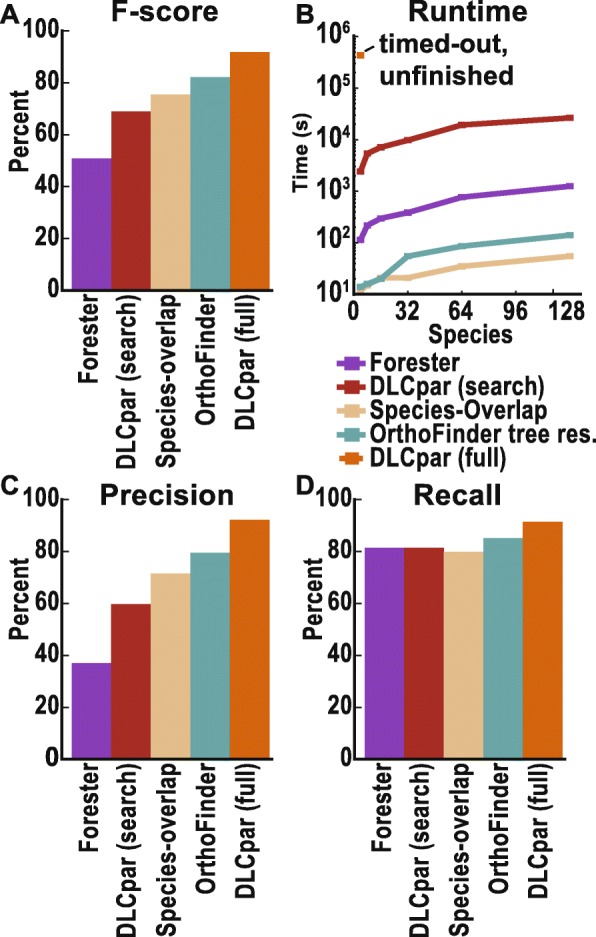
- The novel hybrid duplication-loss-coalescence algorithm raised duplication F-score from 72% with species-overlap to 80%; DLCpar (full) was most accurate at 91.8% but could not process a 4-species dataset (2259 trees, 12,958 genes) in 120 h, while OrthoFinder analyzed 18,651 trees and 948,449 genes from 128 fungi in 141 s.
Methods
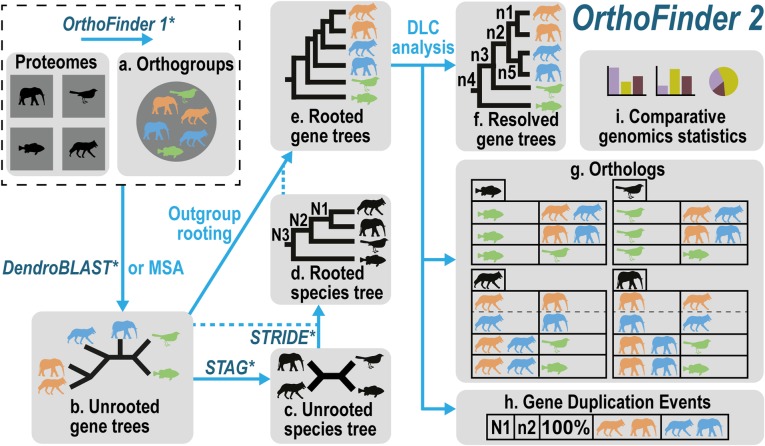
- Input is one FASTA file per species; orthogroups are inferred with the original OrthoFinder algorithm, unrooted gene trees with DendroBLAST, the species tree with STAG, the species tree root with STRIDE, gene trees are rooted using the species tree, and orthologs/duplications are inferred with a novel hybrid species-overlap plus duplication-loss-coalescence algorithm.
- Benchmarks used Quest for Orthologs 2011_04 on 66 species across Eukarya, Bacteria, and Archaea; simulated flies (12,000 trees, 12 species, 12,032 duplications), primates (7500 trees, 17 species, 16,066 duplications), and metazoa (2000 trees, 40 species, 4967 duplications); performance was tested on 4–256 fungal proteomes.
- Analyses compared precision, recall, F-score, pseudo-F-score, Robinson-Foulds agreement, and runtime against methods including Forester, DLCpar (full/search), species-overlap, Notung, and other orthology inference tools.
Limitations
- Stated: STRIDE may fail to identify the species tree root, or only exclude the root from clades, when gene trees contain few duplications; DLCpar (full) was more accurate but not scalable; the default fastest OrthoFinder is less accurate than other OrthoFinder configurations; the authors cannot test all possible multiple sequence alignment and tree inference combinations.
- Evident: STDT and GSTDT lack ground-truth orthologs, so pseudo-F-score substitutes for standard precision/recall; benchmarking is limited to specific Quest for Orthologs datasets and simulated data; OrthoFinder is second fastest, not fastest, on the 256-species dataset; no competitor method also provides gene trees or identifies gene duplication events, so the data-richness advantage is not an accuracy comparison.
Model-written summary. Check it against the paper before relying on it.
Integrity signals
Registry
Cites
Statistics
Figures
Verification
Claims the paper makes
23 Valid · 10 Not valid · 1 Not checked · 62 Own results and interpretations
The cited sources support only part of this claim — read each source’s verdict below.
In the paper
“STRIDE was developed to enable the rooting of the species tree using only information available in the set of gene trees.”
§ OrthoFinder: phylogenetic orthology inference for comparative genomics > Methods > Species tree inference and rooting
What the sources say
- Partly supportedcites [22] Emms DM Kelly S STRIDE: species tree root inference from gene duplication events Mol Biol Evol 2017 34 12 3267 3278 10.1093/molbev/msx259 29029342 PMC5850722 sourceExperimental — accuracy not yet measured
The Introduction says STRIDE uses duplication events from unrooted gene trees to locate the root. But the Results (Application of STRIDE to Real Species Data Sets; page unavailable) say it was run with both gene trees and a published unrooted species tree, so the claim that it uses only information in the gene trees omits a required input. (LLM, conf=0.88)
plainstates a cause- Asserted: passes — The authors put it forward as true.
- Checkable: passes — It can be checked against evidence.
- Load-bearing: passes — The paper’s conclusions depend on it.
- Based: passes — The paper gives a reason why it holds.
- Partly supported
The cited sources support only part of this claim — read each source’s verdict below.
In the paper
“The original OrthoFinder orthogroup inference method is still the most accurate method on the independent Orthobench test set [10] and thus is used for this step.”
§ OrthoFinder: phylogenetic orthology inference for comparative genomics > Methods > Use of orthogroups for gene tree inference
What the sources say
- Partly supportedcites [10] Emms DM Kelly S OrthoFinder: solving fundamental biases in whole genome comparisons dramatically improves orthogroup inference accuracy Genome Biol 2015 16 157 10.1186/s13059-015-0721-2 26243257 PMC4531804 sourceExperimental — accuracy not yet measured
The ‘OrthoFinder outperforms all other methods from the OrthoBench analysis’ section reports that OrthoFinder had the highest F-score among methods applied to OrthoBench, and the Evaluation section describes the dataset as independently evaluated. The 2015 paper does not establish that the original method is *still* the most accurate after that comparison. (LLM, conf=0.84)
plain- Asserted: passes — The authors put it forward as true.
- Checkable: passes — It can be checked against evidence.
- Load-bearing: passes — The paper’s conclusions depend on it.
- Based: passes — The paper gives a reason why it holds.
- Partly supported
The cited sources support only part of this claim — read each source’s verdict below.
In the paper
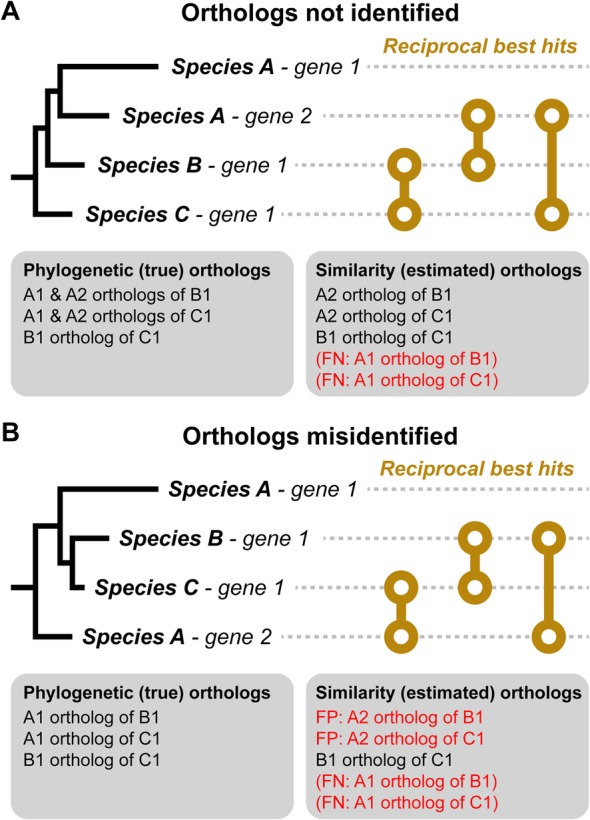
“However, such score-based estimates of the phylogenetic relationship between genes are confounded by multiple factors. For example, variable sequence evolution rates between genes frequently lead to both false-positive and false-negative errors [14, 15] (Fig. 1).”
§ OrthoFinder: phylogenetic orthology inference for comparative genomics > Background
What the sources say
- Partly supportedcites [14] Lafond M Miardan MM Sankoff D Accurate prediction of orthologs in the presence of divergence after duplication Bioinformatics 2018 34 366 375 10.1093/bioinformatics/bty242 PMC6022570 29950018 sourceExperimental — accuracy not yet measured
The Introduction (page unavailable) explains that accelerated mutation after duplication can make orthologous genes dissimilar, so similarity-based methods may fail to identify them—a false negative. It does not establish that variable evolutionary rates frequently cause false-positive errors as well, or support that frequency claim. (LLM, conf=0.82)
- Not checked — no full text of the sourcecites [15] Fitch WM Distinguishing homologous from analogous proteins Sys Zool 1970 19 99 10.2307/2412448 5449325 source
plainstates a cause- Asserted: passes — The authors put it forward as true.
- Checkable: passes — It can be checked against evidence.
- Load-bearing: passes — The paper’s conclusions depend on it.
- Based: passes — The paper gives a reason why it holds.
- Partly supported
Every source the paper cites for this claim was checked and supports it.
In the paper
“A new algorithm, Species Tree from All Genes (STAG), was developed to allow species tree inference even for species sets with few or no complete sets of one-to-one orthologs present in all species [33].”
§ OrthoFinder: phylogenetic orthology inference for comparative genomics > Methods > Species tree inference and rooting
What the sources say
- Supportedcites [33] Emms D, Kelly S. STAG: species tree inference from all genes. bioRxiv. 2018. https://www.biorxiv.org/content/10.1101/267914v1. source
The Discussion says complete one-to-one orthogroups are comparatively rare and that STAG uses orthogroups containing all species regardless of gene copy number. This supports the claim that STAG enables species-tree inference when few or no complete one-to-one ortholog sets are available. Page numbers are not provided in our copy. (LLM, conf=0.94)
plainstates a cause- Asserted: passes — The authors put it forward as true.
- Checkable: passes — It can be checked against evidence.
- Load-bearing: passes — The paper’s conclusions depend on it.
- Based: passes — The paper gives a reason why it holds.
- Supported
The sources with a verdict support this claim; the rest weren’t checked yet, have no full text we could read, or their verdicts aren’t rated yet.
In the paper
“The accuracy of key component algorithms of OrthoFinder has been independently assessed in this work and in dedicated publications [5, 10, 22, 24, 33].”
§ OrthoFinder: phylogenetic orthology inference for comparative genomics > Results > OrthoFinder has the highest ortholog inference accuracy
What the sources say
- Not checked — no full text of the sourcecites [5] Buchfink B Xie C Huson DH Fast and sensitive protein alignment using DIAMOND Nat Methods 2015 12 59 60 10.1038/nmeth.3176 25402007 source
- Supportedcites [10] Emms DM Kelly S OrthoFinder: solving fundamental biases in whole genome comparisons dramatically improves orthogroup inference accuracy Genome Biol 2015 16 157 10.1186/s13059-015-0721-2 26243257 PMC4531804 source
The ‘An improved method for orthogroup delimitation improves overall accuracy’ section assesses the accuracy of OrthoFinder’s gene-pair selection and clustering approach and reports precision, recall, and F-score. The Evaluation section describes testing against the independently evaluated OrthoBench dataset. This dedicated publication therefore supports the citation’s contribution to the statement about assessed component-algorithm accuracy. (LLM, conf=0.88)
- Supportedcites [22] Emms DM Kelly S STRIDE: species tree root inference from gene duplication events Mol Biol Evol 2017 34 12 3267 3278 10.1093/molbev/msx259 29029342 PMC5850722 source
The Results section, “STRIDE Identifies the Correct Root of Species Trees Given Simulated Gene Tree Data Sets” (page not provided), assesses STRIDE’s rooting accuracy on three simulated datasets and reports its duplication-detection precision and recall. This supports citing the dedicated STRIDE publication for an accuracy assessment of an algorithm used in the OrthoFinder workflow; the paper does not assess every OrthoFinder component. (LLM, conf=0.86)
- Supportedcites [24] Kelly S Maini PK DendroBLAST: approximate phylogenetic trees in the absence of multiple sequence alignments PLoS One 2013 8 e58537 10.1371/journal.pone.0058537 23554899 PMC3598851 source
The Methods section, “Comparison of DendroBLAST against other inference methods,” describes an accuracy evaluation against reference trees using five metrics. The Results sections report DendroBLAST’s performance relative to other tree-inference methods. This supports the citation’s role as a dedicated publication assessing the accuracy of a component algorithm; it does not need to assess every OrthoFinder component. (LLM, conf=0.91)
- Supportedcites [33] Emms D, Kelly S. STAG: species tree inference from all genes. bioRxiv. 2018. https://www.biorxiv.org/content/10.1101/267914v1. source
The paper evaluates the accuracy of STAG species-tree inference against literature-derived trees across 12 biological datasets (Results and Discussion; page numbers unavailable). The Discussion also states that STAG was designed to integrate with OrthoFinder and can run directly from its results. This supports citing the publication as a dedicated assessment of a component algorithm. (LLM, conf=0.91)
plain- Asserted: passes — The authors put it forward as true.
- Checkable: passes — It can be checked against evidence.
- Load-bearing: passes — The paper’s conclusions depend on it.
- Based: passes — The paper gives a reason why it holds.
39 more claims · 8 with their cited sources checked
Create a free account to see all 96 claims and every source verdict.
- Probably not a substantial claim. 18
- It may state two separate claims as one. 40
- The quote only partly states this claim. 2
Claims other papers make about this one
Each is checked against this paper’s own text: does it say what the citing paper says it does?
The source backs part of the claim, not all of it — or backs it for a different population, condition or comparison.
In the citing paper
“The original OrthoFinder algorithm applied a per-species-pair gene-length normalization that accounted for both evolutionary distance and gene-length dependence in pairwise bit scores between sequences12.”
From OrthoFinder: improved phylogenetic orthology inference with enhanced accuracy and scalability (2026) · cites this paper as [12]
Experimental — accuracy not yet measuredThe source backs part of the claim, not all of it — or backs it for a different population, condition or comparison.
In the citing paper
“In previous versions of OrthoFinder, orthologs were defined phylogenetically, whereas orthogroups were defined solely based on Markov Cluster Algorithm (MCL) clustering of sequence similarity search results12,16.”
From OrthoFinder: improved phylogenetic orthology inference with enhanced accuracy and scalability (2026) · cites this paper as [12]
Experimental — accuracy not yet measuredThe source backs part of the claim, not all of it — or backs it for a different population, condition or comparison.
In the citing paper
“Other sequence similarity approaches such as OrthoFinder (Emms and Kelly, 2019; Emms and Kelly, 2015) leverage graphs and gene trees to test for orthology, permitting more robust analyses in systems with gene copy number (CNV) or presence–absence variation (PAV).”
From GENESPACE tracks regions of interest and gene copy number variation across multiple genomes (2022) · cites this paper as Emms and Kelly, 2019
Experimental — accuracy not yet measuredThe cited source says what the claim attributes to it.
In the citing paper
“We used two different methods for identifying orthologues—a simple mutual-best-hits method and an alternative orthologue-clustering approach (OrthoFinder47; Supplementary Information 10 and 11), and obtained comparable results using both approaches”
From Ancient gene linkages support ctenophores as sister to other animals (2023) · cites this paper as [47]
The cited source says what the claim attributes to it.
In the citing paper
“Gene tree-based methods determine whether the evolutionary lineages of two genes coalesce in a speciation or a duplication node (12–14).”
From Integrating gene annotation with orthology inference at scale (2023) · cites this paper as [12]
4 more claims about this paper
Create a free account to see every claim other papers make about this one.
Self-check
Percentages, sums and reported differences re-computed from the paper’s own numbers.
Each contradiction between two passages listed here was confirmed by an independent check.
Rated minor: it would not touch a result — a value no result rests on, a p-value that stays on the same side of the significance level, or a conflict that is clerical, resolved elsewhere in the paper, or outside its own findings.
In the paper
§ OrthoFinder: phylogenetic orthology inference for comparative genomics > Methods > Ortholog inference and identification of gene duplication events from gene trees
“The hybrid algorithm was able to analyze the complete set of orthogroup trees for the 128 fungi species in 141 s; this was 9 times faster than Forester and 187 times faster than DLCpar (search) (Fig. 5d).”
§ OrthoFinder: phylogenetic orthology inference for comparative genomics > Results > OrthoFinder implements a novel duplication-loss-coalescent algorithm for identifying gene duplication events and orthologs
“Figure: Fig. 5 a Duplication F-score, on simulated gene trees. b Runtime to analyse all trees from the 4 to 128 species Fungi datasets (see Methods), a maximum time of 120 hours (4.3x10 seconds) was allowed. DLCpar (full) did not complete the smallest dataset in this time limit and so only the lower bound for the first time point is shown. c-d Precision and recall”
Rated minor: it would not touch a result — a value no result rests on, a p-value that stays on the same side of the significance level, or a conflict that is clerical, resolved elsewhere in the paper, or outside its own findings.
In the paper
§ OrthoFinder: phylogenetic orthology inference for comparative genomics > Methods > Chordata dataset
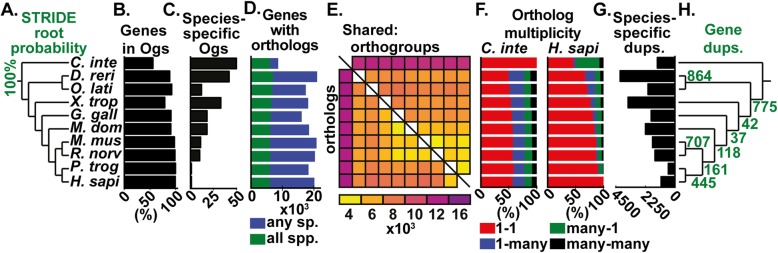
“The data for the OrthoFinder analysis of the ten Chordata species for the illustration of the results of an OrthoFinder analysis (Fig. 2a–h)”
§ OrthoFinder: phylogenetic orthology inference for comparative genomics > Results > OrthoFinder algorithm overview and summary of results files
“Figure: Fig. 3 Summary of OrthoFinder analysis of a set of Chordata species:”
Citations
Cites
MAFFT Multiple Sequence Alignment Software Version 7: Improvements in Performance and Usability
Katoh, K., & Standley, D. M. (2013) · Molecular Biology and Evolution · doi:10.1093/molbev/mst010 · Cited by 46,209 · cited 4×
“Katoh K, Standley DM. MAFFT multiple sequence alignment software version 7: improvements in performance and usability.”
MethodInfluentialRAxML version 8: a tool for phylogenetic analysis and post-analysis of large phylogenies
Stamatakis, A. (2014) · Bioinformatics · doi:10.1093/bioinformatics/btu033 · Cited by 32,291 · cited 4×
“For each successful ortholog set, an MSA is constructed and a gene tree inferred using RAxML [28].”
MethodInfluentialIQ-TREE: A Fast and Effective Stochastic Algorithm for Estimating Maximum-Likelihood Phylogenies
Nguyen, L.-T., Schmidt, H. A., von Haeseler, A., & Minh, B. Q. (2015) · Molecular Biology and Evolution · doi:10.1093/molbev/msu300 · Cited by 26,046
BLAST+: architecture and applications
Camacho, C., Coulouris, G., Avagyan, V., Ma, N., Papadopoulos, J., Bealer, K., & Madden, T. L. (2009) · BMC Bioinformatics · doi:10.1186/1471-2105-10-421 · Cited by 22,074 · cited 3×
“Currently, supported methods for step 1 include BLAST [4] and MMseqs2 [6].”
MethodFastTree 2 – Approximately Maximum-Likelihood Trees for Large Alignments
Price, M. N., Dehal, P. S., & Arkin, A. P. (2010) · PLoS ONE · doi:10.1371/journal.pone.0009490 · Cited by 14,894
Fast and sensitive protein alignment using DIAMOND
Buchfink, B., Xie, C., & Huson, D. H. (2015) · Nature Methods · doi:10.1038/nmeth.3176 · Cited by 14,201
OrthoMCL: Identification of Ortholog Groups for Eukaryotic Genomes
Li, L., Stoeckert, C. J., & Roos, D. S. (2003) · Genome Research · doi:10.1101/gr.1224503 · Cited by 5,707
MMseqs2 enables sensitive protein sequence searching for the analysis of massive data sets
Steinegger, M., & Söding, J. (2017) · Nature Biotechnology · doi:10.1038/nbt.3988 · Cited by 4,840
Emms, D. M., & Kelly, S. (2015) · Genome Biology · doi:10.1186/s13059-015-0721-2 · Cited by 3,408
Self-citationETE 3: Reconstruction, Analysis, and Visualization of Phylogenomic Data
Huerta-Cepas, J., Serra, F., & Bork, P. (2016) · Molecular Biology and Evolution · doi:10.1093/molbev/msw046 · Cited by 2,231
Cited by
Items 3,501–3,600 of 7,986
Orthoweb: a software package for evolutionary analysis of gene networks
Ivanov, R. A., Mukhin, A. M., Владимирович, К. Ф., Мустафин, З. С., Afonnikov, D. A., Matushkin, Y. G., & Lashin, S. A. (2025) · Vavilov Journal of Genetics and Breeding · doi:10.18699/vjgb-24-95 · Cited by 12
Wiśniewska, M. M., Kyslík, J., Alama-Bermejo, G., Lövy, A., Kolísko, M., Holzer, A. S., & Kosakyan, A. (2025) · BMC Genomics · doi:10.1186/s12864-025-11265-x · Cited by 5
“3.11 [100] to identify ortho-logues shared and unique between the de novo and genome-guided assemblies.”
InfluentialKelly, J. B., Carlson, D. E., Reuter, M., Sommershof, A., Adamec, L., & Becks, L. (2025) · Molecular Biology and Evolution · doi:10.1093/molbev/msaf030 · Cited by 5
Lewis, M. T., Poelstra, J. W., & Michel, A. P. (2025) · Scientific Reports · doi:10.1038/s41598-025-87561-z · Cited by 10
“5.4 36 to identify 2,848 annotated soybean aphid genes that were orthologous to previously identified putative effector genes from the pea aphid (Boulain et al. 2018).”
InfluentialDai, Y., He, M., Liu, H., Zeng, H., Wang, K., Wang, R., Ma, X., Zhu, Y., Xie, G., Zhao, Y., et al. (2025) · Plant Biotechnology Journal · doi:10.1111/pbi.14601 · Cited by 5
“…vinifera , A. thaliana and nine other Lamiaceae plant species ( S. splendens , S. miltiorrhiza , S. officinalis , S. rosmarinus , S. baicalensis , S. bowleyana , N. cataria , S. barbata and S. plebeia ) were identified using OrthoFinder (Emms and Kelly, 2019) (version 2.3.12) with default settings.”
InfluentialThe nuclear and mitochondrial genomes of amoebophrya sp. ex Karlodinium veneficum
DeMontigny, W. C., & Bachvaroff, T. R. (2025) · G3 Genes Genomes Genetics · doi:10.1093/g3journal/jkaf030 · Cited by 5
“OrthoFinder (Emms and Kelly 2019) was used to find orthologous groups between the proteomes previously used in the MAKER annotation pipeline and the MAKER-predicted proteins and stop-codon-masked protein alignments.”
Jiang, D., Li, Y., Zhuge, F., Zhou, Q. X., Zong, W., Liu, X., & Shen, X. (2025) · GigaScience · doi:10.1093/gigascience/giaf009 · Cited by 5
Huq, M. A., Kim, Y.-J., Rahman, M., Alam, M. M., Srinivasan, S., Kang, K.-K., & Akter, S. (2025) · INTERNATIONAL JOURNAL OF SYSTEMATIC AND EVOLUTIONARY MICROBIOLOGY · doi:10.1099/ijsem.0.006687 · Cited by 5
“OrthoFinder implements a graph-based clustering approach to assign genes into orthogroups and reconstruct species and gene trees, providing insights into the evolutionary relationships of the strain [21].”
InfluentialZhu, T., Hussain, M., Ning, J., Chen, X., Shi, C. H., Yang, D., Gao, X., & Wu, G. (2025) · International Journal of Molecular Sciences · doi:10.3390/ijms26052031 · Cited by 5
“Conserved domain architectures were systematically profiled through comparative analysis against the NCBI Conserved Domain Database (CDD v3.”
Zou, Z., Fu, X., Yi, X., Li, C., Huang, J., & Zhao, Y. (2025) · Plants · doi:10.3390/plants14050762 · Cited by 5
“The growing conditions of tigernut plants (Reyan3) were as previously described [27].”
Hu, S., Shen, Z., Wang, Y., & Guo, Q. (2025) · International Journal of Biological Macromolecules · doi:10.1016/j.ijbiomac.2025.142291 · Cited by 5
Cheng, G. B., Bongcam‐Rudloff, E., & Schnürer, A. (2025) · Microbial Biotechnology · doi:10.1111/1751-7915.70133 · Cited by 5
Jiang, W., Pan, J., Lin, T., Wang, Y., Wang, Y., Zhang, R., Zhou, X., & Zhang, Y. (2025) · Microbiology Spectrum · doi:10.1128/spectrum.02127-24 · Cited by 4
Zhou, Z., Jiawei, E., Shi, Q., Zhang, W., Sun, L., & Fan, J. (2025) · Journal of Advanced Research · doi:10.1016/j.jare.2025.03.022 · Cited by 7
“4 [47], with the diamond algorithm applied and a sequence alignment e-value threshold of 0.001.”
InfluentialHongfei, X., & Colgan, T. J. (2025) · Molecular Biology and Evolution · doi:10.1093/molbev/msaf063 · Cited by 10
“To determine duplicated genes in B. terrestris , we performed a homology-based analysis using OrthoFinder (v.2.5.4) (Emms and Kelly 2019) with the following species ( n = 42): 18 bumblebee ( Bombus ) species, including representatives from each of the main subgenera, 6 additional species from the…”
InfluentialGenomic insights into evolution of parthenogenesis and triploidy in the flowerpot snake
Lv, Y., Wu, W., Ren, J., Fujita, M. K., Song, M.-H., Wang, Z., Jiang, K., Jiang, D., Yan, C., Peng, C., et al. (2025) · Science Advances · doi:10.1126/sciadv.adt6477 · Cited by 7
Insights into convergent evolution of cosexuality in liverworts from the Marchantia quadrata genome
Potente, G., Yasui, Y., Shimokawa, E., Jenkins, J. W., Walstead, R., Grimwood, J., Schmutz, J., Leebens‐Mack, J., Brůna, T., Kaur, N., et al. (2025) · Cell Reports · doi:10.1016/j.celrep.2025.115503 · Cited by 7
Shi, C., Gu, M., Huang, Y., You, C., Bao, S., Xie, S., Gong, J., Deng, G., Wu, P., Wu, W., et al. (2025) · BMC Plant Biology · doi:10.1186/s12870-025-06496-9 · Cited by 5
Ilievska, M., Chong, S., Lim, K., Immanen, J., Nieminen, K. M., Maaheimo, H., Helariutta, Y., Wurman‐Rodrich, J., Dupree, P., Ord, J., et al. (2025) · New Phytologist · doi:10.1111/nph.70126 · Cited by 6
“Proteomes were clustered using O RTHOFINDER (Emms & Kelly, 2019) with default settings.”
Kim, H., Jo, J., Yang, J. H., Ettahi, K., Jeon, Y., Yu, J., Bhattacharya, D., Kwak, J. H., & Yoon, H. S. (2025) · Genome Biology and Evolution · doi:10.1093/gbe/evaf084 · Cited by 5
“M msa option (Emms and Kelly 2019).”
Chomentowska, A., Raimondeau, P., Wei, L., Jose, E. G. D., Dauerman, S. G., Davis, V. Z., Moreira‐Muñoz, A., Peralta, I. E., & Edwards, E. J. (2025) · New Phytologist · doi:10.1111/nph.70186 · Cited by 8
“We used O RTHO F INDER (Emms & Kelly, 2019) to perform orthology inference and identify orthologs for all photosynthetic genes.”
Greatens, N., Murithi, H. M., Coyne, D., Clough, S. J., Sulyok, M., Okunowo, W. O., Abbas, H. K., Shier, W. T., & Koch, R. A. (2025) · PLoS ONE · doi:10.1371/journal.pone.0321896 · Cited by 4
“Orthology of PKS genes was inferred using Orthofinder [51].”
A bloom of a single bacterium shapes the microbiome during outdoor diatom cultivation collapse
Gilbert, N. E., Kimbrel, J. A., Samo, T. J., Siccardi, A. J., Stuart, R. K., & Mayali, X. (2025) · mSystems · doi:10.1128/msystems.00375-25 · Cited by 6
Vermote, L., Chun, B. H., Khan, S. A., Vuyst, L. D., Jeon, C. O., & Weckx, S. (2025) · International Journal of Food Microbiology · doi:10.1016/j.ijfoodmicro.2025.111283 · Cited by 7
Zhu, X., Luo, W.-J., Chai, S., Tang, J., Wei, X., Wee, A. K. S., & Kang, M. (2025) · BMC Biology · doi:10.1186/s12915-025-02275-y · Cited by 5
“4.1 [66] was used to identify SCGs.”
InfluentialTao, Y., Chen, J., Zhao, Y., Zhang, G., Gao, X., Wu, Y., Xiang, N., Liu, X., & Zhang, R. (2025) · Industrial Crops and Products · doi:10.1016/j.indcrop.2025.121351 · Cited by 5
Cholsaktrakool, P., Kawang, K., Sangpiromapichai, N., Thongsuk, P., Anuntakarun, S., Kunadirek, P., Chuaypen, N., Nilgate, S., Kueakulpattana, N., Rirerm, U., et al. (2025) · iScience · doi:10.1016/j.isci.2025.112962 · Cited by 8
Sun, M., Han, B., Xiao, J., Yu, H., Jia, Y., Yuan, S., Yao, J., Xing, Q., Wu, D., Sun, G., et al. (2025) · BMC Plant Biology · doi:10.1186/s12870-025-06863-6 · Cited by 7
“4.0 [102] across several species, including A. calamus , A. trichopoda , A. thaliana , A. officinalis , H. citrina , H. middendorffii , H. vulgare , O. sativa , P. mume , S. bicolor , T. cacao , and V. vinifera respectively.”
InfluentialDubin, A., Parker, J., Böhne, A., & Roth, O. (2025) · Genome Biology and Evolution · doi:10.1093/gbe/evaf103 · Cited by 7
Sallé, G., Courtot, É., Cabau, C., Parrinello, H., Serreau, D., Reigner, F., Gesbert, A., Jacquinot, L., Lenhof, O., Aimé, A., et al. (2025) · Peer Community Journal · doi:10.24072/pcjournal.571 · Cited by 6
Park, H., Bae, E., Jung, J. G., Kim, J., Choi, B. Y., Lee, G., Kim, C., & Shim, D. (2025) · The Plant Genome · doi:10.1002/tpg2.70070 · Cited by 5
“M msa option (Emms & Kelly, 2018, 2019), we clustered gene families for the 12 plant species.”
Picciani, N., Berger, C. A., Nielsen, S., Musser, J. M., Oel, A. P., Stoilova, M. I., Arendt, D., Garm, A. L., & Oakley, T. H. (2025) · Ecology and Evolution · doi:10.1002/ece3.71784 · Cited by 5
“5.5 (Emms and Kelly 2019) to infer homology relationships.”
InfluentialAncient climate changes and relaxed selection shape cave colonization in North American cavefishes
Hart, P. B., Rincón-Sandoval, M., Meléndez-Vazquez, F., Armbruster, J. W., Troyer, E. M., Bierstein, O. M., Gough, B. J., Betancur‐R, R., Niemiller, M. L., & Arcila, D. (2025) · Proceedings of the Royal Society B Biological Sciences · doi:10.1098/rspb.2024.2516 · Cited by 7
Sullivan, S. A., Orosco, J. C., Callejas‐Hernández, F., Blow, F., Lee, H., Ranallo-Benavidez, T. R., Peters, A., Raidal, S., Girard, Y. A., Johnson, C. K., et al. (2025) · Nature Communications · doi:10.1038/s41467-025-61483-w · Cited by 14
“OrthoFinder 78 was used to identify 6,226 single-copy orthologs (SCOs) across the seven trichomonad species, and GO terms assigned to them using embedding similarity 79 .”
Characterisation of Early Biosynthetic Steps of Atractylon via an Integrative Strategy
Zhu, J., Li, Q., Zhang, Q., Liu, L., Tang, R., He, L., He, S., Feng, S., Li, J., Shu, S., et al. (2025) · Plant Biotechnology Journal · doi:10.1111/pbi.70335 · Cited by 7
“OrthoFinder (Emms and Kelly 2019) was employed for inference of orthologous groups in the 14 selected species.”
EASYstrata: an all-in-one workflow for genome annotation and genomic divergence analysis
Rougemont, Q., Lucotte, E. A., Boyer, L., de Dinechin, A. J., Snirc, A., Giraud, T., & de la Vega, R. C. R. (2025) · NAR Genomics and Bioinformatics · doi:10.1093/nargab/lqaf110 · Cited by 6
“To that aim, the pipeline first infers gene orthology relationships using Or-thoFinder [ 29 ] from the annotated gene set obtained from BRAKER.”
SegMantX: A Novel Tool for Detecting DNA Duplications Uncovers Prevalent Duplications in Plasmids
Hanke, D. M., & Dagan, T. (2025) · Molecular Biology and Evolution · doi:10.1093/molbev/msaf242 · Cited by 5
“Advanced approaches assess gene paralogy and orthology (e.g. OrthoMCL, OrthoFinder, or TreeFam; Li et al. 2003, 2006; Emms and Kelly 2019) or integrate functional annotation of the duplicated genes (e.g. HSDFinder; Zhang et al. 2021).”
Li, D., Yingyi, Z., Fu, C., Pan, X., Yanpo, L., Fang, Z., Xiao, C., Wang, G., Wang, X., & Zhang, W. (2025) · BMC Plant Biology · doi:10.1186/s12870-025-07349-1 · Cited by 5
“3.14 [78], the MaFFT version 7.429 [71] was used to align these 57 common protein-coding genes of 28 chloroplast genomes.”
InfluentialDOO: integrated multi-omics resources for deep ocean organisms
She, J., Qian, P., & Wu, L. (2025) · Nucleic Acids Research · doi:10.1093/nar/gkaf1096 · Cited by 6
“The orthologues and paralogues of deep ocean organisms were identified using OrthoFinder (version 2.5.5) [ 90 ].”
InfluentialSystem drift in the evolution of plant meristem development
van der Jagt, P. L., Oud, S., & Vroomans, R. M. A. (2026) · PLoS Genetics · doi:10.1371/journal.pgen.1012089 · Cited by 5
“A CNS is defined as a non-coding sequence conserved within the upstream/downstream region of genes within an orthogroup [44].”
A geothermal amoeba sets a new upper temperature limit for eukaryotes
Rappaport, H. B., Petek-Seoane, N. A., Tyml, T., Niblo, J. K., Mikus, F., Gilbert, N. E., LaButti, K. M., Ani, G., MacVicar, E., Shepherd, R. M., et al. (2026) · Cell · doi:10.1016/j.cell.2026.08.043 · Cited by 15
Xu, Y., Li, J., Hu, Y., Li, H., Peng, T., Zhong, M., & Hu, Z. (2020) · INTERNATIONAL JOURNAL OF SYSTEMATIC AND EVOLUTIONARY MICROBIOLOGY · doi:10.1099/ijsem.0.004577 · Cited by 5
Bakkali, M., Martín‐Blázquez, R., Ruíz-Estévez, M., & Garrido-Ramos, M. A. (2021) · Genes · doi:10.3390/genes12071017 · Cited by 5
From pairwise to multiple spliced alignment
Jammali, S., Djossou, A., Ouedraogo, W. Y. D. D., Nevers, Y., Chegrane, I., & Ouangraoua, A. (2022) · Bioinformatics Advances · doi:10.1093/bioadv/vbab044 · Cited by 9
“[2008]), Orthofinder (Emms and Kelly [2019]), and SplicedFamAlign (SFA) (Jammali et al. [2019]). Cluss (Kelil et al. [2008]) is a fast alignment-free method for clustering protein families. Orthofinder (Emms and Kelly [2019]) is a widely used alignment-based method that infers orthogroups of coding genes by solving th…”
InfluentialBojko, J., McCoy, K. A., & Blakeslee, A. M. H. (2022) · Journal of Invertebrate Pathology · doi:10.1016/j.jip.2022.107737 · Cited by 5
Xia, Z., Liu, L., Wei, Z., Wang, F., Shen, H., & Yan, Y. (2022) · Plants · doi:10.3390/plants11091198 · Cited by 5
“6) [43] software was used to cluster transcripts into orthologous genes (OGs), which infer core-orthogroups based on all-against-all BLASTP (v.”
MethodTan, S., Wang, W., Jie, W., & Liu, J. (2022) · Computational and Structural Biotechnology Journal · doi:10.1016/j.csbj.2022.07.015 · Cited by 6
“In an attempt to explore the gene conservation between fish species, 133 orthologous genes between species were identified by OrthoFinder [29] using the longest protein 134”
MethodLv, Y., Li, Y., Wen, Z., & Shi, Q. (2022) · Frontiers in Ecology and Evolution · doi:10.3389/fevo.2022.924248 · Cited by 4
Su, X., Liu, T., Liu, Y. P., Harris, A., & Chen, J. (2022) · Journal of Plant Physiology · doi:10.1016/j.jplph.2022.153786 · Cited by 6
Zhou, C., Liu, Y., Zhang, R., Zheng, X., Zhao, G., Li, F., Liu, W., Yue, B., & Yang, N. (2022) · Genome Biology and Evolution · doi:10.1093/gbe/evac128 · Cited by 7
Kim, B., Min, B., Han, J., Park, H., Baek, S., Jeong, S., & Choi, I. (2022) · Mycobiology · doi:10.1080/12298093.2022.2109874 · Cited by 5
“4) using diamond for sequence alignment [21].”
Rigamonti, S., Floriano, A. M., Scaltriti, E., Longbottom, D., Livingstone, M., Comandatore, F., Pongolini, S., Capucci, L., Mandola, M. L., Bazzucchi, M., et al. (2022) · BMC Genomics · doi:10.1186/s12864-022-08860-7 · Cited by 5
Liu, L., Liu, Q., & Gao, T. (2022) · ZooKeys · doi:10.3897/zookeys.1129.91543 · Cited by 5
“The amino acid sequences of single-copy orthologs genes among the 16 species were found using OrthoFinder v. 2.5.4 (Emms and Kelly 2019), and these sequences were aligned by using MAFFT v. 7 (Katoh and Standley 2013).”
MethodInfluentialLiu, K., Xie, N., Wang, D., & Liu, X. (2022) · Gene · doi:10.1016/j.gene.2022.147058 · Cited by 6
Evolutionary analyses and expression patterns of TCP genes in Ranunculales
Damerval, C., Claudot, C., Guilloux, M. L., Silva, N. C. E., Brunaud, V., Soubigou‐Taconnat, L., Caïus, J., Delannoy, É., Nadot, S., Jabbour, F., et al. (2022) · Frontiers in Plant Science · doi:10.3389/fpls.2022.1055196 · Cited by 5
“The proteomes inferred from each of these transcriptomes were analyzed alongside the proteomes of A. coerulea and N. damascena using Orthofinder (Emms and Kelly, 2015; Emms and Kelly, 2019) with default options.”
Halomonas getboli sp. nov., a halotolerant bacteria isolated from a salt flat
Yoo, Y., Lee, H., Khim, J. S., Xu, X., Kim, B., Choi, I., & Kim, J. (2022) · INTERNATIONAL JOURNAL OF SYSTEMATIC AND EVOLUTIONARY MICROBIOLOGY · doi:10.1099/ijsem.0.005634 · Cited by 5
Tu, G., 中山大学海洋科学学院有害生物控制与资源利用国家重点实验室(中山大学), 广. 珠. 5., Zhang, X., Jiang, R., Zhang, L., Lai, C.-J., Yan, Z., Lv, Y., Weng, S., Zhang, L., et al. (2023) · 动物学研究 · doi:10.24272/j.issn.2095-8137.2022.462 · Cited by 10
Pelosi, J. A., Barbazuk, W. B., & Sessa, E. B. (2023) · International Journal of Plant Sciences · doi:10.1086/724824 · Cited by 5
Gao, H., Suo, X., Zhao, L., Ma, X., Cheng, R., Wang, G., & Zhang, H. (2023) · Plant Cell Reports · doi:10.1007/s00299-023-03009-6 · Cited by 5
“OrthoFinder software (Emms and Kelly 2019) was used to classify the protein sequences of Setaria italica, Setaria”
MethodFredriksen, S., Ruijten, S. D. E., Murray, G. G. R., Juanpere-Borràs, M., van Baarlen, P., Boekhorst, J., & Wells, J. M. (2023) · Microbial Genomics · doi:10.1099/mgen.0.000992 · Cited by 7
Lin, M. M.-H., Walker, M. E., Jiranek, V., & Sumby, K. M. (2023) · Microbial Genomics · doi:10.1099/mgen.0.001029 · Cited by 7
Responses to predation pressure involve similar sets of genes in two divergent species of Daphnia
Zhang, X., Wolinska, J., Blair, D., Hu, W., & Yin, M. (2023) · Journal of Animal Ecology · doi:10.1111/1365-2656.13969 · Cited by 6
Zhao, W., Li, J., Sun, X., Zheng, Q., Liu, J., Hua, W., & Liu, J. (2023) · Horticulture Research · doi:10.1093/hr/uhad129 · Cited by 5
“6 package with default parameters [62].”
Uchida, T., Yoshioka, Y., Yoshida, Y., Fujie, M., Yamaki, A., Sasaki, A., Inoue, K., & Shinzato, C. (2023) · DNA Research · doi:10.1093/dnares/dsad014 · Cited by 5
Carramaschi, I. N., Queiroz, M. M. D. C., da Mota, F. F., & Zahner, V. (2023) · Current Microbiology · doi:10.1007/s00284-023-03393-y · Cited by 6
Pan, J., Zhang, X., Xu, W., Liu, Y., Liu, L., Luo, Z.-H., & Li, M. (2023) · mSystems · doi:10.1128/msystems.00305-23 · Cited by 5
“2 (68) with parameters “-S mmseqs -M msa.”
Scheunert, A., Lautenschlager, U., Ott, T., & Oberprieler, C. (2023) · Ecology and Evolution · doi:10.1002/ece3.10190 · Cited by 3
Feng, X., Zhang, R., Dong, W.-G., Wang, Z., Xiao, J., Wei, J., Gao, J., & Qi, J. (2023) · Biochemical Genetics · doi:10.1007/s10528-023-10463-0 · Cited by 5
“Orthologous gene analysis was realized by Orthofinder 2.5.4 (Emms and Kelly 2019), species evolution tree based on orthologues was constructed by IQ-TREE 2.1.3 (Minh et al. 2020) and visualized by Figtree 1.4.4 (http:// tree. bio. ed. ac. uk/ softw are/ figtr ee/), and comparative genomic analysis…”
InfluentialGuo, J., Ren, H., Ijaz, M., Qi, X., Ahmed, T., You, Y., Li, G., Yu, Z., Islam, M. S., Ali, H. M., et al. (2023) · Genomics · doi:10.1016/j.ygeno.2023.110695 · Cited by 5
Mevada, V. A., Patel, R. K., Dudhagara, P. R., Chaudhari, R., Vohra, M., Khan, V., Shyu, D. J. H., Chen, Y.-Y., & Zala, D. B. (2023) · Microorganisms · doi:10.3390/microorganisms11082030 · Cited by 5
Yang, P., Guo, K., Yang, Y., Lyu, M., Liu, J., Li, X., & Feng, Y. (2023) · Gene · doi:10.1016/j.gene.2023.147716 · Cited by 4
Liu, K., Xie, N., Wang, D., & Liu, X. (2023) · Marine Biotechnology · doi:10.1007/s10126-023-10248-x · Cited by 5
“5.4 (Emms and Kelly 2019) was used to extract orthologs, which were annotated using PANTHER v17.”
InfluentialXie, D., Gu, B., Liu, Y., Ye, P., Ma, Y., Wen, T., Song, X., & Zhao, Z. (2023) · BMC Biology · doi:10.1186/s12915-023-01704-0 · Cited by 5
“15) [51].”
Bae, S.-H., Lee, M. H., Lee, J.-H., Yu, Y., Lee, J., & Kim, T.-H. (2023) · Genes · doi:10.3390/genes14101898 · Cited by 5
Wu, T., Yang, Q., Zhou, R., Yu, T., Shen, S., Cao, R. F., Ma, X., & Song, X. (2023) · Physiologia Plantarum · doi:10.1111/ppl.14039 · Cited by 5
Walworth, N. G., Espinoza, J. L., Argyle, P., Hinners, J., Levine, N. M., Doblin, M. A., Dupont, C. L., & Collins, S. (2023) · Molecular Biology and Evolution · doi:10.1093/molbev/msad218 · Cited by 5
“Orthogroups were identified using OrthoFinder (Emms and Kelly 2019) with the high-quality proteins generated from our TransDecoder procedure and all of the Bacillariophyceae proteins listed previously.”
MethodČadež, N., Boundy‐Mills, K., Botha, A., Качалкин, А. В., Dlauchy, D., & Péter, G. (2023) · Yeast · doi:10.1002/yea.3904 · Cited by 5
“5.4 (Emms & Kelly, 2019) with option ‐”
InfluentialGuo, T., Feng, S., Zhang, Y., Li, W., Qin, Y., & Li, Z. (2023) · Genomics · doi:10.1016/j.ygeno.2023.110736 · Cited by 6
Comparative transcriptome analysis reveals deep molecular landscapes in stony coral Montipora clade
Han, T., Liao, X., Guo, Z., Chen, J.-Y., He, C., & Lu, Z. (2023) · Frontiers in Genetics · doi:10.3389/fgene.2023.1297483 · Cited by 7
Chen, B., Wang, Y., Xie, F., Liu, H., & Dai, H. (2023) · The Journal of Antibiotics · doi:10.1038/s41429-023-00675-2 · Cited by 5
“The phylogenetic analysis was conducted by OrthoFinder [19] based on single-copy orthogroups genes with default parameters, including genomes of LS1784 and other 34 Kitasatospora species, the genome of Streptomyces albus NBRC 13014 as the outgroup.”
Genome mining of metabolic gene clusters in the Rubiaceae family
Lemos, S. M. C. D., Paschoal, A. R., Guyot, R., Medema, M. H., & Domingues, D. S. (2023) · Computational and Structural Biotechnology Journal · doi:10.1016/j.csbj.2023.11.034 · Cited by 5
“To achieve this, first we compared the genomes of the study using Orthofinder v. 2.3.8 [16] with default parameters to infer orthology and Orthovenn3 [56] with default parameters to infer gene families expansions and contractions and synteny analysis.”
MethodInfluentialChallenges in estimating effective population sizes from metagenome-assembled genomes
Wang, X., & Feng, X. (2024) · Frontiers in Microbiology · doi:10.3389/fmicb.2023.1331583 · Cited by 6
Fleck, S. J., Tomlin, C., Coelho, F. A. D. S., Richter, M., Danielson, E. S., Backenstose, N. J. C., Krabbenhoft, T. J., Lindqvist, C., & Albert, V. A. (2024) · Communications Biology · doi:10.1038/s42003-023-05748-4 · Cited by 6
Katayama, N., Yamamoto, T., Aiuchi, S., Watano, Y., & Fujiwara, T. (2024) · Frontiers in Plant Science · doi:10.3389/fpls.2023.1286320 · Cited by 6
“After the above fi ltering steps, orthogroups were constructed among parental species, F 1K , F 1T, and Phegopteris decursivepinnata using OrthoFinder v.2.5.2 (Emms and Kelly, 2019).”
InfluentialDinda, V., Kimang’a, A. N., Kariuki, D. W., Sifuna, A. W., O’Brien, T. J., Welch, M., & Reva, O. N. (2024) · Access Microbiology · doi:10.1099/acmi.0.000667.v4 · Cited by 7
“Clusters of orthologous groups (COGs) in sequenced genomes were predicted using the programme OrthoFinder [10] with default parameters.”
MethodPan, Y., Ao, Z., Li, G., & Zhang, Y. (2024) · Agronomy · doi:10.3390/agronomy14020328 · Cited by 5
Talbot, S. C., Vining, K. J., Snelling, J., Clevenger, J. P., & Mehlenbacher, S. A. (2024) · G3 Genes Genomes Genetics · doi:10.1093/g3journal/jkae021 · Cited by 6
“Conservation of putative high confidence homologs between assemblies were compared using OrthoFinder (version 2.5.4, RRID: SCR_017118) (Emms and Kelly 2019).”
MethodInfluentialZare, T., Paril, J. F., Barnett, E. M., Kaur, P., Appels, R., Ebert, B., Roessner, U., & Fournier‐Level, A. (2024) · The Plant Genome · doi:10.1002/tpg2.20430 · Cited by 6
“5.4 (Emms & Kelly, 2019).”
InfluentialAn insight into the gene expression evolution in Gossypium species based on the leaf transcriptomes
Wu, Y., Sun, R., Huan, T., Zhao, Y., Yu, D., & Sun, Y. (2024) · BMC Genomics · doi:10.1186/s12864-024-10091-x · Cited by 7
“OrthoFinder (version 2.5.4) was used to construct the orthologous groups (OGs) among investigated species with default parameters [56].”
MethodInfluentialNazarizadeh, M., Nováková, M., Drábková, M., Catchen, J., Olson, P. D., & Štefka, J. (2024) · Proceedings of the Royal Society B Biological Sciences · doi:10.1098/rspb.2023.2563 · Cited by 6
“For increased accuracy, DIAMOND blast (E-value 1 × 10 − 5 ) in OrthoFinder was used [46].”
MethodInfluentialBarua, N., Herken, A. M., Melendez-Velador, N., Platt, T. G., & Hansen, R. R. (2024) · Biomicrofluidics · doi:10.1063/5.0188270 · Cited by 7
Ma, S., Zhao, X., & Song, N. (2024) · International Journal of Molecular Sciences · doi:10.3390/ijms25063293 · Cited by 5
“5.2 software [67].”
InfluentialDang, Z., Xu, Y., Zhang, X., Mi, W., Chi, Y., Tian, Y., Liu, Y., & Ren, W. (2024) · BMC Genomics · doi:10.1186/s12864-024-10202-8 · Cited by 6
“M msa” parameter was used to infer gene duplications using the STRIDE method and duplication-loss-coalescence model [74].”
MethodInfluentialChen, H., Sahu, S. K., Wang, S., Liu, J., Yang, J., Cheng, L., Chiu, T., & Liu, H. (2024) · iScience · doi:10.1016/j.isci.2024.109599 · Cited by 6
Intestinal cell diversity and treatment responses in a parasitic nematode at single cell resolution
Tyagi, R., Rosa, B. A., Swain, A., Artyomov, M. N., Jasmer, D. P., & Mitreva, M. (2024) · BMC Genomics · doi:10.1186/s12864-024-10203-7 · Cited by 7
“4.1) [58], used to compare protein sequences across 22 species and define orthologous protein families (OPFs), using default values.”
BackgroundMethodInfluentialGenetic factors acting prior to dormancy in sour cherry influence bloom time the following spring
Goeckeritz, C. Z., Grabb, C., Grumet, R., Iezzoni, A. F., & Hollender, C. A. (2024) · Journal of Experimental Botany · doi:10.1093/jxb/erae157 · Cited by 5
A minimal Fanconi Anemia complex in early diverging fungi
Barua, D., Płecha, M., & Muszewska, A. (2024) · Scientific Reports · doi:10.1038/s41598-024-60318-w · Cited by 5
Liao, L., Qin, Q., Yi, D., Lai, Q., Cong, B., Zhang, H., Shao, Z., Zhang, J., & Chen, B. (2024) · Molecular Ecology · doi:10.1111/mec.17385 · Cited by 5
“The time tree was built in MEGA X following the RelTime-Branch Lengths option, using the species tree constructed by OrthoFinder and the divergence time retrieved from the TimeTree database (Hedges et al., 2015).”
MethodDiversity and evolution of transposable elements in the plant-parasitic nematodes
Dayı, M. (2024) · BMC Genomics · doi:10.1186/s12864-024-10435-7 · Cited by 7
“This process involved the use of OrthoFinder v.2.5.1 [36] with the -d flag, which allowed for input of DNA and enabled the clustering of unclassified TEs.”
MethodInfluentialThomas, G. W. C., Gemmell, P., Shakya, S. B., Hu, Z., Liu, J. S., Sackton, T. B., & Edwards, S. V. (2024) · Integrative And Comparative Biology · doi:10.1093/icb/icae056 · Cited by 5
Metadata
- Authors
- Emms, D. M., & Kelly, S.
- Affiliations
- University of Oxford (GB)
- Corresponding author
- Kelly, Steven
- Venue
- Genome Biology
- Published
- 2019-11-14
- Volume
- 20
- Issue
- 1
- Pages
- 238-238
- ISSN
- 1465-6906 (ISSN-L)
- 1474-760X
- PMC
- PMC6857279
- OpenAlex
- W2988396470
- Semantic Scholar
- 94eb4b5f09b5767b3d2f2f0a1c10604f517f2381
- Cited by
- 7,676
- References
- 49
- Citations by year
- 2026: 1354 · 2025: 1592 · 2024: 1601 · 2023: 1155 · 2022: 984 · 2021: 689 · 2020: 263 · 2019: 32
- FWCI
- 168.65
- Type
- journal article
- Language
- en
- Open access
- gold
- doi.org
- Licence
- cc-by
- creativecommons.org/licenses/by/4.0/ (tdm)
- creativecommons.org/licenses/by/4.0/ (vor)
- Locations
- Genome biology (publishedVersion, cc-by)
- bioRxiv (Cold Spring Harbor Laboratory) (acceptedVersion, cc-by)
- PubMed Central (publishedVersion, cc-by)
- PubMed (publishedVersion)
- DOAJ (DOAJ: Directory of Open Access Journals) (submittedVersion, cc-by-sa)
- Funders
- ERC (637765)
- Royal Society (UF140484)
- Topics
- Life Sciences › Biochemistry, Genetics and Molecular Biology › Molecular Biology › Genomics and Phylogenetic Studies
- Life Sciences › Biochemistry, Genetics and Molecular Biology › Genetics › Chromosomal and Genetic Variations
- Life Sciences › Biochemistry, Genetics and Molecular Biology › Molecular Biology › Bioinformatics and Genomic Networks
- Keywords
- OrthoFinder, orthogroups, phylogenetic inference, gene trees, gene duplication, comparative genomics, benchmarking
- MeSH terms
- Algorithms, Animals, Phylogeny, Software, Genomics
About these checks
Registry, retraction, Cites and statistics results are computed, not judged, with one exception: a printed reference that no index lists is read once by a model before it counts as a citation error. Claims are extracted by a model and kept only when their quote appears verbatim in the text; each cited source is then checked, with a model’s help, for whether it says what the claim relies on. Those verdicts can be wrong — read the claim’s quote and the cited source before relying on one.
The claim verdicts this report counts are experimental: their accuracy is not yet measured.
A language model drew the claims from the paper on 2026-11-02, under version 3 of the claim definition (model deepseek-v4.1-flash, prompt extract-v3).
A second model labelled each claim on 2026-11-02 (model jev-1.13-20260917, definition revision gold-guideline-v0.2).
Cited sources are checked with a language model’s help (gpt-6-sol).
Statistics and arithmetic are recomputed, not judged.
Confidence bands are shown only for fields calibrated on our annotated test set. None is calibrated yet, so no band is shown.
What counts as a claim ›How we measure confidence ›How we check this ›
Are you an author, or do you see a problem with this page? Request a review
Data sources
Bibliographic data: Semantic Scholar, OpenAlex, Crossref.
Contains information from the Semantic Scholar Academic Graph Datasets, made available under the ODC Attribution License (ODC-BY 1.0).
Semantic Scholar’s data is described in: Kinney, R., et al. (2023). The Semantic Scholar Open Data Platform. arXiv:2301.10140.
