

OrthoFinder: phylogenetic orthology inference for comparative genomics
Open accessPublished version of a preprint
The DOI matches its Crossref record; 51 of the 51 references it cites were found in a registry or an index; 39 of the 42 sources its claims cite were checked for support.
Abstract
Here, we present a major advance of the OrthoFinder method. This extends OrthoFinder’s high accuracy orthogroup inference to provide phylogenetic inference of orthologs, rooted gene trees, gene duplication events, the rooted species tree, and comparative genomics statistics. Each output is benchmarked on appropriate real or simulated datasets, and where comparable methods exist, OrthoFinder is equivalent to or outperforms these methods. Furthermore, OrthoFinder is the most accurate ortholog inference method on the Quest for Orthologs benchmark test. Finally, OrthoFinder’s comprehensive phylogenetic analysis is achieved with equivalent speed and scalability to the fastest, score-based heuristic methods. OrthoFinder is available at https://github.com/davidemms/OrthoFinder .
Overview
CoChat Summary
TL;DR
OrthoFinder is updated to perform fully phylogenetic orthology inference from protein sequences, inferring orthogroups, rooted gene trees, a rooted species tree, gene duplication events, orthologs, and comparative genomics statistics. It reports the highest ortholog inference accuracy on Quest for Orthologs benchmarks while remaining fast and scalable, with some accuracy–speed trade-offs and rooting limitations.
Key findings
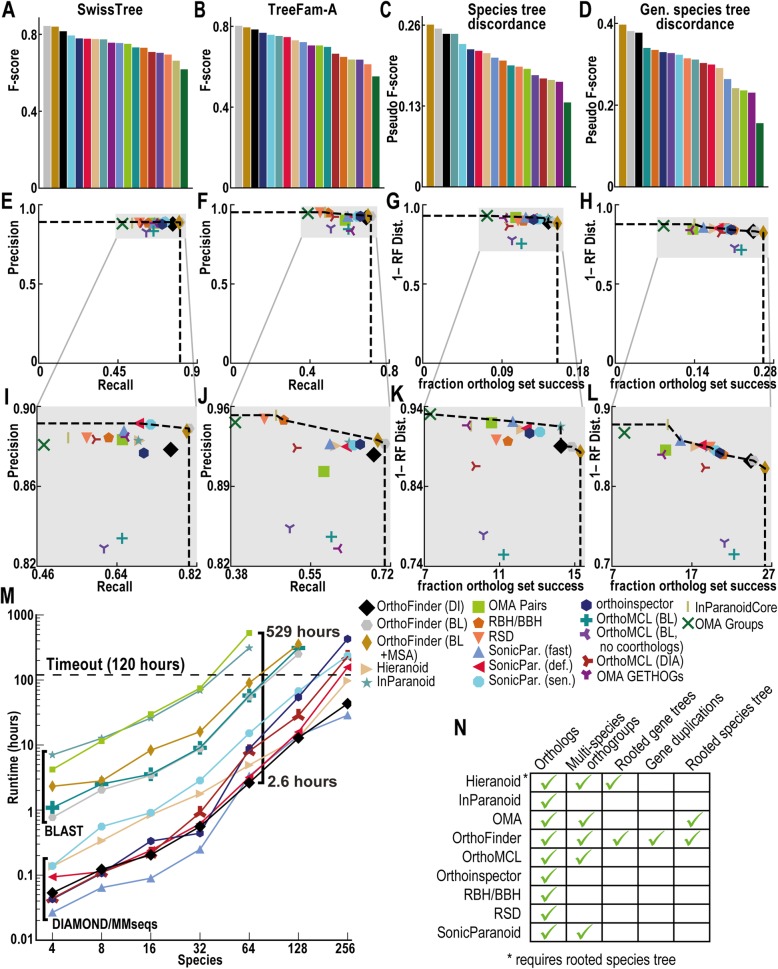
- On Quest for Orthologs 2011_04, the default fastest OrthoFinder was 3–24% more accurate on SwissTree and 2–30% more accurate on TreeFam-A than any other method; other OrthoFinder configurations were a further 1–3% more accurate.
- On the Species Tree Discordance Tests, all OrthoFinder versions had equal or higher pseudo-F-score than all other methods; the default version scored 0–45% higher on STDT and 10–59% higher on GSTDT.
- Default OrthoFinder ran in 192 s on 4 fungal species and 1.8 days on 256 species with 16 threads, making it the second quickest method; SonicParanoid was fastest at 1.2 days on 256 species.
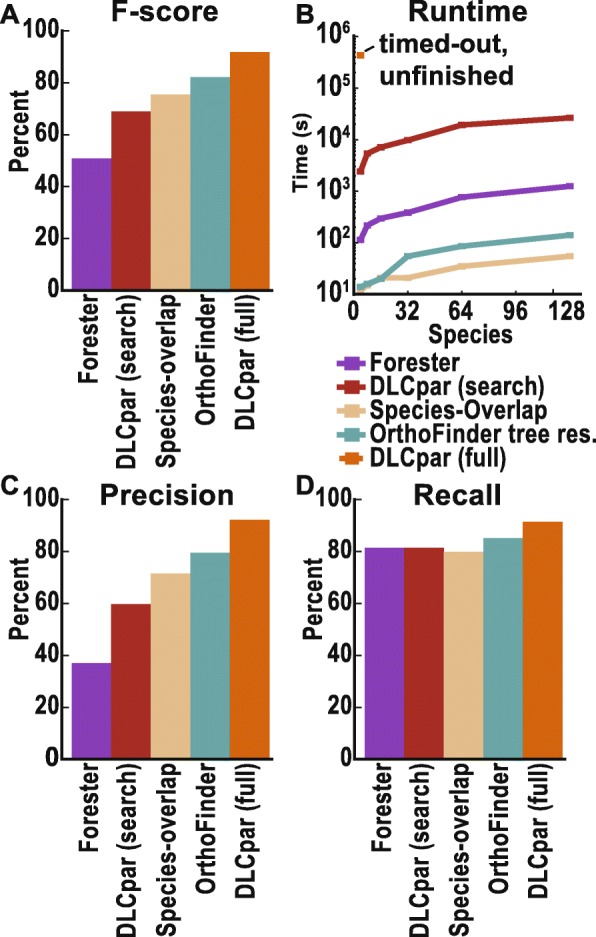
- The novel hybrid duplication-loss-coalescence algorithm raised duplication F-score from 72% with species-overlap to 80%; DLCpar (full) was most accurate at 91.8% but could not process a 4-species dataset (2259 trees, 12,958 genes) in 120 h, while OrthoFinder analyzed 18,651 trees and 948,449 genes from 128 fungi in 141 s.
Methods
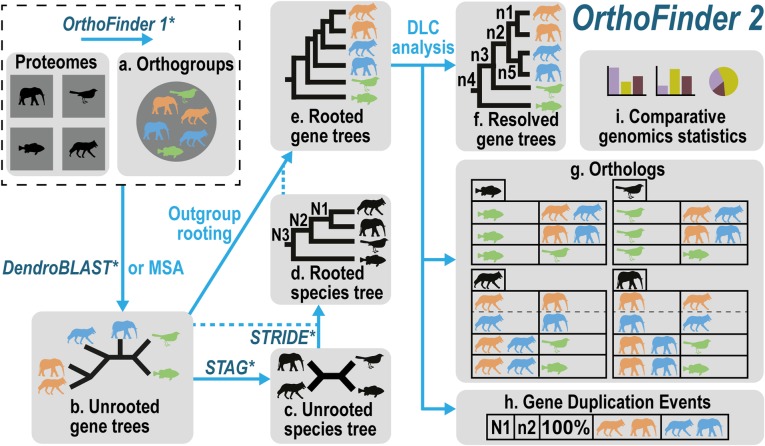
- Input is one FASTA file per species; orthogroups are inferred with the original OrthoFinder algorithm, unrooted gene trees with DendroBLAST, the species tree with STAG, the species tree root with STRIDE, gene trees are rooted using the species tree, and orthologs/duplications are inferred with a novel hybrid species-overlap plus duplication-loss-coalescence algorithm.
- Benchmarks used Quest for Orthologs 2011_04 on 66 species across Eukarya, Bacteria, and Archaea; simulated flies (12,000 trees, 12 species, 12,032 duplications), primates (7500 trees, 17 species, 16,066 duplications), and metazoa (2000 trees, 40 species, 4967 duplications); performance was tested on 4–256 fungal proteomes.
- Analyses compared precision, recall, F-score, pseudo-F-score, Robinson-Foulds agreement, and runtime against methods including Forester, DLCpar (full/search), species-overlap, Notung, and other orthology inference tools.
Limitations
- Stated: STRIDE may fail to identify the species tree root, or only exclude the root from clades, when gene trees contain few duplications; DLCpar (full) was more accurate but not scalable; the default fastest OrthoFinder is less accurate than other OrthoFinder configurations; the authors cannot test all possible multiple sequence alignment and tree inference combinations.
- Evident: STDT and GSTDT lack ground-truth orthologs, so pseudo-F-score substitutes for standard precision/recall; benchmarking is limited to specific Quest for Orthologs datasets and simulated data; OrthoFinder is second fastest, not fastest, on the 256-species dataset; no competitor method also provides gene trees or identifies gene duplication events, so the data-richness advantage is not an accuracy comparison.
Model-written summary. Check it against the paper before relying on it.
Integrity signals
Registry
Cites
Statistics
Figures
Verification
Claims the paper makes
23 Valid · 10 Not valid · 1 Not checked · 62 Own results and interpretations
The cited sources support only part of this claim — read each source’s verdict below.
In the paper
“STRIDE was developed to enable the rooting of the species tree using only information available in the set of gene trees.”
§ OrthoFinder: phylogenetic orthology inference for comparative genomics > Methods > Species tree inference and rooting
What the sources say
- Partly supportedcites [22] Emms DM Kelly S STRIDE: species tree root inference from gene duplication events Mol Biol Evol 2017 34 12 3267 3278 10.1093/molbev/msx259 29029342 PMC5850722 sourceExperimental — accuracy not yet measured
The Introduction says STRIDE uses duplication events from unrooted gene trees to locate the root. But the Results (Application of STRIDE to Real Species Data Sets; page unavailable) say it was run with both gene trees and a published unrooted species tree, so the claim that it uses only information in the gene trees omits a required input. (LLM, conf=0.88)
plainstates a cause- Asserted: passes — The authors put it forward as true.
- Checkable: passes — It can be checked against evidence.
- Load-bearing: passes — The paper’s conclusions depend on it.
- Based: passes — The paper gives a reason why it holds.
- Partly supported
The cited sources support only part of this claim — read each source’s verdict below.
In the paper
“The original OrthoFinder orthogroup inference method is still the most accurate method on the independent Orthobench test set [10] and thus is used for this step.”
§ OrthoFinder: phylogenetic orthology inference for comparative genomics > Methods > Use of orthogroups for gene tree inference
What the sources say
- Partly supportedcites [10] Emms DM Kelly S OrthoFinder: solving fundamental biases in whole genome comparisons dramatically improves orthogroup inference accuracy Genome Biol 2015 16 157 10.1186/s13059-015-0721-2 26243257 PMC4531804 sourceExperimental — accuracy not yet measured
The ‘OrthoFinder outperforms all other methods from the OrthoBench analysis’ section reports that OrthoFinder had the highest F-score among methods applied to OrthoBench, and the Evaluation section describes the dataset as independently evaluated. The 2015 paper does not establish that the original method is *still* the most accurate after that comparison. (LLM, conf=0.84)
plain- Asserted: passes — The authors put it forward as true.
- Checkable: passes — It can be checked against evidence.
- Load-bearing: passes — The paper’s conclusions depend on it.
- Based: passes — The paper gives a reason why it holds.
- Partly supported
The cited sources support only part of this claim — read each source’s verdict below.
In the paper
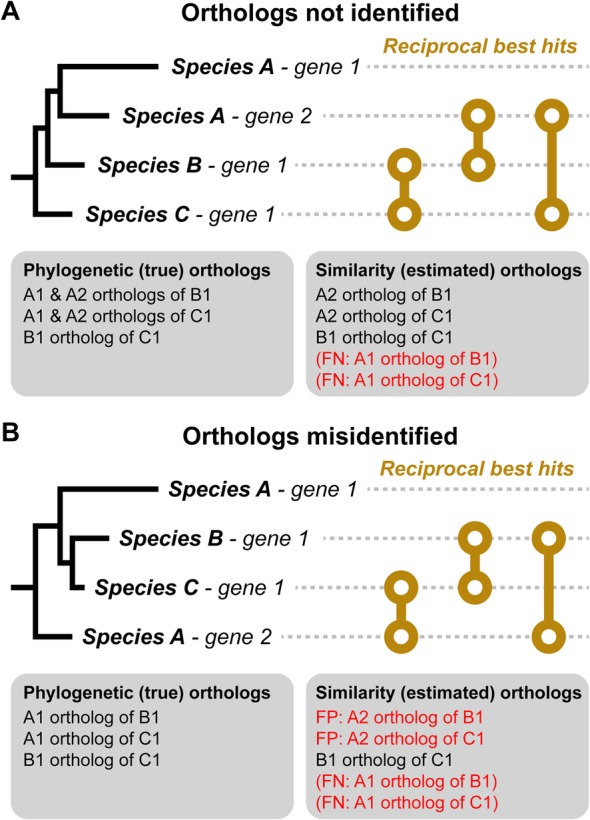
“However, such score-based estimates of the phylogenetic relationship between genes are confounded by multiple factors. For example, variable sequence evolution rates between genes frequently lead to both false-positive and false-negative errors [14, 15] (Fig. 1).”
§ OrthoFinder: phylogenetic orthology inference for comparative genomics > Background
What the sources say
- Partly supportedcites [14] Lafond M Miardan MM Sankoff D Accurate prediction of orthologs in the presence of divergence after duplication Bioinformatics 2018 34 366 375 10.1093/bioinformatics/bty242 PMC6022570 29950018 sourceExperimental — accuracy not yet measured
The Introduction (page unavailable) explains that accelerated mutation after duplication can make orthologous genes dissimilar, so similarity-based methods may fail to identify them—a false negative. It does not establish that variable evolutionary rates frequently cause false-positive errors as well, or support that frequency claim. (LLM, conf=0.82)
- Not checked — no full text of the sourcecites [15] Fitch WM Distinguishing homologous from analogous proteins Sys Zool 1970 19 99 10.2307/2412448 5449325 source
plainstates a cause- Asserted: passes — The authors put it forward as true.
- Checkable: passes — It can be checked against evidence.
- Load-bearing: passes — The paper’s conclusions depend on it.
- Based: passes — The paper gives a reason why it holds.
- Partly supported
Every source the paper cites for this claim was checked and supports it.
In the paper
“A new algorithm, Species Tree from All Genes (STAG), was developed to allow species tree inference even for species sets with few or no complete sets of one-to-one orthologs present in all species [33].”
§ OrthoFinder: phylogenetic orthology inference for comparative genomics > Methods > Species tree inference and rooting
What the sources say
- Supportedcites [33] Emms D, Kelly S. STAG: species tree inference from all genes. bioRxiv. 2018. https://www.biorxiv.org/content/10.1101/267914v1. source
The Discussion says complete one-to-one orthogroups are comparatively rare and that STAG uses orthogroups containing all species regardless of gene copy number. This supports the claim that STAG enables species-tree inference when few or no complete one-to-one ortholog sets are available. Page numbers are not provided in our copy. (LLM, conf=0.94)
plainstates a cause- Asserted: passes — The authors put it forward as true.
- Checkable: passes — It can be checked against evidence.
- Load-bearing: passes — The paper’s conclusions depend on it.
- Based: passes — The paper gives a reason why it holds.
- Supported
The sources with a verdict support this claim; the rest weren’t checked yet, have no full text we could read, or their verdicts aren’t rated yet.
In the paper
“The accuracy of key component algorithms of OrthoFinder has been independently assessed in this work and in dedicated publications [5, 10, 22, 24, 33].”
§ OrthoFinder: phylogenetic orthology inference for comparative genomics > Results > OrthoFinder has the highest ortholog inference accuracy
What the sources say
- Not checked — no full text of the sourcecites [5] Buchfink B Xie C Huson DH Fast and sensitive protein alignment using DIAMOND Nat Methods 2015 12 59 60 10.1038/nmeth.3176 25402007 source
- Supportedcites [10] Emms DM Kelly S OrthoFinder: solving fundamental biases in whole genome comparisons dramatically improves orthogroup inference accuracy Genome Biol 2015 16 157 10.1186/s13059-015-0721-2 26243257 PMC4531804 source
The ‘An improved method for orthogroup delimitation improves overall accuracy’ section assesses the accuracy of OrthoFinder’s gene-pair selection and clustering approach and reports precision, recall, and F-score. The Evaluation section describes testing against the independently evaluated OrthoBench dataset. This dedicated publication therefore supports the citation’s contribution to the statement about assessed component-algorithm accuracy. (LLM, conf=0.88)
- Supportedcites [22] Emms DM Kelly S STRIDE: species tree root inference from gene duplication events Mol Biol Evol 2017 34 12 3267 3278 10.1093/molbev/msx259 29029342 PMC5850722 source
The Results section, “STRIDE Identifies the Correct Root of Species Trees Given Simulated Gene Tree Data Sets” (page not provided), assesses STRIDE’s rooting accuracy on three simulated datasets and reports its duplication-detection precision and recall. This supports citing the dedicated STRIDE publication for an accuracy assessment of an algorithm used in the OrthoFinder workflow; the paper does not assess every OrthoFinder component. (LLM, conf=0.86)
- Supportedcites [24] Kelly S Maini PK DendroBLAST: approximate phylogenetic trees in the absence of multiple sequence alignments PLoS One 2013 8 e58537 10.1371/journal.pone.0058537 23554899 PMC3598851 source
The Methods section, “Comparison of DendroBLAST against other inference methods,” describes an accuracy evaluation against reference trees using five metrics. The Results sections report DendroBLAST’s performance relative to other tree-inference methods. This supports the citation’s role as a dedicated publication assessing the accuracy of a component algorithm; it does not need to assess every OrthoFinder component. (LLM, conf=0.91)
- Supportedcites [33] Emms D, Kelly S. STAG: species tree inference from all genes. bioRxiv. 2018. https://www.biorxiv.org/content/10.1101/267914v1. source
The paper evaluates the accuracy of STAG species-tree inference against literature-derived trees across 12 biological datasets (Results and Discussion; page numbers unavailable). The Discussion also states that STAG was designed to integrate with OrthoFinder and can run directly from its results. This supports citing the publication as a dedicated assessment of a component algorithm. (LLM, conf=0.91)
plain- Asserted: passes — The authors put it forward as true.
- Checkable: passes — It can be checked against evidence.
- Load-bearing: passes — The paper’s conclusions depend on it.
- Based: passes — The paper gives a reason why it holds.
39 more claims · 8 with their cited sources checked
Create a free account to see all 96 claims and every source verdict.
- Probably not a substantial claim. 18
- It may state two separate claims as one. 40
- The quote only partly states this claim. 2
Claims other papers make about this one
Each is checked against this paper’s own text: does it say what the citing paper says it does?
The source backs part of the claim, not all of it — or backs it for a different population, condition or comparison.
In the citing paper
“The original OrthoFinder algorithm applied a per-species-pair gene-length normalization that accounted for both evolutionary distance and gene-length dependence in pairwise bit scores between sequences12.”
From OrthoFinder: improved phylogenetic orthology inference with enhanced accuracy and scalability (2026) · cites this paper as [12]
Experimental — accuracy not yet measuredThe source backs part of the claim, not all of it — or backs it for a different population, condition or comparison.
In the citing paper
“In previous versions of OrthoFinder, orthologs were defined phylogenetically, whereas orthogroups were defined solely based on Markov Cluster Algorithm (MCL) clustering of sequence similarity search results12,16.”
From OrthoFinder: improved phylogenetic orthology inference with enhanced accuracy and scalability (2026) · cites this paper as [12]
Experimental — accuracy not yet measuredThe source backs part of the claim, not all of it — or backs it for a different population, condition or comparison.
In the citing paper
“Other sequence similarity approaches such as OrthoFinder (Emms and Kelly, 2019; Emms and Kelly, 2015) leverage graphs and gene trees to test for orthology, permitting more robust analyses in systems with gene copy number (CNV) or presence–absence variation (PAV).”
From GENESPACE tracks regions of interest and gene copy number variation across multiple genomes (2022) · cites this paper as Emms and Kelly, 2019
Experimental — accuracy not yet measuredThe cited source says what the claim attributes to it.
In the citing paper
“We used two different methods for identifying orthologues—a simple mutual-best-hits method and an alternative orthologue-clustering approach (OrthoFinder47; Supplementary Information 10 and 11), and obtained comparable results using both approaches”
From Ancient gene linkages support ctenophores as sister to other animals (2023) · cites this paper as [47]
The cited source says what the claim attributes to it.
In the citing paper
“Gene tree-based methods determine whether the evolutionary lineages of two genes coalesce in a speciation or a duplication node (12–14).”
From Integrating gene annotation with orthology inference at scale (2023) · cites this paper as [12]
4 more claims about this paper
Create a free account to see every claim other papers make about this one.
Self-check
Percentages, sums and reported differences re-computed from the paper’s own numbers.
Each contradiction between two passages listed here was confirmed by an independent check.
Rated minor: it would not touch a result — a value no result rests on, a p-value that stays on the same side of the significance level, or a conflict that is clerical, resolved elsewhere in the paper, or outside its own findings.
In the paper
§ OrthoFinder: phylogenetic orthology inference for comparative genomics > Methods > Ortholog inference and identification of gene duplication events from gene trees
“The hybrid algorithm was able to analyze the complete set of orthogroup trees for the 128 fungi species in 141 s; this was 9 times faster than Forester and 187 times faster than DLCpar (search) (Fig. 5d).”
§ OrthoFinder: phylogenetic orthology inference for comparative genomics > Results > OrthoFinder implements a novel duplication-loss-coalescent algorithm for identifying gene duplication events and orthologs
“Figure: Fig. 5 a Duplication F-score, on simulated gene trees. b Runtime to analyse all trees from the 4 to 128 species Fungi datasets (see Methods), a maximum time of 120 hours (4.3x10 seconds) was allowed. DLCpar (full) did not complete the smallest dataset in this time limit and so only the lower bound for the first time point is shown. c-d Precision and recall”
Rated minor: it would not touch a result — a value no result rests on, a p-value that stays on the same side of the significance level, or a conflict that is clerical, resolved elsewhere in the paper, or outside its own findings.
In the paper
§ OrthoFinder: phylogenetic orthology inference for comparative genomics > Methods > Chordata dataset
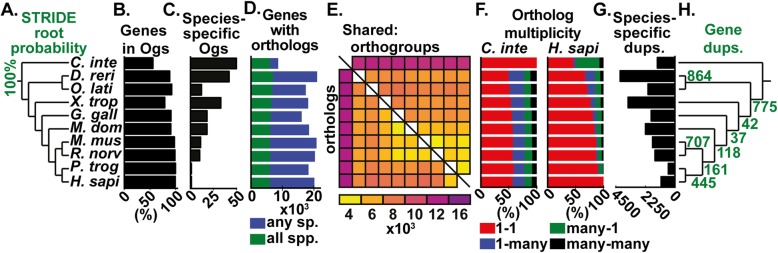
“The data for the OrthoFinder analysis of the ten Chordata species for the illustration of the results of an OrthoFinder analysis (Fig. 2a–h)”
§ OrthoFinder: phylogenetic orthology inference for comparative genomics > Results > OrthoFinder algorithm overview and summary of results files
“Figure: Fig. 3 Summary of OrthoFinder analysis of a set of Chordata species:”
Citations
Cites
MAFFT Multiple Sequence Alignment Software Version 7: Improvements in Performance and Usability
Katoh, K., & Standley, D. M. (2013) · Molecular Biology and Evolution · doi:10.1093/molbev/mst010 · Cited by 46,209 · cited 4×
“Katoh K, Standley DM. MAFFT multiple sequence alignment software version 7: improvements in performance and usability.”
MethodInfluentialRAxML version 8: a tool for phylogenetic analysis and post-analysis of large phylogenies
Stamatakis, A. (2014) · Bioinformatics · doi:10.1093/bioinformatics/btu033 · Cited by 32,291 · cited 4×
“For each successful ortholog set, an MSA is constructed and a gene tree inferred using RAxML [28].”
MethodInfluentialIQ-TREE: A Fast and Effective Stochastic Algorithm for Estimating Maximum-Likelihood Phylogenies
Nguyen, L.-T., Schmidt, H. A., von Haeseler, A., & Minh, B. Q. (2015) · Molecular Biology and Evolution · doi:10.1093/molbev/msu300 · Cited by 26,046
BLAST+: architecture and applications
Camacho, C., Coulouris, G., Avagyan, V., Ma, N., Papadopoulos, J., Bealer, K., & Madden, T. L. (2009) · BMC Bioinformatics · doi:10.1186/1471-2105-10-421 · Cited by 22,074 · cited 3×
“Currently, supported methods for step 1 include BLAST [4] and MMseqs2 [6].”
MethodFastTree 2 – Approximately Maximum-Likelihood Trees for Large Alignments
Price, M. N., Dehal, P. S., & Arkin, A. P. (2010) · PLoS ONE · doi:10.1371/journal.pone.0009490 · Cited by 14,894
Fast and sensitive protein alignment using DIAMOND
Buchfink, B., Xie, C., & Huson, D. H. (2015) · Nature Methods · doi:10.1038/nmeth.3176 · Cited by 14,201
OrthoMCL: Identification of Ortholog Groups for Eukaryotic Genomes
Li, L., Stoeckert, C. J., & Roos, D. S. (2003) · Genome Research · doi:10.1101/gr.1224503 · Cited by 5,707
MMseqs2 enables sensitive protein sequence searching for the analysis of massive data sets
Steinegger, M., & Söding, J. (2017) · Nature Biotechnology · doi:10.1038/nbt.3988 · Cited by 4,840
Emms, D. M., & Kelly, S. (2015) · Genome Biology · doi:10.1186/s13059-015-0721-2 · Cited by 3,408
Self-citationETE 3: Reconstruction, Analysis, and Visualization of Phylogenomic Data
Huerta-Cepas, J., Serra, F., & Bork, P. (2016) · Molecular Biology and Evolution · doi:10.1093/molbev/msw046 · Cited by 2,231
Cited by
Items 4,301–4,400 of 7,975
Orphan and de novo Genes in Fungi and Animals: Identification, Origins and Functions
Seçkin, E., Colinet, D., Sarti, E., & Danchin, É. (2025) · Genome Biology and Evolution · doi:10.1093/gbe/evaf220 · Cited by 3
“…contrast, more recent research increasingly incorporates comprehensive pipelines, employing advanced comparative genomic tools such as OrthoFinder (Emms and Kelly 2019), ORFan-Finder (Ekstrom and Yin 2016), OrthoMCL (Li et al. 2003), and HMMER (Finn et al. 2011) to systematically cluster and…”
InfluentialFlanagan, B. A., Fuess, L. E., Vrtílek, M., Roth-Monzón, A. J., & Bolnick, D. I. (2025) · Molecular Biology and Evolution · doi:10.1093/molbev/msaf323 · Cited by 5
“We focused on head kidney transcriptomes because we wished to build references appropriate to the transcriptomes we later examine with 3 ′ TagSeq, using the same tissues.”
Liu, H., Lei, L., Jiang, F., Zhang, B., Wang, H., Zhang, Y., Wang, A., Zhao, H., Wang, G., & Fan, W. (2025) · GigaScience · doi:10.1093/gigascience/giaf158 · Cited by 2
Segawa, T., Yoshizumi, S., Toyonaga, H., Shiraishi, A., SATO, K., Yamabe, T., Takagi, M., Takagawa, M., Yokoyama, R., Itoh, T., et al. (2026) · Plant and Cell Physiology · doi:10.1093/pcp/pcag002 · Cited by 3
PharaohFUN: phylogenomic analysis for plant protein history and function elucidation
Ramos‐González, M., Ramos-González, V., Serrano-Pérez, E., Arvanitidou, C., Hernández‐García, J., García‐González, M., & Romero–Campero, F. J. (2026) · Molecular Biology and Evolution · doi:10.1093/molbev/msag011 · Cited by 4
“0 (Emms and Kelly 2019; Emms et al. 2025) on the proteomes of the species mentioned in Table S1.”
InfluentialMulti‐season analysis reveals hundreds of drought‐responsive genes in sorghum
Cole, B., Zhang, W., Shi, J., Wang, H., Baker, C. R., Varoquaux, N., Hollingsworth, J., Hutmacher, R., Dahlberg, J. A., Pierroz, G., et al. (2026) · The Plant Journal · doi:10.1111/tpj.70657 · Cited by 4
Schwarz, E. M., Noon, J., Chicca, J., Garceau, C., Li, H., Antoshechkin, I. A., Ilík, V., Pafčo, B., Weeks, A. M., Homan, E. J., et al. (2026) · PLoS neglected tropical diseases · doi:10.1371/journal.pntd.0014106 · Cited by 3
Multiple Evolutionary Events in Host Plant Adaptation in Lepidoptera
Luo, M., Li, B., Ma, L., Jia, Z., Shi, Z., Liu, H., Wang, Z., Zhang, B., Yu, S., Qi, J., et al. (2026) · Plant Cell & Environment · doi:10.1111/pce.70502 · Cited by 3
Moreira, D. A., Lamarca, A. P., Soares, R. F., Coelho, A., Furtado, C., Scherer, N. D. M., Moreira, M. A. M., Seuánez, H. N., & Boroni, M. (2020) · Frontiers in Genetics · doi:10.3389/fgene.2020.00831 · Cited by 3
The complete mitochondrial genome of Orthaga achatina (Lepidoptera: Pyralidae)
Liu, B., Sun, H., Zhan, Q., & Gai, Y. (2021) · Mitochondrial DNA Part B · doi:10.1080/23802359.2021.1884016 · Cited by 3
“7 (Emms and Steven 2019) with default parameter values were used to identify ortholog among all the protein sequences of the 24 mitochondrial genomes.”
MethodInfluentialComparative Genomics Provides Insights into Adaptive Evolution in Tactile-Foraging Birds
Wang, L., Sun, L., Wan, Q., & Fang, S. (2022) · Genes · doi:10.3390/genes13040678 · Cited by 3
“11 [46], and sequences were aligned using PRANK v.”
MethodBu, X., Xia, Z., Liu, Z., Ren, M., Wan, C., & Zhang, L. (2022) · Archives of Microbiology · doi:10.1007/s00203-022-03008-3 · Cited by 3
“Based on all amino acid sequences of the selected species, software Orthofinder (Emms and Kelly 2019) was used to cluster gene family, Blastp to compare, and software Muscle (Edgar 2004) to compare multiple protein sequences in each single-copy gene family.”
MethodCorynebacterium kalidii sp. nov, an endophyte from a shoot of the halophyte Kalidium cuspidatum
Feng, J.-Y., Xu, L., Tang, S., & Sun, J.-Q. (2022) · Archives of Microbiology · doi:10.1007/s00203-022-03101-7 · Cited by 3
“2010), a phylogenomic tree based on all the predicted amino sequences was constructed using the standalone software OrthoFinder with the default parameters (Emms and Kelly 2015, 2019).”
MethodDourron, J., de Ovalle, S., González-Pombo, P., Villarino, A., Ramón, A., & Costábile, A. (2022) · OENO One · doi:10.20870/oeno-one.2022.56.3.5581 · Cited by 3
Genome Assembly of the Polyclad Flatworm Prostheceraeus crozieri
Leite, D. J., Piovani, L., & Telford, M. J. (2022) · Genome Biology and Evolution · doi:10.1093/gbe/evac133 · Cited by 4
“Comparisons of Pfam domain content with other flatworms Orthofinder (Emms and Kelly 2019) analysis identified 23,378 orthogroups of which 4,590 orthogroups were shared between P.”
BackgroundInfluentialXu, X., Chen, Z., Liu, C., Xu, W., Xu, H., & Chen, S. (2022) · Frontiers in Marine Science · doi:10.3389/fmars.2022.1045052 · Cited by 3
“3.8 (Emms and Kelly, 2019).”
InfluentialPhylogenomic and Evolutionary Analyses Reveal Diversifications of SET-Domain Proteins in Fungi
Ding, G., Shang, L., Zhou, W., Lu, S., Zhou, Z., Huang, X., & Li, J. (2022) · Journal of Fungi · doi:10.3390/jof8111159 · Cited by 4
“11 (Oxford, UK) [39] and TimeTree was generated by the r8s [40].”
MethodForni, G., Mikheyev, A. S., Luchetti, A., & Mantovani, B. (2022) · Zoological Letters · doi:10.1186/s40851-022-00197-z · Cited by 3
“The species tree – inferred according to the STAG (Species Tree inference from All Genes) algorithm implemented in Orthofinder2 – is consistent with previous hypotheses on the clade systematic relationships (Supplementary Fig.”
MethodInfluentialAzospirillum Endophyticum sp. nov., an Endophyte of Paris Polyphylla Smith var. Yunnanensis
Zhan, P.-C., Mao, R.-F., Li, C.-J., Zhang, Z., Liu, J., Tang, M., Zhi, X., & Yang, L. (2022) · Current Microbiology · doi:10.1007/s00284-022-03142-7 · Cited by 3
“Phylogenomic analysis on YIM B02556T and its Azospirillum relatives were performed where Clustal Omega [11] was used to align the sequences, OrthoFinder [20, 21] was used to infer the orthologous genes from the aligned sequences, and Gblocks [22] was used to extract conserved sites from the result of multiple sequence…”
MethodPiccinini, G., & Milani, L. (2023) · EvoDevo · doi:10.1186/s13227-022-00207-3 · Cited by 4
“11 [73] with the –ultra-sensitive parameter (highest sensitivity) and all sequences that ended up within the same cluster (OrthoFinder’s OrthoGroups, or OGs) were considered homologous.”
BackgroundDe Novo Assembly of an Allotetraploid Artemisia argyi Genome
Mei, Q., Li, H., Liu, Y., Wu, F., Liu, C., Wang, K., Liu, H., Peng, C. Y., Wang, Z., Wang, L., et al. (2023) · Agronomy · doi:10.3390/agronomy13020436 · Cited by 3
Exploring the expressiveness of abstract metabolic networks
García, I., Chouaia, B., Llabrés, M., & Simeoni, M. (2023) · PLoS ONE · doi:10.1371/journal.pone.0281047 · Cited by 5
Gap-Free Nuclear and Mitochondrial Genomes of Fusarium verticillioides Strain HN2
Yang, W., Zhai, H., Yang, L., Yang, Q., Song, L., Wu, J., Lai, Z., & Li, G. (2023) · PhytoFrontiers™ · doi:10.1094/phytofr-11-22-0123-a · Cited by 3
Draft genomes of three closely related low light-adapted Prochlorococcus
Berta-Thompson, J. W., Thomas, E., Cubillos-Ruiz, A., Hackl, T., Becker, J. W., Coe, A., Biller, S. J., Berube, P. M., & Chisholm, S. W. (2023) · BMC Genomic Data · doi:10.1186/s12863-022-01103-4 · Cited by 3
“[47], 103 – 3,854 SNPs in pairwise alignments [48, 49], and 32 – 132 distinct genes in pairwise ortholog group comparisons [50].”
BackgroundVibrio paucivorans sp. nov. and Vibrio qingdaonensis sp. nov., two marine bacteria
Guo, R., Yuan, Y., Liu, R., Hong, W., Zhou, Y., Zhao, W., Wang, X., & Zhang, X. (2023) · INTERNATIONAL JOURNAL OF SYSTEMATIC AND EVOLUTIONARY MICROBIOLOGY · doi:10.1099/ijsem.0.005822 · Cited by 3
Comparative genomic analysis of five coprinoid mushrooms species
Wang, J., Zhang, R., Ding, G., Wang, L., Wang, W., Zhang, Y., & Zhu, G. (2023) · Functional & Integrative Genomics · doi:10.1007/s10142-023-01094-0 · Cited by 4
“12 (parameter -M msa) (Emms and Kelly 2019) Functional annotation results of GO (Ashburner et al.”
BackgroundHe, Q., Li, Z., Liu, Y., Yang, H., Liu, L.-Z., Ren, Y., Zheng, J., Xu, R., Wang, S., & Zhan, Q. (2023) · The Plant Genome · doi:10.1002/tpg2.20345 · Cited by 3
Rizwan, M., Haider, S. Z., Bakar, A., Rani, S., Danial, M., Sharma, V., Mubin, M., Serfraz, A., Nawaz‐ul‐Rehman, M. S., Shakoor, S., et al. (2023) · Scientific Reports · doi:10.1038/s41598-023-36302-1 · Cited by 3
Annotation-Free Identification of Potential Synteny Anchors
Käther, K. K., Lemke, S., & Stadler, P. F. (2023) · Lecture notes in computer science · doi:10.1007/978-3-031-34953-9_17 · Cited by 4
Alexandre, N. M., Cameron, A. C., Tian, D., Chatla, K., Kolora, S. R. R., Whiteman, N. K., Turner, T. F., & Reinthal, P. N. (2023) · G3 Genes Genomes Genetics · doi:10.1093/g3journal/jkad157 · Cited by 5
“Annotated proteins were also downloaded and included with annotated proteins for spike-dace and loach minnow as input for Orthofinder (v.2.5.4) (Emms and Kelly 2019).”
MethodInfluentialCollington, E., Lobb, B., Mazen, N. A., Doxey, A. C., & Glerum, D. M. (2023) · Genome Biology and Evolution · doi:10.1093/gbe/evad135 · Cited by 2
“1), based on highly conserved single-copy protein families identified in our data set, using OrthoFinder (Emms and Kelly 2019, see Materials and Methods).”
InfluentialYoocha, T., Kongkachana, W., Sonthirod, C., Naktang, C., Phetchawang, P., Yamprasai, S., Tangphatsornruang, S., & Pootakham, W. (2023) · Mitochondrial DNA Part B · doi:10.1080/23802359.2023.2252942 · Cited by 3
“We identified orthologous groups from 1348 proteins in the chloroplast genome sequences of H. fomes and five plant species using OrthoFinder software (Emms and Kelly 2019).”
Gene family expansion analysis and identification of the histone family in Spodoptera frugiperda
Gao, H., Li, Y., Tian, Y., Zhang, H., Kim, K.-C., & Li, B. (2023) · Comparative Biochemistry and Physiology Part D Genomics and Proteomics · doi:10.1016/j.cbd.2023.101142 · Cited by 6
Identification and adaptive evolution analysis of glutaredoxin genes in Populus spp.
Wang, S., Dong, Y., Gu, L., Chen, X., Zhang, C., Long, L., Wang, J., & Yang, M. (2023) · Plant Biology · doi:10.1111/plb.13580 · Cited by 4
Jin, P., Kong, Y., Zhang, Z., Zhang, H., Dong, Y., Lamour, K., Yang, Z., Zhou, Y., & Hu, J. (2023) · Frontiers in Microbiology · doi:10.3389/fmicb.2023.1259241 · Cited by 4
“3.12 (Emms and Kelly, 2019) based on all the protein sequences from the selected fungal species.”
BackgroundInfluentialGIFTdb : a useful gene database for plant fruit traits improving
Liu, Y., Gao, Y., Chen, M., Jin, Y., Qin, Y., & Hao, G. (2023) · The Plant Journal · doi:10.1111/tpj.16506 · Cited by 3
Gunasekera, R. S., Raja, K. K. B., Hewapathirana, S., Țundrea, E., Gunasekera, V., Galbadage, T., & Nelson, P. A. (2023) · PLoS ONE · doi:10.1371/journal.pone.0291260 · Cited by 4
“Similarly, OrthoFinder provides the option to use DIAMOND or its recommended MMseq2 for sequence alignment [21-24].”
MethodGenome-sequenced bacterial collection from sorghum aerial root mucilage
Llontop, M. E. M., Mullet, J. E., & Shade, A. L. (2023) · Microbiology Resource Announcements · doi:10.1128/mra.00468-23 · Cited by 3
Ding, W.-J., Xu, L., Zhao, Y., & Sun, J.-Q. (2023) · Current Microbiology · doi:10.1007/s00284-023-03543-2 · Cited by 3
“A phylogenetic tree based on 490 core amino acid sequences was constructed using OrthoFinder version 2.54 with default parameters [26].”
MethodInfluentialGenomic evolution of island birds from the view of the Swinhoe's pheasant (Lophura swinhoii)
Xu, X., Wang, C., Xu, C., Yuan, J., Wang, G., Wu, Y., Huang, C., Jing, H., Yang, P., Xu, L., et al. (2023) · Molecular Ecology Resources · doi:10.1111/1755-0998.13896 · Cited by 5
“…et al., 2018), common pheasant, brown eared pheasant ( Crossoptilon mantchuricum ) (Wang et al., 2021), silver pheasant (Li et al., 2021) and Swinhoe's pheasant, were identified using the Orthofinder (version 2.5.2) (Emms & Kelly, 2019) pipeline, producing a list of single-copy orthologous genes.”
MethodInfluentialBartoš, O., Klimešová, B., Volfová, K., Chmel, M., Dresler, J., Pajer, P., Kabíčková, H., Adamík, P., Modrý, D., Fucikova, A. M., et al. (2023) · Frontiers in Microbiology · doi:10.3389/fmicb.2023.1289671 · Cited by 4
Djune-Yemeli, L., Hertz, M. I., Nana-Djeunga, H. C., Rush, A., Erdmann-Gilmore, P., Sprung, R. W., Bopda, J. G., Townsend, R., Netongo, P. M., Kamgno, J., et al. (2023) · Frontiers in Parasitology · doi:10.3389/fpara.2023.1292837 · Cited by 3
“4.1) (Emms and Kelly, 2019), retrieved from Rosa et al., (2023).”
InfluentialLiu, W., Gao, J.-W., Zhang, Y., Sun, C., & Xu, L. (2023) · Marine Genomics · doi:10.1016/j.margen.2023.101074 · Cited by 3
Le, M., Morgan, B., Lu, M. J., Moctezuma, V., Burgos-Dueñas, O., & Huang, J. (2023) · Molecular Ecology Resources · doi:10.1111/1755-0998.13908 · Cited by 3
“We used OrthoFinder v2.”
BackgroundInfluentialUrban, J. M., Bateman, J. R., Garza, K., Borden, J. S., Jain, J., Brown, A., Thach, B. J., Bliss, J. E., & Gerbi, S. A. (2023) · Genetics · doi:10.1093/genetics/iyad208 · Cited by 5
From genomics to metabolomics: Deciphering sanguinarine biosynthesis in Dicranostigma leptopodum
Lei, W., Zhu, H., Cao, M., Zhang, F., Lai, Q., Lu, S., Dong, W., Sun, J., & Ru, D. (2023) · International Journal of Biological Macromolecules · doi:10.1016/j.ijbiomac.2023.128727 · Cited by 3
Yang, Y., Zhang, Y., Li, F., Wen, S., Wang, L., Lan, G., Zhou, J., Li, Y., & Zhu, Z. (2023) · Fishes · doi:10.3390/fishes8120613 · Cited by 4
Tenacibaculum tangerinum sp. nov., isolated from a tidal flat sediment
Lee, S. H., Yoo, Y., Kwon, D. Y., Khim, J. S., Xu, X., Kim, B., Choi, I., & Kim, J. (2023) · INTERNATIONAL JOURNAL OF SYSTEMATIC AND EVOLUTIONARY MICROBIOLOGY · doi:10.1099/ijsem.0.006203 · Cited by 3
Expression Quantitative Trait Locus of Wood Formation-Related Genes in Salix suchowensis
Chen, L., Liu, L., Yang, G. X., Li, X., Dai, X., Xue, L., & Yin, T. (2023) · International Journal of Molecular Sciences · doi:10.3390/ijms25010247 · Cited by 4
“5.4 [102], based on the gene annotation of Populus trichocarpa v3.”
MethodInfluentialVineeth, V. K., Reshma, T. R., Babu, S., Philip, S., & Mahadevan, C. (2024) · Journal of Plant Pathology · doi:10.1007/s42161-023-01578-9 · Cited by 4
“Emms and Kelly (2019) described that ortho-log analysis can be employed to study the evolutionary relationships and divergence patterns among different species and organisms.”
The bHLH transcription factor OsPRI1 activates the Setaria viridis PEPC1 promoter in rice
Carvalho, P., Gomes, C. R., Gonçalves, I., Lourenço, T. F., Vlad, D., Langdale, J. A., & Saibo, N. J. M. (2024) · New Phytologist · doi:10.1111/nph.19556 · Cited by 3
A phylogenomic perspective on interspecific competition
Louw, N. L., Wolfe, B. E., & Uricchio, L. H. (2024) · Ecology Letters · doi:10.1111/ele.14359 · Cited by 3
Fang, Y.-X., Wu, D., Gao, N., Lv, M., Zhou, M., Ma, C., Sun, Y.-F., & Cui, B. (2024) · G3 Genes Genomes Genetics · doi:10.1093/g3journal/jkae005 · Cited by 3
“5.4 (Emms and Kelly 2019).”
InfluentialMedina, R., Franco, M. E. E., Bartel, L. C., Lucentini, C. G., Diaz, S. M. Y. L., Saparrat, M. C. N., & Balatti, P. A. (2024) · Plant Pathology · doi:10.1111/ppa.13878 · Cited by 3
Genomic insights into the chromosomal elongation in a family of Collembola
Jin, J., Zhan, Z., Wei, X., Pan, Z., Zhao, Y., Yu, D., & Zhang, F. (2024) · Proceedings of the Royal Society B Biological Sciences · doi:10.1098/rspb.2023.2937 · Cited by 2
“Orthogroups (gene families) in both genomes were identified using OrthoFinder v. 2.5.2 [73] based on their protein-coding genes, with the longest isoform selected for each gene.”
MethodInfluentialSakamoto, F., Kanamori, S., Díaz, L. M., Cádiz, A., Ishii, Y., Yamaguchi, K., Shigenobu, S., Nakayama, T., Makino, T., & Kawata, M. (2024) · Ecology and Evolution · doi:10.1002/ece3.11117 · Cited by 5
“5.4 in the eight Anolis species using the amino acid sequence (Emms & Kelly, 2019).”
InfluentialCastillo-Páez, A., Llera‐Herrera, R., & Cruz‐Barraza, J. A. (2024) · Scientia Marina · doi:10.3989/scimar.05339.082 · Cited by 3
“We used the OrthoFinder tool (Emms and Kelly 2019) to assess the potential orthogroups among all the included species (FastME option) or a selection of those more closely related to M. ( C. ) cecilia morphotypes.”
MethodAng’ang’o, L. M., Waweru, J. W., Makhulu, E. E., Wairimu, A. W., Otieno, F. G., Onchuru, T. O., Bishop, Ö. T., & Herren, J. K. (2024) · Microbiology Resource Announcements · doi:10.1128/mra.00903-23 · Cited by 3
Huang, J., Yang, S., & Hua-li, J. (2024) · Fermentation · doi:10.3390/fermentation10040176 · Cited by 4
“5.4) [35] was used to identify and cluster gene families.”
MethodInfluentialChromosome-level genome assembly and characterization of the Calophaca sinica genome
Cao, J., Zhu, H., Gao, Y., Hu, Y., Li, X., Shi, J., Chen, L., Kang, H., Ru, D., Ren, B., et al. (2024) · DNA Research · doi:10.1093/dnares/dsae011 · Cited by 3
Poquita-Du, R. C., Huang, D., & Todd, P. A. (2024) · Scientific Reports · doi:10.1038/s41598-024-59268-0 · Cited by 4
Bonthala, V. S., & Stich, B. (2024) · Plant Cell Reports · doi:10.1007/s00299-024-03201-2 · Cited by 3
“We used the protein sequences of the longest isoform of the eight potato clones, for which chromosome-scale genome assemblies are available (Table S1), and fed them to OrthoFinder (Emms and Kelly 2019) to compute ortho-groups across eight potato clones.”
MethodPrakash, N. R., Kumar, K., Muthusamy, V., Zunjare, R. U., & Hossain, F. (2024) · Plant Cell Reports · doi:10.1007/s00299-024-03176-0 · Cited by 3
“0/) using Orthofinder version 2.4.0 (Emms and Kelly 2019), to look if any new paralog of these genes is present in the maize pangenome.”
InfluentialEntiauspe-Neto, O. M., Nachtigall, P. G., Martins, M. B., Junqueira-de-Azevedo, I. L. M., & Grazziotin, F. G. (2024) · Toxicon · doi:10.1016/j.toxicon.2024.107740 · Cited by 3
Behrendt, U., Burghard, V., Wende, S., Ulrich, K., Wolf, J., Neumann‐Schaal, M., & Ulrich, A. (2024) · Systematic and Applied Microbiology · doi:10.1016/j.syapm.2024.126516 · Cited by 3
Impact of pre-copulatory sexual cannibalism on genetic diversity and efficacy of selection
Villar, M. M., Bechsgaard, J., Bilde, T., Albo, M. J., & Tomasco, I. H. (2024) · Biology Letters · doi:10.1098/rsbl.2023.0505 · Cited by 2
“First, we used Transdecoder v. 5.5.0 [30] on each species assembly to predict the longest isoforms and the nucleotide coding sequences (CDS), then we used these nucleotide CDS to identify putative 1-to-1 orthologues shared between species using OrthoFinder v. 2.5.4 [31].”
MethodInfluentialA chromosome-level genome assembly of Chinese quince (Pseudocydonia sinensis)
Yang, Y., Liu, J. F., & Jiang, X. F. (2024) · Frontiers in Plant Science · doi:10.3389/fpls.2024.1368861 · Cited by 3
“5.4 (https:// github.com/davidemms/OrthoFinder) (Emms and Kelly, 2019) was applied to cluster the gene families.”
MethodInfluentialLi, Y., He, J., Zhang, X., & Deng, X. (2024) · BMC Genomics · doi:10.1186/s12864-024-10479-9 · Cited by 3
“3.14 [50] with the protein sequences of N. closterium f. minutissima together.”
BackgroundInfluentialDraft assembly and annotation of the Cuban crocodile (Crocodylus rhombifer) genome
Meredith, R. W., Milián‐García, Y., Gatesy, J., Russello, M. A., & Amato, G. (2024) · BMC Genomic Data · doi:10.1186/s12863-024-01240-y · Cited by 3
Jackson, T. K., & Rhode, C. (2024) · Journal of Fish Biology · doi:10.1111/jfb.15844 · Cited by 3
Xue, M., Huang, R., Liu, W., Cheng, J., Liu, Y., Zhang, J., Wang, L., Liu, D., & Jiang, H. (2024) · Frontiers in Microbiology · doi:10.3389/fmicb.2024.1413120 · Cited by 5
“…homologous genes between two genomes, and it is commonly accepted that populations exhibiting close genetic relationships typically have ANI values of at least 70–75%, while strains with ANI values exceeding 95% are considered to belong to the same species (Stamatakis, 2014; Emms and Kelly, 2019).”
Zehetner, L., Széliová, D., Kraus, B., Bort, J. A. H., & Zanghellini, J. (2024) · PLoS Computational Biology · doi:10.1371/journal.pcbi.1012236 · Cited by 5
Pseudomonas fortuita sp. nov., isolated from the endosphere of a wild yam
Carlier, A. L., Beaumel, M., Moreau, S., Acar, T., Sana, T. G., Cnockaert, M. C., & Vandamme, P. A. R. (2024) · INTERNATIONAL JOURNAL OF SYSTEMATIC AND EVOLUTIONARY MICROBIOLOGY · doi:10.1099/ijsem.0.006395 · Cited by 3
Lin, H., Chen, L., Cai, C., Ma, J., Li, J., Ashman, T., Liston, A., & Dong, M. (2024) · Horticulture Research · doi:10.1093/hr/uhae194 · Cited by 3
“We searched OGs among these taxa using OrthoFinder (v. 2.5.4) [64] with the DIAMOND search program [65].”
MethodInfluentialSiadjeu, C., & Kadereit, G. (2024) · BMC Genomics · doi:10.1186/s12864-024-10553-2 · Cited by 6
“5.4 [30].”
InfluentialLiu, Y.-F., Li, Y., Xing, T., Xue, D., & Liu, J. (2024) · iScience · doi:10.1016/j.isci.2024.110563 · Cited by 4
Елисейкина, М. Г., Boyko, A. V., Shamshurina, E. V., & Ryazanova, T. V. (2024) · Journal of Invertebrate Pathology · doi:10.1016/j.jip.2024.108179 · Cited by 3
Genomic Sequencing and Functional Analysis of the Ex-Type Strain of Malbranchea zuffiana
Granados-Casas, A. O., Fernández-Bravo, A., Stchigel, A. M., & Cano, J. (2024) · Journal of Fungi · doi:10.3390/jof10090600 · Cited by 3
Babu, S., Reshma, T. R., Vineeth, V. K., & Philip, S. (2024) · Physiological and Molecular Plant Pathology · doi:10.1016/j.pmpp.2024.102410 · Cited by 3
Xiao, X., Feng, C., Hao, J., Cheng, L., Jian, C., Zeng, Z., & Liu, J. (2024) · Microbiology Spectrum · doi:10.1128/spectrum.00491-24 · Cited by 3
Liu, L., Yang, C., Liang, F., Li, C., Zeng, Q., Han, S., Li, S., & Liu, Y. (2024) · Frontiers in Microbiology · doi:10.3389/fmicb.2024.1456993 · Cited by 6
Chen, J., Zhong, Y., Zou, P., Ni, J., Liu, Y., Dai, S., & Zhou, R. (2024) · International Journal of Molecular Sciences · doi:10.3390/ijms251910250 · Cited by 3
“4.0 [70].”
InfluentialFerguson, S., Bar-Ness, Y. D., Borevitz, J., & Jones, A. (2024) · BMC Genomics · doi:10.1186/s12864-024-10810-4 · Cited by 11
Li, C., Zhang, X., Gao, W., Liang, S., Wang, S., Zhang, X., Wang, J., Yao, J., Li, Y., & Liu, Y. (2024) · International Journal of Biological Macromolecules · doi:10.1016/j.ijbiomac.2024.136273 · Cited by 4
Dong, X., Mao, Y., Zhang, Q.-K., Zhu, L.-R., Hou, J., & Cui, H. (2024) · Extremophiles · doi:10.1007/s00792-024-01366-y · Cited by 3
“Both OrthoFinder and GTDB trees revealed that strain CCL63 T appears as a single branch separated from the current species of the family Natrialbaceae , strain CG52 T tightly clusters with Natronococcus pandeyae then with AD-5 T and other Natronococcus species, and strain KLK7 T gathers with the current species of Hal…”
InfluentialRethinking asexuality: the enigmatic case of functional sexual genes in Lepraria (Stereocaulaceae)
Doellman, M. M., Sun, Y., Bárcenas-Peña, A., Lumbsch, H. T., & Grewe, F. (2024) · BMC Genomics · doi:10.1186/s12864-024-10898-8 · Cited by 4
“5.5 identified single-copy orthologs present in all 26 taxa [56].”
BackgroundInfluentialWu, J., Oguz, C., Teklemichael, A. A., Xu, F., Stadler, R. V., Lucky, A. B., Liu, S., Kaneko, O., Lack, J., & Su, X. (2024) · BMC Genomics · doi:10.1186/s12864-024-10961-4 · Cited by 3
“Ortholog sets from the 17X, YM, N67, and N67C parasites were identified using Orthofinder [41, 57].”
MethodGu, Y., Yu, H., Kuang, J., Ma, X., Tahir, M. S., He, S., & Liao, Y. (2024) · Frontiers in Microbiology · doi:10.3389/fmicb.2024.1432979 · Cited by 3
“OrthoFinder (Emms and Kelly, 2019) was employed to identify orthologous proteins among the 13 pathogens.”
Donaldson, M. L., Barkdull, M., & Moreau, C. S. (2024) · Annals of the Entomological Society of America · doi:10.1093/aesa/saae036 · Cited by 3
Elevated Rates of Molecular Evolution Genome-wide in Mutualist Legumes and Rhizobia
Harrison, T. L., Stinchcombe, J. R., & Frederickson, M. E. (2024) · Molecular Biology and Evolution · doi:10.1093/molbev/msae245 · Cited by 4
Whole-Genome Resequencing and Evolutionary Analysis of Wild Morel Mushroom Morchella sp.
Ren, R., Tang, S., Yan, L., Fan, T., Lei, X., Shao, C., Yang, Y., Zhu, H., Yang, D., & Xu, J. (2024) · Horticulturae · doi:10.3390/horticulturae10121287 · Cited by 3
Liang, W., Zhou, Y., Xu, Z., Li, Y., Chen, X., Yu, C., Hou, F. F., Dai, B., Zhong, L., Bi, J.-A., et al. (2024) · Pathogens · doi:10.3390/pathogens13121083 · Cited by 3
Copeland, M., Landa, S., Owoyemi, A. O., Jonika, M. M., Alfieri, J. M., Johnston, J. S., Sylvester, T. P., Kyre, B. R., Hoover, Z., Hjelmen, C. E., et al. (2024) · Royal Society Open Science · doi:10.1098/rsos.240755 · Cited by 3
Yong, B., Balarynová, J., Li, B., Konečná, D., Rencoret, J., del Río, J. C., Smýkal, P., & He, C. (2024) · Genome Biology and Evolution · doi:10.1093/gbe/evae267 · Cited by 4
Espinosa, E. P., Farhat, S., & Allam, B. (2024) · Comparative Biochemistry and Physiology Part A Molecular & Integrative Physiology · doi:10.1016/j.cbpa.2024.111792 · Cited by 3
Bartholomew, H. P., Gottschalk, C., Cooper, B., Bukowski, M. R., Yang, R., Gaskins, V. L., Luciano‐Rosario, D., Fonseca, J. M., & Jurick, W. M. (2024) · Journal of Fungi · doi:10.3390/jof11010014 · Cited by 3
“5.5) was used to identify orthogroups between the four assemblies [60].”
InfluentialWang, C.-H., Jia, X., Wei, M., Yan, J., Sun, Q., Long, S., Zheng, M., Shi, Y., Jiang, G., Zhao, Y., et al. (2025) · Pathogens · doi:10.3390/pathogens14010035 · Cited by 3
“5.5 software [28] to thoroughly examine gene homology across multiple genomes, resulting in the identification of orthologous gene families.”
InfluentialSylvestre, F., Aubin‐Horth, N., & Bernatchez, L. (2025) · Peer Community Journal · doi:10.24072/pcjournal.507 · Cited by 3
Eldem, V., Çınar, Y. U., Çay, S. B., Obut, O., Kuralay, S. C., Balcı, M. A., Akbaba, P., Öğretici, T., Dabak, T., Özgişi, B. D., et al. (2025) · Apidologie · doi:10.1007/s13592-024-01140-1 · Cited by 4
“5.4 with the default parameter (Emms and Kelly 2019).”
InfluentialThe big, the small and the weird: A phylogenomic analysis of extant Priapulida
Raeker, J., Lord, A., Herranz, M., Giribet, G., Worsaae, K., & Schmidt‐Rhaesa, A. (2025) · Molecular Phylogenetics and Evolution · doi:10.1016/j.ympev.2025.108297 · Cited by 3
Metadata
- Authors
- Emms, D. M., & Kelly, S.
- Affiliations
- University of Oxford (GB)
- Corresponding author
- Kelly, Steven
- Venue
- Genome Biology
- Published
- 2019-11-14
- Volume
- 20
- Issue
- 1
- Pages
- 238-238
- ISSN
- 1465-6906 (ISSN-L)
- 1474-760X
- PMC
- PMC6857279
- OpenAlex
- W2988396470
- Cited by
- 7,676
- References
- 49
- Citations by year
- 2026: 1354 · 2025: 1592 · 2024: 1601 · 2023: 1155 · 2022: 984 · 2021: 689 · 2020: 263 · 2019: 32
- FWCI
- 168.65
- Type
- journal article
- Language
- en
- Open access
- gold
- doi.org
- Licence
- cc-by
- creativecommons.org/licenses/by/4.0/ (tdm)
- creativecommons.org/licenses/by/4.0/ (vor)
- Locations
- Genome biology (publishedVersion, cc-by)
- bioRxiv (Cold Spring Harbor Laboratory) (acceptedVersion, cc-by)
- PubMed Central (publishedVersion, cc-by)
- PubMed (publishedVersion)
- DOAJ (DOAJ: Directory of Open Access Journals) (submittedVersion, cc-by-sa)
- Funders
- ERC (637765)
- Royal Society (UF140484)
- Topics
- Life Sciences › Biochemistry, Genetics and Molecular Biology › Molecular Biology › Genomics and Phylogenetic Studies
- Life Sciences › Biochemistry, Genetics and Molecular Biology › Genetics › Chromosomal and Genetic Variations
- Life Sciences › Biochemistry, Genetics and Molecular Biology › Molecular Biology › Bioinformatics and Genomic Networks
- Keywords
- OrthoFinder, orthogroups, phylogenetic inference, gene trees, gene duplication, comparative genomics, benchmarking
- MeSH terms
- Algorithms, Animals, Phylogeny, Software, Genomics
About these checks
Registry, retraction, Cites and statistics results are computed, not judged, with one exception: a printed reference that no index lists is read once by a model before it counts as a citation error. Claims are extracted by a model and kept only when their quote appears verbatim in the text; each cited source is then checked, with a model’s help, for whether it says what the claim relies on. Those verdicts can be wrong — read the claim’s quote and the cited source before relying on one.
The claim verdicts this report counts are experimental: their accuracy is not yet measured.
A language model drew the claims from the paper on 2026-11-02, under version 3 of the claim definition (model deepseek-v4.1-flash, prompt extract-v3).
A second model labelled each claim on 2026-11-02 (model jev-1.13-20260917, definition revision gold-guideline-v0.2).
Cited sources are checked with a language model’s help (gpt-6-sol).
Statistics and arithmetic are recomputed, not judged.
Confidence bands are shown only for fields calibrated on our annotated test set. None is calibrated yet, so no band is shown.
What counts as a claim ›How we measure confidence ›How we check this ›
Are you an author, or do you see a problem with this page? Request a review
Data sources
Bibliographic data: Semantic Scholar, OpenAlex, Crossref.
Contains information from the Semantic Scholar Academic Graph Datasets, made available under the ODC Attribution License (ODC-BY 1.0).
Semantic Scholar’s data is described in: Kinney, R., et al. (2023). The Semantic Scholar Open Data Platform. arXiv:2301.10140.
