

The DOI matches its Crossref record; 3 of the 3 references it cites were found in a registry or an index.
Comparative entomological study on ecology and behaviour of Anopheles mosquitoes in highland and lowland localities of Derashe District, southern Ethiopia
Open accessAbstract
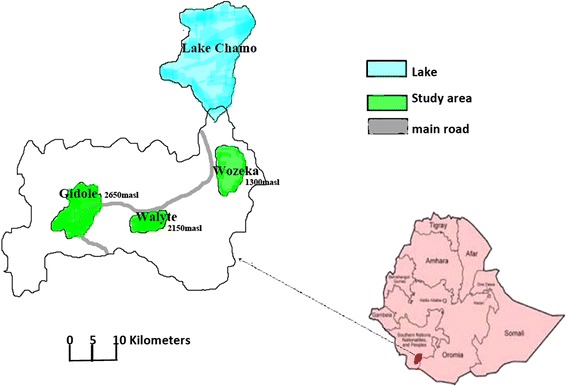
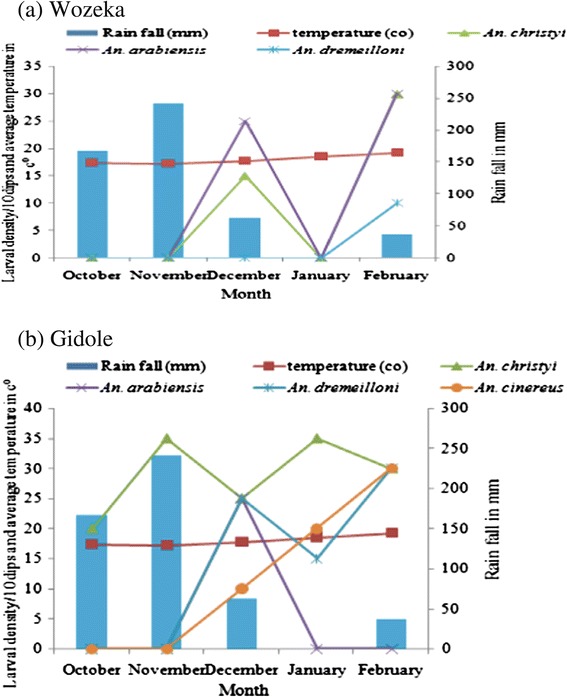
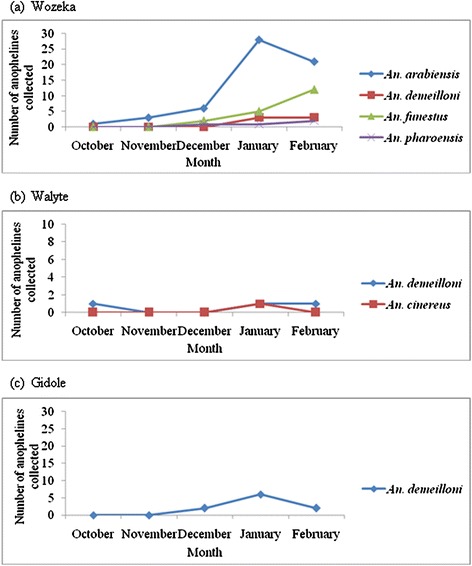
BACKGROUND: Change in climatic and socio-economic situations is paving the way for the spread of malaria in highland areas which were generally known to be malaria free. Despite this, information regarding highland malaria transmission is scarce. Thus, the present study investigated entomological parameters linked to malaria transmission in the highlands of Southern Ethiopia. METHODS: A longitudinal entomological study was conducted in three localities situated at different altitudes ranging between 1300 and 2650m above sea level in Derashe district, Southern Ethiopia. Larval and adult anopheline mosquitoes were collected between October 2011 and February 2012. RESULTS: An. arabiensis and An. funestus s.l existed at significantly higher densities in the lowland (Wozeka) in contrast to An. christyi and An. Demeilloni, which were more abundant in the highland localities (P < 0.01). Conversely, An. pharoensis and An. cinereus were scarce and only found in the lowland and highlands, respectively. Habitats of larvae of An. arabiensis were characterized as clear, sun-lit, permanent, still water (streams) without vegetation and situated close to human habitations. On the other hand, habitats of An. christyi are shaded, still, turbid and contain natural water (rain pools) with vegetation and mats of algae. The relative abundance of An. Arabiensis, which is the primary malaria vector in Ethiopia is significantly and positively correlated with water temperature, pH and average depth (P < 0.05). An. arabiensis, An. funestus s.l and An. demeilloni showed zoophilic and exophilic tendencies. None of the anophelines tested for P. falciparum and P. vivax sporozoite infections were positive. CONCLUSION: In conclusion, malaria parasites and vectors existed in the highlands of Derashe District. Therefore, appropriate disease and vector control strategies must be designed and implemented to prevent potential outbreaks.
Overview
The claims and statistics of this paper haven’t been checked yet.
Run the check — free, no account needed. It reads the open-access text and checks the sources it cites.
Integrity signals
Registry
Cites
Statistics
Figures
Verification
Claims the paper makes
The claims and statistics of this paper haven’t been checked yet.
Run the check — free, no account needed. It reads the open-access text and checks the sources it cites.
Claims other papers make about this one
Each is checked against this paper’s own text: does it say what the citing paper says it does?
The source backs part of the claim, not all of it — or backs it for a different population, condition or comparison.
In the citing paper
“The association between An. arabiensis and livestock production has been confirmed in a plethora of studies in sub-Saharan Africa [55–57] and is based on the fact that female mosquitoes, usually, restrict flight activities to places near animal blood meal hosts and oviposit in water bodies nearby.”
From Sibling species of the major malaria vector Anopheles gambiae display divergent preferences for aquatic breeding sites in southern Nigeria (2024) · cites this paper as [57]
Experimental — accuracy not yet measuredThe cited source says what the claim attributes to it.
In the citing paper
“Contrary to their choice of clean water bodies (see review by [48, 57], An. arabiensis larvae occurred in polluted water in drainages in Agbor-Obi.”
From Sibling species of the major malaria vector Anopheles gambiae display divergent preferences for aquatic breeding sites in southern Nigeria (2024) · cites this paper as [57]
Self-check
Percentages, sums and reported differences re-computed from the paper’s own numbers.
The self-check needs the paper’s full text.
Citations
Cites
Sinka, M. E., Bangs, M. J., Manguin, S., Coetzee, M., Mbogo, C. M., Hemingway, J., Patil, A. P., Temperley, W. H., Gething, P. W., Kabaria, C. W., et al. (2010) · Parasites & Vectors · doi:10.1186/1756-3305-3-117 · Cited by 761
Association between climate variability and malaria epidemics in the East African highlands
Zhou, G., Minakawa, N., Githeko, A. K., & Yan, G. (2004) · Proceedings of the National Academy of Sciences · doi:10.1073/pnas.0308714100 · Cited by 498
Mahande, A., Mosha, F., Mahande, J., & Kweka, E. (2007) · Malaria Journal · doi:10.1186/1475-2875-6-100 · Cited by 211
Research works printed but not linked: 28
- Senay G, Verdin J: Developing a Malaria Early Warning System for Ethiopia. National Center for EROS. 2005, 25th Annual ESRI International User Conference, San Diego, UC2409-
- Tchuinkam T, Simard F, Lélé-Defo E, Téné-Fossog B, Tateng-Ngouateu A, Antonio-Nkondjio C, Mpoame M, Toto JC, Njiné T, Fontenille D, Awono-Ambéné HP: Bionomics of anopheline species and malaria transmission dynamics along an altitudinal transect in western Cameroon. BMC Inf Dis. 2010, 10: 119-10.1186/1471-2334-10-119. · DOI
- Lindsay SW, Martens WJM: Malaria in the African highlands: past, present and future. Bull Wld Hlth Org. 1998, 76: 33-45.
- Abeku AT: Malaria Epidemics in Africa; Prediction, Detection and Response. PhD Thesis: Erasmus University Rotterdam. 2006, Ipskamp, Enschede
- Cox J, Craig M, Le Sueur D, Sharp B: Mapping malaria risk in the highland of Africa. 1999, Technical Report, Malaria project (MARA/HIMAL), London
- Woyessa A, Gebre-Micheal T, Ali A: An indigenous malaria transmission in the outskirts of addis Ababa, akaki town and its environs. Ethiop J Hlth Dev. 2004, 18: 2-7.
- Tesfaye S, Belyhun Y, Teklu T, Mengesha T, Petros B: Malaria prevalence pattern observed in the highland fringe of butajira, southern Ethiopia: a longitudinal study from parasitological and entomological survey. Malar J. 2011, 10: 153-10.1186/1475-2875-10-153. · DOI
- Yohannes M, Haile M, Ghebreyesus TA, Witten KH, Getachew A, Byass P, Lindsay SW: Can source reduction of mosquito larval habitat reduce malaria transmission in Tigray, Ethiopia?. Trop Med & Inter Hlth. 2005, 10: 1274-1285. 10.1111/j.1365-3156.2005.01512.x. · DOI
- Molineaux L: The epidemiology of malaria as an explanation of its distribution, including some implications for its control. Malaria principles and practice of malariology. Edited by: Wernsdorfer W. 1988, Churchill Livingstone Sir McGregor Eds, Great Britain, 913-998.
- Graves PM, Richards FO, Ngondi J, Emerson PM, Shargie EB, Endeshaw T, Ceccato P, Ejigsemahu Y, Mosher AW, Hailemariam A, Zerihun M, Teferi T, Ayele B, Mesele A, Yohannes G, Tilahun A, Gebre T: Individual, householdn and environmental risk factors for malaria infection in Amhara, Oromia and SNNP regions of Ethiopia. Trans R Soc Trop Med Hyg. 2009, 103: 1211-1220. 10.1016/j.trstmh.2008.11.016. · DOI
- Conway D, Mould C, Bewket W: Over one century of rainfall and temperature observations in Addis Ababa, Ethiopia. Int J Climatol. 2004, 24: 77-91. 10.1002/joc.989. · DOI
- Service WM: Mosquito ecology: Field sampling methods. 1993, Chapman and Hall, London · DOI
- Training Module on Malaria Control; Guideline for Malaria Entomology and Vector Control. 2011, WHO Press, Geneva
- Piyaratne MK, Amerasinghe FP, Amerasinghe PH, Konradsen F: Physico-chemical characteristics of Anopheles culicifacies and Anopheles varuna breeding water in a dry zone stream in Sri Lanka. J Vect Borne Dis. 2005, 42: 61-67.
- Minakawa N, Mutero CM, Githure JI, Beier JC, Yan G: Spatial distribution and habitat characterization of anopheline mosquito larvae in western Kenya. Am J Trop Med Hyg. 1999, 6: 1010-1016. · DOI
- Gillies MT, Coetzee M: A supplement to the anophelinae of africa south of the Sahara. Publ S Afr Inst Med Res. 1987, 55: 1-143.
- Scott JA, Brogdon WG, Collins FH: Identification of single specimens of the Anopheles gambiae complex by the polymerase chain reaction. Am J Trop Med Hyg. 1993, 49: 520-529. · DOI
- Wirtz RA, Burkot TR, Graves PM, Andre RG: Field evaluation of enzyme-linked immunosorbent assays for P. Falciparum and P. Vivax sporozoites in mosquitoes (diptera: culicidae) from Papua, New guinea. J Med Entomol. 1987, 24: 433-437. · DOI
- Beier JC, Perkins PV, Wirtz RA, Koros J, Diggs D, Gargan TP, Koach DK: Blood meal identification by direct enzyme linked immunosorbent assay (ELISA), tested on Anopheles (diptera: culucidae) in Kenya. J Med Entomol. 1988, 25: 9-16. · DOI
- Kenea O, Balkew M, Gebre-Michael T: Environmental factors associated with larval habitats of anopheline mosquitoes in irrigation and major drainage areas in the middle course of the Rift Valley, central Ethiopia. J Vect Borne Dis. 2011, 48: 85-92.
- Animut A, Gebre-Michae T, Balkew M, Lindtjørn B: Abundance and dynamics of anopheline larvae in a highland malarious area of south-central Ethiopia. Parasit Vectors. 2012, 5: 117-10.1186/1756-3305-5-117. · DOI
- Adams PCG: Some observations on the flight of stained anophelines at N’kana, Northern Rhodesia. Ann trap Med Parasit. 1940, 34: 35-43. · DOI
- Taye A, Hadis M, Adugnaa N, Tilahun D, Robert Wirtz RA: Biting behavior and plasmodium infection rates of Anopheles arabiensis from sille, Ethiopia. Acta Trop. 2006, 97: 50-54. 10.1016/j.actatropica.2005.08.002. · DOI
- Mulambalah CS, Siamba DN, Ngeiywa MM, Vulule JM:Anopheles species diversity and breeding habitat distribution and the prospect for focused malaria control in the western highlands of Kenya. Int J Trop Med. 2011, 6: 44-51. 10.3923/ijtmed.2011.44.51. · DOI
- Massebo F, Balkew M, Gebre-Michael T, Lindtjørn B: Blood meal origins and insecticide susceptibility of Anopheles arabiensis from chano in south-west ethiopia. Parasit Vectors. 2013, 6: 44-10.1186/1756-3305-6-44. · DOI
- Choi SK, Coetzee M, Koekemoer LL: Simultaneous identification of the Anopheles funestus group and Anopheles longipalpis type C by PCR-RFLP. Malar J. 2010, 9: 316-10.1186/1475-2875-9-316. · DOI
- Minakawa N, Omukunda E, Zhou G, Getheko A, Yan G: Mlaria vector productivity in relation to the highland environment in Kenya. Am J Trop Med Hyg. 2006, 75: 448-453. · DOI
- Wanjala LC, Waitumbi J, Zhou G, Githeko KA: Identification of malaria transmission and epidemic hotspots in the western Kenya highlands: its application to malaria epidemic prediction. Parasit Vectors. 2011, 4: 81-10.1186/1756-3305-4-81. · DOI
Cited by
Sorted by citations
Carter, T. E., Yared, S., Gebresilassie, A., Bonnell, V., Damodaran, L., Lopez, K., Ibrahim, M., Mohammed, S., & Janies, D. (2018) · Acta Tropica · doi:10.1016/j.actatropica.2018.09.001 · Cited by 192
Ebhodaghe, F. I., Sanchez-Vargas, I., Isaac, C., Foy, B. D., & Hemming-Schroeder, E. (2024) · Malaria Journal · doi:10.1186/s12936-024-04871-9 · Cited by 15
“The association between An. arabiensis and livestock production has been confirmed in a plethora of studies in sub-Saharan Africa [55–57] and is based on the fact that female mosquitoes, usually, restrict flight activities to places near animal blood meal hosts and oviposit in water bodies nearby.”
Background
Metadata
- Authors
- Gone, T., Balkew, M., & Gebre-Michael, T.
- Affiliations
- Addis Ababa University (ET)
- Venue
- Parasites & Vectors
- Published
- 2014-10-20
- Volume
- 7
- Issue
- 1
- Pages
- 483-483
- ISSN
- 1756-3305 (ISSN-L)
- PMC
- PMC4207323
- OpenAlex
- W2171048860
- Cited by
- 36
- References
- 3
- Citations by year
- 2026: 3 · 2025: 3 · 2024: 12 · 2023: 3 · 2022: 1 · 2021: 8 · 2020: 1 · 2018: 2 · 2017: 1 · 2016: 1 · 2015: 1
- FWCI
- 1.00
- Type
- journal article
- Language
- en
- Open access
- gold
- doi.org
- Locations
- Parasites & Vectors (publishedVersion, cc-by)
- Europe PMC (PubMed Central) (publishedVersion, cc-by)
- PubMed Central (publishedVersion, cc-by)
- PubMed (publishedVersion)
- DOAJ (DOAJ: Directory of Open Access Journals) (submittedVersion)
- Funders
- Addis Ababa University
- Topics
- Health Sciences › Medicine › Public Health, Environmental and Occupational Health › Malaria Research and Control
- Health Sciences › Medicine › Public Health, Environmental and Occupational Health › Mosquito-borne diseases and control
- Life Sciences › Agricultural and Biological Sciences › Ecology, Evolution, Behavior and Systematics › Diptera species taxonomy and behavior
- Keywords
- Anopheles, malaria vectors, highland malaria, Anopheles arabiensis, larval habitat, zoophily, exophily, water temperature, altitude, malaria vector control
- MeSH terms
- Altitude, Animals, Anopheles, Behavior, Animal, Ethiopia, Family Characteristics, Larva, Population Density, Rain, Temperature, Time Factors, Animal Distribution
About these checks
Registry, retraction, Cites and statistics results are computed, not judged, with one exception: a printed reference that no index lists is read once by a model before it counts as a citation error. Claims are extracted by a model and kept only when their quote appears verbatim in the text; each cited source is then checked, with a model’s help, for whether it says what the claim relies on. Those verdicts can be wrong — read the claim’s quote and the cited source before relying on one.
Statistics and arithmetic are recomputed, not judged.
Confidence bands are shown only for fields calibrated on our annotated test set. None is calibrated yet, so no band is shown.
What counts as a claim ›How we measure confidence ›How we check this ›
Are you an author, or do you see a problem with this page? Request a review
How to cite
Cite CoChat for the checks on this page, and the paper for its own findings.
- This page
- CoChat. (2026). Citation check: Comparative entomological study on ecology and behaviour of Anopheles mosquitoes in highland and lowland localities of Derashe District, southern Ethiopia. https://app.cochat.ai/papers/10.1186/s13071-014-0483-9
- The paper
- Gone, T., Balkew, M., & Gebre-Michael, T. (2014). Comparative entomological study on ecology and behaviour of Anopheles mosquitoes in highland and lowland localities of Derashe District, southern Ethiopia. Parasites & Vectors. https://doi.org/10.1186/s13071-014-0483-9
