

The DOI matches its Crossref record; 163 of the 165 references it cites were found in a registry or an index.
Diapause and quiescence: dormancy mechanisms that contribute to the geographical expansion of mosquitoes and their evolutionary success
Open accessAbstract
Mosquitoes are insects belonging to the order Diptera and family Culicidae. They are distributed worldwide and include approximately 3500 species, of which about 300 have medical and veterinary importance. The evolutionary success of mosquitoes, in both tropical and temperate regions, is due to the various survival strategies these insects have developed throughout their life histories. Of the many adaptive mechanisms, diapause and quiescence, two different types of dormancy, likely contribute to the establishment, maintenance and spread of natural mosquito populations. This review seeks to objectively and coherently describe the terms diapause and quiescence, which can be confused in the literature because the phenotypic effects of these mechanisms are often similar.
Overview
The claims and statistics of this paper haven’t been checked yet.
Run the check — free, no account needed. It reads the open-access text and checks the sources it cites.
Integrity signals
Registry
Cites
Statistics
Figures
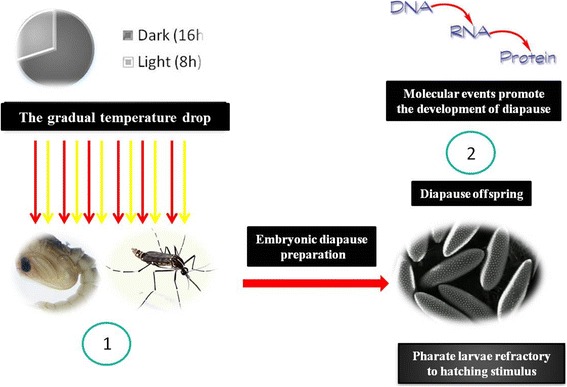
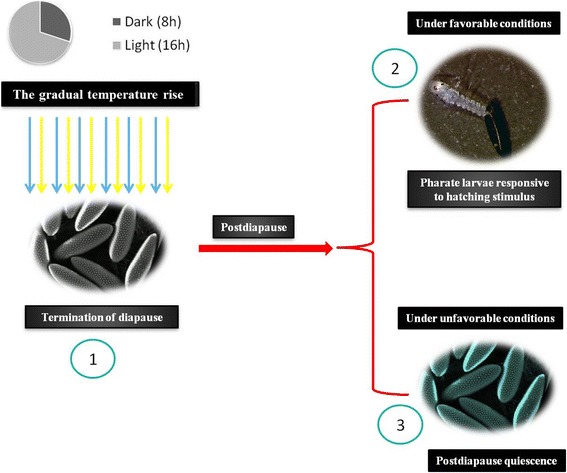
Verification
Claims the paper makes
The claims and statistics of this paper haven’t been checked yet.
Run the check — free, no account needed. It reads the open-access text and checks the sources it cites.
Claims other papers make about this one
Each is checked against this paper’s own text: does it say what the citing paper says it does?
In the citing paper
“Among the mosquito species that best adapt to these kinds of changes are Aedes albopictus and Cx. pipiens, which are recognised vectors of heartworm”
From Expansion of canine heartworm in Spain (2022) · cites this paper as [38]
Self-check
Percentages, sums and reported differences re-computed from the paper’s own numbers.
The self-check needs the paper’s full text.
Citations
Cites
Chapman, R. F. (2012) · Cambridge University Press eBooks · doi:10.1017/cbo9781139035460 · Cited by 2,775
The Insects: Structure and Function
Matthews, R. W. (1971) · Bulletin of the Entomological Society of America · doi:10.1093/besa/17.4.288 · Cited by 2,265
The global distribution of the arbovirus vectors Aedes aegypti and Ae. albopictus
Kraemer, M. U. G., Sinka, M. E., Duda, K. A., Mylne, A., Shearer, F. M., Barker, C. M., Moore, C. G., Carvalho, R. G., Coelho, G. E., Bortel, W. V., et al. (2015) · eLife · doi:10.7554/elife.08347 · Cited by 2,181
Seasonal Adaptations of Insects
Taylor, L. R., Tauber, M. J., Tauber, C. A., & Masaki, S. (1987) · Journal of Animal Ecology · doi:10.2307/4831 · Cited by 1,586
Seasonal Adaptations of Insects
Tauber, M. J., Tauber, C. A., & Masaki, S. (1985) · Cited by 1,438
Denlinger, D. L. (2002) · Annual Review of Entomology · doi:10.1146/annurev.ento.47.091201.145137 · Cited by 1,220
Spread of The Tiger: Global Risk of Invasion by The Mosquito Aedes albopictus
Benedict, M. Q., Levine, R. S., Hawley, W. A., & Lounibos, L. P. (2007) · Vector-Borne and Zoonotic Diseases · doi:10.1089/vbz.2006.0562 · Cited by 1,027
Eco-physiological phases of insect diapause
Košťál, V. (2005) · Journal of Insect Physiology · doi:10.1016/j.jinsphys.2005.09.008 · Cited by 989
Photoperiodism and seasonal development of insects.
Danilevskiĭ, A. S. (1965) · Zenodo (CERN European Organization for Nuclear Research) · doi:10.5281/zenodo.10741286 · Cited by 851
Principais mosquitos de importância sanitária no Brasil
Cônsoli, R. A. G. B., & Lourenço‐de‐Oliveira, R. (1994) · Editora FIOCRUZ eBooks · doi:10.7476/9788575412909 · Cited by 848
Research works printed but not linked: 17
- Lozovel AL. Culicidae (Mosquitos). In: Marcondes CB, editor. Entomologia médica e veterinária. Brasil: Atheneu; 2011. p. 107–74.
- Wilke ABB, Gomes A de C, Natal D, Marrelli MT. Control of vector populations using genetically modifi ed mosquitoes. Rev Lit Arts Am. 2009;43:869–74.
- Danks HV. Insect dormancy: an ecological perspective (Biological Survey of Canada Monograph Series, No 1 ). Broadway: Entomological Society of Canada; 1987.
- Duclaux E. De 1 “influence de froid d”hiver sur Iedevelopment de 1′ embryon du ver à sole et surI’éclosion de la graine. Oompt Eend Acad Sci. 1869;69:1021–2.
- Clements AN, Kerkut GA. The physiology of mosquitoes: international series of monographs on pure and applied biology. Oxford: Pergamon Press. 1963;17:410.
- Mirriam G, Mirriam C. Collegiate dictionary. 20th ed. Encyclopaedia Britannica, Inc: Massachusetts; 2000.
- Eldridge BF, Johnson MD, Bailey CL. Comparative studies of two North American mosquito species, Culex restuans and Culex salinarius: response to temperature and photoperiod in the laboratory. Mosq News. 1976;36:506–13.
- Wang R-L. Observations on the influence of photoperiod on egg diapause in Aedes albopictus (Skuse). Acta Enomol Sin. 1966; 15:75-77.
- Vinogradova E. [Diapause of blood - sucking mosquitoes and its control.] Leningrad. Russia: Nauka Academic Publishers; 1969. (In Russian)
- Abdel-Rahman A, Adham F. The effect of photoperiod on diapause induction in Aedes caspius Pallus. J Egypt Soc Parasitol. 1983;13:343–7.
- Vinogradova E. [An experimental investigation of ecological factors inducing imaginal diapause in blood-sucking mosquitoes (Diptera: Culicidae).] Entomol Obozr. 1960;39:327–340. (In Russian).
- Hudson J. Overwintering sites and ovarian development of some mosquitoes in central Alberta. Canada Mosq News. 1978;38:570–379.
- Saunders D. Insect clocks. Amsterdam: Elsevier; 2002.
- Juliano SA, O’Meara GF, Morrill JR, Cutwa MM. Desiccation and thermal tolerance of eggs and the coexistence of competing mosquitoes. Oecologia. 2002;130:458–69. · DOI
- Ciota AT, Bialosuknia SM, Ehrbar DJ, Kramer LD. Vertical transmission of Zika virus by Aedes aegypti and Aedes albopictus mosquitoes. Emerg Infect Dis. 2017;23:28277199.
- Corbet P, Danks H. Egg-laying habits of mosquitoes in the high arctic. Mosq News. 1975;35:8–14.
- Baker F. A new species of Orthopodomyia, O. alba sp. n. (Diptera, Culicidae). Proc Entomol Soc Wash. 1936;38:1–7.
Cited by
Sorted by citations
Scientists' warning on climate change and insects
Harvey, J. A., Tougeron, K., Gols, R., Heinen, R., Abarca, M., Abram, P. K., Basset, Y., Berg, M. P., Boggs, C. L., Jacques Brodeur, B., et al. (2022) · Ecological Monographs · doi:10.1002/ecm.1553 · Cited by 633
Effects of climate change and human activities on vector-borne diseases
de Souza, W. M., & Weaver, S. C. (2024) · Nature Reviews Microbiology · doi:10.1038/s41579-024-01026-0 · Cited by 444
Kandul, N. P., Liu, J., C., H. M. S., Wu, S. L., Marshall, J. M., & Akbari, O. S. (2019) · Nature Communications · doi:10.1038/s41467-018-07964-7 · Cited by 258
Shocket, M. S., Verwillow, A. B., Numazu, M. G., Slamani, H., Cohen, J. M., El Moustaid, F., Rohr, J., Johnson, L. R., & Mordecai, E. A. (2020) · eLife · doi:10.7554/elife.58511 · Cited by 192
Denlinger, D. L. (2022) · Cambridge University Press eBooks · doi:10.1017/9781108609364 · Cited by 187
Metadata
- Authors
- Diniz, D. F. A., de Albuquerque, C. M. R., Oliva, L. O., de Melo-Santos, M. A. V., & Ayres, C. F. J.
- Affiliations
- Instituto Aggeu Magalhães (BR)
- Universidade Federal de Pernambuco (BR)
- Corresponding author
- Ayres, Constância Flávia Junqueira
- Venue
- Parasites & Vectors
- Published
- 2017-06-26
- Volume
- 10
- Issue
- 1
- Pages
- 310-310
- ISSN
- 1756-3305 (ISSN-L)
- PMC
- PMC5485599
- OpenAlex
- W2709477677
- Cited by
- 200
- References
- 165
- Citations by year
- 2026: 16 · 2025: 17 · 2024: 35 · 2023: 29 · 2022: 40 · 2021: 16 · 2020: 20 · 2019: 20 · 2018: 7
- FWCI
- 1.08
- Type
- journal article
- Language
- en
- Open access
- gold
- doi.org
- Licence
- cc-by
- Locations
- Parasites & Vectors (publishedVersion, cc-by)
- PubMed Central (publishedVersion, cc-by)
- PubMed (publishedVersion)
- DOAJ (DOAJ: Directory of Open Access Journals) (submittedVersion, cc-by-sa)
- Topics
- Physical Sciences › Environmental Science › Ecology › Physiological and biochemical adaptations
- Health Sciences › Medicine › Public Health, Environmental and Occupational Health › Mosquito-borne diseases and control
- Health Sciences › Medicine › Public Health, Environmental and Occupational Health › Malaria Research and Control
- Keywords
- diapause, quiescence, mosquito life history, geographical range expansion, evolutionary success, survival strategies, mosquitoes, overwintering
- MeSH terms
- Diapause, Animals, Cold Temperature, Biological Evolution, Life Cycle Stages, Culicidae, Tropical Climate, Photoperiod
About these checks
Registry, retraction, Cites and statistics results are computed, not judged, with one exception: a printed reference that no index lists is read once by a model before it counts as a citation error. Claims are extracted by a model and kept only when their quote appears verbatim in the text; each cited source is then checked, with a model’s help, for whether it says what the claim relies on. Those verdicts can be wrong — read the claim’s quote and the cited source before relying on one.
Statistics and arithmetic are recomputed, not judged.
Confidence bands are shown only for fields calibrated on our annotated test set. None is calibrated yet, so no band is shown.
What counts as a claim ›How we measure confidence ›How we check this ›
Are you an author, or do you see a problem with this page? Request a review
