

A cross-sectional survey of Aedes aegypti immature abundance in urban and rural household containers in central Colombia
Open accessThe DOI matches its Crossref record; 64 of the 67 references it cites were found in a registry or an index; 21 of the 63 sources its claims cite were checked for support.
Abstract
BACKGROUND: Aedes aegypti, the major vector of dengue, breeds in domestic water containers. The development of immature mosquitoes in such containers is influenced by various environmental, ecological and socioeconomic factors. Urban and rural disparities in water storage practices and water source supply may affect mosquito immature abundance and, potentially, dengue risk. We evaluated the effect of water and container characteristics on A. aegypti immature abundance in urban and rural areas. Data were collected in the wet season of 2011 in central Colombia from 36 urban and 35 rural containers, which were either mosquito-positive or negative. Immature mosquitoes were identified to species. Data on water and container characteristics were collected from all containers. RESULTS: A total of 1452 Aedes pupae and larvae were collected of which 81% were A. aegypti and 19% A. fluviatilis. Aedes aegypti immatures were found in both urban and rural sites. However, the mean number of A. aegypti pupae was five times higher in containers in the urban sites compared to those in the rural sites. One of the important factors associated with A. aegypti infestation was frequency of container washing. Monthly-washed or never-washed containers were both about four times more likely to be infested than those washed every week. There were no significant differences between urban and rural sites in frequency of washing containers. Aedes aegypti immature infestation was positively associated with total dissolved solids, but negatively associated with dissolved oxygen. Water temperature, total dissolved solids, ammonia, nitrate, and organic matter were significantly higher in urban than in rural containers, which might explain urban-rural differences in breeding of A. aegypti. However, many of these factors vary substantially between studies and in their degree of association with vector breeding, therefore they may not be reliable indices for vector control interventions. CONCLUSIONS: Although containers in urban areas were more likely to be infested with A. aegypti, rural containers still provide suitable habitats for A. aegypti. Containers that are washed more frequent are less likely to produce A. aegypti. These results highlight the importance of container washing as an effective vector control tool in both urban and rural areas. In addition, alternative designs of the highly productive washbasins should continue to be explored. To control diseases such as dengue, Zika and chikungunya, effective vector breeding site control must be implemented in addition to other interventions.
Overview
CoChat Summary
TL;DR
In a cross-sectional survey of 71 domestic water containers in central Colombia, Aedes aegypti immatures were found in both urban and rural sites, but urban containers had over five times higher mean A. aegypti pupal abundance than rural containers. Frequent container washing was associated with lower A. aegypti infestation, while total dissolved solids was positively and dissolved oxygen negatively associated with infestation.
Key findings
- Of 1452 Aedes immatures collected, 1172 (80.7%) were A. aegypti and 280 (19.3%) were A. fluviatilis.
- Mean A. aegypti pupae were 6.2/container in urban vs 1.2/container in rural sites (ratio of means 5.13, 95% CI 1.18–22.37, P = 0.030); larval abundance did not differ significantly (14.3 vs 11.3 larvae/container; ratio 1.26, 95% CI 0.48–3.36, P = 0.639).
- Monthly-washed and never-washed containers had higher odds of A. aegypti infestation than weekly-washed containers (multivariate OR 4.23, 95% CI 1.31–13.68, P = 0.016; and OR 4.55, 95% CI 1.09–18.96, P = 0.037, respectively).
- TDS was positively associated with infestation in univariate analysis (OR 8.60, 95% CI 1.57–46.84, P = 0.013), while dissolved oxygen was negatively associated in multivariate analysis (OR 0.51, 95% CI 0.28–0.92, P = 0.026); non-Aedes larvae were less abundant in urban than rural containers (ratio 0.24, 95% CI 0.06–0.89, P = 0.032).
Methods
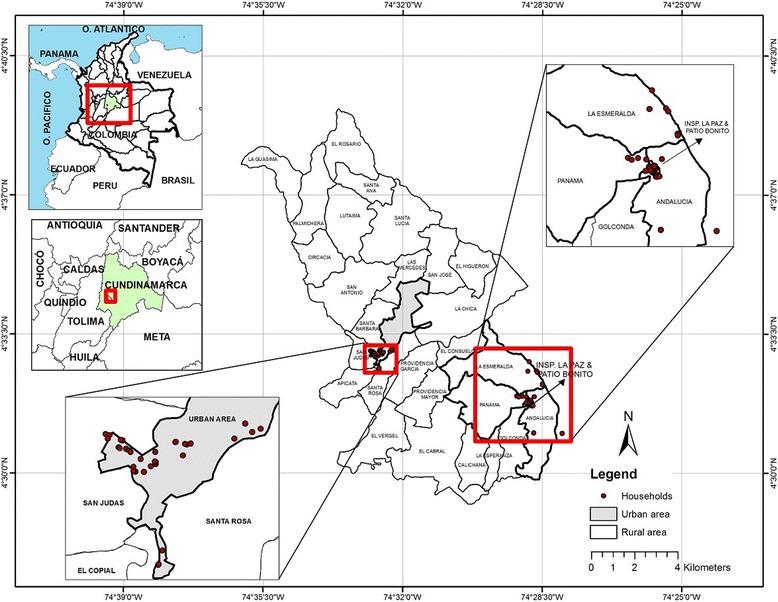
- Cross-sectional study with the water storage container as the unit of analysis, conducted in Anapoima municipality, Cundinamarca, central Colombia, during the rainy season of October–December 2011.
- A total of 71 domestic containers were sampled: 36 urban and 35 rural; 37 mosquito-positive and 34 mosquito-negative; only ground tanks and concrete washbasins were included.
- Immatures were collected and identified to species; container and water characteristics were recorded, including physicochemical and bacterial measurements. Analysis used zero-truncated negative binomial models for larval abundance, standard negative binomial models for pupal abundance, and univariate/multivariate logistic regression for infestation, in Stata 14.1.
Limitations
- The paper states that containers were selected to include equal numbers of positive and negative containers, so the proportion of Aedes-positive houses or containers and indices such as Breteau could not be compared; numbers of inspected but excluded positive/negative containers were not recorded.
- The paper states that only ground tanks and washbasins were sampled because they are considered the most productive containers, and that such assumptions may change with environmental and climate change.
- Evident from the text: the sample was small (71 containers), restricted to one municipality and one wet season, and urban/rural comparisons were confounded by altitude and water temperature differences, limiting causal inference.
Model-written summary. Check it against the paper before relying on it.
Integrity signals
Registry
Cites
Statistics
Figures
Verification
Claims the paper makes
13 Valid · 1 Not valid · 20 Not checked · 67 Own results and interpretations
The cited sources support only part of this claim — read each source’s verdict below.
In the paper
“The most productive and permanent containers are ground tanks and concrete washbasins for laundry (albercas), whereas other containers, such as bottles, cans, tires, etc., are only productive during the rainy season and produce low numbers of pupae [21, 32, 33].”
§ A cross-sectional survey of Aedes aegypti immature abundance in urban and rural household containers in central Colombia > Background
What the sources say
- Not checked — no full text of the sourcecites [21] Romero-Vivas C Arango-Padilla P Falconar A Pupal-productivity surveys to identify the key container habitats of Aedes aegypti (L.) in Barranquilla, the principal seaport of Colombia Ann Trop Med Parasitol 2006 100 S87 S95 10.1179/136485906X105543 16630394 source
- Supportedcites [32] Quintero J Brochero H Manrique-Saide P Barrera-Perez M Basso C Romero S Ecological, biological and social dimensions of dengue vector breeding in five urban settings of Latin America: a multi-country study BMC Infect Dis 2014 14 38 10.1186/1471-2334-14-38 24447796 PMC3904013 source
The Results section on vector breeding reports that large cement tanks in the Colombian study site produced more than 70% of Aedes pupae in both dry and wet seasons, and identifies rectangular wash tanks among the major producers. The Table 4 note says the same water tanks were present in both seasons, supporting the description of them as permanent; the evidence is specific to the Colombian study site. (LLM, conf=0.87)
- Partly supportedcites [33] Alcalá L Quintero J González-Uribe C Brochero H Productividad de Aedes aegypti (L.) (Diptera: Culicidae) en viviendas y espacios públicos en una ciudad endémica para dengue en Colombia Biomedica 2015 35 2 258 268 10.7705/biomedica.v35i2.2567 26535548 sourceExperimental — accuracy not yet measured
The Discussion (page unavailable) says albercas and ground-level tanks had the highest pupal productivity in Girardot homes, and the section on productive containers says albercas produced high percentages of pupae consistently. This supports the claim for homes in Girardot, but not as a general finding for Colombia or for public spaces, where the leading container types varied by season. (LLM, conf=0.85)
plain- Asserted: passes — The authors put it forward as true.
- Checkable: passes — It can be checked against evidence.
- Load-bearing: unclear — It is unclear whether the paper’s conclusions depend on it.
- Based: passes — The paper gives a reason why it holds.
The cited sources support only part of this claim — read each source’s verdict below.
In the paper
“In Latin-America, A. aegypti is expanding into peri-urban and rural areas [10–16].”
§ A cross-sectional survey of Aedes aegypti immature abundance in urban and rural household containers in central Colombia > Background
What the sources say
- Not matchedcites [10] Troyes L Villegas Z Troyes M Expansión del Aedes aegypti a localidades rurales de Cajamarca Rev Perú Med Exp Salud Pública 2006 23 163 167
Its entry has no title and year that we can search by.
- Not matchedcites [11] Instituto Nacional de Salud: Informe Quincenal Epidemiológico Nacional (IQEN). 17 (16). 30 de Agosto de 2012. http://www.ins.gov.co/iqen/IQUEN/IQEN%20vol%2017%202012%20num%2016.pdf. Accessed May 2017.
We searched by its title and found no matching paper.
- Not matchedcites [12] Padilla JC Rojas DP Sáenz-Gómez R Dengue en Colombia: Epidemiología de la reemergencia a la hiperendemia. Primera edición 2012 Guías de Impresión Ltda Bogotá, Colombia
We searched by its title and found no matching paper.
- Partly supportedcites [13] Diaz-Nieto LM Macia A Perotti MA Beron CM Geographical limits of the southeastern distribution of Aedes aegypti (Diptera, Culicidae) in Argentina PLoS Negl Trop Dis 2013 71 10.1371/journal.pntd.0001963 PMC3561174 23383351 sourceExperimental — accuracy not yet measured
The Background and Present Distribution sections document A. aegypti expanding into small towns along a highway in Argentina. They do not establish expansion into rural areas or show that this pattern holds across Latin America. Page numbers are not provided in our copy. (LLM, conf=0.84)
- Supportedcites [14] Guagliardo SA Barboza JL Morrison AC Astete H Vazquez-Prokopec G Kitron U Patterns of geographic expansion of Aedes aegypti in the Peruvian Amazon PLoS Negl Trop Dis 2014 8 8 10.1371/journal.pntd.0003033 25101786 PMC4125293 source
The Introduction states that A. aegypti is expanding from urban to rural areas in Latin America and Peru. The Discussion explicitly describes expansion from urban to peri-urban and rural areas. (LLM, conf=0.94)
- Not checked — no full text of the sourcecites [15] Olano VA Matiz MI Lenhart A Cabezas L Vargas SL Jaramillo JF Schools as potential risk sites for vector-borne disease transmission: mosquito vectors in rural schools in two municipalities in Colombia J Am Mosq Control Assoc 2015 31 3 212 222 10.2987/moco-31-03-212-222.1 26375902 source
- Partly supportedcites [16] Perez-Castro R Castellanos JE Olano VA Matiz MI Jaramillo JF Vargas SL Detection of all four dengue serotypes in Aedes aegypti female mosquitoes collected in a rural area in Colombia Memorias do Instituto Oswaldo Cruz 2016 111 4 233 240 10.1590/0074-02760150363 27074252 PMC4830112 sourceExperimental — accuracy not yet measured
The Abstract and Discussion (page numbers not supplied) report that A. aegypti occurs abundantly in rural areas of Colombia. They do not establish that it is expanding over time, or document expansion into peri-urban areas across Latin America. (LLM, conf=0.84)
plainstates a cause- Asserted: passes — The authors put it forward as true.
- Checkable: passes — It can be checked against evidence.
- Load-bearing: passes — The paper’s conclusions depend on it.
- Based: passes — The paper gives a reason why it holds.
- Not matched
The cited sources support only part of this claim — read each source’s verdict below.
In the paper
“The importance of cleaning containers for dengue vector control has been shown in many studies [60–63] and is recommended by WHO [64]”
§ A cross-sectional survey of Aedes aegypti immature abundance in urban and rural household containers in central Colombia > Discussion
What the sources say
- Supportedcites [60] Phuanukoonnon S Mueller I Bryan JH Effectiveness of dengue control practices in household water containers in Northeast Thailand Tropical Med Int Health 2005 10 8 755 763 10.1111/j.1365-3156.2005.01452.x 16045462 source
The Abstract (p. 755) states that weekly cleaning was effective for larval control in most types of household water containers. This supports the cited paper's contribution to the claim that cleaning containers matters for dengue vector control. (LLM, conf=0.93)
- Partly supportedcites [61] Maciel-de-Freitas R Marques WA Peres RC Cunha SP de Oliveira RL Variation in Aedes aegypti (Diptera: Culicidae) container productivity in a slum and a suburban district of Rio de Janeiro during dry and wet seasons Mem Inst Oswaldo Cruz 2007 102 4 489 496 10.1590/S0074-02762007005000056 17612770 sourceExperimental — accuracy not yet measured
The Discussion (page unavailable) says that eliminating productive containers, such as water tanks and metal drums, could possibly reduce adult mosquito density. This supports targeting containers for dengue vector control, but the study does not show that cleaning containers, as distinct from eliminating them, is effective. (LLM, conf=0.84)
- Partly supportedcites [62] Arunachalam N Tana S Espino F Kittayapong P Abeyewickreme W Wai KT Eco-bio-social determinants of dengue vector breeding: a multicountry study in urban and periurban Asia Bull World Health Organ 2010 88 3 173 184 10.2471/BLT.09.067892 20428384 PMC2828788 sourceExperimental — accuracy not yet measured
The Conclusion recommends targeting productive containers and says eliminating or treating unprotected outdoor containers can make a difference. It does not specifically assess or recommend cleaning containers, so the cited study supports container management for vector control but not the stated cleaning practice. (LLM, conf=0.78)
- Supportedcites [63] Ferdousi F Yoshimatsu S Ma E Sohel N Wagatsuma Y Identification of essential containers for Aedes larval breeding to control dengue in Dhaka Bangladesh Trop Med Health 2015 43 4 253 264 10.2149/tmh.2015-16 26865829 PMC4689612 source
The Conclusion recommends regularly cleaning indoor water-storage containers to reduce Aedes larval breeding sites. The Discussion also reports that previous studies found weekly cleaning of water-holding containers effective in controlling larval production. The separate WHO recommendation is attributed to another citation, not this paper. (LLM, conf=0.92)
- Not matchedcites [64] WHO: Dengue - Guidelines for diagnosis, treatment, prevention and control. Geneva: World Health Organization; 2009. 23762963
Its entry has no title and year that we can search by.
boostedstates a cause- Asserted: passes — The authors put it forward as true.
- Checkable: passes — It can be checked against evidence.
- Load-bearing: passes — The paper’s conclusions depend on it.
- Based: passes — The paper gives a reason why it holds.
- Supported
The cited sources support only part of this claim — read each source’s verdict below.
In the paper
“because these are most productive containers [32]”
- Also stated in: § Conclusions · hedged
“as they currently are considered the most productive containers in both urban and rural areas”
§ A cross-sectional survey of Aedes aegypti immature abundance in urban and rural household containers in central Colombia > Discussion
What the sources say
- Partly supportedcites [32] Quintero J Brochero H Manrique-Saide P Barrera-Perez M Basso C Romero S Ecological, biological and social dimensions of dengue vector breeding in five urban settings of Latin America: a multi-country study BMC Infect Dis 2014 14 38 10.1186/1471-2334-14-38 24447796 PMC3904013 sourceExperimental — accuracy not yet measured
The Discussion ('Vector production in highly endemic areas'; page unavailable) says major vector production occurred mostly in large tanks or barrels. Table 4 in Results ('Water and sanitation'; page unavailable) ranks tanks highest in Colombia and Ecuador, but other container types lead elsewhere. The copy does not identify ground tanks and washbasins as the most productive containers overall. (LLM, conf=0.85)
plain- Asserted: passes — The authors put it forward as true.
- Checkable: passes — It can be checked against evidence.
- Load-bearing: passes — The paper’s conclusions depend on it.
- Based: passes — The paper gives a reason why it holds.
- Also stated in: § Conclusions · hedged
A result the paper reports from its own data — it cites no other source for it, so there is none to check. The quote shows it is in the paper.
In the paper
“Containers reported to be washed every month or never washed had each four times higher odds of A. aegypti infestation compared to containers with a weekly washing (Table 3).”
- Also stated in: § Results · plain
“Monthly-washed or never-washed containers were both about four times more likely to be infested than those washed every week.”
§ A cross-sectional survey of Aedes aegypti immature abundance in urban and rural household containers in central Colombia > Results > Factors associated with A. aegypti immature production
plainstates an association- Asserted: passes — The authors put it forward as true.
- Checkable: passes — It can be checked against evidence.
- Load-bearing: passes — The paper’s conclusions depend on it.
- Based: passes — The paper gives a reason why it holds.
- Also stated in: § Results · plain
49 more claims
Create a free account to see all 101 claims and to verify the 8 references still open.
- Probably not a substantial claim. 32
- It may state two separate claims as one. 26
Statistics recomputed
Every reported test result, recomputed from its test statistic and degrees of freedom. A result shows as not adding up only once an independent check has confirmed it.
- Not confirmedt(69) = -2.67reported p = .005 · recomputed p = .009
“t (69) = -2.67, p = .005”
- Not confirmedt(69) = 2.08reported p = .021 · recomputed p = .041
“t (69) = 2.08, p = .021”
- Not confirmedt(69) = -1.81reported p = .037 · recomputed p = .075
“t (69) = -1.81, p = .037”
Self-check
Percentages, sums and reported differences re-computed from the paper’s own numbers.
Each contradiction between two passages listed here was confirmed by an independent check.
Rated minor: it would not touch a result — a value no result rests on, a p-value that stays on the same side of the significance level, or a conflict that is clerical, resolved elsewhere in the paper, or outside its own findings.
In the paper
§ A cross-sectional survey of Aedes aegypti immature abundance in urban and rural household containers in central Colombia > Methods > Study design and sample size
“In the rural sites, 37 of 192 houses were selected, 29 in Patio Bonito and 8 dispersed houses in La Paz and Andalucía combined.”
§ A cross-sectional survey of Aedes aegypti immature abundance in urban and rural household containers in central Colombia > Methods > Study area
“Patio Bonito (total 45 households or 23 houses)”
Rated minor: it would not touch a result — a value no result rests on, a p-value that stays on the same side of the significance level, or a conflict that is clerical, resolved elsewhere in the paper, or outside its own findings.
In the paper
§ A cross-sectional survey of Aedes aegypti immature abundance in urban and rural household containers in central Colombia > Discussion
“the odds of pupal infestation was five times higher (P = 0.03).”
§ A cross-sectional survey of Aedes aegypti immature abundance in urban and rural household containers in central Colombia > Results > Aedes aegypti productivity in mosquito-positive containers
“| Variable | Level | No. specimens (%) | No. containers | Ratio of means | 95% CI | Z | P | | --- | --- | --- | --- | --- | --- | --- | --- | | A. aegypti larvae | Rural | 395 (43) | 37 | 1 | | | |”
Citations
Cites
Standard methods: For the examination of water and waste water
(1990) · Analytical Biochemistry · doi:10.1016/0003-2697(90)90598-4 · Cited by 72,091
The global distribution and burden of dengue
Bhatt, S., Gething, P. W., Brady, O. J., Messina, J. P., Farlow, A. W., Moyes, C. L., Drake, J. M., Brownstein, J. S., Hoen, A. G., Sankoh, O., et al. (2013) · Nature · doi:10.1038/nature12060 · Cited by 10,037 · cited 2×
“Dengue fever is rapidly spreading globally [3]; approximately 2.”
2013 NCHS Urban-Rural Classification Scheme for Counties.
Ingram, D. D., & Franco, S. J. (2012) · PubMed · Cited by 1,762
Dengue, Urbanization and Globalization: The Unholy Trinity of the 21st Century
Gubler, D. J. (2011) · Tropical Medicine and Health · doi:10.2149/tmh.2011-s05 · Cited by 1,098
Feeding Behavior, Natural Food, and Nutritional Relationships of Larval Mosquitoes
Merritt, R. W., Dadd, R. H., & Walker, E. D. (1992) · Annual Review of Entomology · doi:10.1146/annurev.en.37.010192.002025 · Cited by 679 · cited 2×
“Larval mosquito diets mainly consist of bacteria and detritus [44, 45].”
BackgroundDISPERSAL OF THE DENGUE VECTOR AEDES AEGYPTI WITHIN AND BETWEEN RURAL COMMUNITIES
HARRINGTON, L. C., SCOTT, T. W., LERDTHUSNEE, K., COLEMAN, R. C., COSTERO, A., CLARK, G. G., JONES, J. J., KITTHAWEE, S., KITTAYAPONG, P., SITHIPRASASNA, R., et al. (2005) · The American Journal of Tropical Medicine and Hygiene · doi:10.4269/ajtmh.2005.72.209 · Cited by 619 · cited 1×
“Aedes aegypti has a very limited flight range [17], therefore mosquitoes most likely disperse passively along human transportation networks, e.”
BackgroundChemical Ecology and Behavioral Aspects of Mosquito Oviposition
Bentley, M. D., & Day, J. F. (1989) · Annual Review of Entomology · doi:10.1146/annurev.en.34.010189.002153 · Cited by 588 · cited 1×
“Mosquito oviposition behavior is affected by visual, tactile, and olfactory cues, including physico-chemical properties of the water [35].”
BackgroundMetabolic relationship between female body size, reserves, and fecundity of Aedes aegypti
Briegel, H. (1990) · Journal of Insect Physiology · doi:10.1016/0022-1910(90)90118-y · Cited by 498
Tun‐Lin, W., Burkot, T. R., & Kay, B. H. (2000) · Medical and Veterinary Entomology · doi:10.1046/j.1365-2915.2000.00207.x · Cited by 497
Scott, T. W., Amerasinghe, P. H., Morrison, A. C., Lorenz, L. H., Clark, G. G., Strickman, D., Kittayapong, P., & Edman, J. D. (2000) · Journal of Medical Entomology · doi:10.1603/0022-2585-37.1.89 · Cited by 486
Alto, B. W., & Juliano, S. A. (2001) · Journal of Medical Entomology · doi:10.1603/0022-2585-38.5.646 · Cited by 293
Barrera, R., Amador, M., & MacKay, A. J. (2011) · PLoS Neglected Tropical Diseases · doi:10.1371/journal.pntd.0001378 · Cited by 292
Schmidt, W.-P., Suzuki, M., Dinh Thiem, V., White, R. G., Tsuzuki, A., Yoshida, L.-M., Yanai, H., Haque, U., Huu Tho, L., Anh, D. D., et al. (2011) · PLoS Medicine · doi:10.1371/journal.pmed.1001082 · Cited by 276
Arunachalam, N., Tana, S., Espino, F., Kittayapong, P., Abeyewickreme, W., Wai, K. T., Tyagi, B. K., Kroeger, A., Sommerfeld, J., & Petzold, M. (2010) · Bulletin of the World Health Organization · doi:10.2471/blt.09.067892 · Cited by 245
Ponnusamy, L., Xu, N., Nojima, S., Wesson, D. M., Schal, C., & Apperson, C. S. (2008) · Proceedings of the National Academy of Sciences · doi:10.1073/pnas.0802505105 · Cited by 244 · cited 1×
“aegypti are affected by the bacterial composition of water [84], presence of conspecifics [41], and other potential cues from the water and the container in order to maximize survival of offspring.”
BackgroundWalker, E. D., Lawson, D. L., Merritt, R. W., Morgan, W. T., & Klug, M. J. (1991) · Ecology · doi:10.2307/1940953 · Cited by 216
Eisen, L., Monaghan, A. J., Lozano-Fuentes, S., Steinhoff, D. F., Hayden, M. H., & Bieringer, P. E. (2014) · Journal of Medical Entomology · doi:10.1603/me13214 · Cited by 176
Maciel-de-Freitas, R., Marques, W. A., Peres, R. C., Cunha, S. P., & Lourenço-de-Oliveira, R. (2007) · Memórias do Instituto Oswaldo Cruz · doi:10.1590/s0074-02762007005000056 · Cited by 173
Alto, B. W., & Juliano, S. A. (2001) · Journal of Medical Entomology · doi:10.1603/0022-2585-38.4.548 · Cited by 164
Marinho, R. A., Beserra, E. B., Bezerra-Gusmão, M. A., Porto, V. D. S., Olinda, R. A., & dos Santos, C. A. C. (2016) · Journal of Vector Ecology · doi:10.1111/jvec.12187 · Cited by 151
The Premise Condition Index: A Tool for Streamlining Surveys of Aedes aegypti
Tun-Lin, W., Kay, B. H., & Barnes, A. (1995) · American Journal of Tropical Medicine and Hygiene · doi:10.4269/ajtmh.1995.53.591 · Cited by 145
Quintero, J., Brochero, H., Manrique-Saide, P., Barrera-Pérez, M., Basso, C., Romero, S., Caprara, A., De Lima Cunha, J. C., Beltrán - Ayala, E., Mitchell-Foster, K., et al. (2014) · BMC Infectious Diseases · doi:10.1186/1471-2334-14-38 · Cited by 140
Seasonal pattern of abundance of Aedes aegypti (Diptera: Culicidae) in Buenos Aires city, Argentina
Vezzani, D., Velázquez, S. M., & Schweigmann, N. (2004) · Memórias do Instituto Oswaldo Cruz · doi:10.1590/s0074-02762004000400002 · Cited by 127
Barrera, R., Amador, M., & Clark, G. G. (2006) · Journal of Medical Entomology · doi:10.1093/jmedent/43.3.484 · Cited by 120
Vong, S., Khieu, V., Glass, O., Ly, S., Duong, V., Huy, R., Ngan, C., Wichmann, O., Letson, G. W., Margolis, H. S., et al. (2010) · PLoS Neglected Tropical Diseases · doi:10.1371/journal.pntd.0000903 · Cited by 118 · cited 1×
“Dengue transmission and outbreaks, as well as DENV infected mosquitoes are not that uncommon in rural areas [9, 16, 59].”
BackgroundThe Southern House Mosquito, Culex quinquefasciatus: profile of a smart vector
Bhattacharya, S., & Basu, P. K. (2016) · Journal of Entomology and Zoology Studies · Cited by 117
Allan, S. A., & Kline, D. L. (1998) · Journal of Medical Entomology · doi:10.1093/jmedent/35.6.943 · Cited by 109
Effect of size and geographic origin of Aedes aegypti on oral infection with dengue-2 virus.
Sumanochitrapon, W., Strickman, D., Sithiprasasna, R., et al. (1998) · American Journal of Tropical Medicine and Hygiene · doi:10.4269/ajtmh.1998.58.283 · Cited by 105
BURKE, R., BARRERA, R., LEWIS, M., KLUCHINSKY, T., & CLABORN, D. (2010) · Medical and Veterinary Entomology · doi:10.1111/j.1365-2915.2010.00864.x · Cited by 103
Muturi, E. J., Mwangangi, J., Shililu, J., Jacob, B. G., Mbogo, C., Githure, J., & Novak, R. J. (2008) · Journal of Vector Ecology · doi:10.3376/1081-1710(2008)33[56:efawtd]2.0.co;2 · Cited by 91
Ferdousi, F., Yoshimatsu, S., Ma, E., Sohel, N., & Wagatsuma, Y. (2015) · Tropical Medicine and Health · doi:10.2149/tmh.2015-16 · Cited by 89
Walker, E. D., Olds, E. J., & Merritt, R. W. (1988) · Journal of Medical Entomology · doi:10.1093/jmedent/25.6.551 · Cited by 87
Pérez-Castro, R., Castellanos, J. E., Olano, V. A., Matiz, M. I., Jaramillo, J. F., Vargas, S. L., Sarmiento, D. M., Stenström, T. A., & Overgaard, H. J. (2016) · Memórias do Instituto Oswaldo Cruz · doi:10.1590/0074-02760150363 · Cited by 86 · cited 2×
“aegypti collected in 2012–2013 in the rural study area showed high DENV infection rates, with a pool positivity rate of 62% and estimated individual mosquito infection rate of about 4% [16].”
BackgroundSelf-citationRuiz-López, F., González-Mazo, A., Vélez-Mira, A., Gómez, G. F., Zuleta, L., Uribe, S., & Vélez-Bernal, I. D. (2016) · Biomédica · doi:10.7705/biomedica.v36i2.3301 · Cited by 80 · cited 1×
“aegypti is present in all departments (first-level administrative subdivision) and up to an altitude of at least 2300 m above sea level [31].”
BackgroundSommerfeld, J., & Kroeger, A. (2012) · Pathogens and Global Health · doi:10.1179/2047773212y.0000000055 · Cited by 79
Effectiveness of dengue control practices in household water containers in Northeast Thailand
Phuanukoonnon, S., Mueller, I., & Bryan, J. H. (2005) · Tropical Medicine & International Health · doi:10.1111/j.1365-3156.2005.01452.x · Cited by 79
Egg‐laying Yellow Fever Mosquitoes avoid sites containing eggs laid by themselves or by conspecifics
Chadee, D. D., Corbet, P. S., & Greenwood, J. J. D. (1990) · Entomologia Experimentalis et Applicata · doi:10.1111/j.1570-7458.1990.tb01442.x · Cited by 78
Patterns of Geographic Expansion of Aedes aegypti in the Peruvian Amazon
Guagliardo, S. A., Barboza, J. L., Morrison, A. C., Astete, H., Vazquez-Prokopec, G., & Kitron, U. (2014) · PLoS Neglected Tropical Diseases · doi:10.1371/journal.pntd.0003033 · Cited by 77 · cited 1×
“hitchhiking in cars, buses and boats [14].”
Quintero, J., Carrasquilla, G., Suárez, R., González, C., & Olano, V. A. (2009) · Cadernos de Saúde Pública · doi:10.1590/s0102-311x2009001300009 · Cited by 70
Self-citation(2001) · PubMed · Cited by 67
Fernández, E. A., Leontsini, E., Sherman, C., Chan, A. S. T., Reyes, C. E., Lozano, R. C., Fuentes, B. A., Nichter, M., & Winch, P. J. (1998) · Acta Tropica · doi:10.1016/s0001-706x(98)00033-3 · Cited by 66
(1965) · Mosquito news · Cited by 65
Romero-Vivas, C. M. E., Arango-Padilla, P., & Falconar, A. K. I. (2006) · Annals of Tropical Medicine & Parasitology · doi:10.1179/136485906x105543 · Cited by 63 · cited 3×
“may produce low numbers of mosquitoes, but usually only in the rainy season [21, 33].”
BackgroundQuintero, J., Garcia-Betancourt, T., Cortes, S., Garcia, D., Alcala, L., Gonzalez-Uribe, C., Brochero, H., & Carrasquilla, G. (2015) · Transactions of the Royal Society of Tropical Medicine and Hygiene · doi:10.1093/trstmh/tru208 · Cited by 55
Factors that modify the larval indices of Aedes aegypti in Colima, Mexico
Espinoza‐Gómez, F., Hernández-Suárez, C., & Coll-Cárdenas, R. (2001) · Revista Panamericana de Salud Pública · doi:10.1590/s1020-49892001000700002 · Cited by 55
Díaz-Nieto, L. M., Maciá, A., Perotti, M. A., & Berón, C. M. (2013) · PLoS Neglected Tropical Diseases · doi:10.1371/journal.pntd.0001963 · Cited by 50
Gopalakrishnan, R., Das, M., Baruah, I., Veer, V., & Dutta, P. (2013) · Journal of Vector Borne Diseases · doi:10.4103/0972-9062.120930 · Cited by 50 · cited 2×
“On the other hand, another study from India found opposite results to ours, with a negative correlation between TDS and larval density and a positive correlation between DO and larval density [75].”
ResultRaw sewage as breeding site to Aedes ( Stegomyia ) aegypti (Diptera, culicidae)
Chitolina, R. F., Anjos, F. A., Lima, T. S., Castro, E. A., & Costa-Ribeiro, M. C. V. (2016) · Acta Tropica · doi:10.1016/j.actatropica.2016.07.013 · Cited by 46 · cited 1×
“aegypti has been observed to oviposit and develop normally in raw sewage with low levels of dissolved oxygen, suggesting a wide tolerance spectrum [36].”
BackgroundOlano, V. A., Matiz, M. I., Lenhart, A., Cabezas, L., Vargas, S. L., Jaramillo, J. F., Sarmiento, D., Alexander, N., Stenström, T. A., & Overgaard, H. J. (2015) · Journal of the American Mosquito Control Association · doi:10.2987/moco-31-03-212-222.1 · Cited by 41
Self-citationBrooker, S., Bethony, J. M., Rodrigues, L. C., Alexander, N., Geiger, S. M., & Hotez, P. J. (2005) · Expert Review of Vaccines · doi:10.1586/14760584.4.1.35 · Cited by 40 · cited 1×
“The sample size was determined to be at least 34 containers representing the urban and rural area, respectively (a total of at least 68 containers) giving 80% power to detect a ratio of means of 2, with negative binomial k parameter of 2 and significance level of 5% [54].”
Self-citationGonzalez, P. V., Audino, P. A. G., & Masuh, H. (2015) · Journal of Medical Entomology · doi:10.1093/jme/tjv189 · Cited by 37
Irving, E. C., Liber, K., & Culp, J. M. (2004) · Environmental Toxicology and Chemistry · doi:10.1897/03-230 · Cited by 36
Lenhart, A. E., Castillo, C. E., Oviedo, M., & Villegas, E. (2006) · Annals of Tropical Medicine & Parasitology · doi:10.1179/136485906x105516 · Cited by 35
Chatterjee, S., Chakraborty, A., & Sinha, S. K. (2015) · Indian Journal of Medical Research · doi:10.4103/0971-5916.176631 · Cited by 29 · cited 2×
“Also in these containers, there was a significant positive correlation between TDS and larval density [69].”
BackgroundAlcalá, L. A., Quintero, J., González, C., & Brochero, H. (2015) · Biomédica · doi:10.7705/biomedica.v35i2.2567 · Cited by 26
Beserra, E. B., Fernandes, C. R. M., de Sousa, J. T., de Freitas, E. M., & Santos, K. D. (2010) · Neotropical Entomology · doi:10.1590/s1519-566x2010000600026 · Cited by 24
Abundance and distribution of immature mosquitoes in urban rivers proximate to their larval habitats
Ma, M., Huang, M., & Leng, P. (2016) · Acta Tropica · doi:10.1016/j.actatropica.2016.08.010 · Cited by 23 · cited 1×
“[70] also found a significantly negative association between DO and overall larval abundance in Chinese urban river systems, although these larvae mainly consisted of Culex species.”
BackgroundEcología del Aedes aegypti en un pueblo de Colombia, Suramérica
Tinker, M. E., & Olano, V. A. (1993) · Biomédica · doi:10.7705/biomedica.v13i1.2041 · Cited by 22
Self-citationDarriet, F., & Corbel, V. (2008) · Comptes Rendus. Biologies · doi:10.1016/j.crvi.2008.05.003 · Cited by 14 · cited 1×
“aegypti-positive containers have been found to have more dissolved nitrogen ions than negative containers [50].”
BackgroundCLAVE ILUSTRADA PARA LA DETERMINACION GENERICA DE LARVAS DE CULICIDAE DE COLOMBIA Y EL NUEVO MUNDO.
Obando, R. G., & Darsie, R. F. (2013) · Boletin del Museo de Entomología de la Universidad del Valle · Cited by 9
Kent, R. H., & Belitz, K. (2004) · doi:10.3133/wri034326 · Cited by 7
Infección por el virus del Chikungunya
Jaramillo, R., & Nelly, B. (2014) · Revista CES Medicina · Cited by 6
(2008) · Revista cubana de higiene y epidemiología · Cited by 1
(2006) · doi:10.17843/rpmesp.2006.233.1043
Research works printed but not linked: 7
- Padilla JC Rojas DP Sáenz-Gómez R Dengue en Colombia: Epidemiología de la reemergencia a la hiperendemia. Primera edición 2012 Guías de Impresión Ltda Bogotá, Colombia
- Focks D, Alexander N. Multicountry study of Aedes aegypti pupal productivity survey methodology: findings and recommendations. vol. TDR/IRM/DEN/06.1. Geneva: Special Programme for Research and Training in Tropical Diseases (TDR), World Health Organization; 2006: 48.
- Haramis L Larval nutrition, adult body size, and the biology of Aedes triseriatus In: Ecology of mosquitoes: Proceedings of a workshop: January 9–12, 1984 1985 Vero Beach, Florida Florida Medical Entomology Laboratory 431 437
- Forattini OP Entomologia médica 1965 São Paulo, Brazil Faculdade de Higiene e Saúde Pública
- WHO: Dengue - Guidelines for diagnosis, treatment, prevention and control. Geneva: World Health Organization; 2009. 23762963
- Deborah CE Water quality assessments: a guide to use of biota, sediments and water in environmental monitoring 1996 2 London Published on behalf of UNESCO/WHO/UNEP. E&FN Spon
- Wetzel R Limnology: Lake and river ecosystems. 3rd ed. Edn 2001 San Diego, CA Academic Press
Cited by
Liu-Helmersson, J., Brännström, Å., Sewe, M. O., Semenza, J. C., & Rocklöv, J. (2019) · Frontiers in Public Health · doi:10.3389/fpubh.2019.00148 · Cited by 145
Rahman, M. S., Ekalaksananan, T., Zafar, S., Poolphol, P., Shipin, O. V., Haque, U., Paul, R. E. L., Rocklöv, J., Pientong, C., & Overgaard, H. J. (2021) · International Journal of Environmental Research and Public Health · doi:10.3390/ijerph18115971 · Cited by 106
Self-citationWorldwide impacts of landscape anthropization on mosquito abundance and diversity: A meta‐analysis
Perrin, A., Glaizot, O., & Christe, P. (2022) · Global Change Biology · doi:10.1111/gcb.16406 · Cited by 107
Badolo, A., Sombié, A., Yameogo, F., Wangrawa, D. W., Sanon, A., Pignatelli, P. M., Sanon, A., Viana, M., Kanuka, H., Weetman, D., et al. (2022) · PLoS neglected tropical diseases · doi:10.1371/journal.pntd.0010059 · Cited by 81
After the epidemic: Zika virus projections for Latin America and the Caribbean
Colón‐González, F. J., Peres, C. A., Bernardo, C. S. S., Hunter, P. R., & LAKE, I. R. (2017) · PLoS neglected tropical diseases · doi:10.1371/journal.pntd.0006007 · Cited by 78
Metadata
- Authors
- Overgaard, H. J., Olano, V. A., Jaramillo, J. F., Matiz, M. I., Sarmiento, D., Stenström, T. A., & Alexander, N.
- Affiliations
- Norwegian University of Life Sciences (NO)
- Universidad El Bosque (CO)
- Durban University of Technology (ZA)
- London School of Hygiene & Tropical Medicine (GB)
- Corresponding author
- Overgaard, Hans J.
- Venue
- Parasites & Vectors
- Published
- 2017-07-27
- Volume
- 10
- Issue
- 1
- Pages
- 356-356
- ISSN
- 1756-3305 (ISSN-L)
- PMC
- PMC5530958
- OpenAlex
- W2740477784
- Cited by
- 95
- References
- 67
- Citations by year
- 2026: 10 · 2025: 10 · 2024: 10 · 2023: 13 · 2022: 19 · 2021: 13 · 2020: 8 · 2019: 6 · 2018: 3 · 2017: 2
- FWCI
- 4.87
- Type
- journal article
- Language
- en
- Open access
- gold
- doi.org
- Licence
- cc-by
- Locations
- Parasites & Vectors (publishedVersion, cc-by)
- PubMed Central (publishedVersion, cc-by)
- PubMed (publishedVersion)
- LSHTM Research Online (London School of Hygiene and Tropical Medicine) (acceptedVersion)
- DOAJ (DOAJ: Directory of Open Access Journals) (submittedVersion, cc-by-sa)
- NORA - Norwegian Open Research Archives (submittedVersion, cc-by-nc-nd)
- LA Referencia (Red Federada de Repositorios Institucionales de Publicaciones Científicas) (submittedVersion, cc-by)
- Greater South Information System
- Funders
- Norges Forskningsråd (NO) (201349)
- Fundacion Lazos de Calandaima (0000)
- Universidad El Bosque (0000)
- Topics
- Health Sciences › Medicine › Public Health, Environmental and Occupational Health › Mosquito-borne diseases and control
- Health Sciences › Medicine › Public Health, Environmental and Occupational Health › Dengue and Mosquito Control Research
- Health Sciences › Medicine › Public Health, Environmental and Occupational Health › Malaria Research and Control
- Keywords
- Aedes aegypti, Aedes fluviatilis, dengue vector, household water containers, urban-rural differences, water quality, dissolved solids, dissolved oxygen, mosquito breeding sites, vector control, central Colombia, washbasin
- MeSH terms
- Mosquito Vectors, Aedes, Animals, Colombia, Cross-Sectional Studies, Dengue, Disease Reservoirs, Housing, Humans, Larva, Mosquito Control, Pupa, Rural Population, Seasons, Socioeconomic Factors, Urban Population, Water Supply
About these checks
Registry, retraction, Cites and statistics results are computed, not judged, with one exception: a printed reference that no index lists is read once by a model before it counts as a citation error. Claims are extracted by a model and kept only when their quote appears verbatim in the text; each cited source is then checked, with a model’s help, for whether it says what the claim relies on. Those verdicts can be wrong — read the claim’s quote and the cited source before relying on one.
The claim verdicts this report counts are experimental: their accuracy is not yet measured.
A language model drew the claims from the paper on 2026-10-01, under version 3 of the claim definition (model deepseek-v4.1-flash, prompt extract-v3).
A second model labelled each claim on 2026-10-01 (model jev-1.13-20260917, definition revision gold-guideline-v0.2).
Cited sources are checked with a language model’s help (gpt-6-sol).
Statistics and arithmetic are recomputed, not judged.
Confidence bands are shown only for fields calibrated on our annotated test set. None is calibrated yet, so no band is shown.
What counts as a claim ›How we measure confidence ›How we check this ›
Are you an author, or do you see a problem with this page? Request a review
Data sources
Bibliographic data: Semantic Scholar, OpenAlex, Crossref.
Contains information from the Semantic Scholar Academic Graph Datasets, made available under the ODC Attribution License (ODC-BY 1.0).
Semantic Scholar’s data is described in: Kinney, R., et al. (2023). The Semantic Scholar Open Data Platform. arXiv:2301.10140.
