

Seasonality and changing prevalence of common canine gastrointestinal nematodes in the USA
Open accessThe DOI matches its Crossref record; 16 of the 16 references it cites were found in a registry or an index.
Abstract
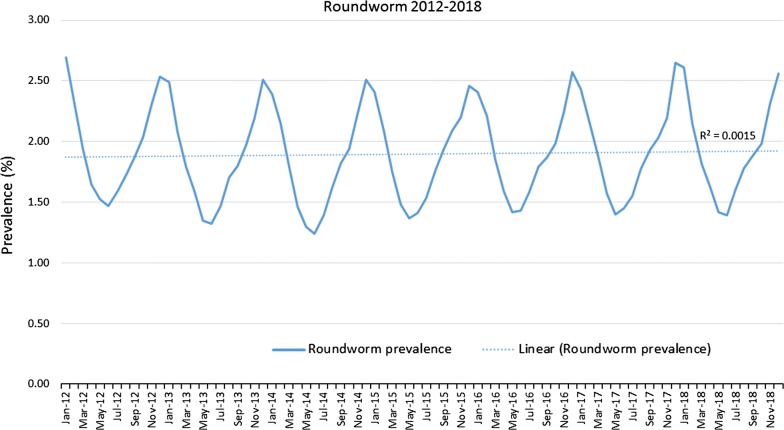
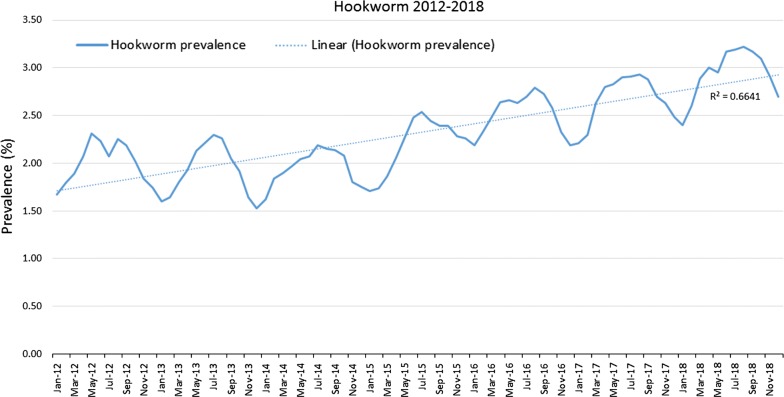
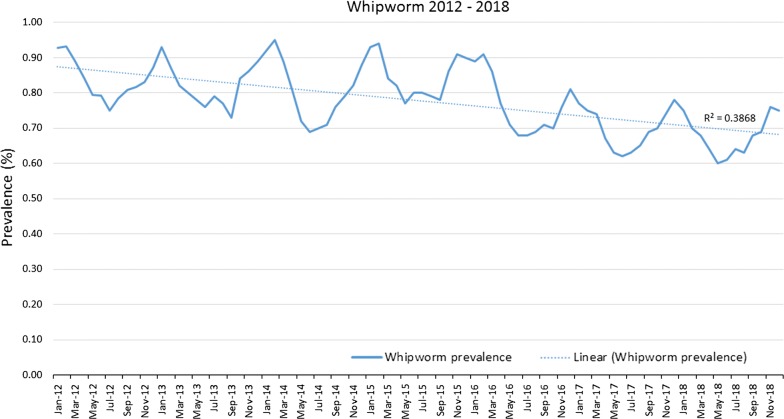
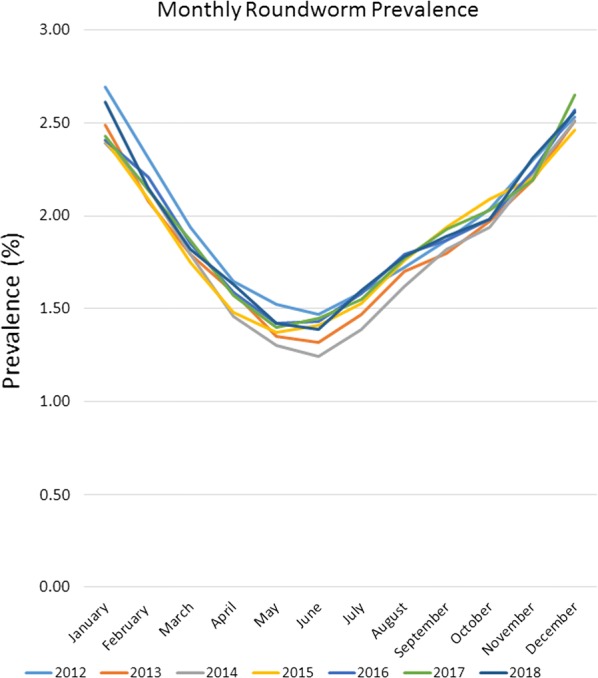
BACKGROUND: The three most commonly diagnosed gastrointestinal parasites of pet dogs within the USA are the whipworm, the hookworm, and the roundworm. The collection of large data sets from various sources throughout the industry have produced a number of publications on parasite prevalence in recent years. In this study, we look at data captured by the Companion Animal Parasite Council from 2012-2018, which includes 4.3-7.2 million annual fecal exams, to evaluate not only changes in prevalence, but also possible seasonal fluctuations of the three most common canine gastrointestinal parasites. METHODS: Annual and monthly data were collected from the CAPC parasite prevalence maps for canine roundworms, hookworms and whipworm. The map data were provided to CAPC by two large national reference laboratories. The data were evaluated for changes in prevalence on a monthly basis throughout each year as well as changes in prevalence from year to year from 2012-2018. Additionally, positive test results and total tests performed for each of the three parasites from 2012-2018 during individual months were totaled without using the year as a variable in order to evaluate the results for seasonality (i.e. all tests and positive results occurring in January, regardless of year, were totaled and analyzed). RESULTS: Evaluation of gastrointestinal nematode prevalence data from over 39 million fecal samples examined over a 7-year period revealed a subtle, yet significant, increasing prevalence for roundworms, an increasing prevalence for hookworms, and a slightly decreasing prevalence for whipworms. Seasonality was demonstrated for roundworms, hookworms, and to our knowledge, for the first time canine whipworms. Highest seasonal prevalence for roundworms, hookworms, and whipworms occurred during December-January, July-August, and January-February, respectively. CONCLUSIONS: Evaluation of monthly gastrointestinal parasite prevalence data from over 39 million fecal samples collected over a 7-year period revealed a slightly increasing prevalence for roundworms, an increasing prevalence for hookworms, and a slightly decreasing prevalence for whipworms. In addition to the annual changes in prevalence, seasonal prevalence was shown for the first time for whipworms. Prevalence of both whipworm and roundworm peaked in the winter, while prevalence of hookworm peaked in the late summer and early autumn.
Overview
The claims and statistics of this paper haven’t been checked yet.
Free: it reads the open-access text and checks the first 5 claims that cite a source we can check. Create a free account to check every claim.
Integrity signals
Registry
Cites
Statistics
Figures
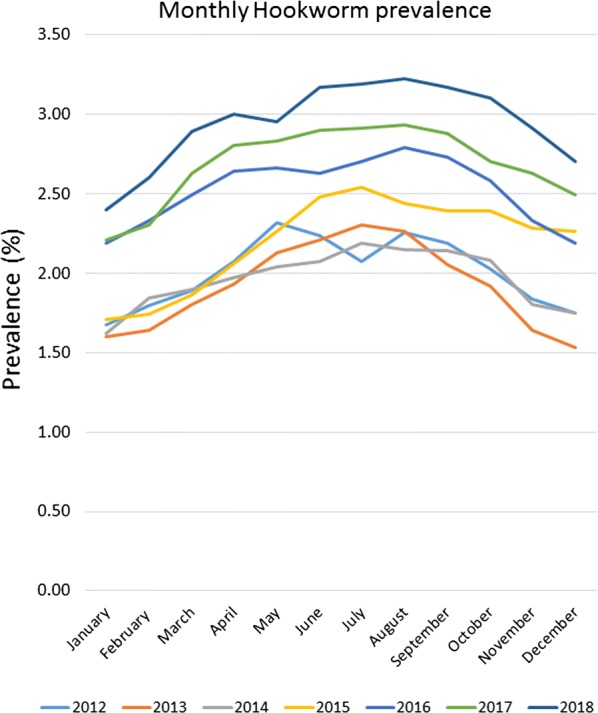
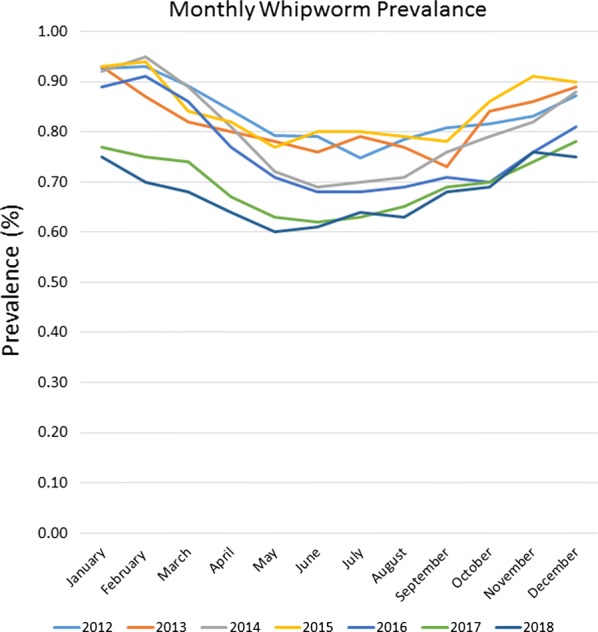
Verification
Claims the paper makes
The claims and statistics of this paper haven’t been checked yet.
Free: it reads the open-access text and checks the first 5 claims that cite a source we can check. Create a free account to check every claim.
Claims other papers make about this one
Each is checked against this paper’s own text: does it say what the citing paper says it does?
The source backs part of the claim, not all of it — or backs it for a different population, condition or comparison.
In the citing paper
“A recent study evaluating over 39 million fecal samples from 2012–2018, showed evidence of a steady yearly increase in prevalence from 2015–2018, with an overall increase of 47% [2].”
From Multiple drug resistance in the canine hookworm Ancylostoma caninum: an emerging threat? (2019) · cites this paper as [2]
Experimental — accuracy not yet measured
Self-check
Percentages, sums and reported differences re-computed from the paper’s own numbers.
The self-check needs the paper’s full text.
Citations
Cites
Comparison of common fecal flotation techniques for the recovery of parasite eggs and oocysts.
Dryden, M. W., Payne, P. A., Ridley, R. K., & Smith, D. H. (2005) · PubMed · Cited by 340
Prevalence of intestinal parasites in pet dogs in the United States
Little, S. E., Johnson, E. M., Lewis, D., Jaklitsch, R. P., Payton, M. E., Blagburn, B. L., Bowman, D. D., Moroff, S., Tams, T., Rich, L., et al. (2009) · Veterinary Parasitology · doi:10.1016/j.vetpar.2009.07.044 · Cited by 234
Prevalence of intestinal parasites in dogs from São Paulo State, Brazil
Oliveira-Sequeira, T. C. G., Amarante, A. F. T., Ferrari, T. B., & Nunes, L. C. (2002) · Veterinary Parasitology · doi:10.1016/s0304-4017(01)00575-1 · Cited by 234
Fontanarrosa, M. F., Vezzani, D., Basabe, J., & Eiras, D. F. (2006) · Veterinary Parasitology · doi:10.1016/j.vetpar.2005.11.012 · Cited by 181
Ecological analysis and description of the intestinal helminths present in dogs in Mexico City
Eguía-Aguilar, P., Cruz-Reyes, A., & Maya, J. J. M. (2004) · Veterinary Parasitology · doi:10.1016/j.vetpar.2004.10.004 · Cited by 163
Kirkpatrick, C. E. (1988) · Veterinary Parasitology · doi:10.1016/0304-4017(88)90158-6 · Cited by 129
Seasonal variation in development and survival of Ascaris suum and Trichuris suis eggs on pastures
Larsen, M. N., & Roepstorff, A. (1999) · Parasitology · doi:10.1017/s0031182099004503 · Cited by 105
Nolan, T. J., & Smith, G. (1995) · Veterinary Parasitology · doi:10.1016/0304-4017(94)00742-u · Cited by 97
Drake, J., & Wiseman, S. (2018) · Parasites & Vectors · doi:10.1186/s13071-018-2631-0 · Cited by 85
Self-citationElsemore, D. A., Geng, J., Cote, J., Hanna, R., Lucio‐Forster, A., & Bowman, D. D. (2017) · Journal of Veterinary Diagnostic Investigation · doi:10.1177/1040638717706098 · Cited by 84
Research works printed but not linked: 5
- 4. Blagburn BL, Lindsay DS, Vaughan JL, et al. Prevalence of canine parasites based on fecal floatation. Compend Contin Educ Pract Vet. 1996;18:483-509.
- 9. Bowman DD, Mannella C. Treating whipworms in the dog. NAVC Clin Brief. 2011;6:65-8.
- 19. Castro PJ, Howell S, Kaplan R. Evidence of multiple drug resistance in Ancylostoma caninum confirmed by in vitro assays and in vivo trials. In: Proceedings of the American Association of Veterinary Parasitologists 63rd Annual Meeting, 14-17 July 2018. p. 93-4.
- 20. Bowman DD. Hookworm parasites of dogs and cats. Compendium. 1992;14:585-95.
- 21. Bowman DD. Helminths. In: Zehnbauer B, editor. Georgisʼ parasitology for veterinarians. 10th ed. St. Louis: Elsevier Health Sciences; 2014.
Cited by
Multiple drug resistance in the canine hookworm Ancylostoma caninum: an emerging threat?
Jimenez Castro, P. D., Howell, S. B., Schaefer, J. J., Avramenko, R. W., Gilleard, J. S., & Kaplan, R. M. (2019) · Parasites & Vectors · doi:10.1186/s13071-019-3828-6 · Cited by 192
Venkatesan, A., Castro, P. D. J., Morosetti, A., Horvath, H., Chen, R., Redman, E., Dunn, K., Collins, J. B., Fraser, J. S., Andersen, E. C., et al. (2023) · PLoS Pathogens · doi:10.1371/journal.ppat.1011146 · Cited by 106
Detection of gastrointestinal parasitism at recreational canine sites in the USA: the DOGPARCS study
Stafford, K., Kollasch, T. M., Duncan, K. T., Horr, S., Goddu, T., Heinz-Loomer, C., Rumschlag, A. J., Ryan, W. G., Sweet, S., & Little, S. E. (2020) · Parasites & Vectors · doi:10.1186/s13071-020-04147-6 · Cited by 86
“canis, as samples were collected during July and August, a time when infections with these nematodes may be at their lowest prevalence [27].”
BackgroundMultiple drug resistance in hookworms infecting greyhound dogs in the USA
Castro, P. D. J., Venkatesan, A., Redman, E., Chen, R., Malatesta, A., Huff, H., Salazar, D. A. Z., Avramenko, R. W., Gilleard, J. S., & Kaplan, R. M. (2021) · International Journal for Parasitology Drugs and Drug Resistance · doi:10.1016/j.ijpddr.2021.08.005 · Cited by 79
“Interestingly, this prevalence is more than 71 twice as high as that reported for 2018 by (Drake and Carey, 2019), and is more than 70% 72”
BackgroundInfluentialvon Samson‐Himmelstjerna, G., Thompson, R. C. A., Krücken, J., Grant, W. N., Bowman, D. D., Schnyder, M., & Deplazes, P. (2021) · International Journal for Parasitology Drugs and Drug Resistance · doi:10.1016/j.ijpddr.2021.07.003 · Cited by 75
“) or cats (Toxocara cati, hookworms) represent serious zoonotic risks, arising also from asymptomatic older infected pets (Beugnet et al., 2014; Deplazes et al., 2011; Drake and Carey, 2019; Little et al., 2009; Stafford et al., 2020).”
BackgroundJimenez Castro, P. D., Mansour, A., Charles, S., Hostetler, J., Settje, T., Kulke, D., & Kaplan, R. M. (2020) · International Journal for Parasitology: Drugs and Drug Resistance · doi:10.1016/j.ijpddr.2020.04.003 · Cited by 56
“A recent study evaluating over 39 million fecal samples from 2012 to 2018, showed evidence of a steady yearly increase in prevalence from 2015 onwards, with an overall increase of 47% (Drake and Carey, 2019).”
BackgroundNagamori, Y., Payton, M. E., Looper, E., Apple, H., & Johnson, E. M. (2019) · Veterinary Parasitology · doi:10.1016/j.vetpar.2019.109008 · Cited by 52
Nagamori, Y., Payton, M. E., Looper, E., Apple, H., & Johnson, E. M. (2020) · Veterinary Parasitology · doi:10.1016/j.vetpar.2020.109137 · Cited by 49
Ancylostoma caninum and Other Canine Hookworms
Hawdon, J. M., & Wise, K. A. (2020) · Parasitology research monographs · doi:10.1007/978-3-030-53230-7_9 · Cited by 51
Detection of Giardia and helminths in Western Europe at local K9 (canine) sites (DOGWALKS Study)
Drake, J., Sweet, S., Baxendale, K., Hegarty, E., Horr, S., Friis, H., Goddu, T., Ryan, W. G., & von Samson‐Himmelstjerna, G. (2022) · Parasites & Vectors · doi:10.1186/s13071-022-05440-2 · Cited by 38
“This was shown in the USA where between 2015 and 2018 there was a 47% increase in reported prevalence of hookworms [17].”
BackgroundSelf-citationSobotyk, C., Upton, K. E., Lejeune, M., Nolan, T. J., Marsh, A. E., Herrin, B. H., Borst, M. M., Piccione, J., Zajac, A. M., Camp, L. E., et al. (2021) · Parasites & Vectors · doi:10.1186/s13071-021-04960-7 · Cited by 35
Leutenegger, C. M., Lozoya, C. E., Tereski, J., Andrews, J., Mitchell, K. D., Meeks, C., Willcox, J. L., Freeman, G., Richmond, H. L., Savard, C., et al. (2023) · Parasites & Vectors · doi:10.1186/s13071-023-05904-z · Cited by 29
“Keywords PCR, Gastrointestinal, Parasites, Resistance, Giardia , Zoonotic, Ancylostoma Background Gastrointestinal (GI) parasitism is common in domestic dogs and cats in North America and can cause significant clinical disease, particularly in puppies and kittens [1].”
BackgroundAdhikari, R. B., Dhakal, M. A., & Ghimire, T. R. (2023) · Veterinary Medicine and Science · doi:10.1002/vms3.1258 · Cited by 33
Leutenegger, C. M., Evason, M. D., Willcox, J. L., Rochani, H., Richmond, H. L., Meeks, C., Lozoya, C. E., Tereski, J., Loo, S., Mitchell, K., et al. (2024) · International Journal for Parasitology Drugs and Drug Resistance · doi:10.1016/j.ijpddr.2024.100520 · Cited by 29
“With the onset of MADR in canine hookworm, an increasing prevalence of hookworm infections in dogs between 2012 and 2018 has been reported (Drake and Carey, 2019).”
BackgroundResultInfluentialEvason, M. D., Weese, J. S., Polansky, B. J., & Leutenegger, C. M. (2023) · American Journal of Veterinary Research · doi:10.2460/ajvr.23.05.0116 · Cited by 30
McKean, E. L., Grill, E., Choi, Y., Mitreva, M., O’Halloran, D. M., & Hawdon, J. M. (2024) · Parasitology · doi:10.1017/s0031182023001385 · Cited by 18
“Hookworm prevalence has been increasing (Drake and Carey, 2019; Nagamori et al ., 2020), possibly reflecting the emergence of multiple anthelmintic-resistant hookworm isolates like BCR reported here in greyhounds and spreading to the general pet dog population (Jimenez Castro et al ., 2019, 2021;…”
BackgroundMultiple anthelmintic drug resistant Ancylostoma caninum in foxhounds
Balk, J. D., Mitchell, N. D., Hughes, J., Nauto, P. S., Rossi, J. S., & Ramírez, R. (2023) · International Journal for Parasitology Drugs and Drug Resistance · doi:10.1016/j.ijpddr.2023.07.001 · Cited by 22
Vrhovec, M. G., Alnassan, A. A., Pantchev, N., & Bauer, C. (2022) · Veterinary Parasitology · doi:10.1016/j.vetpar.2022.109836 · Cited by 17
Quintana, T. A., Johnson, W. L., Ritchie, D., Smith, D. H., Martin, K. A., McMahan, K., Brewer, M. T., & Chelladurai, J. R. J. J. (2023) · Journal of Helminthology · doi:10.1017/s0022149x23000159 · Cited by 16
“Yet, there is an important need for this information due to the reported increase in the annual incidence of infection in dogs (Drake & Carey, 2019), which increases the risk of human infection.”
BackgroundEpidemiological and molecular updates on hookworm species in dogs from southern Italy
Illiano, S., Ciucă, L., Maurelli, M. P., Pepe, P., Caruso, V., Bosco, A., Pennacchio, S., Amato, R., Pompameo, M., & Rinaldi, L. (2023) · BMC Veterinary Research · doi:10.1186/s12917-023-03765-3 · Cited by 14
Stocker, T., Ward, M. P., & Šlapeta, J. R. (2024) · Veterinary Parasitology · doi:10.1016/j.vetpar.2024.110118 · Cited by 11
Kotwa, J. D., French, S. K., Greer, T., Elsemore, D. A., Hanna, R., Jardine, C. M., Pearl, D. L., Weese, J. S., Mercer, N. J., & Peregrine, A. S. (2021) · Veterinary Parasitology Regional Studies and Reports · doi:10.1016/j.vprsr.2021.100618 · Cited by 15
Hayes, B., Wiseman, S., & Snyder, D. E. (2021) · Parasites & Vectors · doi:10.1186/s13071-021-04766-7 · Cited by 11
Castro, P. D. J., Willcox, J. L., Rochani, H. D., Richmond, H. L., Martinez, H. E., Lozoya, C. E., Savard, C., & Leutenegger, C. M. (2025) · International Journal for Parasitology Drugs and Drug Resistance · doi:10.1016/j.ijpddr.2025.100584 · Cited by 14
“Concurrently, there has been a steady increase in reported canine hookworm frequencies from 2012 to 2018, indicating an overall increase of 45.6% over the seven-year period (Drake and Carey, 2019).”
InfluentialGeary, T. G., Drake, J., Gilleard, J. S., Chelladurai, J. R. J. J., Castro, P. D. J., Kaplan, R. M., Marsh, A. E., Reinemeyer, C. R., & Verocai, G. G. (2025) · Veterinary Parasitology · doi:10.1016/j.vetpar.2025.110536 · Cited by 15
Self-citationYoung, L. M., Wiseman, S., Crawley, E., Bowman, D. D., Reinemeyer, C. R., & Snyder, D. E. (2021) · Parasites & Vectors · doi:10.1186/s13071-021-04762-x · Cited by 10
Hauck, D., Raue, K., Blazejak, K., Hanna, R., Elsemore, D. A., Pantchev, N., & Strübe, C. (2022) · Parasitology Research · doi:10.1007/s00436-022-07715-0 · Cited by 10
Batista, C. L., Cabeças, R., Paredes, C., Pereira, M. A., & Mateus, T. L. (2024) · Pathogens · doi:10.3390/pathogens13090799 · Cited by 11
“This result is in accordance with a study in the USA where roundworm prevalence was consistent each year (2012–2018), with the highest seasonal prevalence occurring from December to January [34].”
ResultForster, S., Wiseman, S., & Snyder, D. E. (2021) · Parasites & Vectors · doi:10.1186/s13071-021-04808-0 · Cited by 9
Porter, E., Seguin, M. A., Estrada, M. M., Szlosek, D. A., Massolo, A., & Visscher, D. R. (2022) · Veterinary Parasitology Regional Studies and Reports · doi:10.1016/j.vprsr.2022.100704 · Cited by 12
Nezami, R., Blanchard, J., & Godoy, P. (2023) · PubMed Central · Cited by 24
Fonseca, J. D. S., Valverde, H. A., Barbosa, B. B., Santos, H. A., & de Araújo, J. V. (2024) · Acta Tropica · doi:10.1016/j.actatropica.2024.107180 · Cited by 6
Charles, S. D., Deuster, K., Wang, X., Wiseman, S., Reinemeyer, C. R., van der Mescht, L., Mansour, A., Cheikhi, I. B., & Young, L. (2025) · Parasites & Vectors · doi:10.1186/s13071-025-06757-4 · Cited by 5
“A recent study conducted in the USA that analyzed more than 39 million fecal samples from 2012 to 2018 showed a consistent increase in hookworm prevalence from 2015, demonstrating a total upsurge of 47% [3, 4].”
Barrera, J. P., Montoya, A., Marino, V., Sarquis, J., Checa, R., Carmena, D., Estévez-Sánchez, E., Gómez-Velasco, C., Moraleda, P., Cano, L., et al. (2025) · Parasites & Vectors · doi:10.1186/s13071-025-07168-1 · Cited by 11
“…may be explained by increased indoor housing, leading to higher transmission rates, whereas autumn peaks in helminths could be related to increased environmental contamination in this season because the climate conditions are more favourable for the survival of infective larval stages [53].”
Nagamori, Y., Warren, Z., Houma, M., & Samarakoon, N. (2025) · Veterinary Parasitology · doi:10.1016/j.vetpar.2025.110466 · Cited by 5
Yee, H. K., Arruda, A. G., Rudinsky, A. J., Iazbik, M. C., Millward, L. M., & Marsh, A. E. (2021) · Veterinary Parasitology Regional Studies and Reports · doi:10.1016/j.vprsr.2021.100647 · Cited by 7
Amarasingha, S., Anupama, N. M. T., Rajakaruna, R. S., Rajapakse, J., & Perera, P. K. (2024) · Acta Parasitologica · doi:10.1007/s11686-024-00829-8 · Cited by 6
“In certain countries, it has also been found that the prevalence of hookworms in dogs is higher in warmer seasons than in colder seasons in the same geographical location [13].”
Morandi, B., Sabetti, M. C., Napoleoni, M., Pascucci, I., Orlandi, G., Pietra, M., VanLeeuwen, J. A., Greenwood, S. J., Poglayen, G., & Galuppi, R. (2023) · PLoS ONE · doi:10.1371/journal.pone.0293330 · Cited by 6
Canine nematode and Giardia spp. infections in dogs in Edmonton, Alberta, the “CANIDA” study
Visscher, D. R., Porter, E., Sweet, S., Szlosek, D. A., & Horr, S. (2022) · Parasites & Vectors · doi:10.1186/s13071-022-05386-5 · Cited by 6
Burton, K. W., Hegarty, E., & Couto, C. G. (2024) · Veterinary Parasitology Regional Studies and Reports · doi:10.1016/j.vprsr.2024.101026 · Cited by 4
Charles, S. D., Wiseman, S., Savadelis, M. D., Nichols, E. C., & Young, L. (2025) · Parasites & Vectors · doi:10.1186/s13071-025-06932-7 · Cited by 4
“In a study evaluating monthly prevalence data captured by the Companion Animal Parasite Council (CAPC) in the USA between 2012 and 2018, prevalence rates of A. caninum were reported to have increased yearly, with an overall 47% increase during this time [1].”
InfluentialRegional and seasonal variability in canine parasitism across the United States
Nagamori, Y., Warren, Z., Houma, M., & Samarakoon, N. (2025) · Veterinary Parasitology · doi:10.1016/j.vetpar.2025.110579 · Cited by 2
Prevalencia de parásitos digestivos de perros del centro de México
Hernández-Valdivia, E., Martínez-Robles, J., Valdivia‐Flores, A. G., Cruz-Vázquez, C. R., Martínez, R. O., & Quezada-Tristán, T. (2023) · Revista Mvz Córdoba · doi:10.21897/rmvz.2686 · Cited by 8
“caninum presentan picos de prevalencia en invierno (32).”
BackgroundNezami, R., Otis, C., Boyer, A., Blanchard, J., Moreau, M., Pelletier, J., Martel‐Pelletier, J., Godoy, P., & Troncy, É. (2024) · Veterinary Parasitology Regional Studies and Reports · doi:10.1016/j.vprsr.2024.101036 · Cited by 6
Nagamori, Y., Kennedy, J. L., Miller, E., Kennedy, L. L., Wood, C., Geraghty, Q., Mulkey, K., Warren, Z., Houma, M., Samarakoon, N., et al. (2025) · Veterinary Parasitology Regional Studies and Reports · doi:10.1016/j.vprsr.2025.101269 · Cited by 2
Fagundes‐Moreira, R., Bezerra‐Santos, M. A., Alves, M. H., Palazzo, N., Lia, R. P., Mendoza‐Roldan, J. A., Šlapeta, J. R., & Otranto, D. (2025) · Veterinary Parasitology · doi:10.1016/j.vetpar.2025.110581 · Cited by 2
Snyder, D. E., Wiseman, S., Crawley, E., Wallace, K., Bowman, D. D., & Reinemeyer, C. R. (2021) · Parasites & Vectors · doi:10.1186/s13071-021-04761-y · Cited by 2
“Intestinal nematode infections are commonly diagnosed in dogs from all parts of the world, including Europe [1–4].”
BackgroundInfluentialYabsley, M. J., & Sapp, S. G. H. (2021) · Elsevier eBooks · doi:10.1016/b978-0-323-50934-3.00112-9 · Cited by 1
Anthelmintic resistance in the canine hookworm,Ancylostoma caninum
Castro, P. D. J. (2024) · Companion animal · doi:10.12968/coan.2023.0042 · Cited by 1
EFFECTIVENESS OF IVERMECTIN AGAINST ECTO- AND ENDO-PARASITIC INVASION OF DOGS
Tishyn, O. L., Yuskiv, I. D., & Yuskiv, L. L. (2024) · Scientific and Technical Bulletin оf State Scientific Research Control Institute of Veterinary Medical Products and Fodder Additives аnd Institute of Animal Biology · doi:10.36359/scivp.2024-25-1.27 · Cited by 1
“Разом з тим, поширені ендопаразити (токсокари, токсаскариди, анкілостоми, трихуриси) у собак (Drake & Carey 2019; Morandi et al., 2023).”
Genetic characterization of the zoonotic parasite Ancylostoma caninum in the central and eastern USAPreprint
Quintana, T. A., Johnson, W. L., Ritchie, D., Smith, V., Martin, K. A., McMahan, K., Brewer, M. T., & Chelladurai, J. R. J. J. (2022) · bioRxiv (Cold Spring Harbor Laboratory) · doi:10.1101/2022.12.22.521591
Osman, F. A. (2024) · Wiley eBooks · doi:10.1002/9781394158256.ch18
Castro, P. D. J., Willcox, J. L., Rochani, H., Richmond, H. L., Martinez, H. E., Lozoya, C. E., Savard, C., & Leutenegger, C. M. (2024) · bioRxiv (Cold Spring Harbor Laboratory) · doi:10.1101/2024.09.08.611871
Gastroenteritis Diagnosed at Necropsy: A Review of Cases Spanning a Decade
Muhammed, M. S., Hassan, B. A., Orakpoghenor, O., Bilbonga, G., Umar, F. S., Saleh, A., Sambo, S. J., Mohammed, B., Fatihu, M. Y., Oladele, S. B., et al. (2024) · Research in Veterinary Science and Medicine · doi:10.25259/rvsm_10_2024
Anthelmintic resistance in the canine hookworm, Ancylostoma caninum
Castro, P. D. J. (2025) · The Veterinary Nurse · doi:10.12968/vetn.2025.0009b
Teixeira, R., Flor, I., Nunes, T. P., Pinto, C., Pomba, M. C., & de Carvalho, L. M. (2025) · Parasitology International · doi:10.1016/j.parint.2025.103177
Stafford, K., Kollasch, T. M., Duncan, K. T., Horr, S., Goddu, T., Heinz-Loomer, C., Rumschlag, A. J., Ryan, W. G., Sweet, S., & Little, S. E. (2020) · Figshare · doi:10.6084/m9.figshare.12413837
Drake, J., Sweet, S., Baxendale, K., Hegarty, E., Horr, S., Friis, H., Goddu, T., Ryan, W. G., & von Samson‐Himmelstjerna, G. (2022) · Figshare · doi:10.6084/m9.figshare.20887397
Self-citationSobotyk, C., Upton, K. E., Lejeune, M., Nolan, T. J., Marsh, A. E., Herrin, B. H., Borst, M. M., Piccione, J., Zajac, A. M., Camp, L. E., et al. (2021) · Figshare · doi:10.6084/m9.figshare.16551051
Drake, J., Sweet, S., Baxendale, K., Hegarty, E., Horr, S., Friis, H., Goddu, T., Ryan, W. G., & von Samson‐Himmelstjerna, G. (2022) · Figshare · doi:10.6084/m9.figshare.20887394
Self-citationStafford, K., Kollasch, T. M., Duncan, K. T., Horr, S., Goddu, T., Heinz-Loomer, C., Rumschlag, A. J., Ryan, W. G., Sweet, S., & Little, S. E. (2020) · Figshare · doi:10.6084/m9.figshare.12413849
Kelly, M. A., Anderson, K., Castro, P. D. J., Savard, C., Loo, S., Tereski, J., Leutenegger, C. M., & Verocai, G. G. (2026) · Parasites & Vectors · doi:10.1186/s13071-026-07258-8
“Among the most common GI parasites infecting dogs worldwide are nematodes Ancylostoma spp., Toxocara canis , and Tri-churis vulpis ; the flea tapeworm Dipylidium caninum ; and protozoans such as Giardia duodenalis , Cystoisos-pora spp., and Cryptosporidium spp. [4, 8–14].”
Dini, M., Chen, R., Redman, E., Leutenegger, C. M., Tereski, J., Loo, S., Savard, C., Castro, P. D. J., Miyashiro, S. I., & Gilleard, J. S. (2026) · International Journal for Parasitology Drugs and Drug Resistance · doi:10.1016/j.ijpddr.2026.100643 · Cited by 2
“An analysis of 39 million diagnostic reports revealed a 47% increase in hookworm prevalence among pet dogs across the USA from 2012 to 2018 (Drake and Carey, 2019).”
Patterns of antiparasitic usage in Golden Retriever breed of dogs: A 9-year cohort study
Oladoye, M. J., Awosile, B., Adekoya, O., Rodríguez-Mori, H., & Akinkuotu, O. A. (2026) · Journal of Helminthology · doi:10.1017/s0022149x26101710
“Reports show that winter months may be associated with increased prevalence of canine parasitism, frequent indoor contact, and heightened awareness of parasite prevention during annual veterinary visits (Drake and Carey 2019; Nagamori et al. 2025).”
Lopes, P., Geraldes, M. A., Gomes, J., Louro, M., da Fonseca, I. P., & Cunha, M. V. (2026) · Preventive Veterinary Medicine · doi:10.1016/j.prevetmed.2026.106962
Idris, I., Awosile, B. B., Oladoye, M. J., Adekoya, O., Rodríguez-Mori, H., Akinkuotu, O. A., & Akinkuotu, O. (2026) · BMC Veterinary Research · doi:10.1186/s12917-026-05915-9
Metadata
- Authors
- Drake, J., & Carey, T.
- Affiliations
- Elanco (United States) (US)
- Corresponding author
- Drake, Jason
- ORCID
- Drake, Jason
- Venue
- Parasites & Vectors
- Published
- 2019-09-05
- Volume
- 12
- Issue
- 1
- Pages
- 430-430
- ISSN
- 1756-3305 (ISSN-L)
- PMC
- PMC6728981
- OpenAlex
- W2971676613
- Semantic Scholar
- ec493190edf6a097e0f7fe290fe727c078bcfee1
- Cited by
- 66
- References
- 16
- Citations by year
- 2026: 5 · 2025: 11 · 2024: 13 · 2023: 10 · 2022: 8 · 2021: 11 · 2020: 6 · 2019: 2
- FWCI
- 8.89
- Type
- journal article
- Language
- en
- Open access
- gold
- doi.org
- Licence
- cc-by
- creativecommons.org/licenses/by/4.0/ (tdm)
- creativecommons.org/licenses/by/4.0/ (vor)
- Locations
- Parasites & Vectors (publishedVersion, cc-by)
- PubMed Central (publishedVersion, cc-by)
- PubMed (publishedVersion)
- DOAJ (DOAJ: Directory of Open Access Journals) (submittedVersion)
- Funders
- Elanco Animal Health
- Topics
- Life Sciences › Immunology and Microbiology › Parasitology › Helminth infection and control
- Life Sciences › Immunology and Microbiology › Parasitology › Parasitic infections in humans and animals
- Life Sciences › Immunology and Microbiology › Parasitology › Parasites and Host Interactions
- Keywords
- Trichuris trichiura, hookworm, nematodes, seasonal prevalence, pet dogs, fecal analysis
- MeSH terms
- Animals, Dog Diseases, Dogs, Feces, Hookworm Infections, Intestinal Diseases, Parasitic, Nematode Infections, Seasons, Trichuriasis, United States, Prevalence
About these checks
Registry, retraction, Cites and statistics results are computed, not judged, with one exception: a printed reference that no index lists is read once by a model before it counts as a citation error. Claims are extracted by a model and kept only when their quote appears verbatim in the text; each cited source is then checked, with a model’s help, for whether it says what the claim relies on. Those verdicts can be wrong — read the claim’s quote and the cited source before relying on one.
Statistics and arithmetic are recomputed, not judged.
Confidence bands are shown only for fields calibrated on our annotated test set. None is calibrated yet, so no band is shown.
What counts as a claim ›How we measure confidence ›How we check this ›
Are you an author, or do you see a problem with this page? Request a review
Data sources
Bibliographic data: Semantic Scholar, OpenAlex, Crossref.
Contains information from the Semantic Scholar Academic Graph Datasets, made available under the ODC Attribution License (ODC-BY 1.0).
Semantic Scholar’s data is described in: Kinney, R., et al. (2023). The Semantic Scholar Open Data Platform. arXiv:2301.10140.
