

The DOI matches its Crossref record; 9 of the 9 references it cites were found in a registry or an index.
Digital twins to personalize medicine
Open accessAbstract
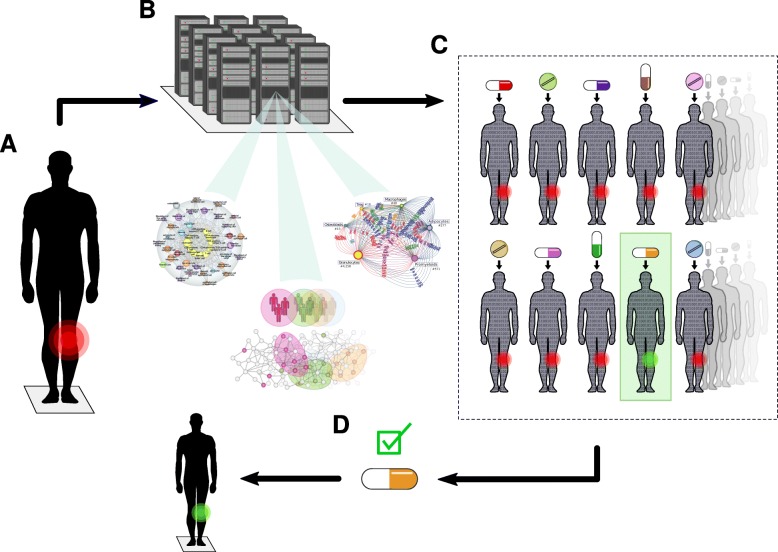
Personalized medicine requires the integration and processing of vast amounts of data. Here, we propose a solution to this challenge that is based on constructing Digital Twins. These are high-resolution models of individual patients that are computationally treated with thousands of drugs to find the drug that is optimal for the patient.
Overview
The claims and statistics of this paper haven’t been checked yet.
Run the check — free, no account needed. It reads the open-access text and checks the sources it cites.
Integrity signals
Registry
Cites
Statistics
Figures
Verification
Claims the paper makes
The claims and statistics of this paper haven’t been checked yet.
Run the check — free, no account needed. It reads the open-access text and checks the sources it cites.
Claims other papers make about this one
Each is checked against this paper’s own text: does it say what the citing paper says it does?
The cited source says what the claim attributes to it.
In the citing paper
“In healthcare, digital twins are a promising tool for drug target discovery 65,66 .”
From Multimodal biomedical AI (2022) · cites this paper as [65]
The cited source says what the claim attributes to it.
In the citing paper
“This will likely require large collaborations across health systems, research groups and industry, such as the Swedish Digital Twins Consortium 65,72 .”
From Multimodal biomedical AI (2022) · cites this paper as [65]
Self-check
Percentages, sums and reported differences re-computed from the paper’s own numbers.
The self-check needs the paper’s full text.
Citations
Cites
Network medicine: a network-based approach to human disease
Barabási, A.-L., Gulbahce, N., & Loscalzo, J. (2011) · Nature Reviews Genetics · doi:10.1038/nrg2918 · Cited by 5,034
Intra- and Inter-cellular Rewiring of the Human Colon during Ulcerative Colitis
Smillie, C. S., Biton, M., Ordovás-Montañés, J., Sullivan, K. M., Burgin, G., Graham, D. B., Herbst, R. H., Rogel, N., Slyper, M., Waldman, J., et al. (2019) · Cell · doi:10.1016/j.cell.2019.06.029 · Cited by 1,417
Deep learning: new computational modelling techniques for genomics
Eraslan, G., Avsec, Ž., Gagneur, J., & Theis, F. J. (2019) · Nature Reviews Genetics · doi:10.1038/s41576-019-0122-6 · Cited by 1,288
Tao, F., & Qi, Q. (2019) · Nature · doi:10.1038/d41586-019-02849-1 · Cited by 799
Human symptoms–disease network
Zhou, X., Menche, J., Barabási, A.-Ĺ., & Sharma, A. (2014) · Nature Communications · doi:10.1038/ncomms5212 · Cited by 659
Single-cell analyses to tailor treatments
Shalek, A. K., & Benson, M. (2017) · Science Translational Medicine · doi:10.1126/scitranslmed.aan4730 · Cited by 163
Self-citationA decade of digital medicine innovation
Topol, E. J. (2019) · Science Translational Medicine · doi:10.1126/scitranslmed.aaw7610 · Cited by 117
Gawel, D. R., Serra-Musach, J., Lilja, S., Aagesen, J., Arenas, À., Asking, B., Bengnér, M., Björkander, J., Biggs, S., Ernerudh, J., et al. (2019) · Genome Medicine · doi:10.1186/s13073-019-0657-3 · Cited by 95
Self-citationGustafsson, M., Gawel, D. R., Alfredsson, L. S., Baranzini, S. E., Björkander, J., Blomgran, R., Hellberg, S., Eklund, D., Ernerudh, J., Kockum, I. S., et al. (2015) · Science Translational Medicine · doi:10.1126/scitranslmed.aad2722 · Cited by 67
Self-citation
Research works printed but not linked: 1
- US Food and Drug Administration. Paving the way for personalized medicine: FDA’s role in a new era of medical product development. Silver Spring: US Food and Drug Administration; 2013. https://www.fdanews.com/ext/resources/files/10/10-28-13-Personalized-Medicine.pdf. Accessed 26 Nov 2019.
Cited by
Sorted by citations
Acosta, J. N., Falcone, G. J., Rajpurkar, P., & Topol, E. J. (2022) · Nature Medicine · doi:10.1038/s41591-022-01981-2 · Cited by 1,365
Digital twins for health: a scoping review
Katsoulakis, E., Wang, Q., Wu, H., Shahriyari, L., Fletcher, R., Liu, J., Achenie, L. E. K., Liu, H., Jackson, P., Xiao, Y., et al. (2024) · npj Digital Medicine · doi:10.1038/s41746-024-01073-0 · Cited by 848
Rathore, M. M., Shah, S. A., Shukla, D., Bentafat, E., & Bakiras, S. (2021) · IEEE Access · doi:10.1109/access.2021.3060863 · Cited by 616
How Machine Learning Will Transform Biomedicine
Goecks, J., Jalili, V., Heiser, L. M., & Gray, J. W. (2020) · Cell · doi:10.1016/j.cell.2020.03.022 · Cited by 604
The next generation of evidence-based medicine
Subbiah, V. (2023) · Nature Medicine · doi:10.1038/s41591-022-02160-z · Cited by 606
Metadata
- Authors
- on behalf of the Swedish Digital Twin Consortium, Björnsson, B., Borrebaeck, C., Elander, N., Gasslander, T., Gawel, D. R., Gustafsson, M., Jörnsten, R., Lee, E. J., Li, X., Lilja, S., Martínez-Enguita, D., Matussek, A., Sandström, P., Schäfer, S., Stenmarker, M., Sun, X. F., Sysoev, O., Zhang, H., & Benson, M.
- Affiliations
- Lund University (SE)
- Linköping University (SE)
- Chalmers University of Technology (SE)
- Karolinska University Hospital (SE)
- Futurum - Akademin för Hälsa och Vård (SE)
- Corresponding author
- Benson, Mikael
- ORCID
- Venue
- Genome Medicine
- Published
- 2019-12-31
- Volume
- 12
- Issue
- 1
- Pages
- 4-4
- ISSN
- 1756-994X (ISSN-L)
- PMC
- PMC6938608
- OpenAlex
- W2999365564
- Cited by
- 566
- References
- 9
- Citations by year
- 2026: 143 · 2025: 126 · 2024: 103 · 2023: 79 · 2022: 66 · 2021: 37 · 2020: 12
- FWCI
- 19.56
- Type
- journal article
- Language
- en
- Open access
- gold
- doi.org
- Locations
- Genome Medicine (publishedVersion, cc-by)
- Europe PMC (PubMed Central) (publishedVersion, cc-by)
- PubMed Central (publishedVersion, cc-by)
- PubMed (publishedVersion)
- DiVA (Linkoping University) (submittedVersion, other-oa)
- DOAJ (DOAJ: Directory of Open Access Journals) (submittedVersion, cc-by-sa)
- Lund University Publications (Lund University) (submittedVersion)
- Chalmers Research (Chalmers University of Technology) (submittedVersion)
- Funders
- Swedish Cancer Foundation
- Topics
- Life Sciences › Pharmacology, Toxicology and Pharmaceutics › Drug Discovery › Computational Drug Discovery Methods
- Health Sciences › Medicine › Health Informatics › Artificial Intelligence in Healthcare and Education
- Physical Sciences › Computer Science › Artificial Intelligence › Machine Learning in Healthcare
- Keywords
- digital twin, personalized medicine, patient modeling, drug repurposing, computational drug screening, precision medicine, data integration
- MeSH terms
- Disease, Humans, Databases, Factual, Neural Networks, Computer, Precision Medicine
About these checks
Registry, retraction, Cites and statistics results are computed, not judged, with one exception: a printed reference that no index lists is read once by a model before it counts as a citation error. Claims are extracted by a model and kept only when their quote appears verbatim in the text; each cited source is then checked, with a model’s help, for whether it says what the claim relies on. Those verdicts can be wrong — read the claim’s quote and the cited source before relying on one.
Statistics and arithmetic are recomputed, not judged.
Confidence bands are shown only for fields calibrated on our annotated test set. None is calibrated yet, so no band is shown.
What counts as a claim ›How we measure confidence ›How we check this ›
Are you an author, or do you see a problem with this page? Request a review
